Yellow and Black Bird: How to Identify What You Saw
The yellow and black bird most people spot in North America is the American goldfinch, a small finch where breeding males show brilliant yellow with a black cap and black wings. The other strong candidates are the Baltimore oriole, orange-yellow with a fully black head, the eastern meadowlark, yellow-breasted with a bold black V, and the yellow-headed blackbird of western marshes.
Which one you saw depends mostly on size, where it was, and how the black is arranged. A small bird at a feeder is almost certainly a goldfinch; a larger bird in a treetop is more likely an oriole; one singing from a fencepost in open grassland is a meadowlark. This guide walks through the main candidates and how to separate them.
The most likely yellow and black bird is the American goldfinch, a small feeder bird with a black cap and black wings on a bright yellow body. Other common candidates are the Baltimore oriole (larger, orange-yellow, fully black head), the eastern meadowlark (yellow breast with a black V, in open grassland), and the yellow-headed blackbird (western marshes). Size, habitat, and where the black sits separate them quickly.
| Bird | Key Marking | Where |
|---|---|---|
| American Goldfinch | Black cap, black wings, bright yellow body | Feeders, weedy fields |
| Baltimore Oriole | Fully black head and back, orange-yellow below | Treetops, edges |
| Eastern Meadowlark | Yellow breast with a black V | Open grassland, fenceposts |
| Yellow-headed Blackbird | Yellow head, black body | Western marshes |
| Evening Grosbeak | Heavy pale bill, yellow and black, bold wing patch | Northern conifers, winter feeders |
What Yellow and Black Birds Are Most Common?
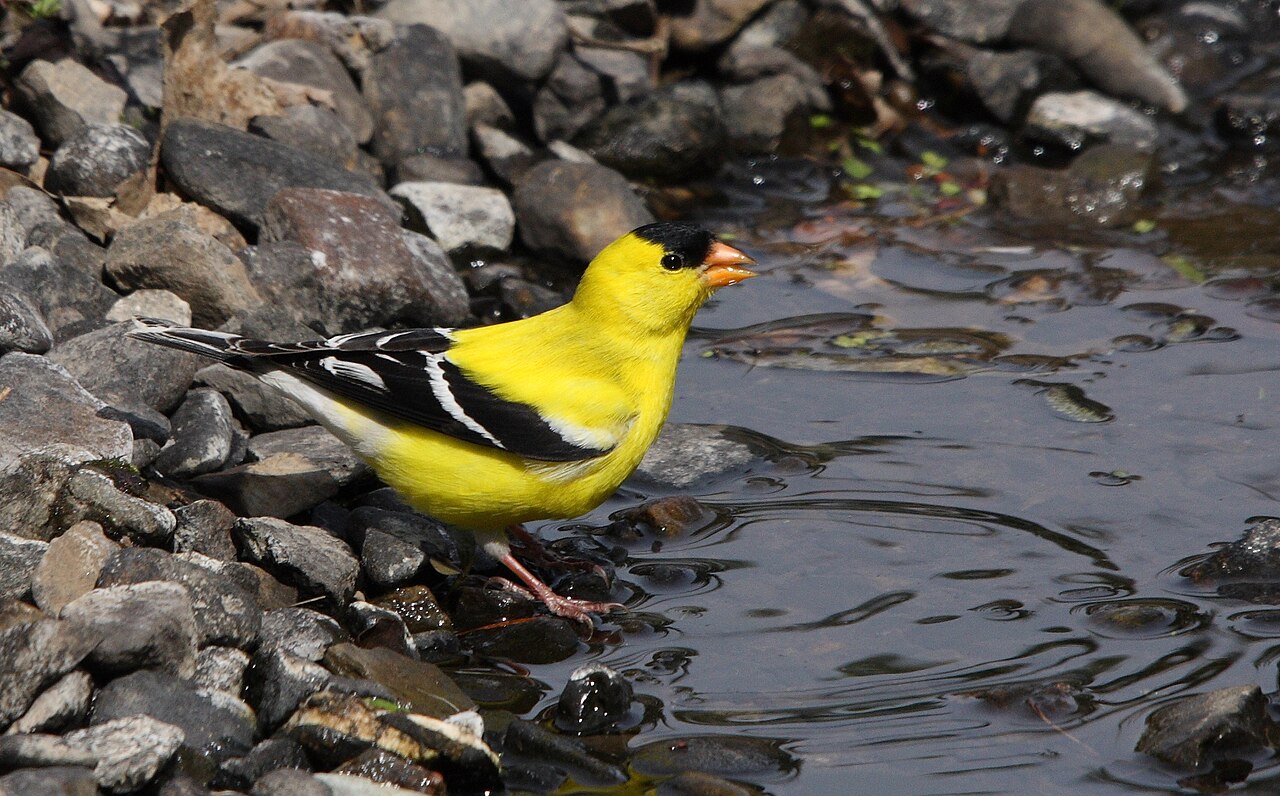
The American goldfinch is the default answer across most of North America, particularly at backyard feeders, where breeding males are unmistakable: a small, bright canary-yellow bird with a neat black cap on the forehead and black wings with white bars.
The Baltimore oriole is the next most likely in the eastern half of the continent, larger than a goldfinch and more orange than yellow, with an entirely black head and back contrasting against a bright underside, usually seen high in deciduous trees rather than at seed feeders.
Eastern and western meadowlarks are the grassland option, chunky birds with a bright yellow breast crossed by a bold black V, most often noticed singing from a fencepost or wire over open fields rather than in a yard. The types of yellow birds guide covers the fuller range of yellow species.
What Kind of Finch Is Yellow and Black?
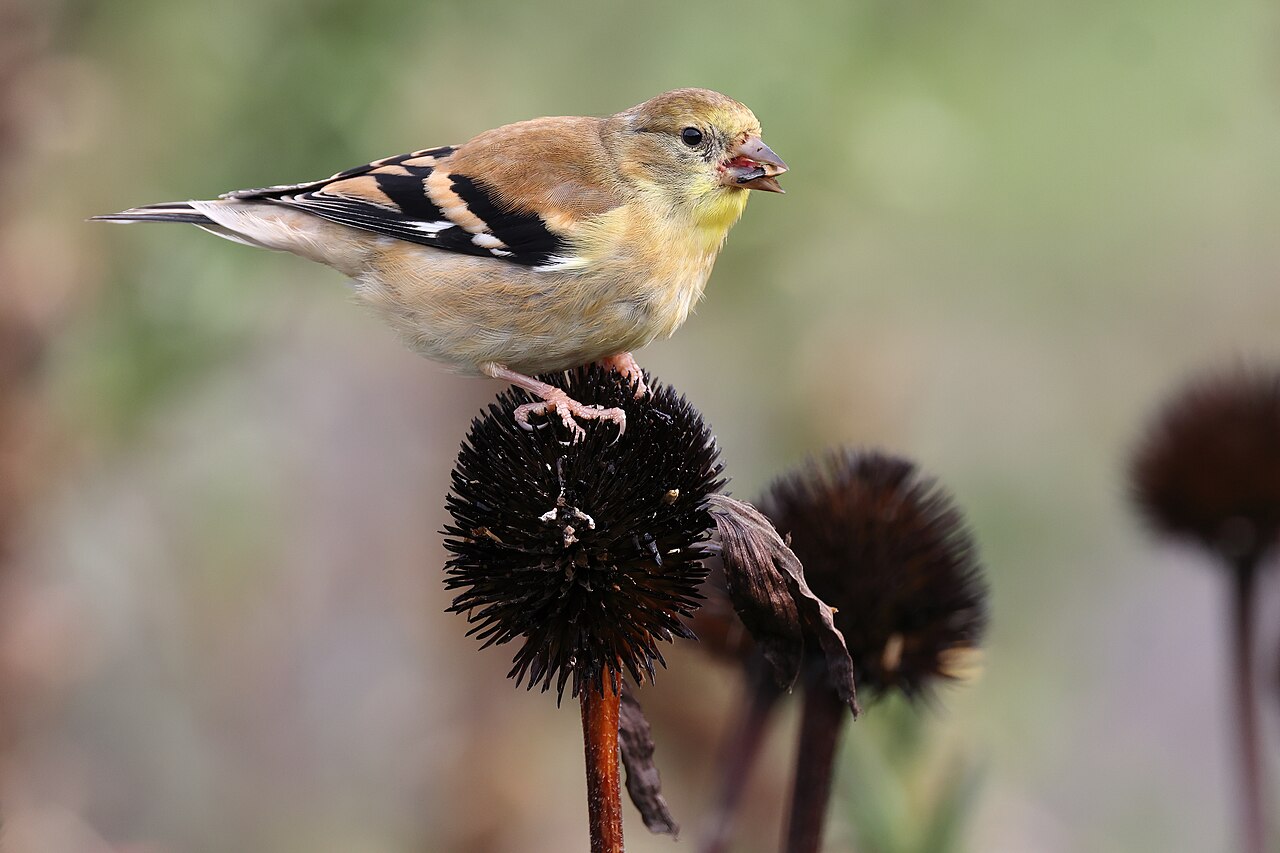
The American goldfinch, and specifically the breeding male, which is the plumage that produces the striking yellow-and-black look people notice. This is a seasonal appearance rather than a permanent one, which is the source of a lot of identification confusion.
Breeding males from roughly April through August show brilliant lemon-yellow bodies with a sharply defined black cap, black wings, and a black tail, all set off by a bright orange bill, making them one of the more conspicuous small birds at a feeder.
The same bird in winter is drab olive-brown with no black cap and a duller bill, which is why people who put out feeders year-round often assume the goldfinches have left and been replaced by something else, when in fact the same individuals have simply molted. The American goldfinch guide covers this seasonal change in detail.
How Do You Tell a Goldfinch From an Oriole?
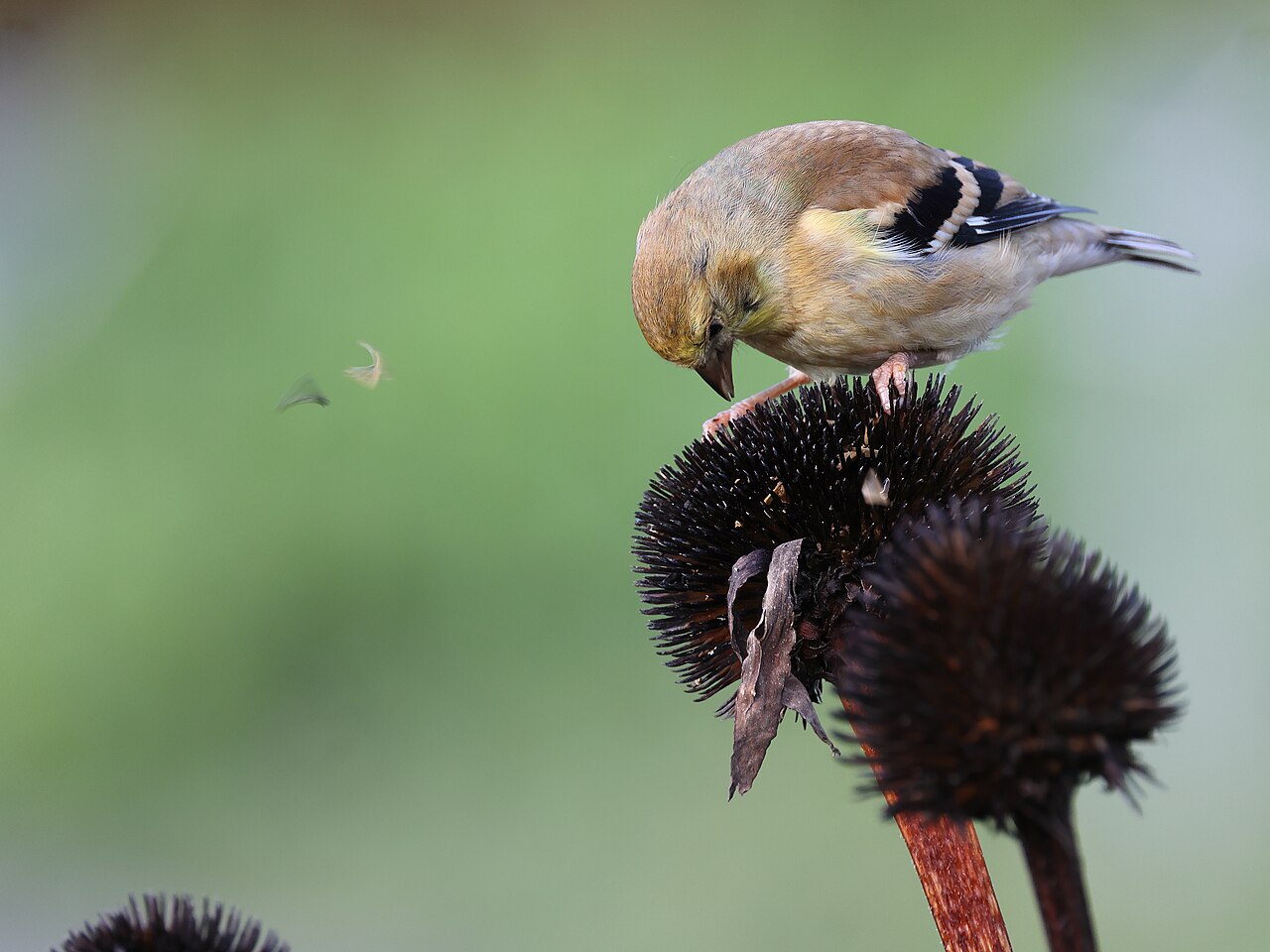
Size settles it fastest. An American goldfinch is a small finch roughly sparrow-sized at about five inches, while a Baltimore oriole is noticeably larger at seven to eight inches, closer to a robin in overall bulk.
The distribution of black is the second check. A goldfinch has a small black cap sitting on the forehead with a yellow face below it, whereas an oriole’s entire head, throat, and back are solid black, giving a much heavier, hooded appearance.
Color tone helps too: goldfinches are a clean lemon or canary yellow, while Baltimore orioles lean distinctly orange, particularly on the breast and rump, and this warmer tone is usually apparent even in poor light. The female Baltimore oriole guide covers the considerably duller female, which causes its own confusion.
What Is the Bird With a Yellow Breast and Black V?
A meadowlark, either eastern or western depending on your region, and the black V across a bright yellow breast is one of the most distinctive markings on any North American bird, essentially diagnostic once seen clearly.
Meadowlarks are grassland specialists, found in pastures, hayfields, prairies, and roadside verges rather than in yards or woodlands, and they are most often noticed perched upright on a fencepost, wire, or low shrub delivering a clear whistled song.
Eastern and western meadowlarks look almost identical and overlap in range through the central states, and the reliable way to separate them is by song rather than plumage, with the eastern giving clear descending whistles and the western a richer, more gurgling flutelike phrase.
What About the Yellow-Headed Blackbird?
This is the inverse arrangement: a bird with a bright yellow head and breast set against an otherwise black body, and it is unmistakable where it occurs but limited to the western and central parts of the continent.
They breed in marshes with dense cattails and reeds, often alongside red-winged blackbirds, and are far more likely to be seen from a roadside beside a wetland than in any backyard setting, which narrows the identification considerably by habitat alone.
The call is notably unmusical, a harsh grating sound often compared to a rusty hinge, which surprises people expecting something more pleasant from such a striking bird and serves as a useful confirmation when the bird is heard before it is seen. The red-winged blackbird guide covers the species they most often share a marsh with.
Are There Yellow and Black Warblers?
Several, and they add real complexity for anyone trying to identify a small yellow-and-black bird in spring. The magnolia warbler shows a yellow underside heavily streaked with black, and the Canada warbler has a distinctive black necklace across a yellow breast.
Warblers are considerably smaller and slimmer than goldfinches, with thin pointed bills suited to picking insects rather than the short conical seed-cracking bill of a finch, and this bill shape difference is one of the more reliable structural clues when color is ambiguous.
Behavior separates them further. Warblers move constantly through foliage gleaning insects, rarely sitting still, while goldfinches perch steadily at feeders and cling to seed heads, meaning a small yellow bird that will not stop moving is far more likely a warbler. The types of warblers guide covers the group in more detail.
What Is the Evening Grosbeak?
A large, heavy-billed finch with a yellow and black pattern quite unlike a goldfinch, showing a dark head with a bright yellow eyebrow stripe, a yellow body, and black wings with a large bold white patch that flashes conspicuously in flight.
The bill is the standout feature, enormously thick and pale greenish or ivory, built for cracking large seeds, and it gives the bird a distinctly front-heavy appearance that is obvious even at a distance or in a poor view.
They are northern and irruptive, meaning they appear in large numbers well south of their normal range in some winters and are entirely absent in others depending on northern seed crops, which makes an evening grosbeak sighting notable rather than routine for most feeder watchers.
Why Are Some Birds Yellow?
Carotenoid pigments obtained through diet, not pigments the bird manufactures itself, which means the yellow a bird displays is effectively a record of what it has been eating while those feathers were growing.
Goldfinches get their carotenoids from seeds, particularly thistle and other composites, and a male on a poor diet during molt grows noticeably duller yellow feathers, which research suggests females can assess as a signal of foraging ability and overall condition.
Black, by contrast, comes from melanin, which birds produce internally, so the black cap and wings of a goldfinch are not diet-dependent in the same way and remain consistent regardless of feeding conditions. The guide to what goldfinches eat covers the seeds behind the color.
Does Seeing a Yellow and Black Bird Mean Anything?
Culturally, yellow birds are often associated with joy, optimism, and positive change across various traditions, while black birds carry a wider and often more ambivalent range of associations depending on the culture and the specific species involved.
These are cultural interpretations rather than anything grounded in the bird’s actual behavior or ecology, and different traditions assign quite different meanings to the same species, so the symbolism says more about the observer’s background than about the animal.
Practically, a yellow-and-black bird in a yard usually means the habitat offers something specific: seed-bearing plants and feeders for goldfinches, mature deciduous trees for orioles, or nearby open grassland for meadowlarks, which is a more useful reading than any symbolic one if you want more of them around.
How Do You Attract Them to a Yard?
For goldfinches, nyjer seed in a mesh or tube feeder is the most reliable draw, along with sunflower hearts, and leaving coneflowers, cosmos, and other seed heads standing through autumn rather than cutting them back provides a natural food source.
Orioles need a completely different approach, since they largely ignore seed feeders. Halved oranges, grape jelly in a shallow dish, and nectar feeders with larger ports draw them in, most effectively in spring when they first arrive and natural food is still limited.
Meadowlarks and yellow-headed blackbirds are essentially not backyard birds and cannot be attracted to a typical yard, since they require open grassland and marsh habitat respectively, meaning seeing them is a matter of going to them rather than the reverse. The guide to attracting goldfinches covers feeder setup in detail.
What If the Bird Was Dull Yellow?
Almost certainly a female or a non-breeding male, since in most of these species the bright yellow-and-black pattern belongs to breeding males and females are considerably duller, which accounts for a large share of failed identifications.
Female goldfinches are olive-brown above with pale yellow underparts and no black cap at all, while female Baltimore orioles are yellowish-orange with grey-brown wings and lack the solid black head entirely, appearing to many observers like a completely different species.
Structure and behaviour carry more weight than colour in these cases: bill shape, overall size, and where the bird is feeding all remain consistent between sexes, so a dull bird at a nyjer feeder with a short conical bill is a goldfinch regardless of how little yellow it shows.
Frequently Asked Questions
What is the yellow and black bird at my feeder?
Almost certainly an American goldfinch, a small finch with a black cap and black wings on a bright yellow body during breeding season.
What kind of finch is yellow and black?
The American goldfinch, specifically the breeding male. In winter the same bird molts to a drab olive-brown with no black cap.
How do you tell a goldfinch from an oriole?
Size and head pattern. Goldfinches are small with a small black forehead cap; Baltimore orioles are robin-sized with an entirely black head and a more orange body.
What bird has a yellow breast with a black V?
A meadowlark, eastern or western depending on region. They live in open grassland and are usually seen singing from fenceposts.
Are yellow-headed blackbirds rare?
Not rare within their western and central range, but they are marsh specialists rarely seen outside cattail wetlands, so most people encounter them only when travelling.
Why are goldfinches bright yellow?
Carotenoid pigments from seeds in their diet. A poor diet during molt produces duller yellow, which females appear to read as a condition signal.