Blue Bird with Orange Chest: 6 Species and How to Tell Them Apart
A blue bird with an orange chest in North America is almost always an Eastern Bluebird (Sialia sialis) east of the Rocky Mountains, or a Western Bluebird (Sialia mexicana) west of them. Both are small thrushes with deep blue upperparts and a rusty orange breast, and between them they cover most of the continent. Three or four other species get confused for them often enough to be worth checking.
The quickest way to sort them out is not the blue, which looks similar on every candidate, but the throat. Where the orange stops, where the white begins, and what the bird was doing when you saw it will name the species in about ten seconds. What follows is that test, plus each species in enough detail to be sure.
The blue bird with an orange chest is the Eastern Bluebird in the eastern United States and the Western Bluebird in the West. An orange throat means Eastern, a blue throat with orange shoulders means Western, and a deeply forked tail in fast flight means Barn Swallow instead.
| Species | Throat | Chest | Size | Range |
|---|---|---|---|---|
| Eastern Bluebird | Orange | Rusty orange, white belly | 6.3 to 8.3 in (16 to 21 cm) | East of the Rockies |
| Western Bluebird | Blue | Orange, often onto the back | 6.3 to 7.5 in (16 to 19 cm) | West Coast to the Rockies |
| Mountain Bluebird | Blue | Sky blue, no orange | 6.3 to 7.9 in (16 to 20 cm) | Interior West |
| Lazuli Bunting | Blue | Cinnamon orange, white wingbars | 5.1 to 5.9 in (13 to 15 cm) | West, summer only |
| Barn Swallow | Rust | Cinnamon, forked tail | 5.9 to 7.5 in (15 to 19 cm) | Continent wide in summer |
| Blue Grosbeak | Blue | Blue with chestnut wingbars | 5.5 to 6.3 in (14 to 16 cm) | Southern US |
What Are the Blue Birds with Orange Breasts?
Five North American birds regularly produce this sighting. The three bluebirds in the genus Sialia account for most of them, the Barn Swallow (Hirundo rustica) accounts for most of the rest, and the Lazuli Bunting (Passerina amoena) fills in across the western states in summer. All five are small, none is dangerous, and all five are welcome yard birds.
Geography does most of the work. If you are east of a line running roughly from Texas to North Dakota, Eastern Bluebird is the default answer and the odds are better than nine in ten. West of the Rockies, Western Bluebird and Lazuli Bunting both come into play, and the interior mountain states add Mountain Bluebird, which usually shows no orange at all.
Eastern Bluebird: The Most Likely Answer
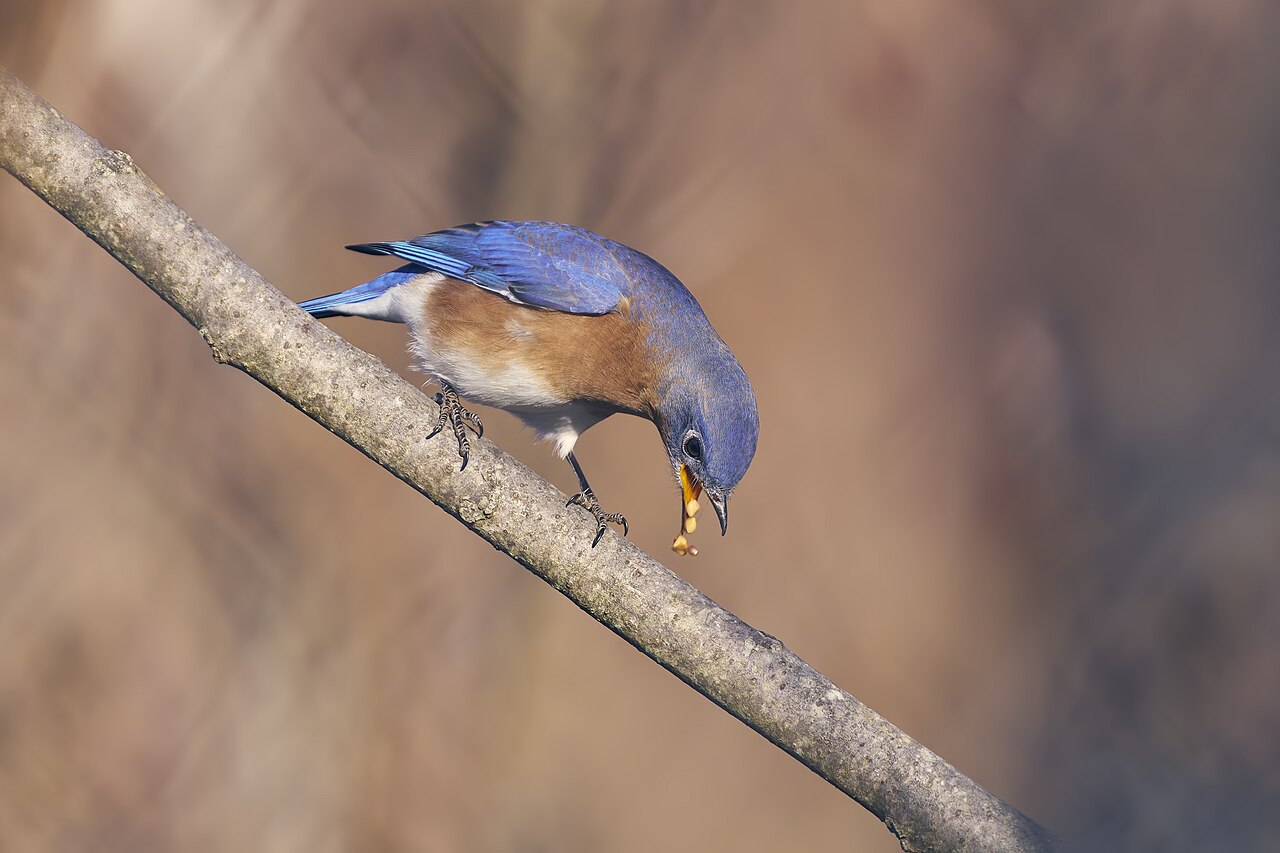
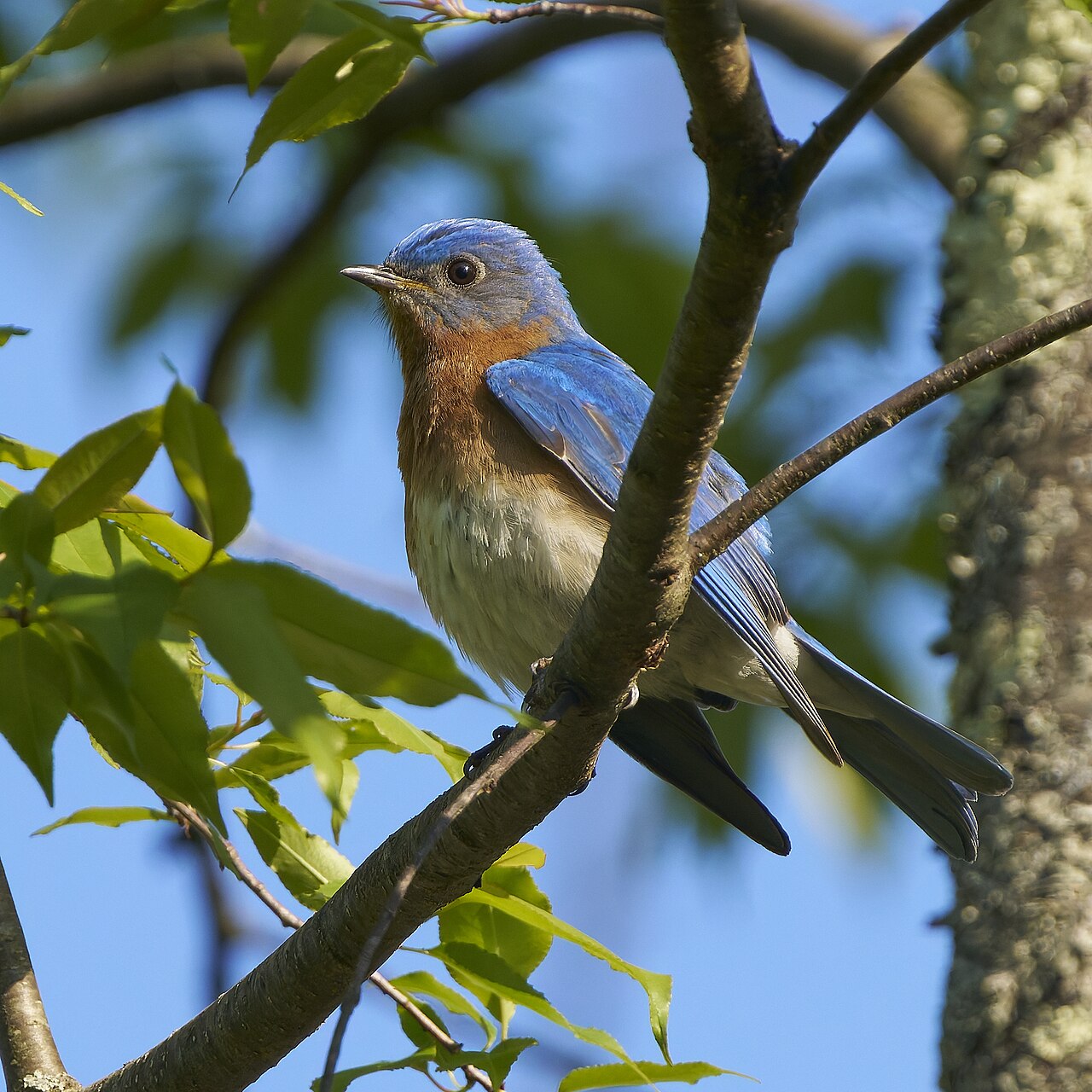
The male Eastern Bluebird is royal blue above from crown to tail, with a rusty orange throat and breast that fades to a clean white belly and undertail. It measures 6.3 to 8.3 in (16 to 21 cm) with a wingspan near 12 in (30 cm), and it perches upright on fence wires, low branches, and nest box roofs with a slightly hunched, round shouldered posture.
The orange throat is the decisive mark. No other North American bluebird has it, so a blue bird whose orange runs all the way up under the bill is an Eastern Bluebird. Watch the hunting style too: the bird drops straight down from a low perch onto an insect in short grass, then returns to the same perch, over and over.
Western Bluebird: Blue Throat, Orange Shoulders
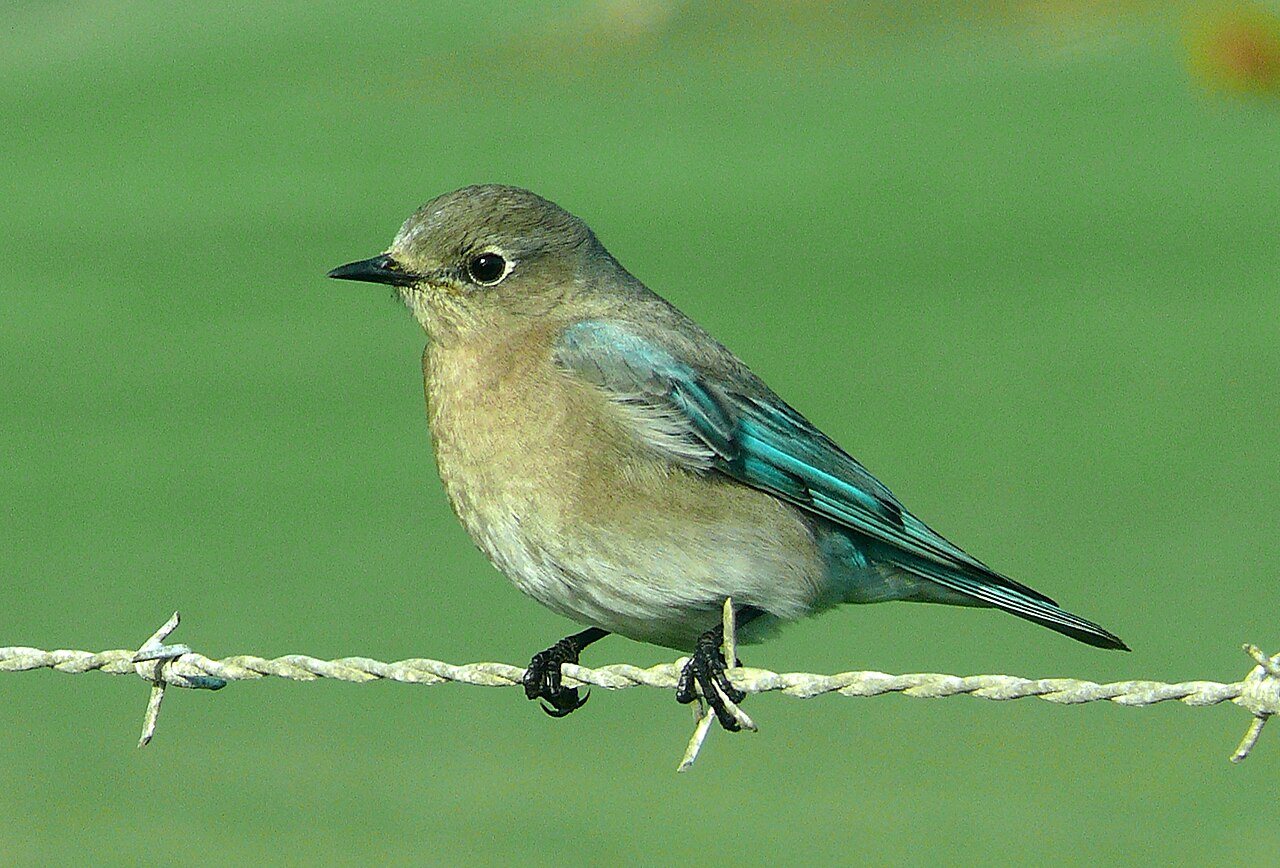
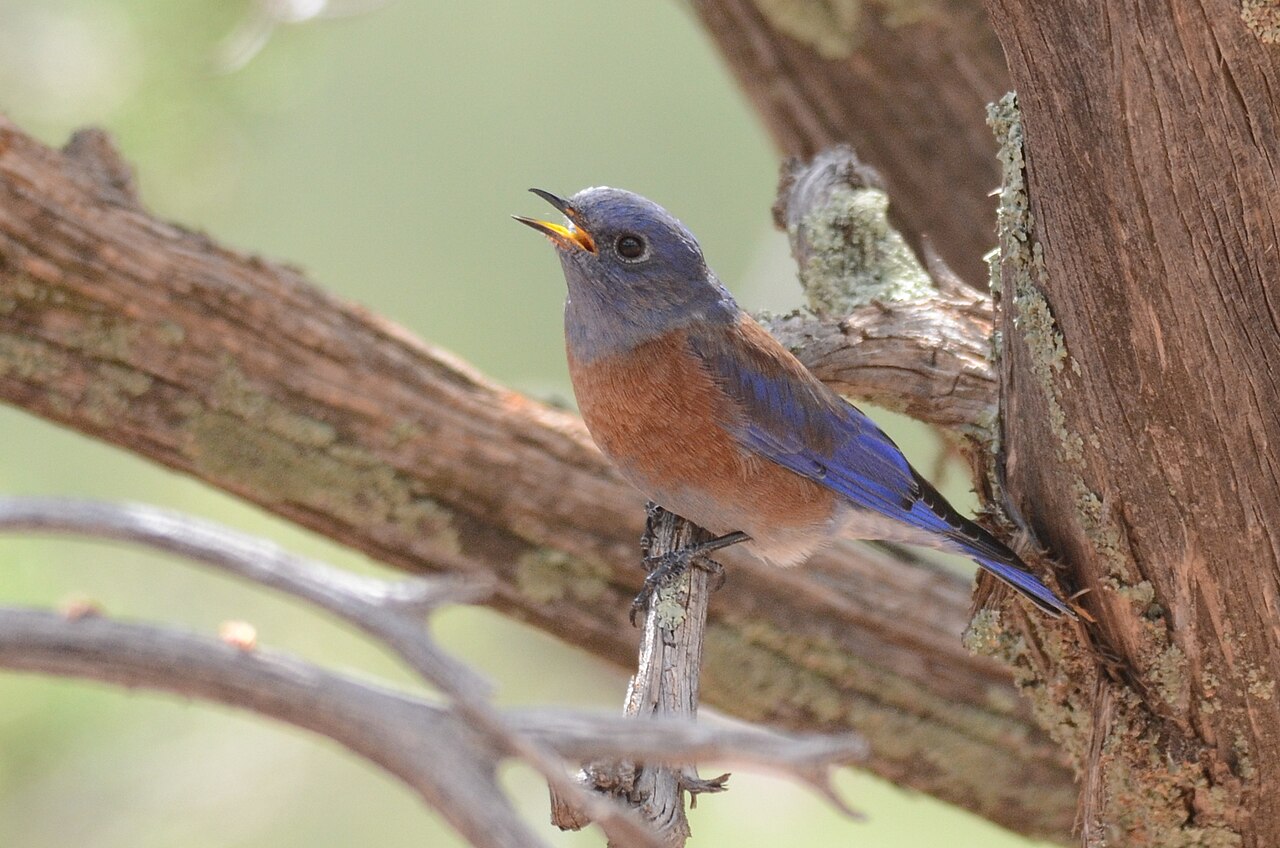
The Western Bluebird looks like the eastern species at a glance and differs in exactly the places that matter. The throat is blue, not orange, so the orange starts at the chest and often wraps onto the upper back and shoulders in a rusty saddle that the Eastern never shows. The belly is gray rather than bright white.
Its range runs from southern British Columbia down through California, Arizona, and New Mexico into Mexico, overlapping the Mountain Bluebird in the interior and rarely meeting the Eastern at all. Western Bluebirds favor open pine and oak woodland edges and burned forest with standing snags, so they turn up around cavities more than bluebirds of open pasture do.
Mountain Bluebird: Blue Without the Orange
The Mountain Bluebird (Sialia currucoides) is the species that breaks the pattern. Males are an even sky blue from head to tail with no orange anywhere, paler below, and the effect in bright light is almost turquoise. If you are certain the bird was a bluebird but recall no orange, this is why.
Females are the trap. A female Mountain Bluebird is gray brown with blue wings and tail and can show a faint warm buff wash on the chest that reads as orange in poor light. Mountain Bluebirds also hover over grassland before dropping on prey, a behavior the other two rarely use, and they breed at higher elevations across the interior West.
Lazuli Bunting: The Western Look Alike
A small blue bird with an orange chest in a western thicket in June is more likely a Lazuli Bunting than a bluebird. The male has a bright turquoise blue head and back, a cinnamon orange breast, a white belly, and two bold white wingbars that no bluebird has. At 5.1 to 5.9 in (13 to 15 cm) it is noticeably smaller and finer billed.
Habitat separates them cleanly. Lazuli Buntings sing from brushy hillsides, streamside willows, and weedy field edges rather than from fence wires over mown grass, and they are strictly summer birds that winter in Mexico. The stubby conical seed eating bill, visible even at distance, rules out any thrush.
Barn Swallow: The Blue Bird with a Rust Colored Breast in Flight
If the bird never sat still, it was probably a Barn Swallow. Steel blue above and cinnamon below, with a rust colored throat and a long, deeply forked tail, it spends nearly all daylight in continuous low flight over fields, ponds, and parking lots. Bluebirds fly in short direct hops between perches; swallows wheel and bank without stopping.
Barn Swallows nest in mud cups under eaves, bridges, and barn rafters across the entire continent in summer, so almost anyone in the United States can see one. The forked tail is unmistakable once you know to look for it, and no bluebird, bunting, or grosbeak has anything close.
A Three Step Field Test for a Blue Bird with a Rusty Colored Chest
Step one, check the throat. Orange throat means Eastern Bluebird. Blue throat with an orange chest means Western Bluebird or Lazuli Bunting. Rust throat on a bird that will not land means Barn Swallow.
Step two, check for white wingbars. Two crisp white bars on a small blue bird with a conical bill means Lazuli Bunting, since no bluebird shows them. Step three, check the behavior: a bird that perches upright on a wire and drops into grass is a bluebird, one that sings from a shrub top is a bunting, and one that never stops flying is a swallow. Other confusions are covered in our guide to birds that look like Blue Jays.
Where and When to Look
Bluebirds want open ground with short grass and scattered perches, which is why golf courses, cemeteries, orchards, pastures, and power line cuts are the classic spots. They are cavity nesters that cannot excavate their own holes, so they depend on old woodpecker cavities and on nest boxes, and a properly placed box is the single best way to bring them to a property.
Eastern Bluebirds are year round residents across the southern two thirds of their range and short distance migrants in the north, which means winter flocks appear in places that had none in summer. Look in early morning, when the birds hunt hardest, and scan fence wires rather than treetops. A Blue Jay in the same field will be nearly twice the size and much louder.
Male and Female: What Changes
Female bluebirds are the reason many sightings go unidentified. A female Eastern Bluebird is gray above with blue restricted to the wings and tail, a pale orange wash on the chest, and a subtle white eye ring. She is muted enough that people describe her as a gray bird with an orange chest and never think of a bluebird at all.
Juveniles add another layer. Young bluebirds of all three species are heavily spotted on the breast, a reminder that they are thrushes and close relatives of the American Robin, with only a hint of blue in the wings. The pale blue eggs in the nest are the same family signature that makes robin eggs blue.
Why These Birds Look Blue but Carry No Blue Pigment
No bird in North America produces blue pigment. The orange on a bluebird’s chest comes from carotenoids in its diet, but the blue comes from structure: microscopic air pockets in the feather barbs scatter short wavelengths back to your eye while the underlying melanin absorbs the rest. Grind a blue feather to dust and the dust is brown.
This is why a bluebird blazes in direct sunlight and looks dull gray on an overcast morning, and why photographs so often disappoint. The same physics gives the blue morpho butterfly its color through a different structure. For a technical breakdown of bluebird plumage and measurements, the Cornell Lab species account is the standard reference.
Is the Eastern Bluebird Rare?
The Eastern Bluebird is not rare today, though it very nearly was. Populations crashed through the middle of the twentieth century as introduced House Sparrows and European Starlings seized nest cavities, pesticide use cut insect prey, and old wooden fence posts gave way to metal. By the 1970s the decline was steep enough to alarm ornithologists.
A volunteer nest box movement reversed it. Bluebird trails built and monitored by thousands of people across the eastern states pushed numbers back up, and the species has increased steadily since. Seeing one now is a matter of being in the right habitat rather than being lucky, which is a genuinely unusual conservation outcome.
What Does It Mean to See an Eastern Bluebird?
In North American folklore, seeing an Eastern Bluebird is read as a sign of happiness, renewal, and good news arriving, a symbolism that runs from Indigenous traditions through the 1930s standard about the bluebird of happiness. Because the species returns early in spring across much of its range, it also carries an association with the end of winter.
Ecologically the meaning is simpler and more useful: bluebirds indicate open habitat with healthy insect populations and available cavities. Their presence says a property is doing something right. Similar interpretive traditions surround other blue birds, including what it means when you see a Blue Jay.
Related reading: Bird with Red Chest.
Frequently Asked Questions
What is a blue bird with a brown breast?
Most often a female Eastern or Western Bluebird, whose chest is a muted brownish orange rather than the male’s bright rust. A juvenile bluebird with a spotted brown breast and blue wings is the other common answer. In the West, a female Lazuli Bunting is warm brown overall with only a trace of blue in the wings and tail.
Are indigo buntings rare to see?
Indigo Buntings (Passerina cyanea) are not rare at all. They are common summer birds across the eastern United States, often singing from the highest twig of a roadside shrub through the hottest part of the day. They are entirely blue with no orange, so an orange chest rules them out immediately.
Which birds have orange breasts but are not blue?
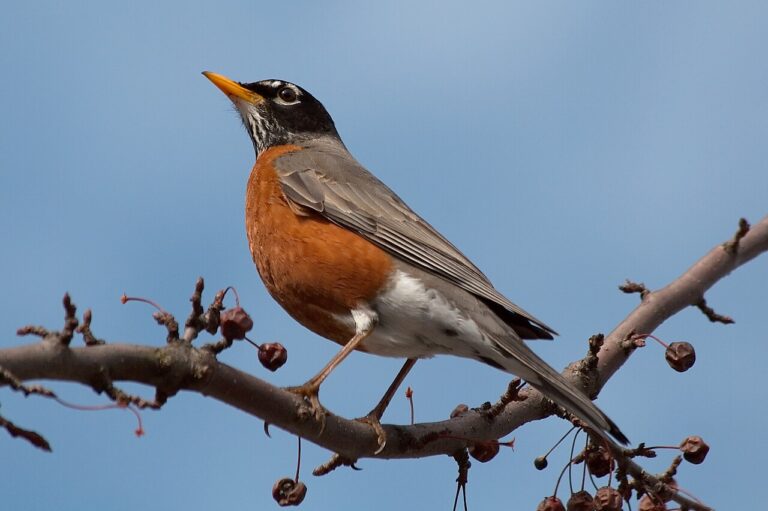
The American Robin is the usual one, gray brown above with a brick orange breast. Others include the Baltimore Oriole, which is black and orange, the Varied Thrush of the Pacific Northwest, which adds a dark chest band, the American Redstart, and the Black-headed Grosbeak in the West.
How do I attract bluebirds to my yard?
Put up a nest box with a 1.5 in (38 mm) entrance hole on a smooth pole 4 to 6 ft (1.2 to 1.8 m) high, facing an open area, with a predator baffle below. Keep some grass short, skip broad spectrum insecticides, and offer live or dried mealworms. Bluebirds rarely take seed from feeders.
Do bluebirds stay all winter?
Many do. Eastern Bluebirds are year round residents across the southern and central parts of their range and switch from insects to fruit such as sumac, holly, and juniper berries in cold months. Northern birds move south, and winter flocks of ten or more roosting together in a single cavity are common in hard weather.
What is the difference between a bluebird and a Blue Jay?
Size and shape settle it. A Blue Jay is 9.8 to 11.8 in (25 to 30 cm) with a prominent crest, a black necklace, and white wing patches, and it screams. A bluebird is a quiet, round shouldered thrush about half the weight with an orange chest and no crest. A Blue Jay nest is an open stick cup, not a cavity.