Northern Hawk Owl: Identification, Facts, and Habits
The Northern Hawk Owl is a striking boreal owl that looks and behaves more like a hawk than a typical owl, with a long tail, pointed wings, and a habit of perching conspicuously at the very top of a spruce in broad daylight. Unlike most owls, it hunts largely by sight during the day, scanning open country from a high vantage and flying out low and fast to seize prey, much as a falcon or a small hawk would. A bird of the far northern forests, it thrills birdwatchers when it occasionally irrupts south in winter. This guide covers how to identify a Northern Hawk Owl, its hawk-like behavior, where and when to find it, its diet, calls, and nesting.
| Feature | Detail |
|---|---|
| Scientific name | Surnia ulula |
| Length | 14 to 18 in (36 to 46 cm) |
| Wingspan | 27 to 35 in (69 to 88 cm) |
| Weight | 8 to 16 oz (225 to 450 g) |
| Activity | Diurnal (day-active), hunts by sight |
| Diet | Voles in summer, birds in winter |
| Conservation | Least Concern (rare south of Canada) |
How to identify a Northern Hawk Owl
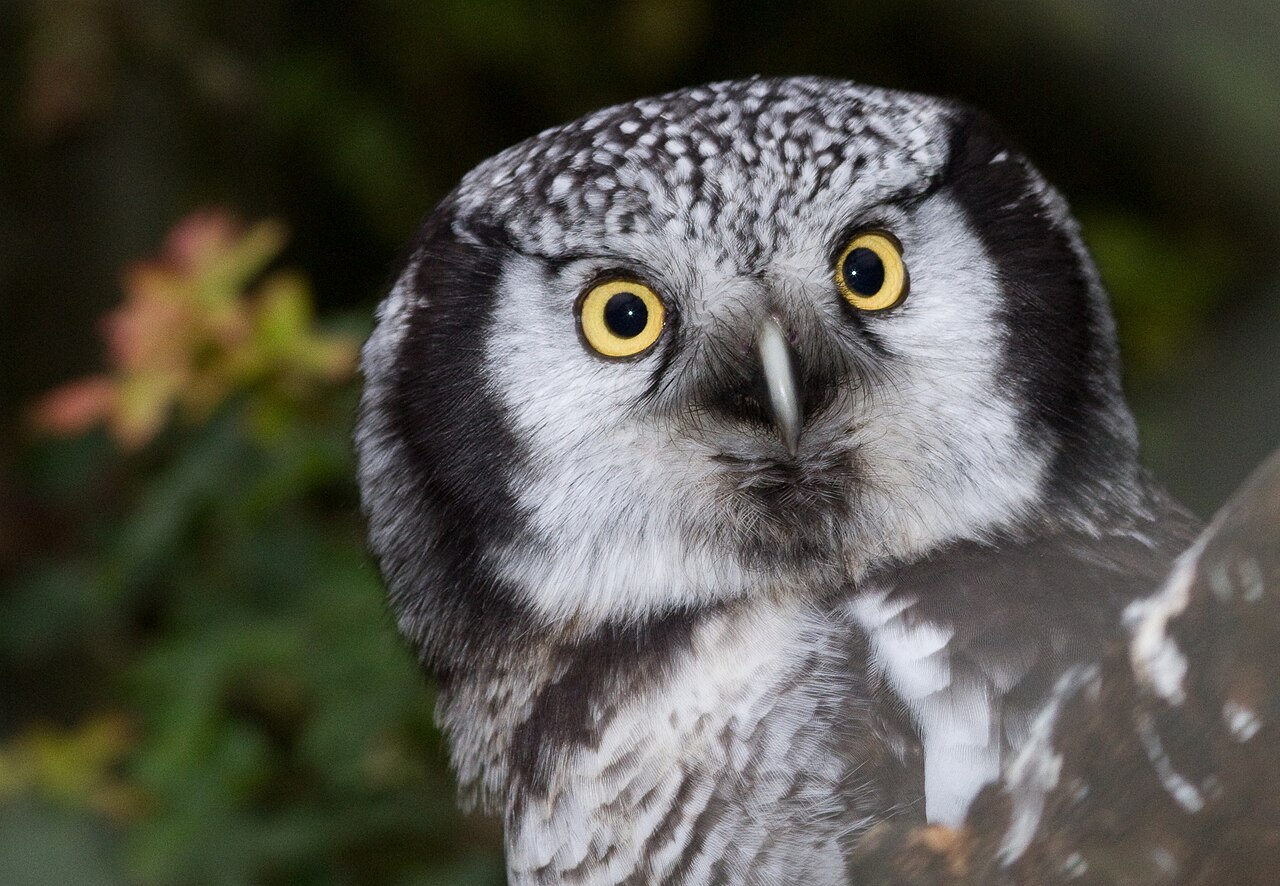
The Northern Hawk Owl is a medium-sized owl with a distinctly hawk-like silhouette: a long, tapering tail, a fairly small head, and pointed wings that give it a falcon-like look in flight. Its face is pale and framed by bold black borders, like heavy sideburns, and set with sharp yellow eyes; it has no ear tufts. The underparts are finely barred crosswise, the back is dark brown spotted with white, and the cap is dark with pale flecks.
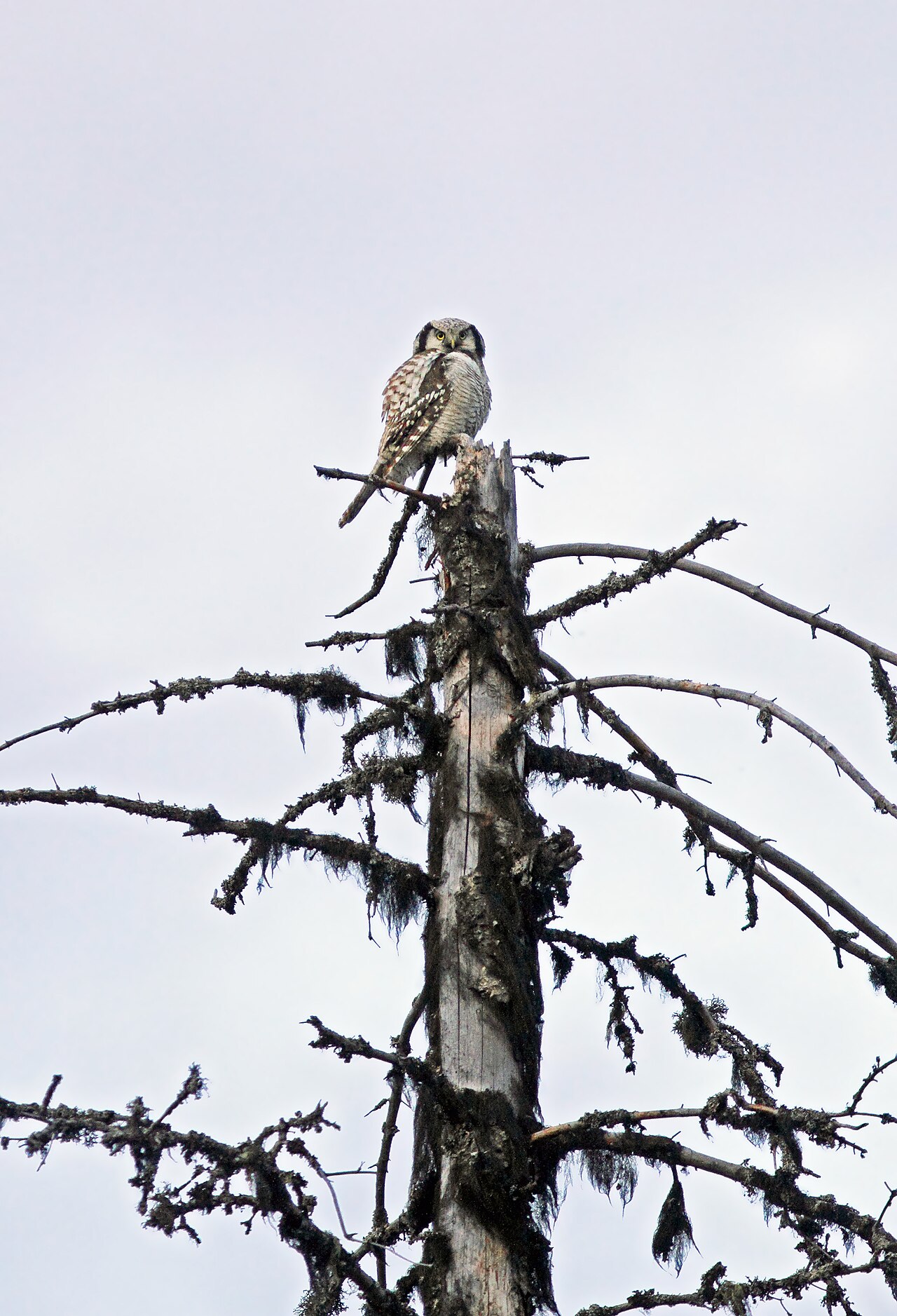
The clinching traits are its shape and posture. Where most owls sit upright and rounded, the Hawk Owl perches at a slight forward angle atop a tall tree or snag, often twitching its long tail, exactly as an accipiter might. This hawk-like build and its daytime activity make it hard to confuse with other owls once seen. See how it fits among relatives in our owl types guide.
An owl that acts like a hawk
The Northern Hawk Owl earns its name through behavior as much as looks. It is one of the most diurnal of all owls, active and hunting through the daylight hours, and it relies heavily on its keen eyesight rather than hunting by sound in darkness as most owls do. It typically perches at the top of a spruce or on a high snag, scanning the surrounding openings, then flies out in a low, fast, direct dash to strike prey, sometimes spotting a vole from a great distance.
This hawk-like hunting suits its open boreal habitat, where scattered tall perches overlook bogs, burns, and clearings full of rodents. Its sharp vision is complemented by excellent hearing, and it can also detect and capture prey hidden beneath snow. The combination of daytime activity and conspicuous perching makes the Northern Hawk Owl one of the more observable owls, when you can find one at all.
Range, habitat, and irruptions
The Northern Hawk Owl is a resident of the boreal forest, ranging across northern Canada and Alaska and around the top of the globe through northern Eurasia. It favors open coniferous and mixed forest with clearings, muskeg, bogs, burned areas, and forest edges, the kind of country that offers both tall perches and open hunting ground. Across most of this range it is uncommon and thinly distributed.
For birdwatchers in the northern United States, the Hawk Owl is chiefly a winter prize. In some years, driven by fluctuations in prey, individuals or small numbers irrupt south into the northern tier of states, where a cooperative bird perched atop a spruce can draw admirers for weeks. These irregular appearances are unpredictable, which makes finding one all the more exciting. Our regional guides such as types of owls in Michigan note which owls reach various states.
What Northern Hawk Owls eat
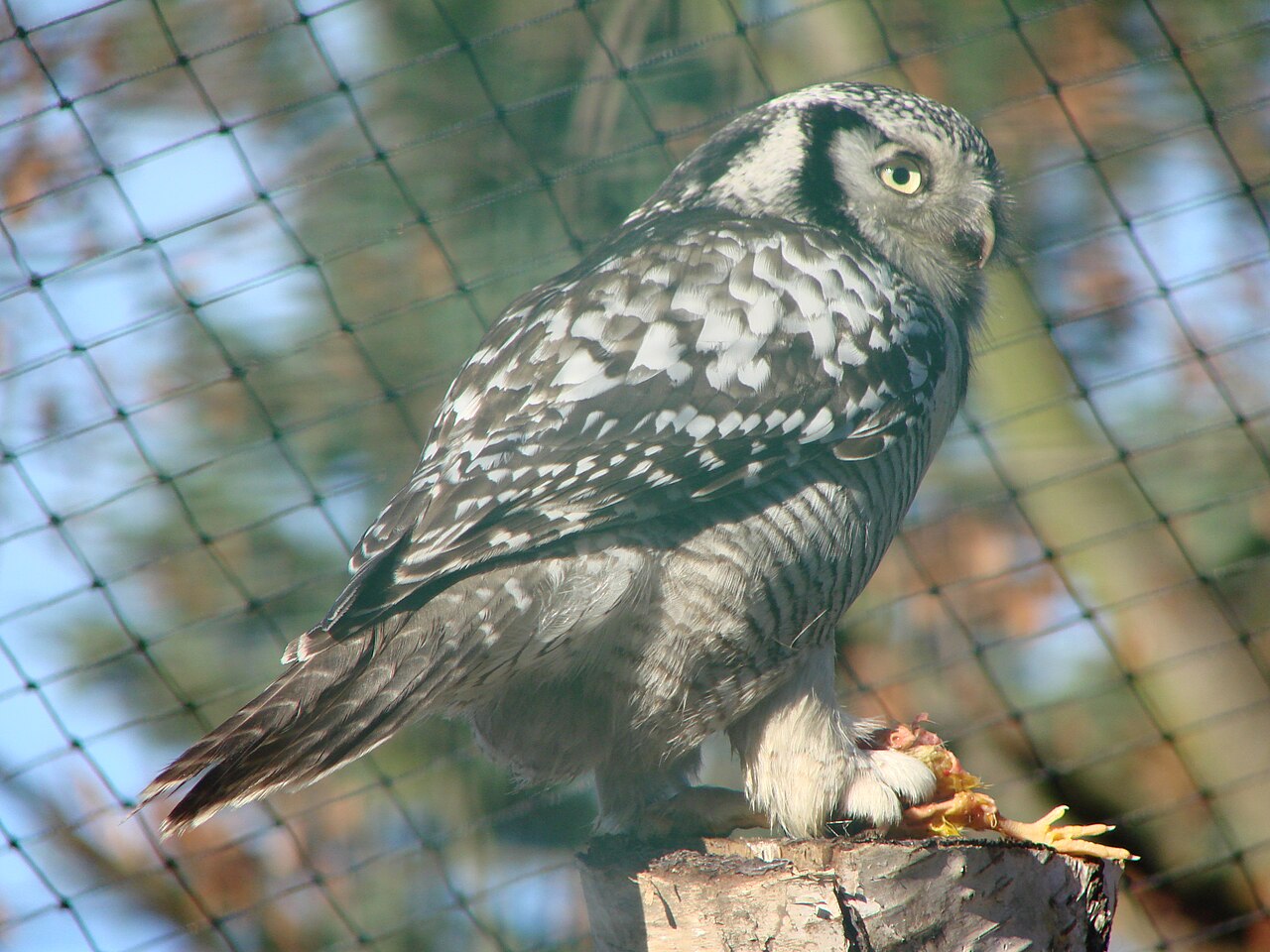
The Northern Hawk Owl’s diet shifts with the seasons. In the warmer months it feeds mainly on small mammals, especially voles, which it hunts by sight from its lofty perches. In winter, when rodents are harder to find, it takes a greater proportion of birds, including species up to the size of grouse and ptarmigan, showing a boldness in line with its hawk-like manner. It also caches surplus food to survive lean spells.
Its willingness to switch between mammals and birds, and to hunt actively in daylight, helps it endure the harsh boreal winter. Like the vole-dependent owls in our guide to owl diets, its breeding success tracks rodent abundance, so in years of plentiful voles it raises large families, while lean years see fewer young.
Sounds, nesting, and conservation
The Northern Hawk Owl’s song is a long, rolling, bubbling trill or whistle given by the male, often from a high perch, and both sexes give sharp, hawk-like kip-kip-kip notes and screeching alarm calls near the nest. Because the bird is often silent outside the breeding season and lives in remote country, its voice is heard far less often than that of more familiar owls.
For nesting, the Northern Hawk Owl uses tree cavities, the hollow broken tops of dead trees, old woodpecker holes, and abandoned stick nests. The female lays a clutch that varies with food supply, often several eggs and sometimes many in vole-rich years, and she incubates while the male hunts. Globally the species is listed as Least Concern, though it is seldom seen south of Canada and depends on healthy boreal forest. The Cornell Lab of Ornithology and Audubon document its irruptions and boreal range. Owls of every kind carry rich symbolism and inspire the beliefs behind seeing an owl.
Northern Hawk Owl versus hawks and other owls
The Northern Hawk Owl’s hawk-like looks and daytime hunting can cause a moment of confusion, but a few features settle the identification. Unlike a true hawk, it has a rounded, owl-like head with a facial disk framed by bold black borders and forward-facing yellow eyes, rather than a hawk’s smaller head and side-set eyes. In flight its long tail and pointed wings recall an accipiter, yet its face and perched posture are clearly those of an owl.
Among owls, its slim, long-tailed shape and habit of perching upright and exposed at treetops by day set it apart from the bulky, tuft-headed Great Horned Owl and every other North American owl. No other owl combines a long tail, hawk-like flight, bold black facial borders, and confident daytime hunting. When a mystery raptor at a spruce top turns out to have an owl’s face and a long tail, the Northern Hawk Owl is the answer. Compare it with the wider group in our owl types guide and with true hawks in our types of hawks guide.
Fascinating Northern Hawk Owl facts
The Northern Hawk Owl is one of the most atypical owls in the world. It is among the most day-active of all owls, hunting by sight through daylight hours, and its vision is so sharp that it can reportedly spot prey from as far as half a mile away, then fly in fast and low to strike. Like several northern owls it also caches surplus food, storing kills to survive lean spells in the harsh boreal winter.
Its long tail is not just for looks; it gives the agility to maneuver in fast, direct flight between perches, reinforcing the hawk-like impression. The species is circumpolar, ringing the top of the globe through the boreal forests of North America and Eurasia, yet it is so tied to remote northern country that most birdwatchers in the United States only ever see one during an unpredictable winter irruption. Explore where it fits among relatives in our owl types guide.
Frequently Asked Questions
Why is it called a Northern Hawk Owl?
Because it looks and behaves like a hawk. It has a long tail and pointed wings, perches conspicuously at treetops, and hunts by sight during the day, unlike most owls that hunt by sound at night.
Is the Northern Hawk Owl active during the day?
Yes. It is one of the most diurnal of all owls, hunting through the daylight hours and relying heavily on keen eyesight, which makes it more observable than most owls when one can be found.
What do Northern Hawk Owls eat?
Mainly voles and other small mammals in summer, and a greater share of birds, up to grouse size, in winter. They hunt by sight from high perches and cache surplus food for lean spells.
Where do Northern Hawk Owls live?
In the boreal forests of northern Canada, Alaska, and northern Eurasia, favoring open coniferous forest with clearings, bogs, and burns. They rarely appear in the northern US except during winter irruptions.
How can I find a Northern Hawk Owl?
In the northern US, look during winter irruption years for a bird perched at the very top of an isolated spruce or snag along the edge of a clearing or bog. They hunt by day and often stay put for weeks.
What does a Northern Hawk Owl sound like?
The male gives a long, rolling, bubbling trill, and both sexes give sharp, hawk-like kip-kip-kip notes and screeching alarms near the nest. It is heard far less often than more familiar owls.
How big is a Northern Hawk Owl?
It is medium-sized, 14 to 18 inches long with a 27 to 35 inch wingspan, weighing 8 to 16 ounces. Its long tail and pointed wings give it a hawk-like rather than owl-like shape.
Do Northern Hawk Owls migrate?
They are largely resident in the boreal forest but stage irregular southward irruptions in some winters, driven by fluctuations in prey, which is when birdwatchers in the northern US get their rare chances to see one.