Red-Tailed Hawk vs Red-Shouldered Hawk: Key Differences
The main difference between a red-tailed hawk and a red-shouldered hawk is size and color: red-tailed hawks are larger, with a broad body and a brick-red tail in adults, while red-shouldered hawks are smaller and more boldly patterned, with rust-colored shoulders, a barred reddish chest, and a black-and-white banded tail. Both are buteos, the broad-winged soaring hawks found across much of North America, and both frequently show up in the same wooded neighborhoods, which is exactly why they get confused so often. This guide breaks down the size, color, tail pattern, habitat, and call differences so you can identify either hawk with confidence, and also looks at a few other hawks that sometimes get mistaken for one or the other.
| Feature | Red-Tailed Hawk | Red-Shouldered Hawk |
|---|---|---|
| Length | 18 to 25 in | 17 to 24 in |
| Wingspan | 45 to 52 in | 37 to 42 in |
| Weight | 1.5 to 3.5 lbs | 1 to 1.9 lbs |
| Tail | Brick red in adults, banded in juveniles | Black and white bands, all ages |
| Underside | Pale with dark belly band | Barred rufous chest |
| Habitat | Open country, roadsides, fields | Wooded areas near water |
| Call | Descending scream, “kee-eeeee-arrr” | Sharp, repeated “kee-aah” |
Size and Body Shape Differences
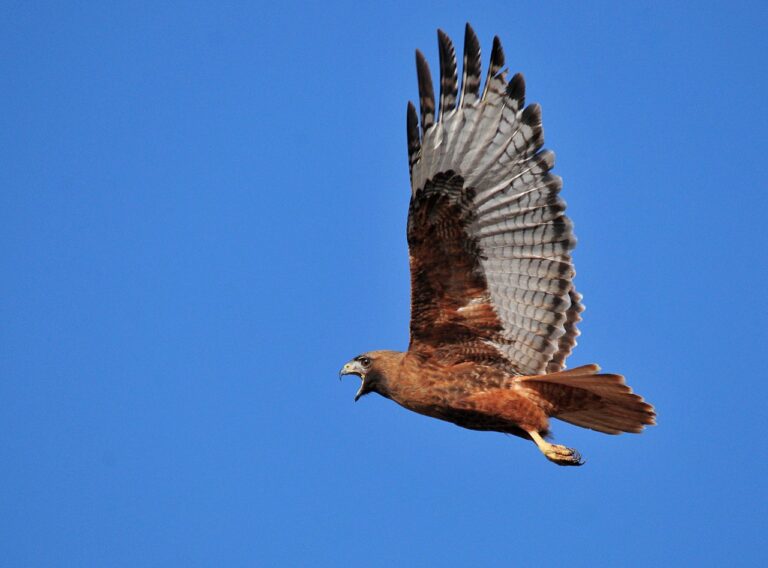
The red-tailed hawk is the larger of the two, typically weighing between 1.5 and 3.5 pounds with a wingspan that can reach 52 inches, giving it a heavy, broad-chested silhouette built for soaring on flat wings for long stretches without flapping. The red-shouldered hawk is noticeably smaller and slimmer, usually under 2 pounds with a wingspan closer to 40 inches, and it tends to fly with quicker, shallower wingbeats between glides rather than the long, steady soaring bouts typical of a red-tailed hawk. Side by side, the size gap is obvious, with the red-tailed hawk appearing noticeably bulkier through the chest and shoulders, but a lone bird overhead can be harder to judge without something for scale, which is why color and tail pattern end up being the more reliable field marks for a single sighting rather than size alone.
Color and Plumage Differences
Adult red-tailed hawks are variable, ranging from pale, mostly white-chested birds to much darker morphs, but nearly all show a pale head, a dark leading edge on the underwing called a patagial mark, and a streaked or barred belly band across an otherwise light belly. The red-shouldered hawk is far more consistently colorful across its range: adults show warm reddish shoulder patches on the upperwing, a chest barred in rufous and white, and pale crescent-shaped “windows” near the wingtips that flash brightly when the bird is in flight and catches the light. That reddish barring across the whole chest, rather than just a dark band across the belly, is one of the most reliable ways to separate an adult red-shouldered hawk from a red-tailed hawk at a distance, even before considering the tail.
Tail Pattern: The Fastest Way to Tell Them Apart
Tail color is often the single fastest field mark available to a birder standing in a driveway with no binoculars handy. An adult red-tailed hawk has a solid brick-red tail with only a thin dark band near the tip, visible from above or as a warm glow when backlit from below on a sunny day. A red-shouldered hawk’s tail never turns red at any age; instead it stays boldly banded in black and white stripes throughout its life, a pattern that remains constant from its first year onward. If a soaring buteo shows a plain reddish tail, it is a red-tailed hawk. If the tail is clearly striped black and white, it is a red-shouldered hawk, a juvenile red-tailed hawk, or possibly a different species entirely, which is where the other field marks in this guide become useful.
Range and Habitat Differences
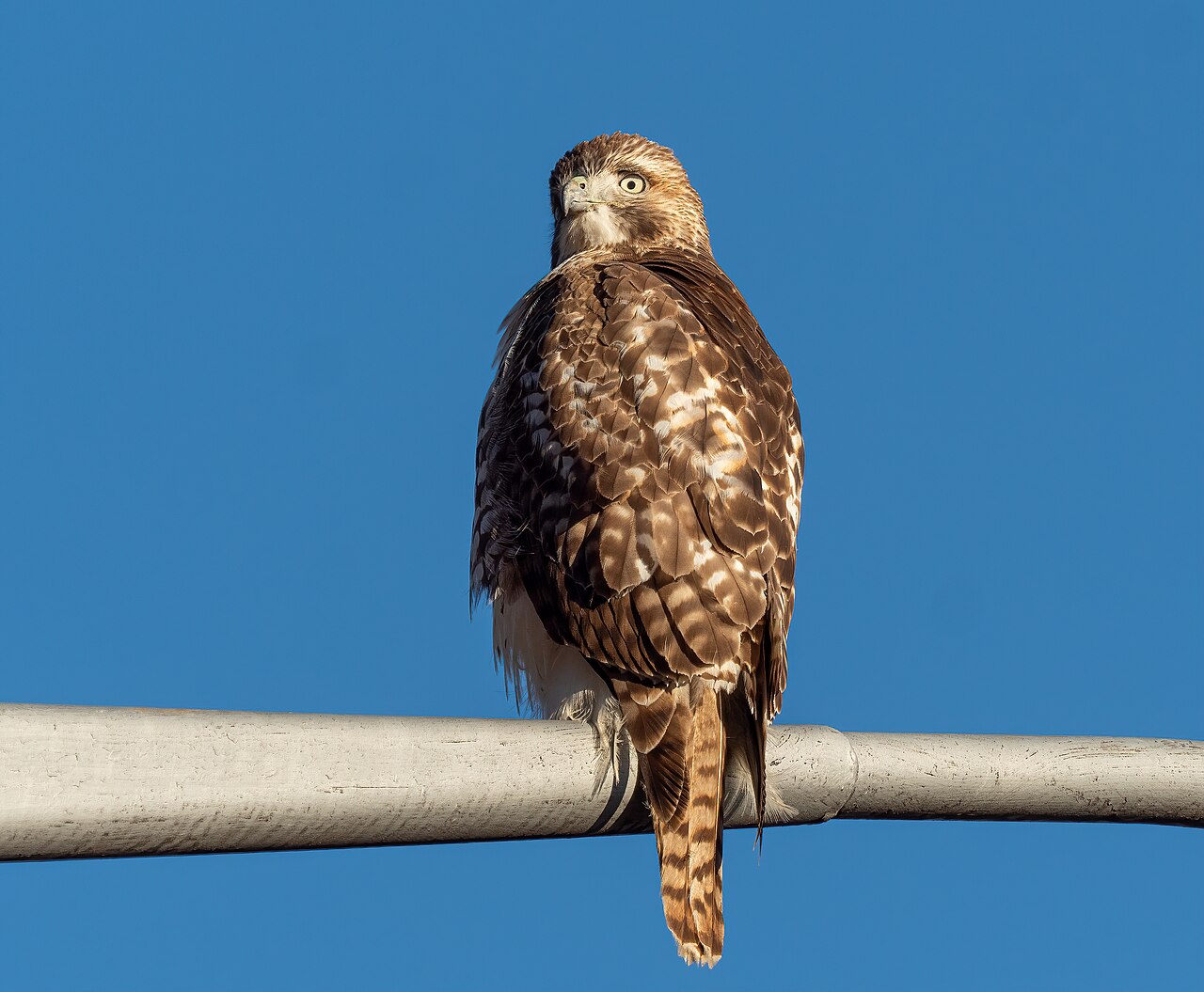
Red-tailed hawks are true habitat generalists, equally at home over farmland, deserts, highway medians, city parks, and open woodland edges across nearly all of North America, which is why they are the hawk most people see perched on roadside poles watching the shoulder for movement. Red-shouldered hawks are more specialized, favoring mature deciduous or mixed forest close to rivers, swamps, and other wetlands, and they are considerably less common in wide-open habitat away from water. Their range is also more limited, concentrated in the eastern United States and along the West Coast, with red-tailed hawks filling in nearly every gap in between across the rest of the continent. A hawk seen soaring high over an open field is more likely a red-tailed hawk, while one calling from a wooded streamside perch is a strong candidate for a red-shouldered hawk instead.
Call and Sound Differences
The two species sound distinctly different once you know what to listen for. The red-tailed hawk gives a hoarse, descending scream, often written as “kee-eeeee-arrr,” that drops in pitch through the whole call and is instantly recognizable as the classic hawk sound used throughout film and television whenever a raptor appears on screen. The red-shouldered hawk instead gives a sharp, evenly pitched “kee-aah” that it typically repeats three to five times in a row, a call so distinctive that blue jays are well known for imitating it almost perfectly to scatter competitors from a feeder. For a full breakdown of both calls alongside recordings and other hawk species, see our guide to hawk calls and sounds.
Juvenile Red-Tailed vs Red-Shouldered Hawks
Young hawks of both species lack the adult tail colors, which makes juveniles considerably trickier to separate than fully grown adults. Juvenile red-tailed hawks show a brown-banded tail rather than red, a heavily streaked belly band, and an overall darker, more mottled brown back that can look surprisingly different from the classic adult. Juvenile red-shouldered hawks look similar at first glance, with a streaked chest and banded brown tail, but they are smaller, slimmer-winged, and show the same pale wing crescents near the wingtips that adults display, a mark juvenile red-tailed hawks lack entirely. According to the Cornell Lab of Ornithology, wing and tail proportions remain one of the most reliable ways to separate young buteos when color and size alone are inconclusive, alongside habitat and voice, since juvenile plumage overlaps more between species than adult plumage does.
Other Hawks Sometimes Confused with These Two
Red-tailed and red-shouldered hawks are not the only buteos that can cause identification headaches for birders working without a field guide handy. The broad-winged hawk is considerably smaller than either species and shows a sharply banded black-and-white tail with far fewer, wider bands than a red-shouldered hawk, along with a more compact, stocky build overall. Swainson’s hawk, mostly found in open western country, has a distinctive dark chest band that neither red-tailed nor red-shouldered hawks share, making it one of the easier buteos to rule out once you know the mark. It is also worth ruling out the accipiters entirely, since a fast-flying Cooper’s hawk or sharp-shinned hawk chasing songbirds through a yard has a completely different, slimmer silhouette than either buteo covered in this guide. For the complete lineup of North American hawk species and a full identification breakdown, see our guide to types of hawks, and if you are unsure whether you are even looking at a hawk at all, our list of birds that look like hawks covers common lookalikes such as falcons and large owls.
Frequently Asked Questions
Which is bigger, a red-tailed hawk or a red-shouldered hawk?
The red-tailed hawk is larger, typically weighing 1.5 to 3.5 pounds with a wingspan up to 52 inches, compared to the red-shouldered hawk’s 1 to 1.9 pounds and roughly 40-inch wingspan.
How can you tell a red-tailed hawk from a red-shouldered hawk in flight?
Look at the tail: a plain brick-red tail means a red-tailed hawk, while a tail banded in black and white throughout belongs to a red-shouldered hawk, whatever the bird’s age.
Do red-tailed and red-shouldered hawks sound the same?
No. The red-tailed hawk gives a hoarse, descending scream, while the red-shouldered hawk gives a sharper, evenly pitched “kee-aah” repeated several times in a row.
Are juvenile red-tailed and red-shouldered hawks hard to tell apart?
Yes, juveniles of both species show streaked chests and brown banded tails, so size, wing shape, pale wing crescents, and habitat become the more reliable clues than color alone.
Which hawk is more likely to visit a backyard, red-tailed or red-shouldered?
Red-tailed hawks are the more frequent backyard and roadside sighting thanks to their habitat flexibility, while red-shouldered hawks stick closer to wooded areas near water.
Do red-tailed and red-shouldered hawks live in the same areas?
Their ranges overlap across much of the eastern and central United States, though red-shouldered hawks are confined to wooded wetland habitat within that shared range.