Backyard Birds of Virginia: 15 Common Species (2026 Identification Guide)
Virginia’s geographic spread from the Atlantic Tidewater through the Piedmont to the Blue Ridge and Appalachian Mountains creates one of the most diverse backyard bird communities in the Mid-Atlantic. The state hosts 460+ recorded bird species, with 30-45 commonly visiting suburban yards depending on region and season. Virginia’s mild climate in most of the state means year-round backyard birding is rewarding, and the state’s position along the Atlantic Flyway makes spring and fall migration spectacular. From the Chesapeake Bay’s coastal yards to Shenandoah Valley farms to the Blue Ridge Mountains’ forested suburbs, Virginia offers distinctive bird communities by region. This guide covers the 15 most common backyard birds across Virginia with field marks, regional ranges, and proven attraction strategies.
Quick Reference: 15 Common Backyard Birds of Virginia
| Species | Size | Key ID Feature | Where in VA |
|---|---|---|---|
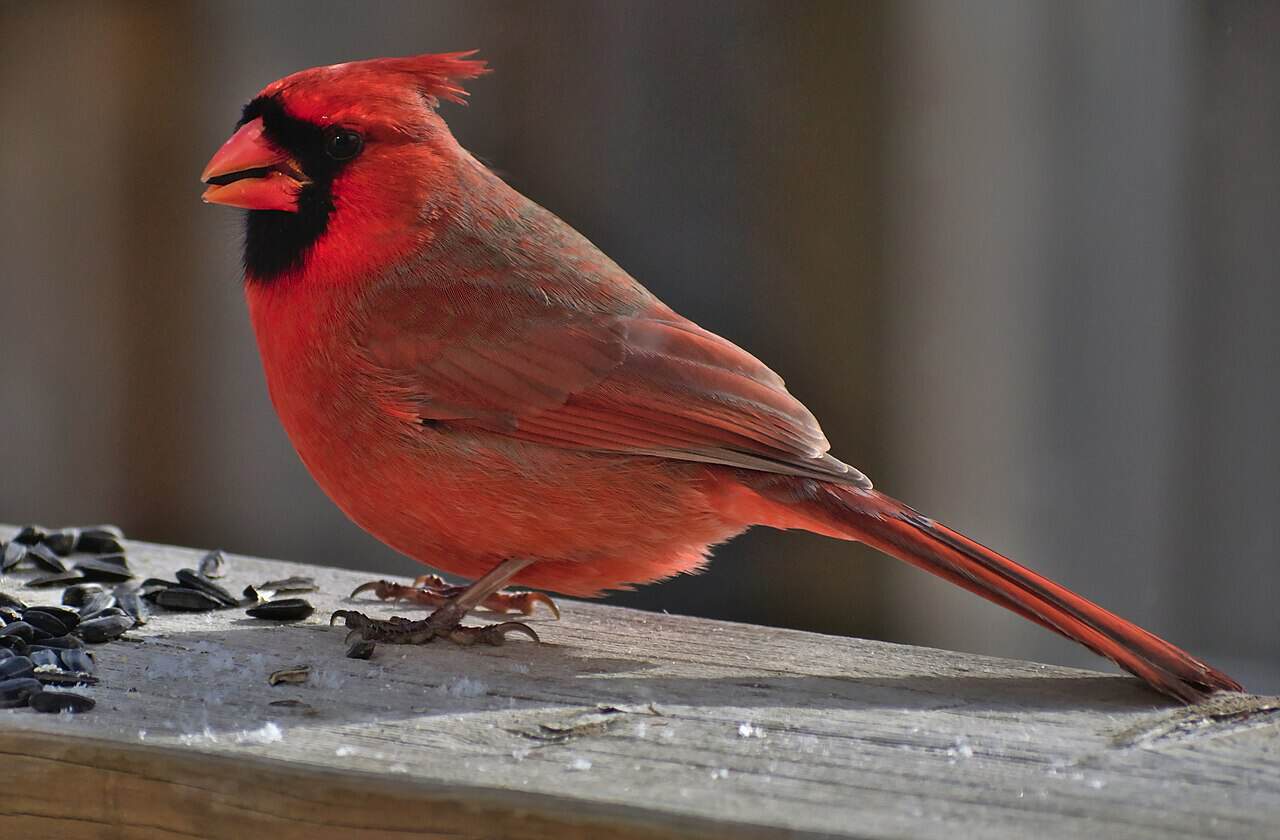
| Northern Cardinal (state bird) | 8.5″ | All red (male) + crest + black face mask | Statewide year-round |
| Carolina Chickadee | 4.75″ | Black cap + white cheeks + black bib | Statewide year-round |
| Carolina Wren | 5.5″ | Rust-brown + bold white eyebrow | Statewide year-round |
| Tufted Titmouse | 6.5″ | Gray crest + buff flanks + black eye | Statewide year-round |
| Blue Jay | 11″ | Blue crest + black necklace + white below | Statewide year-round |
| Mourning Dove | 12″ | Tan + long pointed tail + small head | Statewide year-round |
| House Finch | 5.5″ | Red head/breast (male) + streaky belly | Statewide year-round |
| American Goldfinch | 5″ | All yellow (summer male) + black wings | Year-round |
| Eastern Bluebird | 7″ | Blue back + rust breast + white belly | Statewide year-round |
| Downy Woodpecker | 6.75″ | Small + short bill + checkered wings | Statewide year-round |
| Red-Bellied Woodpecker | 9.25″ | Red cap + zebra back + tan belly | Statewide year-round |
| Brown-Headed Nuthatch | 4.5″ | Brown cap + gray back + small + pine forests | Tidewater pine forests |
| White-Breasted Nuthatch | 5.75″ | Gray back + black cap + walks down trees | Statewide year-round |
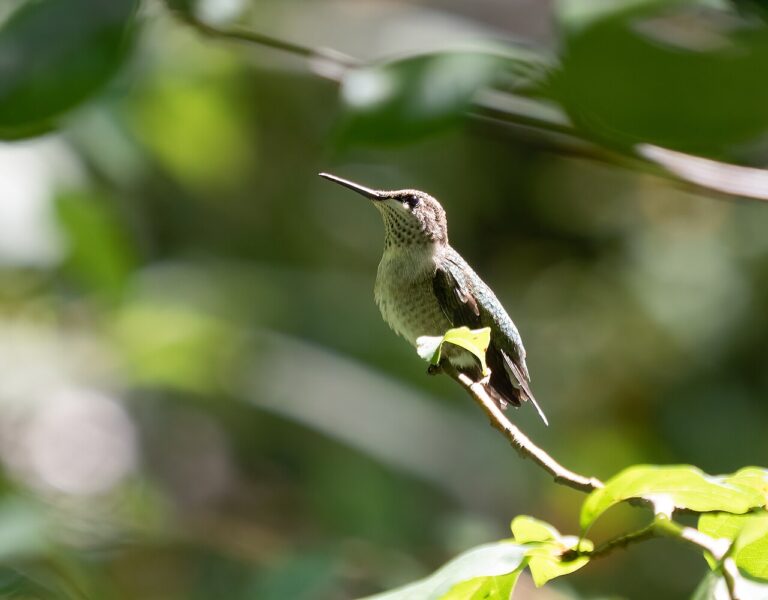
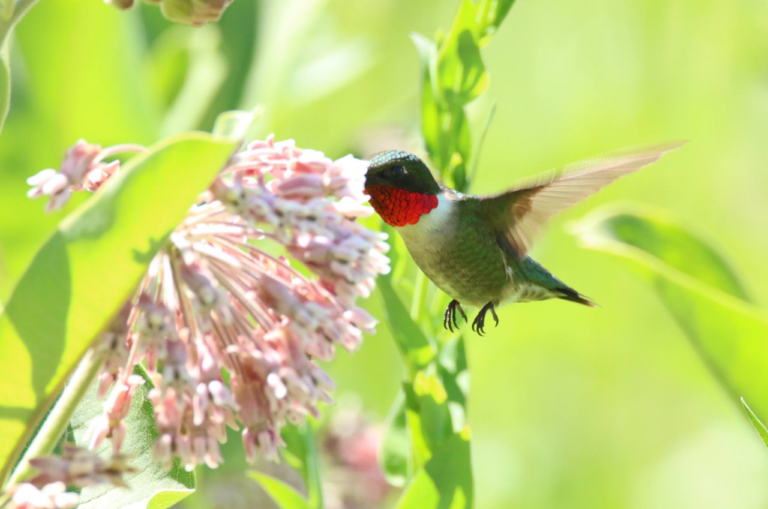
| Ruby-Throated Hummingbird | 3.5″ | Iridescent green + ruby throat (male) | Summer (Apr-Oct) |
| Pileated Woodpecker | 16.5″ | Crow-sized + flaming red crest | Forested areas year-round |
Species Identification
Northern Cardinal (State Bird)
Virginia’s official state bird, designated in 1950. Male Northern Cardinals are brilliant red overall with a pointed red crest, black face mask, and thick orange-red bill. Females are tan-brown with red highlights on crest, wings, and tail. Cardinal pairs mate for life and stay together year-round in Virginia yards.
Range in Virginia: Statewide year-round.
Habitat: Yards with shrubby cover, parks, woodland edges, urban areas with brush.
Key ID: Brilliant red + pointed crest + black face mask + thick orange-red bill (male). The most familiar red bird in VA yards.
Where to see: Hopper or platform feeders with sunflower or safflower seed. Cardinals prefer dawn/dusk feeding. Plant native shrubs (American Beautyberry, native viburnums, holly species) for nesting cover.
Carolina Chickadee
Virginia’s small year-round companion. Carolina Chickadees have a black cap, black throat/bib, white cheeks, gray back, and buffy flanks. Smaller than the Black-Capped Chickadee (which occurs only at the highest elevations in the far western mountains of Virginia). Faster, higher-pitched ‘chick-a-dee’ call distinguishes them by voice.
Range in Virginia: Statewide year-round. (Highest mountain elevations may have Black-Capped Chickadees.)
Habitat: Wooded yards, parks, forests.
Key ID: Black cap + black bib + white cheeks + small size. The chickadee species across most of Virginia.
Where to see: Common at sunflower, peanut, and suet feeders. Will use small nest boxes (1.125 inch hole).
Carolina Wren
Virginia’s loudest backyard voice. Carolina Wrens have rich rust-brown upperparts, buff underparts, and a striking bold white eyebrow stripe. Their loud, ringing ‘tea-kettle tea-kettle tea-kettle’ song carries throughout Virginia yards year-round. They nest in unexpected places, flower pots, garage corners, hanging baskets.
Range in Virginia: Statewide year-round.
Habitat: Wooded yards, gardens with brush, edges of forests.
Key ID: Rich rust color + bold white eyebrow + loud voice. Larger than House Wrens.
Where to see: Common at suet feeders. Will visit platform feeders. Provide brush piles for cover. Will use small nest boxes.
Eastern Bluebird
Virginia’s bluebird species. Male Eastern Bluebirds have brilliant royal-blue heads and backs, rust-orange throats and breasts, and clean white bellies. Females are paler. Virginia has very active bluebird trail networks, thousands of nest boxes maintained by volunteers across the state.
Range in Virginia: Statewide year-round.
Habitat: Open habitat with scattered trees, pastures, golf courses, parks, suburbs with old trees.
Key ID: Bright blue back + rust-orange breast + clean white belly. Eastern form has white belly.
Where to see: Install NABS-approved bluebird nest boxes on poles in open areas. Provide mealworms. Plant native berry shrubs (Eastern Red Cedar, Winterberry Holly, American Holly).
Brown-Headed Nuthatch
A Virginia specialty in pine forests. Brown-Headed Nuthatches are very small (4.5 inches), with a brown cap and nape, blue-gray back, and white face and underparts. Habitat specialist, almost exclusively in mature pine forests, especially in the Tidewater region. They use small twigs as tools to pry up bark, among the few birds known to use tools.
Range in Virginia: Tidewater region and Coastal Plain (where pine forests dominate). Less common in mountains.
Habitat: Mature pine forests, especially loblolly pine ecosystems.
Key ID: Very small + brown cap + gray back + white underparts. The tool-using behavior is diagnostic.
Where to see: Yards adjacent to mature pine forests. Will visit suet and peanut feeders. Will use small nest boxes (1.125 inch hole) on pine trees.
Tufted Titmouse
Virginia’s perky crested feeder companion. Tufted Titmice have a clean gray back, white underparts with buff flanks, a pointed gray crest, large black eyes, and a small black forehead patch. Loud ‘peter-peter-peter’ calls fill Virginia woodlands year-round.
Range in Virginia: Statewide year-round.
Habitat: Mature deciduous forests, parks, suburban yards.
Key ID: Gray crest + buff flanks + black eye + small size. Distinctive crest separates from chickadees.
Where to see: Common at backyard feeders with sunflower seed, peanuts, and suet. Often in mixed flocks with Carolina Chickadees and nuthatches.
Blue Jay
Virginia’s familiar crested blue bird. Blue Jays have bright blue heads, wings, and backs (with black markings), white chests, and a prominent blue crest. Loud, intelligent, and dominant at feeders. Virginia Blue Jays cache thousands of acorns each fall.
Range in Virginia: Statewide year-round.
Habitat: Forests, parks, suburban backyards with mature trees.
Key ID: Blue + black necklace + prominent crest + white below.
Where to see: Platform feeders with peanuts in shell, sunflower seed, and corn. Bird baths regularly.
Pileated Woodpecker
Virginia’s largest woodpecker, crow-sized and spectacular. Pileated Woodpeckers are mostly black with bold white neck stripes, white underwings flashing in flight, and a brilliant flaming-red crest. Males have a red ‘mustache’ stripe; females have black mustache stripes.
Range in Virginia: Statewide in forested areas, most common in mountains, Shenandoah Valley, and forested Tidewater areas.
Habitat: Mature forests with large dead trees. Backyards adjacent to or within mature forest cover.
Key ID: Very large + black with bold white neck + flaming red crest. The largest woodpecker most Virginia residents will see.
Where to see: Will visit suet feeders if your yard is near mature forest. Plant native trees and leave dead standing trees (‘snags’) if safe.
Ruby-Throated Hummingbird (Summer Visitor)
Virginia’s only common breeding hummingbird. Male Ruby-Throated Hummingbirds have an iridescent green back and a brilliant ruby-red throat (gorget), appears black in poor light, flashes ruby-red in good light. Females have green backs with white throats. Migrate to Central America for winter.
Range in Virginia: Statewide in summer (April-October). First arrivals in Tidewater late March; mountain arrivals mid-April.
Habitat: Gardens, parks, woodland edges with flowering plants.
Key ID: Iridescent green back + ruby throat (male, requires good light) + tiny size.
Where to see: Hummingbird feeders (4:1 water-to-sugar ratio, no red dye). Plant native flowers (cardinal flower, bee balm, native salvias, coral honeysuckle).
American Goldfinch
Virginia’s brightest summer bird. Summer male American Goldfinches are brilliant lemon-yellow overall with jet-black wings and a black cap. Females and winter birds are duller olive-brown with pale yellow wash. Goldfinches breed late (July-September) to coincide with peak thistle and weed seed availability.
Range in Virginia: Statewide year-round.
Habitat: Open habitat with weeds, gardens, parks, suburban yards.
Key ID: Brilliant yellow (summer male) + black wings + black cap. Winter birds duller olive-brown.
Where to see: Nyjer (thistle) feeders. Will also visit sunflower feeders. Often in flocks throughout winter.
House Finch
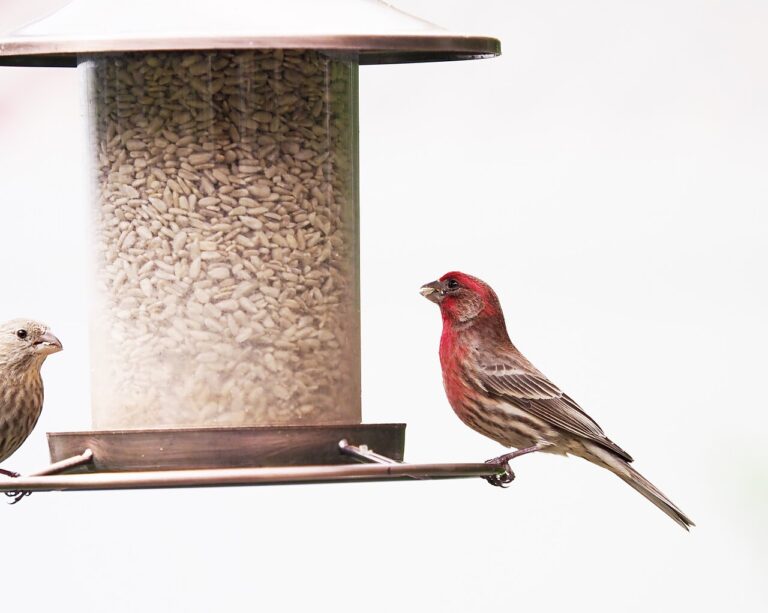
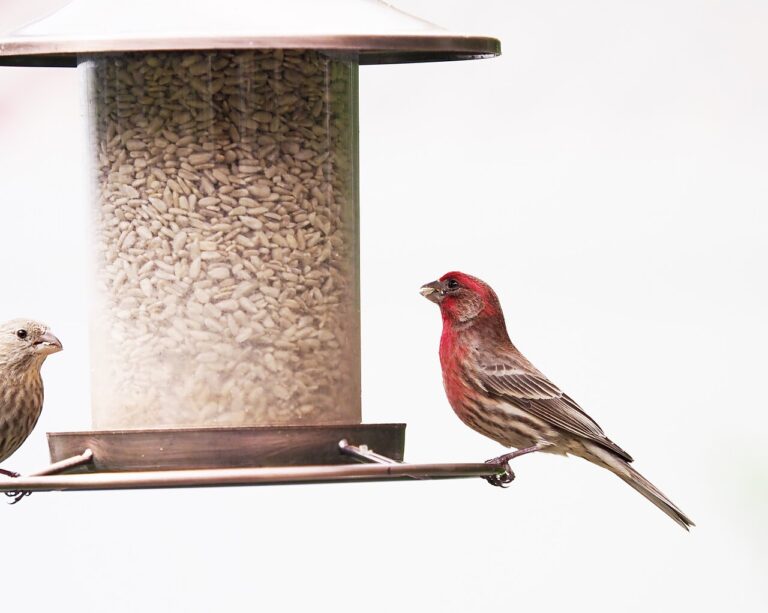
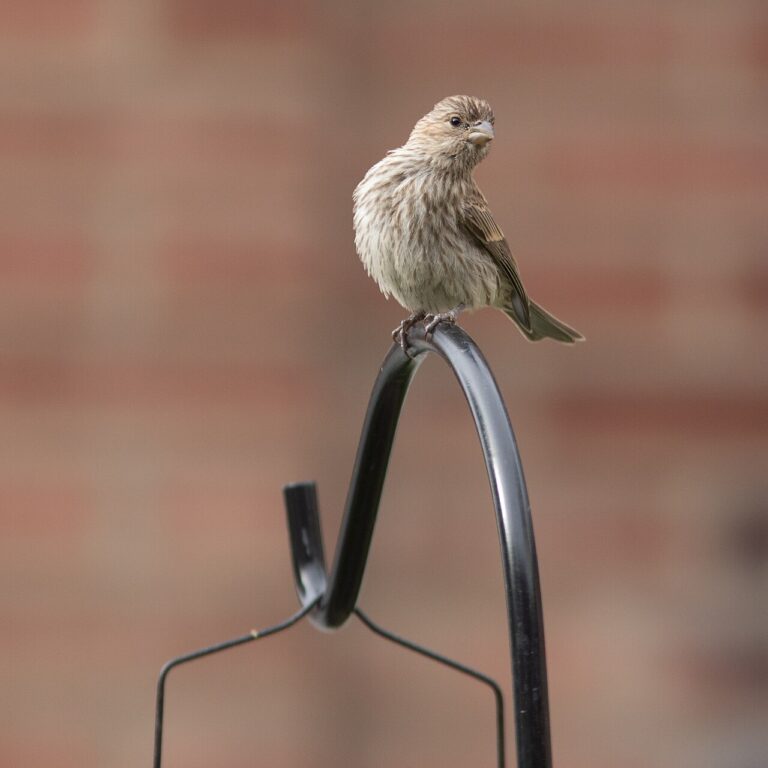
Virginia’s most common feeder finch. Male House Finches have red wash over the head, breast, and rump with brown-streaked flanks. Females are uniformly brown-streaked.
Range in Virginia: Statewide year-round.
Habitat: Urban, suburban, agricultural areas.
Key ID: Red on head/breast (male) + brown-streaked flanks. Smaller than cardinals. Conical bill.
Where to see: Tube feeders with nyjer or sunflower seed. Often in small flocks.
Mourning Dove
Virginia’s most widespread dove. Mourning Doves have sleek tan-brown bodies, small heads, and long pointed tails with white edges. Their distinctive whistling wing sound on takeoff is recognizable in every Virginia yard.
Range in Virginia: Statewide year-round.
Habitat: Open habitat, suburbs, parks, agricultural areas.
Key ID: Tan-brown + long pointed tail + small head. Whistling wing-sound in flight.
Where to see: Ground feeders or platform feeders with mixed seed, sunflower, or cracked corn. Often in pairs.
Regional Variations Across Virginia
Virginia’s geographic diversity creates distinct backyard bird communities by region. The Tidewater and Coastal Plain (Virginia Beach, Norfolk, Newport News, Eastern Shore) host coastal specialists. Brown-Headed Nuthatches are common in pine forests. Boat-Tailed Grackles occur near coastal saltwater. Year-round Painted Buntings (rare) at the northern edge of their range. Spring/fall migration is spectacular along the coast.
The Piedmont (Richmond, Charlottesville, Fredericksburg, Manassas, Lynchburg) is the most populated region. Typical mid-Atlantic backyard birds dominate, Cardinals, Carolina Chickadees, Carolina Wrens, Tufted Titmice, Blue Jays, Eastern Bluebirds. Seasonal migrants in spring and fall.
Northern Virginia and DC suburbs (Arlington, Fairfax, Alexandria) host urban-adapted populations of common species, plus migration along the Potomac River. Spring migration through the Mt. Vernon area can be exceptional.
Shenandoah Valley (Winchester, Harrisonburg, Staunton) hosts farmland species, Eastern Bluebirds on fence posts, plus typical Mid-Atlantic yard birds. The valley is a major migration corridor.
Blue Ridge and Appalachian Mountains (Roanoke, Wytheville, far western Virginia) host higher-elevation species: Dark-Eyed Juncos breed in summer (most VA areas only see them in winter), Black-Capped Chickadees at highest peaks, Hermit Thrushes, Common Ravens, plus Black-Throated Blue Warblers (summer). Winter brings irruptive species like Pine Siskin and Common Redpoll.
Chesapeake Bay shoreline and the Eastern Shore host distinctive bird communities, Brown Pelicans in summer, plus wintering waterfowl on the bay. Backyards near the Chesapeake see diverse migration.
The Northern Cardinal: Virginia’s Iconic Year-Round Bird
The Northern Cardinal (Cardinalis cardinalis) was designated Virginia’s official state bird on January 25, 1950. Virginia is one of seven states that share the Cardinal as state bird (along with Kentucky, Illinois, Ohio, Indiana, North Carolina, West Virginia).
Cardinals are nonmigratory in Virginia, meaning the same individual birds may visit your feeders for years. Cardinal pairs mate for life and stay together year-round. The male’s courtship feeding behavior, bringing seed to the female and placing it in her bill, is one of the most photographed Virginia bird behaviors.
Cardinals have expanded their range dramatically northward over the past century. Once primarily a Southern bird, Cardinals now breed in southern Canada. Climate change and bird feeders (especially in winter) are credited for the expansion. Virginia has been at the heart of the species’ historical range for centuries.
Cardinals are particularly active at dawn and dusk in Virginia, typically the first birds to arrive at feeders each morning and the last to leave each evening. This crepuscular pattern is reliable enough that Virginia bird-watchers plan photography sessions around it.
Plant native shrubs with dense cover for Cardinal nesting: American Beautyberry, native viburnums, American Holly, and Eastern Red Cedar. Cardinals prefer nests 4-8 feet above ground in dense vegetation. Providing this habitat almost guarantees a breeding pair in suburban Virginia yards.
How to Attract Virginia Backyard Birds
Virginia’s mild climate creates year-round backyard birding opportunities. Winter (December-February) feeder activity is the most rewarding watching season, natural food sources are scarce, and birds rely heavily on backyard feeders even in Virginia’s relatively mild winters.
Winter feeding strategy: black oil sunflower seed in tube and hopper feeders (universal favorite), suet in cage feeders (attracts woodpeckers and Carolina Chickadees), peanuts (shelled, raw) for Blue Jays and chickadees, nyjer (thistle) seed in small-port feeders for goldfinches.
Heated bird baths aren’t strictly necessary in most of Virginia (water rarely stays frozen for long), but they help on cold snaps. In the mountains, heated baths become more valuable December-March.
Spring migration (April-May) brings warblers, vireos, thrushes, tanagers, and orioles through Virginia. Most migrants don’t visit seed feeders but appreciate fruit (oranges, grape jelly for orioles), mealworms, and water features.
Summer (June-August) is breeding season. Provide nest boxes for cavity nesters: Eastern Bluebirds (1.5 inch hole, in open areas), Carolina Chickadees (1.125 inch), Tufted Titmice. Brown-Headed Nuthatches use small nest boxes in pine areas.
Hummingbird feeders are essential April through October. Ruby-Throated Hummingbirds breed across Virginia. Use 4:1 water-to-sugar ratio, no red dye. Multiple feeders reduce male territorial fighting. Clean every 3-4 days during summer heat.
Native plant landscaping outperforms turfgrass dramatically. Virginia-native plants (oaks, dogwoods, native viburnums, American Beautyberry, Eastern Red Cedar) support 10-100x more bird food than non-native landscaping.
Manage outdoor cats. Virginia outdoor cats kill millions of birds annually. Keeping cats indoors is the single most effective bird protection strategy.
Avoid pesticides if possible. Most lawn ‘pests’ (grubs, caterpillars) are actually critical food for nesting birds.
Top Native Virginia Plants for Backyard Birds
**White Oak (Quercus alba) or Northern Red Oak (Q. rubra):** Virginia’s native oaks support hundreds of caterpillar species, the most productive single plantings for Virginia yards. Acorns feed Blue Jays, woodpeckers, and many other species.
**Flowering Dogwood (Cornus florida):** Virginia’s state flower and tree. Native small tree producing bright red berries in fall that feed 36+ bird species. Spring white flowers attract pollinators.
**Eastern Red Cedar (Juniperus virginiana):** Native conifer producing blue-gray berries that feed Cedar Waxwings, American Robins, Yellow-Rumped Warblers, and many other species. Provides essential winter cover.
**American Beautyberry (Callicarpa americana):** Native shrub producing dramatic clusters of bright purple-violet berries in fall. Feeds Northern Mockingbirds, Cardinals, Brown Thrashers, and 40+ other Virginia bird species.
**Coral Honeysuckle (Lonicera sempervirens):** Native vine with tubular red flowers attracting Ruby-Throated Hummingbirds. Spring through summer bloom. Native (not the invasive Japanese honeysuckle).
**American Holly (Ilex opaca):** Virginia’s native broadleaf evergreen. Produces bright red berries that persist through winter, critical food when other berries are gone. Feeds American Robins, Cedar Waxwings, and many other species. Provides essential winter cover.
Frequently Asked Questions
What’s the most common backyard bird in Virginia?
Northern Cardinal (the state bird), Carolina Chickadee, Carolina Wren, Mourning Dove, Tufted Titmouse, House Finch, and Blue Jay are all extremely common across Virginia year-round. American Goldfinches and Eastern Bluebirds add abundance throughout the year. The exact most-common species varies by region and habitat.
When do hummingbirds arrive in Virginia?
Ruby-Throated Hummingbirds typically arrive in coastal Virginia in late March, Piedmont by mid-April, and mountains by late April. They breed statewide and stay through October before migrating to Central America for winter. Have feeders up by late March in Tidewater and early April in the Piedmont.
Are there Black-Capped Chickadees in Virginia?
Only at the very highest mountain elevations (above approximately 3,500 feet) in western Virginia. Most of Virginia has Carolina Chickadees only. If you’re in the high Appalachians or far western Virginia mountains, you might see Black-Capped Chickadees. Everywhere else in Virginia, it’s Carolina Chickadee.
What’s that small bird with the brown cap on my Virginia pine tree?
Brown-Headed Nuthatch, a Virginia pine forest specialist. Very small (4.5 inches) with a brown cap and nape, blue-gray back, and white face/underparts. Found in mature pine forests, especially in the Tidewater region. Uses twigs as tools to pry up bark, among the few tool-using bird species.
How do I attract Eastern Bluebirds to my Virginia yard?
Install a NABS-approved bluebird nest box (1.5 inch entrance hole) on a pole 5-6 feet high in an open area with scattered trees. Provide mealworms (live or freeze-dried) in a shallow dish. Plant native berry shrubs like Eastern Red Cedar, Winterberry Holly, and American Holly. Bluebirds prefer open habitat, they won’t use boxes in dense forests.
What’s the huge bird with red crest in my Virginia woods?
Pileated Woodpecker, Virginia’s largest woodpecker, crow-sized (16.5 inches). Mostly black with bold white neck stripes and a brilliant flaming-red crest. Males have a red ‘mustache’ stripe; females have black. Common in Virginia mature forests, especially mountains and forested rural areas. Will visit suet feeders in yards near mature forest.
Do birds migrate through Virginia in fall?
Yes, Virginia is a major fall migration corridor. Hawk migration at Kiptopeke State Park (Eastern Shore) and Rockfish Gap (Blue Ridge) is spectacular. Songbird migration peaks in September-October. Backyards see migrating warblers, vireos, thrushes, plus arriving winter species like Dark-Eyed Juncos and White-Throated Sparrows. Maintain feeders year-round to support migration.
What native plants attract the most Virginia birds?
White Oak and Northern Red Oak are the single most productive plantings, supporting hundreds of caterpillar species. Other top natives: American Beautyberry, Flowering Dogwood (state flower!), Eastern Red Cedar, Coral Honeysuckle, and American Holly. Plant native, not non-native ornamentals, native plants support 10-100x more bird food.