Blue Jay: Complete Identification, Diet, and Behavior Guide (2026)
The Blue Jay (Cyanocitta cristata) is one of North America’s most intelligent, beautiful, and complex backyard birds. With brilliant blue plumage, a distinctive crest, and a reputation for both intelligence and mischief, Blue Jays are members of the corvid family (Corvidae), relatives of crows, ravens, and magpies. They’re capable of using tools, planning for the future, remembering thousands of acorn cache locations, and even mimicking hawks. This comprehensive guide covers everything you need to know about Blue Jay identification, range, diet, remarkable intelligence, behavior, nesting, vocalizations, and proven strategies for attracting Blue Jays to your backyard, plus understanding their crucial ecological role in maintaining North American oak forests.
Blue Jay: Key Facts at a Glance
| Attribute | Detail |
|---|---|
| Scientific Name | Cyanocitta cristata |
| Family | Corvidae (Crows, jays, magpies) |
| Size | 9-12 inches (23-30 cm) length |
| Wingspan | 13-17 inches (34-43 cm) |
| Weight | 2.5-3.5 oz (70-100 g) |
| Lifespan | 7 years average; up to 27 years recorded |
| Diet | Omnivore, acorns, seeds, fruits, insects, occasional small vertebrates |
| Habitat | Mixed and deciduous forests, parks, suburban yards |
| Range | Eastern and central North America |
| Population Status | Very common, 17 million estimated North American population |
| Conservation Status | Least Concern (IUCN) |
| Distinctive Feature | Bright blue + black necklace + prominent crest + white below |
| Vocalizations | Loud ‘jay-jay!’, whisper songs, hawk mimicry, many other calls |
| Intelligence | Among the most intelligent backyard birds |
| Cultural Role | Major dispersers of North American oaks |
Blue Jay Identification: How to Identify a Blue Jay
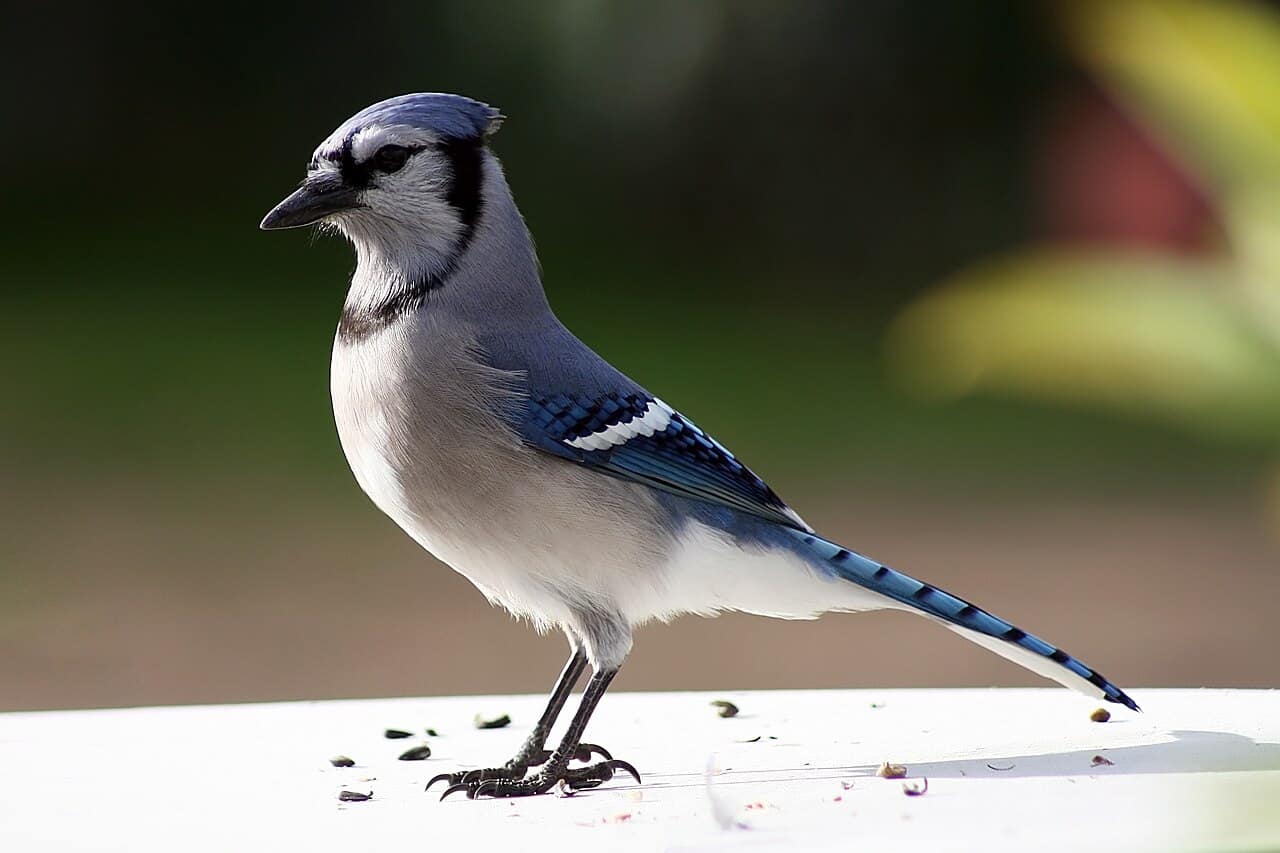
Blue Jays are striking and unmistakable: blue overall on the head, wings, back, and tail; white face, chest, and belly; a sharp black ‘necklace’ or collar across the throat; a prominent blue crest that can be raised or lowered; and black-and-white barring on the wings and tail. The blue color is structural, it’s caused by light scattering in the feathers, not pigment.
Male and female Blue Jays look essentially identical, there’s no significant sexual dimorphism. Both have the same crest, blue plumage, white underside, and black markings. Field guides note that males MAY be slightly larger but the difference is rarely useful in field identification.
Juvenile Blue Jays look like duller versions of adults. They have slightly grayer-blue plumage, less distinct markings, and a smaller crest. Juveniles develop full adult plumage by their first winter.
Size: Blue Jays are 9-12 inches long, larger than most backyard songbirds. They’re significantly bigger than Cardinals (8.5 inches), comparable to Mourning Doves (12 inches), and substantially larger than House Sparrows (6 inches).
Crest position is informative behaviorally. A Blue Jay with the crest fully raised is alarmed, alert, or excited. A relaxed Blue Jay holds the crest flat or slightly raised. The crest position is a quick visual cue to the bird’s state.
Blue Jays are often confused with Steller’s Jays (Pacific Northwest and Western US) which have BLACK heads and prominent crests with dark blue bodies. The two species don’t overlap much, Blue Jays in the east, Steller’s Jays in the west. Florida Scrub-Jays have NO crest and are limited to Florida scrub habitat.
Blue Jay Range and Habitat
Blue Jays occupy a vast range across eastern and central North America, from southern Canada through the eastern US to Florida and west to roughly the Great Plains/Rocky Mountain transition (eastern Colorado, eastern Wyoming). They’re expanding westward into the Pacific Northwest in some areas.
Blue Jays are habitat generalists with a preference for deciduous and mixed forests, especially oak-dominated forests. They thrive in suburban yards with mature trees, urban parks, woodland edges, and forest interiors. Pure pine forests and treeless habitats are less suitable.
Blue Jay range and behavior: Many Blue Jays are year-round residents, but the species shows complex partial migration patterns. Some populations migrate while others remain. Even within a single neighborhood, some Blue Jays may migrate while others overwinter. Migration is highly variable year-to-year, some years bring large irruptions of northern Blue Jays into southern states; other years show minimal movement.
Range expansion: Blue Jays are expanding their range westward, partially due to oak tree planting in cities and suburbs across the Great Plains. They’ve established small breeding populations in places where they were historically absent (Wyoming, Montana, eastern Washington).
Habitat preference for oaks: Blue Jays have a profound preference for oak forests. They depend on acorns as a primary food source, and they in turn are MAJOR dispersers of oak seeds. The relationship is so strong that scientists believe Blue Jays were crucial in the post-glacial expansion of North American oak forests, they cached acorns far from parent trees, allowing oak forests to spread northward as climates warmed.
Blue Jay Diet: What Do Blue Jays Eat?
Blue Jays are omnivores with extraordinarily diverse diets. They eat acorns (the single most important food), seeds, fruits, berries, insects, small frogs and snakes (occasionally), other birds’ eggs and nestlings (rarely but importantly), and human-provided foods like peanuts, sunflower seeds, suet, and bread.
Acorns are the foundation of Blue Jay ecology. A single Blue Jay may cache 3,000-5,000 acorns each fall. They have specialized gular pouches (expandable throat sacs) that can hold up to 5 acorns at once, they fly with these acorns to cache sites up to several miles away. They bury acorns just below the surface in scattered locations.
Blue Jays remember cache locations remarkably well, better than many human memories. Researchers have documented Blue Jays returning to cached acorns months later, even under snow cover. They use spatial memory and landmarks to locate caches. Not all acorns are recovered, however, the uneaten acorns germinate into new oak trees. This is the source of Blue Jays’ major role in oak forest regeneration.
At feeders: Blue Jays love peanuts (in shell or shelled), sunflower seeds, corn (whole or cracked), suet, mealworms, and occasionally bread. They’re dominant feeders, smaller birds typically yield space at feeders when Blue Jays arrive. They visit feeders 3-5 times daily, often multiple birds at once.
Caching behavior at feeders: Blue Jays don’t just eat at feeders, they cache food away for later. A Blue Jay may visit a peanut feeder 10-20 times in 30 minutes, taking peanuts away to cache rather than eating them. This caching behavior makes peanut consumption appear to be much higher than the birds actually consume. Place feeders in areas where you don’t mind sprouting peanut plants (they germinate from cached peanuts!).
Eggs and nestlings: Blue Jays occasionally eat other birds’ eggs and nestlings, contributing to their reputation as nest predators. However, studies have shown this is a relatively minor component of their diet (less than 1% in most studies). The popular reputation overstates the actual prevalence of egg-eating.
Blue Jay Intelligence: Among the Smartest Backyard Birds
Blue Jays are among the most intelligent backyard birds in North America. As corvids, they share cognitive abilities with crows, ravens, and magpies, including problem-solving, tool use, future planning, and social learning. Research has documented remarkable Blue Jay intelligence.
Problem-solving: Captive Blue Jays have solved complex puzzles, learned to use sticks as tools to extract food from tubes, and demonstrated insight learning (the ability to solve a problem without trial-and-error). Wild Blue Jays have been observed using bark strips as tools to scrape food from crevices.
Spatial memory: Blue Jays cache thousands of acorns each fall and successfully retrieve them months later. This requires exceptional spatial memory, researchers estimate Blue Jays remember the locations of thousands of cache sites simultaneously.
Future planning: Some research suggests Blue Jays plan for future needs, caching seasonal foods in anticipation of winter scarcity rather than just current hunger. This ‘future-oriented’ behavior is rare in animals and indicates significant cognitive sophistication.
Social learning: Blue Jays learn from observing other birds. They observe successful foraging strategies of other species and adapt their own behavior. They also teach their young through extended parental care.
Vocal mimicry: Blue Jays are excellent mimics of other bird species, especially raptors. They imitate Red-Tailed Hawks, Red-Shouldered Hawks, and Cooper’s Hawks. The hawk mimicry serves multiple purposes, alerting Blue Jays to actual hawks in the area, possibly deceiving other birds at feeders to leave (so Blue Jays have feeders to themselves), or warning competitors away from feeding spots.
Recognition: Blue Jays recognize individual humans. Captive studies show they can distinguish human faces and remember specific people for years. Wild Blue Jays in your yard may recognize you specifically, and treat you differently than strangers based on whether you typically provide food.
Blue Jay Behavior and Social Structure
Blue Jays are highly social birds. They live in small family groups or pairs year-round, often joined by extended family or unrelated ‘mob’ members during food-rich periods. The social structure is more complex than most backyard birds.
Breeding pairs: Blue Jays typically mate for life or for many years. Pairs work together to build nests, raise young, and defend territories. Both parents incubate eggs and feed nestlings.
Mobbing behavior: Blue Jays famously mob predators, Cooper’s Hawks, owls, snakes, and even cats. When a predator is detected, Blue Jays vocalize loudly and gather others to harass the threat. The mob may include other species (chickadees, titmice, nuthatches, robins) attracted by Blue Jay alarm calls. Mobbing serves to drive away predators and educate young birds about threats.
Communal foraging: Blue Jay family groups often forage together. Multiple birds visit feeders together, alternating between eating and watching for threats. This communal vigilance allows safer feeding than solo foraging would.
Aggression at feeders: Blue Jays are dominant at feeders. They typically displace smaller birds. However, the displacement is usually brief, Blue Jays move on after a few minutes, allowing smaller birds to return. Some Blue Jays develop relationships with humans that override typical aggression, they may accept peanuts from outstretched hands.
Lifespan: Wild Blue Jays have been recorded surviving 27 years (banded bird), though this is exceptional. Typical lifespan is 7-8 years for adults. First-year mortality is high (~50%) due to predation and learning to forage. Major mortality factors: predation by Cooper’s Hawks, owls (especially Great Horned Owls), West Nile virus (which has reduced Blue Jay populations in some regions), window strikes, and vehicle collisions.
Blue Jay Breeding and Nesting
Blue Jay breeding begins in March or April in the southern US, and April-May in northern regions. Most pairs raise one brood per year, though occasional second broods occur in southern regions.
Nest construction: Both male and female participate in nest building. The nest is bulky and cup-shaped, made of twigs, roots, bark strips, grass, and often human-made materials (string, paper, cloth). Nests are typically placed 10-25 feet above ground in deciduous trees, often in crotches of branches.
Eggs: Each clutch contains 4-5 eggs (occasionally 2-7). Blue Jay eggs are bluish or greenish with brown speckling. Incubation takes 17-18 days, with both parents participating (female does most of the incubation).
Nestling period: Both parents feed nestlings. Nestlings remain in the nest for 17-21 days, relatively long for backyard birds. After fledging, juveniles remain with parents for 1-2 months while learning to forage. This extended parental care is typical of corvids and contributes to Blue Jay intelligence development.
Anti-predator behaviors: Blue Jay nests are often vulnerable to predation. Common predators include Cooper’s Hawks (adults can take Blue Jays), Eastern Gray Squirrels, raccoons, and snakes. Blue Jays defend nests aggressively, multiple family members mob predators that approach nests.
Yard nesting: Blue Jays will nest in yards with appropriate large trees. They prefer oaks, maples, and other deciduous trees with dense foliage. A pair may nest in the same tree year after year.
Blue Jay Subspecies and Regional Variations
Blue Jays show subtle regional variation across their range. Currently four recognized subspecies, though some ornithologists question the validity of the distinctions.
Northern Blue Jay (C. c. bromia): The most common subspecies, found across most of the northern and central US and Canada. Standard Blue Jay appearance.
Coastal Blue Jay (C. c. cristata): Atlantic coast from Massachusetts to North Carolina. Slightly smaller than the northern subspecies.
Florida Blue Jay (C. c. semplei): Found only in southern Florida. Smaller and slightly paler than other subspecies.
Interior Blue Jay (C. c. cyanotephra): Found in central US states. Brighter blue overall than other subspecies.
The differences between subspecies are subtle and generally not field-identifiable for most birders. Most birders simply identify all Blue Jays as ‘Blue Jay’ without further distinction.
Climate adaptation: Northern Blue Jays show some seasonal variation, birds in colder climates have slightly thicker plumage in winter than southern birds. Migration patterns also vary by region.
Range expansion: Blue Jays are expanding westward, especially into areas where oaks have been planted. The expansion creates genetic mixing between traditional subspecies and may eventually reduce regional differentiation.
How to Attract Blue Jays to Your Backyard
Blue Jays are among the easier large backyard birds to attract, once they discover your yard offers reliable food, they become regular and entertaining visitors. Their intelligence makes them especially rewarding to feed and observe.
1. Offer peanuts in shell. Peanuts in shell are the gold-standard Blue Jay food. Blue Jays grab whole peanuts and fly off to cache them. Place peanuts on platform feeders, tray feeders, or even directly on tree branches. A ‘peanut feeder’ (specialized feeder for whole peanuts) works exceptionally well. Whole peanuts in shell typically last only minutes after Blue Jays discover them.
2. Provide black oil sunflower seed. Universal favorite for Blue Jays (and most other backyard birds). Use hopper feeders or platform feeders. Blue Jays prefer feeders with stable perching surfaces, tube feeders with tiny perches don’t accommodate them well.
3. Offer suet (especially in winter). Blue Jays visit suet feeders regularly, particularly during cold winter months. Use cage-style suet feeders accessible from multiple sides.
4. Cracked corn or whole corn. Inexpensive option that Blue Jays readily consume. Scatter on platform feeders or directly on the ground.
5. Plant native oaks. Oak trees are the foundation of Blue Jay ecology, they provide acorns (essential food), nesting habitat, and overall ecosystem support. Plant native oaks like White Oak, Northern Red Oak, or whatever species is native to your region. A mature oak can sustain a Blue Jay pair indefinitely.
6. Provide a quality bird bath. Blue Jays are reliable bath users, they often visit baths daily. Use a deeper bath (3-4 inches) than typical bird baths since Blue Jays are larger birds. Position the bath where Blue Jays can easily access it while watching for predators.
7. Provide cover for escape routes. Blue Jays watch for Cooper’s Hawks (their major predator). Position feeders within 10-15 feet of dense cover (shrubs, evergreens, brush piles) where Blue Jays can escape from sudden hawk attacks.
8. Embrace Blue Jay caching behavior. Blue Jays cache thousands of peanuts and acorns each year. Some will sprout in your yard as new oak trees or peanut plants. Embrace this, Blue Jay caching contributes to North American oak forest regeneration.
9. Train Blue Jays to take peanuts from your hand. Many bird enthusiasts have trained Blue Jays to take peanuts directly from their hand. Start by consistently providing peanuts at the same time daily, gradually moving closer to the feeder. Over weeks or months, some Blue Jays become bold enough to take peanuts from your outstretched palm. This is one of the most rewarding backyard birding experiences possible.
Blue Jays’ intelligence makes them particularly entertaining to observe. Their hawk mimicry, mobbing behavior, caching strategies, and family dynamics provide endless interesting watching. They’re often called ‘the most intelligent bird at the feeder’ for good reason.
Related reading: Baby Blue Jay.
Related reading: Blue Jay Symbolism.
Frequently Asked Questions
Are Blue Jays bad for other birds?
Blue Jays have a controversial reputation. They DO occasionally eat other birds’ eggs and nestlings, but studies have shown this represents less than 1% of their diet. The popular reputation overstates the actual prevalence. Far more important: Blue Jays drive away hawks and predators through mobbing, alerting other birds to threats. They’re net positive for most bird communities, despite occasional nest predation. Their role in oak forest regeneration also supports countless other species.
Why do Blue Jays mimic hawks?
Blue Jays mimic Red-Tailed Hawks, Red-Shouldered Hawks, and Cooper’s Hawks for multiple possible reasons. Theories include: warning others of real hawks in the area, deceiving other birds at feeders to leave (so Blue Jays have feeders to themselves), warning rival Blue Jays or other species from food sources, or simply demonstrating vocal skill. Research suggests multiple functions occur in different contexts.
How smart are Blue Jays?
Among the most intelligent backyard birds, they’re members of the corvid family (crows, ravens, magpies) which is widely considered one of the smartest bird families. Documented capabilities include tool use, future planning, problem-solving, exceptional spatial memory (remembering thousands of cache locations), social learning, and individual recognition of humans. Blue Jays can solve puzzles that defeat many other birds.
Do Blue Jays migrate?
Blue Jays show complex partial migration patterns. Many populations are year-round residents, while others migrate. Within a single population, some individuals migrate while others remain. Migration patterns vary by year, some years bring large irruptions of northern Blue Jays into southern states. The migration patterns aren’t fully understood, but they’re more flexible than typical migratory species.
Why are Blue Jays so loud?
Blue Jays are loud for several reasons: communication across distances (their territories can be large), alarm calls warning of predators, mobbing calls organizing group defense, hawk mimicry, and pair communication. The loud ‘jay-jay!’ call carries far in forests and serves as both contact and alarm. Their vocal volume reflects their social complexity, Blue Jays have a lot to communicate.
Why do Blue Jays bury food?
Caching food is a survival strategy. Blue Jays cache thousands of acorns and peanuts each fall to access during food-scarce winter months. They have specialized gular pouches (expandable throat sacs) that hold up to 5 acorns at once. They remember cache locations remarkably well. Unrecovered caches germinate into new plants, this is the source of Blue Jays’ major role in oak forest regeneration.
How long do Blue Jays live?
Wild Blue Jays have been recorded surviving 27 years (banded bird), though this is exceptional. Typical lifespan is 7-8 years for adults that survive their first year. First-year mortality is high (~50%) due to predation and learning challenges. Major mortality factors include predation by Cooper’s Hawks, Great Horned Owls, West Nile virus (which has reduced populations in some regions), window strikes, and vehicles.
Can I train Blue Jays to take peanuts from my hand?
Yes! Many backyard birders successfully train Blue Jays to accept peanuts from outstretched hands. Start by consistently providing peanuts at the same time daily at a feeder. Over weeks, gradually approach the feeder while Blue Jays are present, staying still until they accept your closer presence. Eventually you can hold peanuts in your hand near the feeder. Patient training over 1-3 months often results in successful hand-feeding. Blue Jays’ intelligence and individual recognition makes this possible.
Related reading: what it means when you see a blue jay.
Related reading: birds that look like blue jays.
Related reading: types of jays.