American Goldfinch: Complete Identification, Diet, and Behavior Guide (2026)
The American Goldfinch (Spinus tristis) is one of North America’s most beautiful and distinctive songbirds. With brilliant lemon-yellow summer plumage on males contrasting with jet-black wings and cap, American Goldfinches are easy to identify and reliably attract to backyards across nearly the entire continent. The American Goldfinch is the state bird of three states (Iowa, New Jersey, Washington), second only to Northern Cardinal in state-bird popularity. They’re also remarkable for unusual life-history traits: they’re strict vegetarians (unusual among songbirds), they breed in late summer instead of spring, and they undergo dramatic seasonal plumage changes. This comprehensive guide covers American Goldfinch identification, range, diet, behavior, breeding, vocalizations, and proven strategies for attracting goldfinches to your backyard.
American Goldfinch: Key Facts at a Glance
| Attribute | Detail |
|---|---|
| Scientific Name | Spinus tristis |
| Family | Fringillidae (True finches) |
| Size | 4.3-5.5 inches (11-14 cm) length |
| Wingspan | 7.5-8.7 inches (19-22 cm) |
| Weight | 0.4-0.7 oz (11-20 g) |
| Lifespan | 3-6 years average; up to 10+ years recorded |
| Diet | Almost exclusively seeds (99% of diet), strict vegetarian |
| Habitat | Weedy fields, gardens, parks, suburban yards, woodland edges |
| Range | All of US and southern Canada |
| Population Status | Common, 42 million estimated North American population |
| Conservation Status | Least Concern (IUCN) |
| State Bird Of | Iowa, New Jersey, Washington (3 states) |
| Distinctive Feature | Lemon-yellow body (summer male) + black wings + black cap |
| Unusual Trait | Late breeder (July-September) + strict vegetarian |
| Song | Long musical ‘po-ta-to-chip’ flight call |
American Goldfinch Identification
American Goldfinches show some of the most dramatic seasonal plumage changes of any North American bird. Summer breeding males are spectacular: brilliant lemon-yellow head, breast, and belly; jet-black cap on the forehead; jet-black wings with white wing bars and white tail edges; bright orange bill. Winter (non-breeding) males are much duller, olive-brown above with pale yellow wash below.
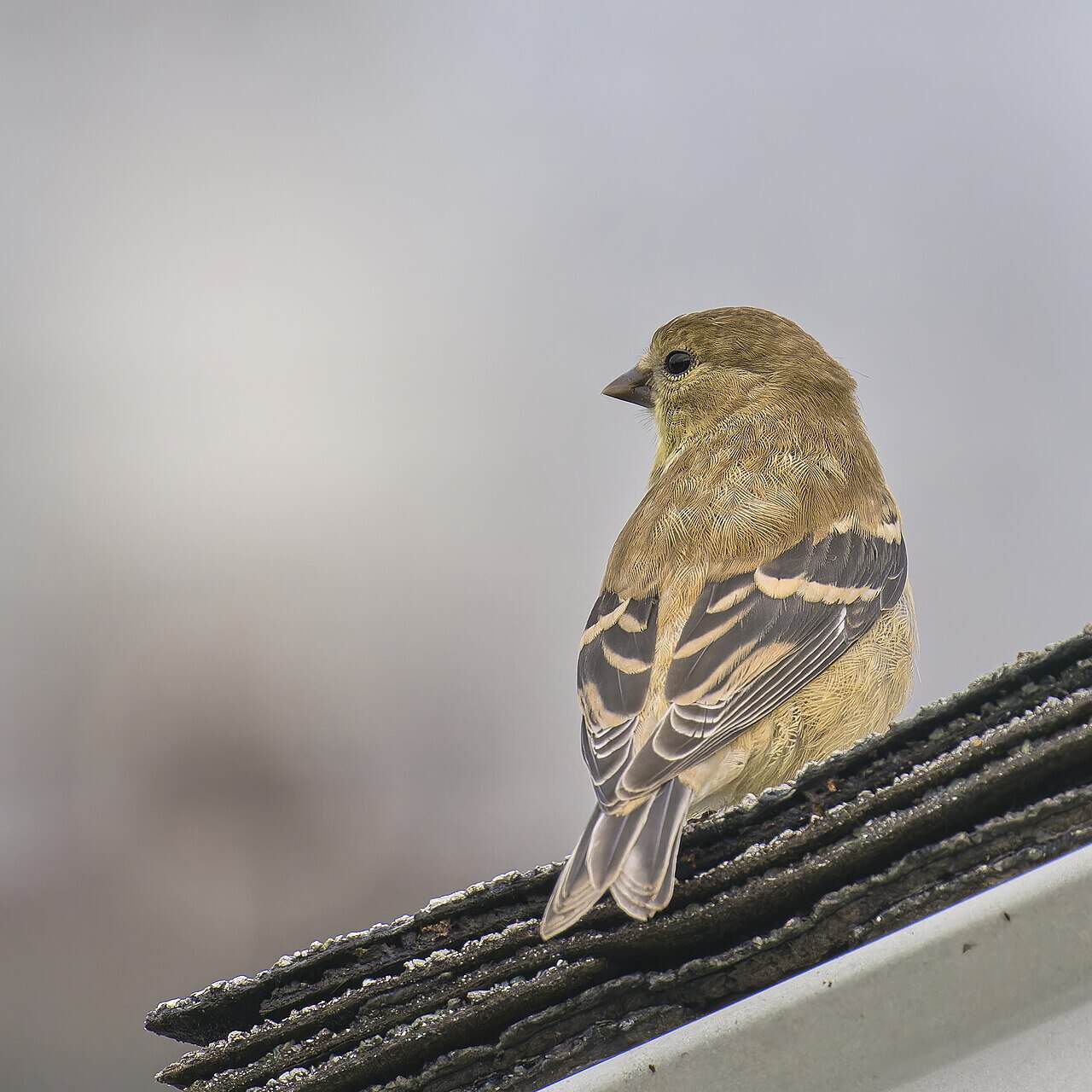
Female American Goldfinches are duller year-round, pale olive-yellow above, with grayer head and white belly with a hint of yellow. They have the same black wings as males but without the bright contrast.
Juvenile Goldfinches look similar to winter females, pale olive-brown with subtle yellow tones. They retain juvenile plumage through their first fall, then molt into adult plumage.
Size: American Goldfinches are 4.3-5.5 inches long, quite small. Smaller than House Finches (5.5 inches), comparable to chickadees in size.
Conspicuous vs Inconspicuous: The dramatic plumage difference between summer and winter creates a ‘two birds’ impression for new bird-watchers. Summer male Goldfinches are unmistakable, they’re often the brightest bird in the yard. Winter Goldfinches are duller and easy to overlook.
American Goldfinch vs Yellow Warbler: Sometimes confused. Yellow Warbler is similar size, but has a chestnut-streaked breast (not solid yellow), olive back (not black wings), and slimmer warbler-shaped bill (not the heavy conical finch bill). Yellow Warblers also occur only in summer in most of their range.
American Goldfinch Range and Habitat
American Goldfinches have one of the widest ranges of any North American finch, they breed across most of the United States and southern Canada. Some populations are year-round residents; others migrate seasonally.
Migration patterns: American Goldfinches show complex partial migration. Northern populations (Canada, northern US) migrate south for winter. Most populations across the lower 48 states are partial or non-migratory, they may shift slightly toward feeders during severe winter weather but don’t undertake long migrations.
Habitat: American Goldfinches prefer weedy fields, gardens with native flowers, parks, suburban yards with mature trees, woodland edges, and disturbed habitat with abundant seed-producing plants. They generally avoid dense forests and pure agricultural land.
Suburban adaptation: American Goldfinches have benefited from suburbanization and bird feeding. Wildflower gardens, neglected weedy lots, and the proliferation of nyjer (thistle) feeders have all supported Goldfinch populations.
Population stability: American Goldfinch populations have been relatively stable across their range over the past century. Some local declines due to habitat loss (loss of weedy fields to development), but the species is not threatened.
Year-round residence: Many American Goldfinches are year-round residents in their summer breeding areas. The same individual birds may visit your yard for years, though they look so different in summer vs winter that bird-watchers often don’t realize they’re the same individuals.
American Goldfinch Diet: Strict Vegetarians
American Goldfinches are remarkably specialized, they’re almost exclusively granivorous (seed-eaters), with seeds making up approximately 99% of their diet. This makes them one of the most specialized seed-eaters among North American songbirds.
Top seed choices: Native thistles (Cirsium and Carduus species), native asters, dandelions, sunflowers, native coneflowers, native goldenrods, birches, and grasses. Goldfinches show strong preferences for small, high-fat seeds.
Vegetarian breeding diet: Unique among most North American songbirds, American Goldfinches feed their NESTLINGS REGURGITATED SEEDS, not insects. Most other songbirds feed nestlings insects (protein-rich) during the rapid growth phase. Goldfinches are vegetarian even during breeding.
Brown-Headed Cowbird parasitism: The strict vegetarian diet makes American Goldfinches poor host species for Brown-Headed Cowbird parasitism. Cowbird chicks placed in Goldfinch nests typically starve because they can’t survive on seeds alone (cowbird chicks need insects). This is one of the few natural defenses against cowbird parasitism in North American songbirds.
At feeders: Top backyard feeder choices include nyjer (thistle) seed (universal Goldfinch favorite, they prefer it over almost any other seed), black oil sunflower seed, sunflower hearts, and millet. American Goldfinches use specialized ‘finch feeders’ with small ports designed for their small bills.
Feeding behavior: American Goldfinches feed in flocks. They cling to feeders and often feed upside-down, they’re remarkably agile. They prefer tube feeders with multiple ports allowing multiple birds to feed simultaneously.
American Goldfinch Behavior
American Goldfinches are social, vocal, and highly distinctive in their behavior.
Flock behavior: American Goldfinches form flocks year-round, with the largest flocks during fall and winter. Flocks of 20-100 birds are common at productive seed sources. They feed together, fly together (in distinctive ‘roller coaster’ undulating flight), and roost together.
Roller-coaster flight: American Goldfinches show a distinctive undulating flight pattern, alternating bursts of wing-beats with closed-wing glides. The undulating flight gives flying Goldfinches an unmistakable ‘roller-coaster’ appearance from a distance. The pattern is so distinctive that experienced birders can identify Goldfinch flights without seeing the birds clearly.
Late breeding: American Goldfinches breed remarkably LATE in summer, typically July through September. This is much later than most North American songbirds (which breed in spring). The timing coincides with peak availability of thistle seeds (essential for nestling food). The late breeding gives Goldfinch nestlings access to plentiful late-summer seed crops.
Vocalizations and identity: American Goldfinches have distinctive ‘po-ta-to-chip’ flight calls, repeated as they fly. Different individuals show subtly different calls. Goldfinches likely recognize each other by individual call patterns.
Lifespan: Wild American Goldfinches have been recorded surviving 10+ years. Average lifespan is 3-6 years for adults. First-year mortality is moderate (~40-50%), lower than many backyard birds because the late breeding gives juveniles time to mature before harsh winter weather. Major mortality factors: predation by Cooper’s Hawks (especially at feeders), outdoor cats, and severe winter weather.
American Goldfinch Breeding and Nesting
American Goldfinch breeding is unique among North American songbirds, they breed LATE in summer (July-September). This timing is unusual; most North American songbirds breed in spring.
Why so late: The late breeding timing coincides with peak availability of thistle and other small seeds that Goldfinches use to feed nestlings. The late timing also coincides with thistle ‘down’ (the fluffy fibers around thistle seeds), which Goldfinches use to line their nests.
Nest construction: Female American Goldfinches build nests with limited male help. Nests are cup-shaped, made of plant fibers, fine grasses, and lined extensively with thistle ‘down.’ The thistle down lining is so distinctive that experienced nest researchers can identify Goldfinch nests immediately by the white fluff in the lining.
Nest placement: Goldfinch nests are placed 4-25 feet above ground in dense vegetation, often in willows, alders, or other dense shrubs and small trees. They prefer locations near weedy fields or gardens where thistle and seed sources are abundant.
Eggs: Each clutch contains 4-6 eggs (typically 5). Goldfinch eggs are pale bluish-white. Incubation takes 12-14 days, performed entirely by the female. The male feeds the female during incubation.
Nestling period: Nestlings receive regurgitated seeds (vegetarian diet). They remain in the nest for 11-15 days. The vegetarian diet means slower nestling growth than most North American songbirds (which feed nestlings protein-rich insects).
Single brood: Most American Goldfinch pairs raise only ONE brood per year. The late breeding season combined with the short remaining time before winter leaves little time for a second brood. Some southern pairs may attempt a second brood if the first is destroyed early.
American Goldfinch Vocalizations
American Goldfinches produce distinctive vocalizations, easy to learn and helpful for identification.
Flight call: The signature ‘po-ta-to-chip!’ flight call, given as Goldfinches fly. Often described as ‘per-CHIK-or-ee.’ The repetitive flight calls help Goldfinches maintain flock cohesion during flight. Experienced birders can identify flying Goldfinches by sound alone.
Song: A long, twittering musical phrase given primarily during breeding season (June-September). The song is melodic and includes ‘po-ta-to-chip!’ phrases interspersed with longer twittering. Songs may last 5-10 seconds.
Singing period: American Goldfinches sing primarily during breeding season (June-September). Some quiet song occurs at other times of year.
Calls: Soft contact calls between flock members. Sharp alarm calls when threatened.
Female calls: Female Goldfinches also produce calls, though typically softer and less frequent than male songs. Mated pair communication uses soft, quiet vocalizations.
American Goldfinch Subspecies and Regional Variations
American Goldfinches are divided into four recognized subspecies across their range. Most variations are subtle.
Eastern American Goldfinch (S. t. tristis): The most familiar subspecies across the eastern US and adjacent Canada. Standard bright yellow summer plumage on males.
Western American Goldfinch (S. t. salicamans): Western US. Slightly different plumage shades, with subtle differences in song patterns.
Pale Goldfinch (S. t. pallida): Found in the central US Great Plains. Paler yellow than other subspecies.
Northwestern American Goldfinch (S. t. jewetti): Pacific Northwest. Slightly darker than other subspecies.
Other regional patterns: American Goldfinches in different regions sing slightly different songs and may have different migration patterns. The variations are most apparent comparing eastern vs western populations.
Climate adaptation: Birds in colder climates (Canada, northern US) tend to be slightly larger than southern birds, an example of Bergmann’s Rule.
How to Attract American Goldfinches to Your Backyard
American Goldfinches are reliably attracted to most yards. A few key strategies dramatically increase Goldfinch abundance.
1. Offer nyjer (thistle) seed in specialized tube feeders. The universal American Goldfinch attractant. Use feeders specifically designed for nyjer seed with small ports. Goldfinches LOVE nyjer; they may visit feeders 20+ times daily. Standard nyjer feeders accommodate multiple birds simultaneously.
2. Provide black oil sunflower seed. Universal favorite for most backyard birds. Goldfinches readily eat sunflower seeds, especially the smaller hulls or sunflower hearts.
3. Plant native thistles and weedy flowers. Native thistles (Cirsium species, NOT the invasive bull thistle), asters, coneflowers, native sunflowers, native goldenrods, and other seed-producing native flowers. These provide natural Goldfinch food and nesting materials (thistle down for nest lining).
4. Leave weedy patches in your yard if possible. American Goldfinches use weedy patches with native seed-producing plants. Letting parts of your yard ‘go wild’ (rather than maintaining tight lawns everywhere) supports Goldfinch food sources.
5. Provide a quality bird bath. American Goldfinches drink and bathe regularly. Use a shallow bath with reliable fresh water; add a heated bath in winter.
6. Maintain feeders year-round. American Goldfinches stay through winter in most of their range, they appreciate consistent winter food.
7. Plant native grasses. Native grasses produce seeds Goldfinches eat. Native sedges, switchgrass, and other native grasses support both Goldfinches and other wildlife.
8. Avoid pesticides. Pesticides reduce wild seeds and weed seeds that Goldfinches eat. Organic gardening supports Goldfinch food.
9. Manage outdoor cats. Outdoor cats kill many American Goldfinches. Keeping cats indoors substantially improves their survival.
10. Be patient with seasonal changes. American Goldfinches look dramatically different in summer (bright yellow males) vs winter (duller olive-brown). Many bird-watchers don’t recognize winter Goldfinches initially. The same individual birds may visit your yard year-round, despite the appearance change.
Related reading: American Goldfinch Symbolism.
Related reading: what do goldfinches eat.
Frequently Asked Questions
Why do American Goldfinches change color in fall?
American Goldfinches molt twice a year. The summer molt (April-May) produces brilliant breeding plumage, males become brilliant yellow with black caps and wings. The fall molt (September-October) produces drab winter plumage, males become olive-brown like females. The dramatic color change is part of their evolutionary strategy: bright colors attract mates during breeding, while drab colors provide camouflage during the rest of the year when energy is better spent on survival than territorial displays.
Why do American Goldfinches breed so late in summer?
American Goldfinches breed remarkably LATE, typically July through September, much later than most North American songbirds (which breed in spring). The late timing coincides with peak availability of thistle seeds and other small seeds that Goldfinches use to feed nestlings. Thistle ‘down’ (the fluffy fibers around thistle seeds) is also available for nest lining. The late breeding strategy gives Goldfinch nestlings access to plentiful late-summer seed crops.
Do American Goldfinches migrate?
American Goldfinches show complex partial migration. Northern populations (Canada, northern US) migrate south for winter. Most populations across the lower 48 states are partial or non-migratory, they may shift slightly toward feeders during severe winter weather. The same individual birds may visit your yard year-round in most of the US.
How do I attract American Goldfinches to my yard?
Provide nyjer (thistle) seed in specialized tube feeders with small ports. Plant native thistles, asters, coneflowers, native sunflowers. Leave some weedy patches if possible. Provide black oil sunflower seed as a secondary option. Goldfinches will typically discover your feeders within days and become reliable visitors. Maintain feeders year-round; Goldfinches stay through winter in most of the US.
Are American Goldfinches vegetarian?
Almost entirely yes, American Goldfinches are among the most strictly granivorous (seed-eating) North American songbirds. Seeds make up approximately 99% of their diet. Most remarkably, they feed their NESTLINGS regurgitated SEEDS (not insects), unlike most North American songbirds which feed nestlings protein-rich insects. This strict vegetarian diet is so unusual that it provides natural protection against Brown-Headed Cowbird parasitism, cowbird chicks placed in Goldfinch nests typically starve.
How long do American Goldfinches live?
Wild American Goldfinches have been recorded surviving 10+ years. Average lifespan for adults is 3-6 years. First-year mortality is moderate (~40-50%), lower than many backyard birds because the late breeding gives juveniles time to mature before harsh winter weather. Major mortality factors: predation by Cooper’s Hawks, outdoor cats, and severe winter weather.
What’s the difference between American and Lesser Goldfinch?
Both are small yellow-and-black finches but distinct species. American Goldfinch: bright yellow breeding males with BLACK CAP, black wings with white wing bars, range across most of the US. Lesser Goldfinch: smaller, found primarily in the western US (Mexico to southern Oregon), males have BLACK BACKS (rather than yellow). The two species sometimes share feeders in the western US. American Goldfinches are far more widespread.
Why do American Goldfinches fly in a roller-coaster pattern?
American Goldfinches show distinctive undulating flight, alternating bursts of wing-beats with closed-wing glides. The pattern is so characteristic that experienced birders can identify Goldfinch flights by sound and pattern alone. The undulating flight is energy-efficient: bursts of wing-beats provide lift, while glides save energy. The flight pattern is so common among finches that it’s called ‘finch flight’ in birding terminology.
More in this series: how to attract goldfinches.
Related reading: female goldfinch identification, types of finches.
Related reading: types of yellow birds.