White Peacock: Leucistic, Not Albino, and What One Costs
A white peacock is not a separate species and not an albino bird. It is an Indian peafowl (Pavo cristatus) with leucism, a genetic condition that strips pigment from the feathers while leaving the eyes blue and the skin normally colored. The famous train still carries the full eyespot pattern, but every barb of it is white.
White peafowl turn up in collections and hobby flocks far more often than in the wild, where a bird that bright rarely survives to breed.
White peacocks are leucistic Indian peafowl, not albinos and not a distinct species. A recessive gene removes feather pigment but leaves the eyes blue. Chicks hatch yellow and whiten with each molt. Captive birds sell for roughly 100 to 1,000 US dollars depending on age and sex.
| Trait | White Peacock |
|---|---|
| Species | Indian peafowl (Pavo cristatus) |
| Cause of color | Leucism, a recessive gene |
| Eye color | Blue, not pink or red |
| Chick color | Pale yellow, whitening with each molt |
| Adult male train | 5 to 6 ft (1.5 to 1.8 m), fully white |
| Price range | 100 to 1,000 US dollars |
| Lifespan | 15 to 20 years in captivity |
What Is a White Peacock?
A white peacock is a color variant of the Indian peafowl caused by leucism, a recessive gene that blocks pigment cells from reaching the growing feather. Because the gene is recessive, two normally colored parents that both carry it can produce white chicks, which is how breeders build white lines.
The difference from albinism matters. An albino bird lacks melanin everywhere and has pink eyes, while a leucistic peafowl keeps blue eyes and gray legs, which separates it from a true albino peacock. The structure that makes the peacock feather shimmer blue and green is still there, but with no pigment layer behind it there is nothing left to refract.
How Rare Is a White Peacock and What Is One Worth?
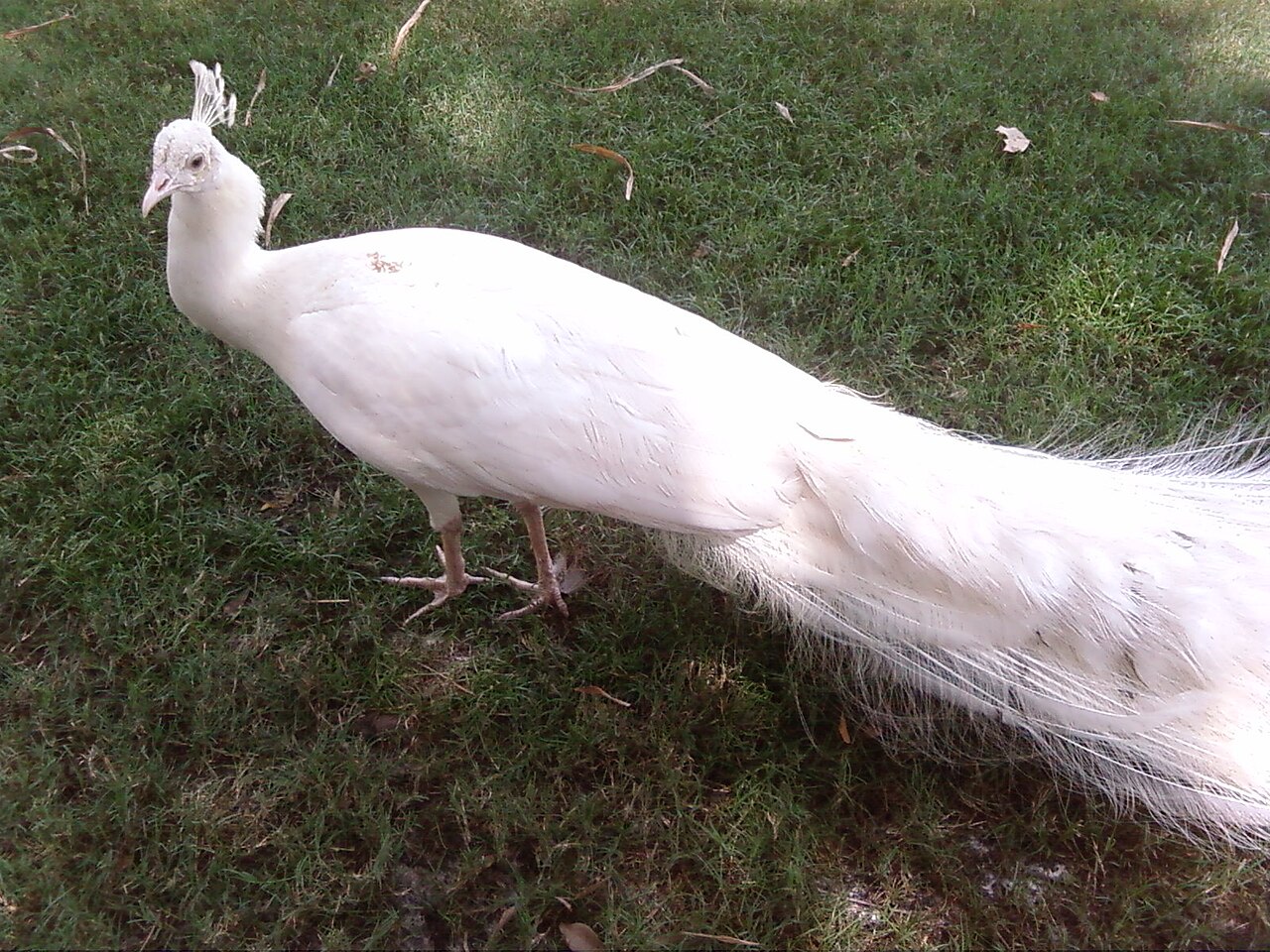
White peafowl are common in captivity and genuinely rare in the wild. Breeders have kept the trait going since the 19th century, so most US hobby flocks can source one, but a white bird in a wild Indian population stands out to every predator and seldom reaches adulthood.
Prices track age and sex more than color: chicks run 50 to 100 US dollars, yearlings 150 to 300, and a mature male with a full train 500 to 1,000. The rarest peafowl color is not white but the peach and opal varieties.
Is a White Peacock Male or Female?

Strictly, only the male is a peacock. The female is a peahen, and both sexes together are peafowl. In white birds the clue is the train: only adult males grow the long upper tail coverts, and they do not appear until the third year.
Before that, judge by size and posture. Males are taller with longer legs and a more upright neck, while peahens keep a shorter, rounded tail, a compact body and sparser crest feathers.
What Is the Rarest Color of a Peacock?

White is the best known color variant but not the rarest. Breeders recognize around 15 color mutations and 10 pattern varieties in Indian peafowl, and the scarcest are the peach, opal and midnight lines, which sell for several times the price of a white bird.
Two varieties are often mistaken for white. Pied birds carry white patches on colored plumage, and the silver pied is roughly 80 percent white with colored flecks. A true white peacock has no colored feathers anywhere.
Where Do White Peacocks Come From?
All white peafowl trace back to the wild Indian peafowl of India and Sri Lanka, where the species lives in open forest and farmland. Leucistic birds appear there occasionally, but almost every white peacock alive today comes from captive breeding lines in Europe and North America.
Free-ranging flocks exist in the US on ranches, estates and a few Florida and California neighborhoods, descended from escaped birds. They survive mild winters well and forage on insects, seeds and garden plants. A white peacock spotted in an American yard is a local escapee, not a wild bird.
What Does It Mean When You See a White Peacock?
In most traditions a white peacock symbolizes transformation and renewal, drawn from the way the bird sheds and regrows its entire train each year. The Hindu association of peafowl with Lakshmi adds prosperity, and white adds purity.
Sightings in the US almost always mean an escaped or free-ranging bird from a nearby property rather than anything mystical, since there is no wild population here. That is the same practical caveat we give for seeing a white owl, where a real bird is usually a local resident. For the biology behind the birds rather than the symbolism, the Smithsonian’s National Zoo keeps species profiles on peafowl and their relatives.
Frequently Asked Questions
How rare is a white peacock?
Rare in the wild, routine in captivity. The leucistic gene is recessive, so wild birds that show it are uncommon and get picked off by predators early. Breeders in the US and Europe have maintained white lines for over a century, which is why zoos display them reliably.
Is a white peacock an albino?
No. Albino birds lack melanin throughout the body and have pink or red eyes and pale skin. White peafowl are leucistic: pigment is missing from the feathers only, so the eyes stay blue and the legs stay gray. True albino peafowl exist but are far less common than white ones.
Can a peacock be a house pet?
Not indoors. Peafowl need a covered pen of at least 80 square feet per bird plus outdoor range, they roost high, and they are loud enough to strain neighbors. Many US municipalities regulate them as poultry. They do well on acreage, not in a yard.
How much is a white peacock worth?
Between 50 and 1,000 US dollars depending on age and sex. Chicks start around 50 to 100, yearlings run 150 to 300, and a mature male with a full train reaches 500 to 1,000. Breeding pairs cost more, and shipping live birds adds 100 to 200 dollars per order.
Is it safe to touch a peacock?
Hand-raised birds tolerate contact, but wild or free-ranging peafowl should be left alone. Males defend territory in spring and strike with spurred legs and a heavy beak, and any bird can carry salmonella. Feeding them by hand also teaches a flock to approach people, which causes most peafowl complaints.
Why do peacocks scream at night?
Males call at night mainly during the spring breeding season to advertise territory and locate rivals, and both sexes give alarm calls when a predator moves near the roost. The sound carries over a mile. Other white birds are quieter; compare the near-silent flight of white owls, which hunt by stealth instead. The name also confuses searchers with the white peacock butterfly, an unrelated insect of the southern US.