Barred Owl Sound: All 6 Calls and What They Mean
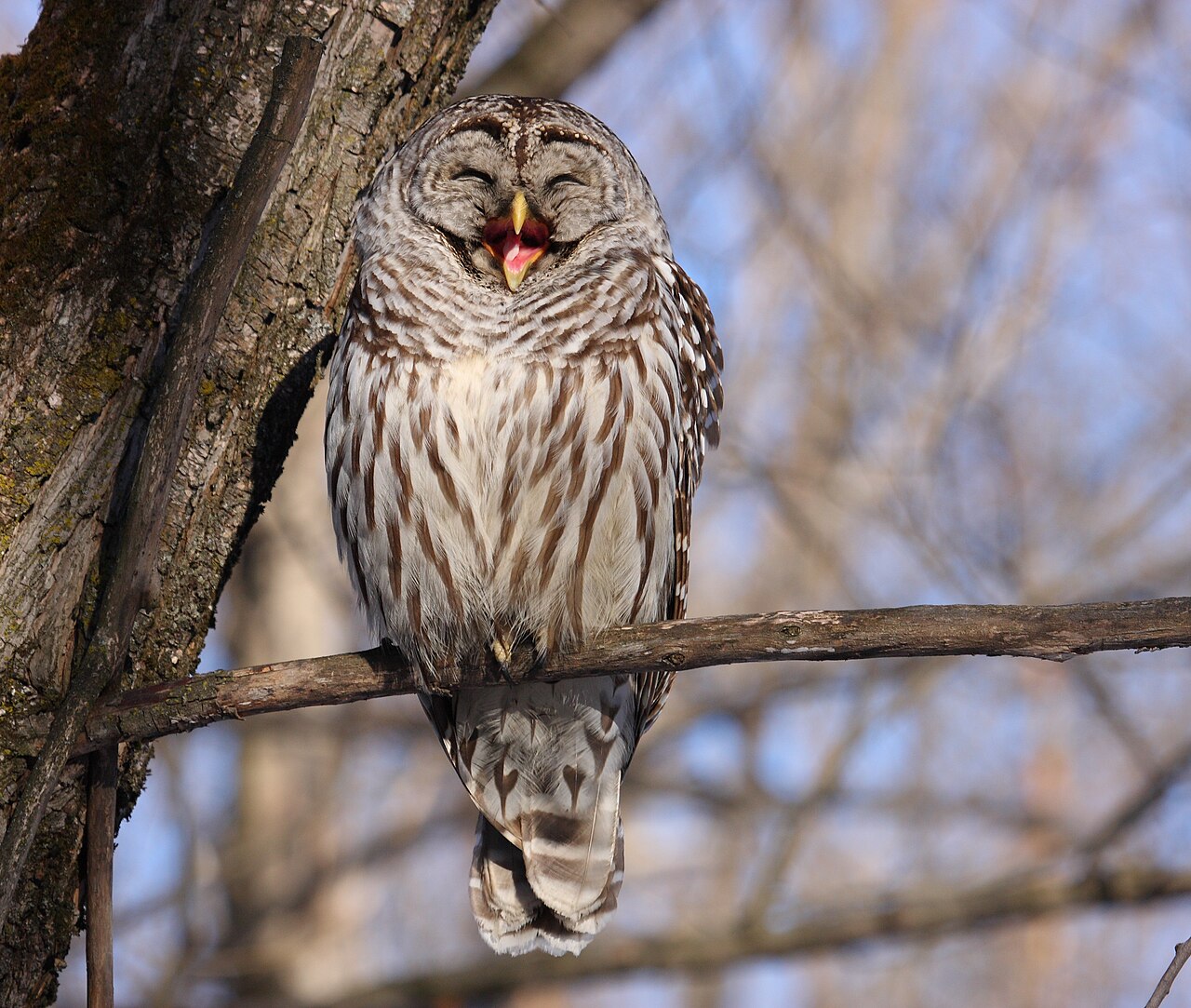
The barred owl sound most people know is a rhythmic eight note hoot that birders translate as “Who cooks for you? Who cooks for you all?” It is the loudest and most recognizable owl call in eastern North America, and it carries close to half a mile through wet woodland on a still night.
That hoot is only the opening. Barred Owls (Strix varia) also bark, gurgle, scream, and run wild duets that sound more like fighting monkeys than birds, and their fledged young produce a raspy shriek that gets reported as a woman screaming every summer. Knowing the whole range is what turns a strange noise in the dark into a named bird.
A barred owl sounds like a deep, rhythmic “Who cooks for you? Who cooks for you all?” with a drawn out final note that slides downward. The same bird also produces sharp barks, rising hoo-aah notes, and a wild gurgling duet called caterwauling that resembles screaming monkeys.
What Does a Barred Owl Sound Like?
A barred owl sounds deep, round, and unmistakably rhythmic. The pitch sits low enough to feel as much as hear, the notes are smooth rather than harsh, and the pattern repeats in a way no other North American owl matches. Once you have the cadence, identification takes about two seconds.
The repertoire runs well past the standard hoot. Single rising hoo-aah notes, short barking series, an ascending groan, hisses near the nest, and the extended vocal free for all of a mated pair all belong to this one species. Barred Owls are the most talkative large owls on the continent.
Context tells you which one you are hearing. Territorial hooting comes from a lone bird on a steady perch. Barking and gurgling mean two birds are interacting. A steady rasping shriek in July almost always means a hungry juvenile. For a broader comparison across species, our guide to owl calls lays them out side by side.
| Sound | Description | Who Makes It | Season |
|---|---|---|---|
| Eight note hoot | Who cooks for you, who cooks for you all | Both sexes, males lower | Year round, peak February to April |
| Hoo-aah | Single note rising then falling away | Either bird, often as a reply | Year round |
| Barking series | Four to eight fast, dry hoots | Agitated adult | Any time, often at intruders |
| Caterwauling | Gurgles, cackles, screams in a duet | Mated pair together | Courtship and territory disputes |
| Begging shriek | Rasping, drawn out scream | Fledged juveniles | June through September |
| Hiss and bill snap | Sharp crack and air hiss | Threatened adult or nestling | Nesting season |
Who Cooks for You: The Classic Eight Note Call
The territorial song is built from two phrases of four notes each, and the mnemonic fits the rhythm almost perfectly. The first phrase lands as “who cooks for you,” the second as “who cooks for you all,” and the final syllable drags out into a falling aaawww that no other owl adds. That trailing note is the single best field mark in the whole call.
Males and females both sing it, and pairs answer each other back and forth across a territory. The male’s voice is noticeably lower and fuller; the female’s is higher and slightly rougher. Hearing two birds trade the phrase at different pitches usually means you are listening to an established pair rather than a wandering single.
The delivery stays remarkably consistent. Barred Owls almost never rush or shorten the pattern, which is why the call functions so well as a long distance territory marker. Our dedicated breakdown of the who cooks for you call covers the note by note timing in more detail.
What Is Barred Owl Caterwauling?
Caterwauling is the name for the extended, chaotic duet a Barred Owl pair performs together, and it is the strangest sound in North American owl biology. It mixes gurgles, cackles, whoops, rising screams, and notes that break into something close to laughter, with both birds overlapping for anywhere from ten seconds to several minutes.
People who hear it for the first time rarely guess owl. The most common reports are monkeys, coyotes fighting, or two people yelling in the woods. The resemblance to primates is close enough that the sound is widely nicknamed the monkey call, and recordings of it circulate every year as unexplained forest noise.
It serves two purposes. Pairs caterwaul during courtship and pair bonding, especially in late winter, and they also use it in territorial confrontations when a neighboring pair pushes too close to a boundary. Either way it means two or more owls are in the same patch of woods and taking each other seriously.
Juvenile Begging Calls and Other Barred Owl Noises

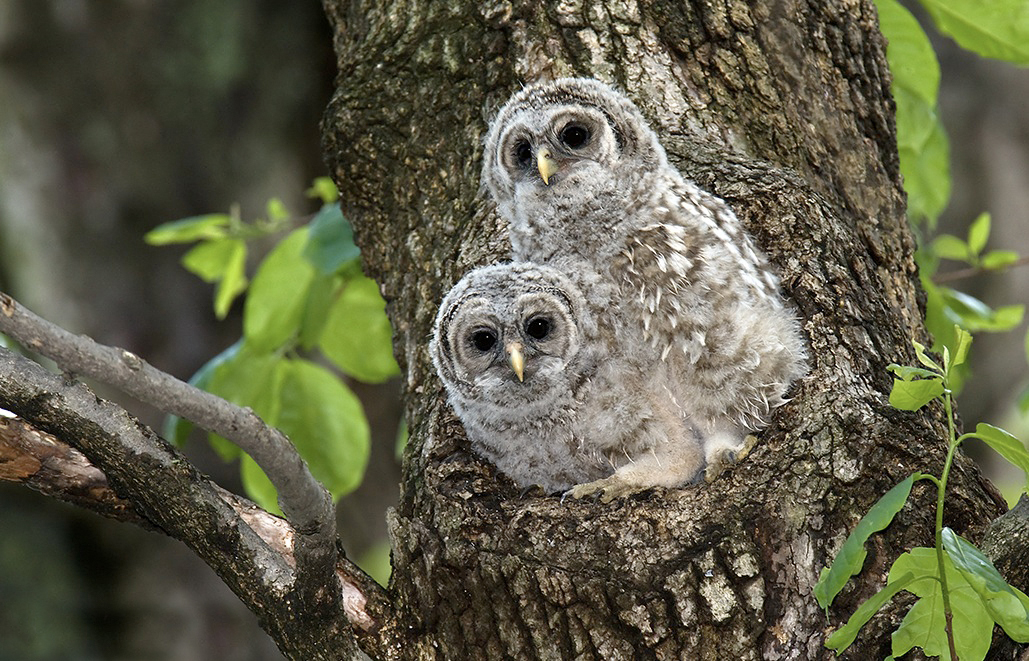
Young Barred Owls leave the nest well before they can fly properly and spend weeks climbing and perching while their parents keep feeding them. Throughout that period they give a rasping, drawn out shriek every few minutes, a sound with almost no owl quality to it at all.
This is the call behind most summer reports of a woman screaming or an animal in distress in eastern woodlands. It runs from roughly June into September, gets more insistent as the young grow, and often continues most of the night. It is a normal, healthy sound and not a sign that anything is wrong.
Adults add several shorter noises that rarely get attributed correctly. A dry bill snap warns an intruder off, a hiss accompanies a defensive posture, and a soft ascending groan passes between mates at close range. Compare the trembling descending whinny in our guide to eastern screech owl sounds, which is a completely different kind of night call.
When Barred Owls Are Most Vocal

Barred Owls call all year, but the volume rises sharply from February through April when pairs are courting, renewing bonds, and defending nest sites. A second peak arrives in late summer and fall as that year’s young disperse and start testing territories of their own, which forces resident adults to answer.
Within a night, the first hour after sunset and the hour before dawn produce the most calling. Activity does not stop in between, and a pair will often strike up around midnight for no obvious reason. Wet, still, overcast nights are the best listening conditions; wind is what actually shuts them down.
Daytime calling is normal for this species and sets it apart from most owls. Barred Owls hoot in broad daylight fairly regularly, especially on dark overcast days and when Blue Jays or crows mob a roosting bird into answering.
What Does It Mean to Hear a Barred Owl at Night?
Biologically, it means a Barred Owl is holding territory within earshot, and in most of the eastern United States that is an ordinary thing to have in your neighborhood. The species does well in mature woodland with water nearby and has adapted comfortably to wooded suburbs, golf courses, and parks.
Repeated calling from the same direction night after night indicates a resident pair rather than a passing bird. Calling that moves around, or that triggers barking and caterwauling responses, usually means a young bird is probing an occupied territory and being told to leave.
Culturally, owl calls at night carry heavy symbolic weight in many traditions, ranging from warnings and death omens to wisdom and protection. Those readings belong to folklore rather than biology. What the bird is actually announcing is a boundary. Our overview of the barred owl covers the habitat side of why one has settled near you.
What Does It Mean When an Owl Is Hooting Outside Your House?
An owl hooting outside your house usually means your property sits inside or on the edge of its territory, and the perch it has chosen is simply a good one. Tall trees near open lawn, roof edges, and utility poles all give an owl a clear view of ground where rodents move, and houses tend to have all three.
Yards that host owls generally share a few features: mature trees, a brush pile or unmown edge that holds mice and voles, water within a few hundred yards, and outdoor lighting that concentrates insects and the small animals that follow them. None of that means the bird has singled you out.
If the calling is unwelcome, the practical fix is habitat rather than harassment. Reducing rodent cover near the house and switching off unnecessary outdoor lights lowers the hunting value of the yard. Note that all owls in the United States are protected under the Migratory Bird Treaty Act, so trapping, harming, or disturbing nests is illegal.
Are Barred Owls Aggressive?
Barred Owls are among the more assertive North American owls toward people, though attacks remain rare and are concentrated in a narrow window. Nearly all incidents involve birds defending an active nest or recently fledged young, and they take the form of a fast silent strike at the head from behind, usually with talons grazing the scalp.
Well documented cases exist, including a stretch of repeated strikes on joggers in a park in Salem, Oregon, that made national news. Runners and cyclists moving quickly through wooded trails at dusk account for most reports, probably because rapid movement triggers a defensive response.
Avoidance is straightforward. If an owl strikes once, leave the area rather than looking for it, and take a different route for a few weeks until the young have dispersed. Wearing a hat or waving a raised arm overhead while walking through a known spot is enough in practice.
Can a Barred Owl Pick Up a 10 lb Cat?
No. An adult Barred Owl weighs roughly 1 to 2.3 lb (470 to 1050 g), and raptors generally cannot carry much beyond their own body weight in flight. A 10 lb (4.5 kg) cat is four to ten times heavier than the owl attempting to lift it, and the physics simply do not allow it.
That is not the same as saying cats are safe. A Barred Owl can strike, injure, or kill an animal it cannot carry, and kittens and very small cats are within range as actual prey. Great Horned Owls, which are substantially larger and stronger, account for most verified owl attacks on pets.
Normal Barred Owl diet is much smaller. Voles, mice, shrews, squirrels, rabbits, small birds, frogs, and a surprising amount of crayfish make up most of it. Birds that eat enough crayfish sometimes develop a pink wash on the underparts from the pigments. Keeping cats indoors after dark removes the risk entirely.
How to Tell a Barred Owl From Other Night Sounds
The Great Horned Owl is the main confusion, and rhythm separates them cleanly. Great Horned Owls give four to five slow, evenly spaced hoots with no rhythmic phrasing and no trailing note. Barred Owls give eight notes in two clear groups with a falling tail. Our guide to great horned owl calls has the full comparison.
The screaming sounds cause the other half of the confusion. A Barn Owl produces a long harsh rasp with no melody, a red fox gives a short sharp scream in winter, and a bobcat yowls with a distinctly feline quality that carries much further than people expect. Our guide to bobcat sounds covers the calls most often mistaken for a person screaming.
When in doubt, count and listen for the ending. Eight notes plus a falling aaawww is a Barred Owl every time, and no other species in the region produces the caterwauling duet. Reference recordings of every call described here are available from the Cornell Lab at All About Birds.
Related reading: Western Screech Owl Sound.
Related reading: Snowy Owl Sounds.
Frequently Asked Questions
What is an owl’s worst enemy?
For a Barred Owl, the Great Horned Owl. It is larger, more powerful, and a documented predator of Barred Owls, and it will drive them out of otherwise suitable woodland or kill them outright. Barred Owls go quiet and relocate when a Great Horned Owl moves into their territory.
What does it mean if a barred owl visits you?
Ecologically it means your property offers a good perch and reliable prey, nothing more. Various cultural traditions read an owl visit as an omen, a warning, or a message, and those readings vary widely by tradition. The bird’s own motive is hunting and territory.
Do barred owls go after cats?
Occasionally, but rarely. Kittens and very small cats fall within the prey range, and an owl may strike a larger cat it cannot carry. Most owl attacks on pets involve Great Horned Owls. Keeping cats indoors from dusk to dawn eliminates the risk and protects local birds at the same time.
Do barred owls call during the day?
Yes, more often than most owls. Daytime hooting is normal for the species, particularly on dark overcast days, during the late winter courtship peak, and when crows or jays discover a roosting bird and mob it until it answers.
Why does a barred owl sound like a monkey?
The caterwauling duet between a mated pair mixes gurgles, whoops, cackles, and rising screams at a tempo and pitch range that closely resembles primate calls. The overlap of two birds vocalizing at once adds to the effect. It signals courtship or a territorial dispute, not distress.
Can you call a barred owl in by imitating the hoot?
Often, yes. Barred Owls respond readily to a decent imitation of the eight note phrase and will approach to investigate. Use it sparingly. Repeated calling pulls birds away from hunting and into needless territorial displays, and it is discouraged or prohibited in many parks and refuges.