Red Lizard: 8 US Species and Which One Is Venomous
A red lizard in the United States is almost always one of eight animals: an African redhead agama, a Gila monster, a desert spiny lizard, a chuckwalla, a broad-headed skink, a crevice spiny lizard, an escaped red tegu, or a captive-bred red bearded dragon. Only one of them, the Gila monster, is venomous. Everything else on that list is harmless to people and useful in a yard.
Red is rarely the whole animal. In most species the color sits on the head, the throat, the flanks, or a saddle across the back, and it often appears only in adult males during the breeding season. That is why the same lizard can look brick red in April and dull gray in September, and why size, region, and body shape settle an identification faster than color alone. One note for searchers: the red lizard of the game Rain World is not an animal, and the creature below has nothing to do with it.
Most red lizards in the US are harmless. The African redhead agama, desert spiny lizard, chuckwalla, broad-headed skink, and crevice spiny lizard all carry red or orange and cannot hurt you. The only venomous red lizard is the Gila monster, a pink and black banded desert species that bites only when handled.
| Species | Length | Where the red is | Region | Dangerous? |
|---|---|---|---|---|
| African redhead agama | 10 to 15 in | Head and tail, males | South Florida | No |
| Gila monster | 18 to 22 in | Pink to salmon bands | AZ, NV, UT, NM, CA | Venomous |
| Desert spiny lizard | 7 to 12 in | Rusty saddle, sides | Southwest deserts | No |
| Common chuckwalla | 11 to 16 in | Body and tail, males | Mojave, Sonoran | No |
| Broad-headed skink | 6 to 13 in | Head only, spring males | Southeast | No |
| Crevice spiny lizard | 4 to 11 in | Whole back, orange red | West Texas, NM | No |
| Red tegu | 30 to 54 in | Flanks and head | Escaped pets, FL | Bites hard |
Are red lizards dangerous?
With one exception, no. Of roughly 100 native lizard species in the United States, exactly one is venomous: the Gila monster. No skink, no spiny lizard, no agama, and no anole carries venom, and the old folk belief that bright skinks are poisonous has no basis. Skinks are eaten by hawks, snakes, and house cats without harm.
A red lizard bite from a harmless species breaks skin at worst. Larger animals bite harder: a cornered chuckwalla or an adult tegu can draw blood and leave a wound that needs cleaning. The real health concern with any lizard is Salmonella, which healthy reptiles carry in their gut and shed in feces. Wash hands after contact, and keep reptiles away from food surfaces and from children under five.
Color is not a warning signal in US lizards the way it is in some snakes. A bright red head on a skink means a male in breeding condition, nothing more. Red and black banding in snakes is a different matter entirely, and the rules for reading it are set out in red and black snake identification.
Gila Monster: The One Red Lizard to Leave Alone
The Gila monster (Heloderma suspectum) is a heavy-bodied desert lizard of 18 to 22 in with a blunt head, a thick tail, and beadlike scales in pink, salmon, or orange bands across a black ground color. Hatchlings are the brightest. It lives in Arizona, southwestern Utah, southern Nevada, southwestern New Mexico, and a thin strip of southeastern California.
Venom glands sit in the lower jaw, and the animal has to chew to work venom into a wound. Bites are extremely rare and almost never happen to anyone who was not holding the lizard. They are painful and cause swelling and a sharp drop in blood pressure, but no verified modern human death exists. Gila monsters are protected by state law across their range, so handling or collecting one is illegal.
Behavior gives it away long before color does. A Gila monster walks slowly with a side-to-side gait and spends more than 90 percent of its life in burrows, surfacing mainly in spring mornings. No other red lizard in the US moves that way.
What Makes a Lizard Red
Red and orange in lizard skin come from carotenoid and pteridine pigments held in cells called erythrophores, stacked under the outer skin layer. Diet supplies some of the carotenoids, so a wild lizard eating pigment-rich insects and plants can show stronger color than a captive on a plain feeder diet. What the animal eats matters, and the range of that diet is covered in what lizards eat.
Hormones control the timing. Testosterone rising in spring switches on display color in males of many species, which is why a broad-headed skink head goes from brown to blazing orange in six to eight weeks and fades again by midsummer. Rock color plays a part too: desert populations on red sandstone are often redder than populations of the same species on gray granite, because predators remove the mismatched individuals.
African Redhead Agama (Agama picticauda)
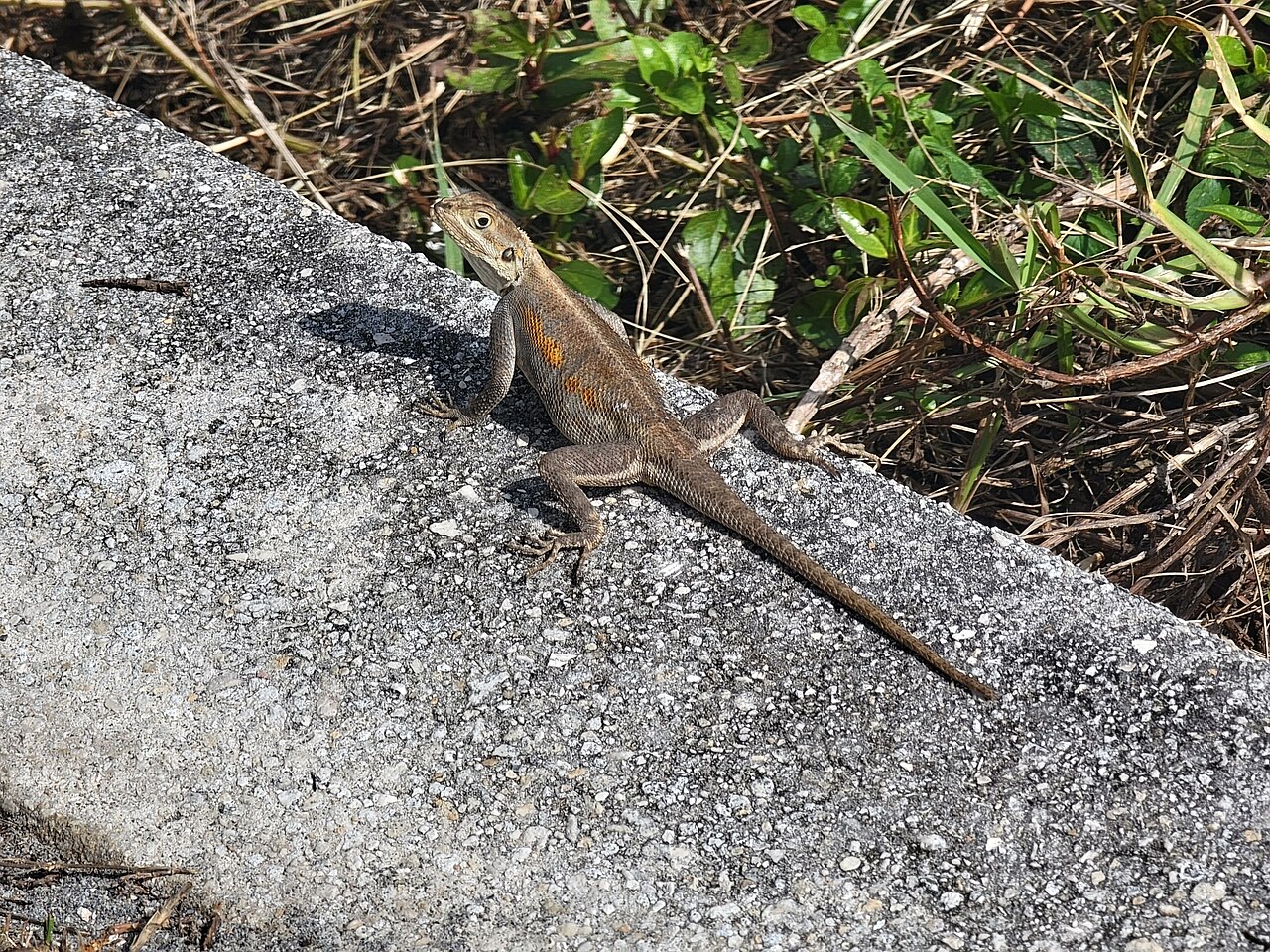
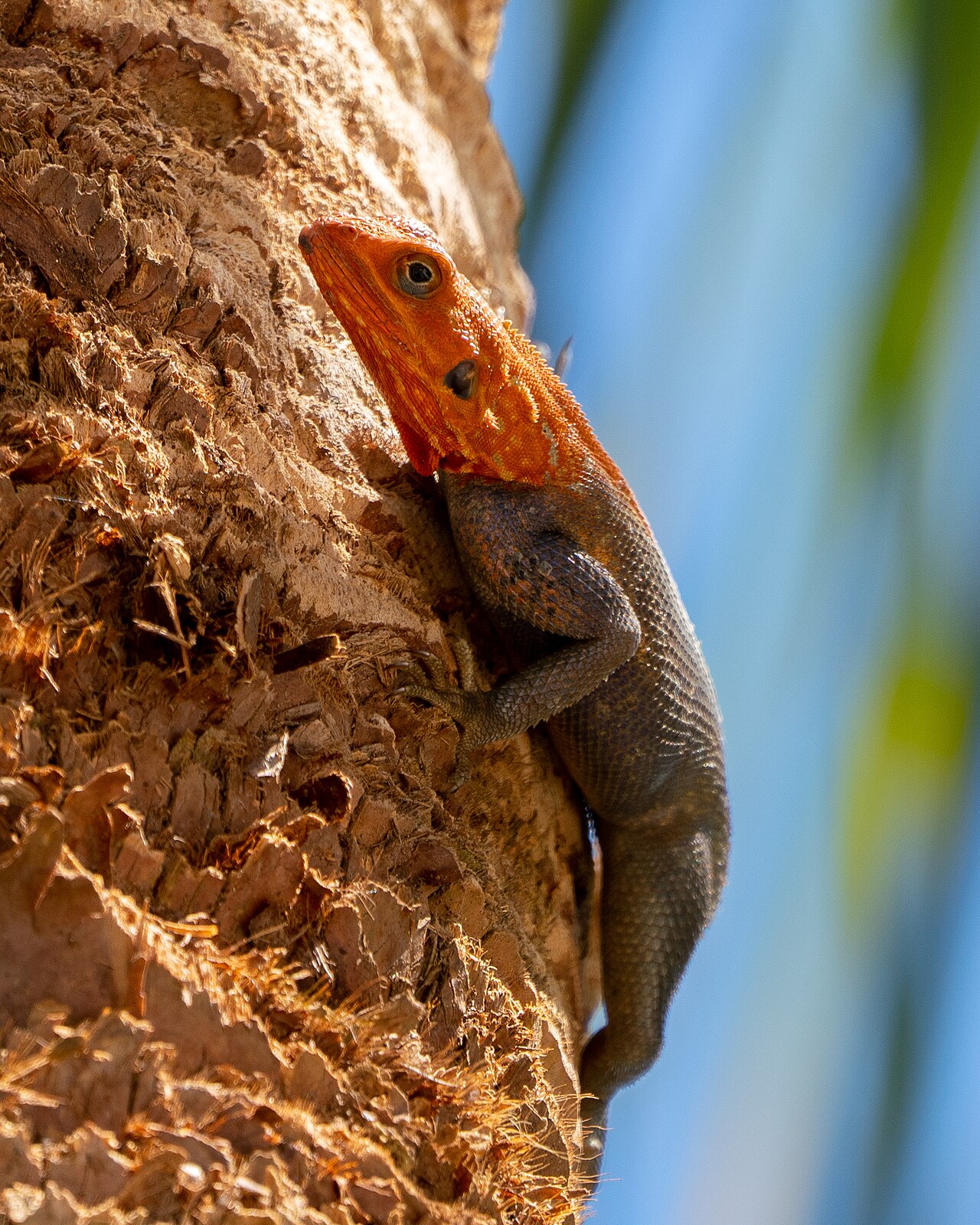
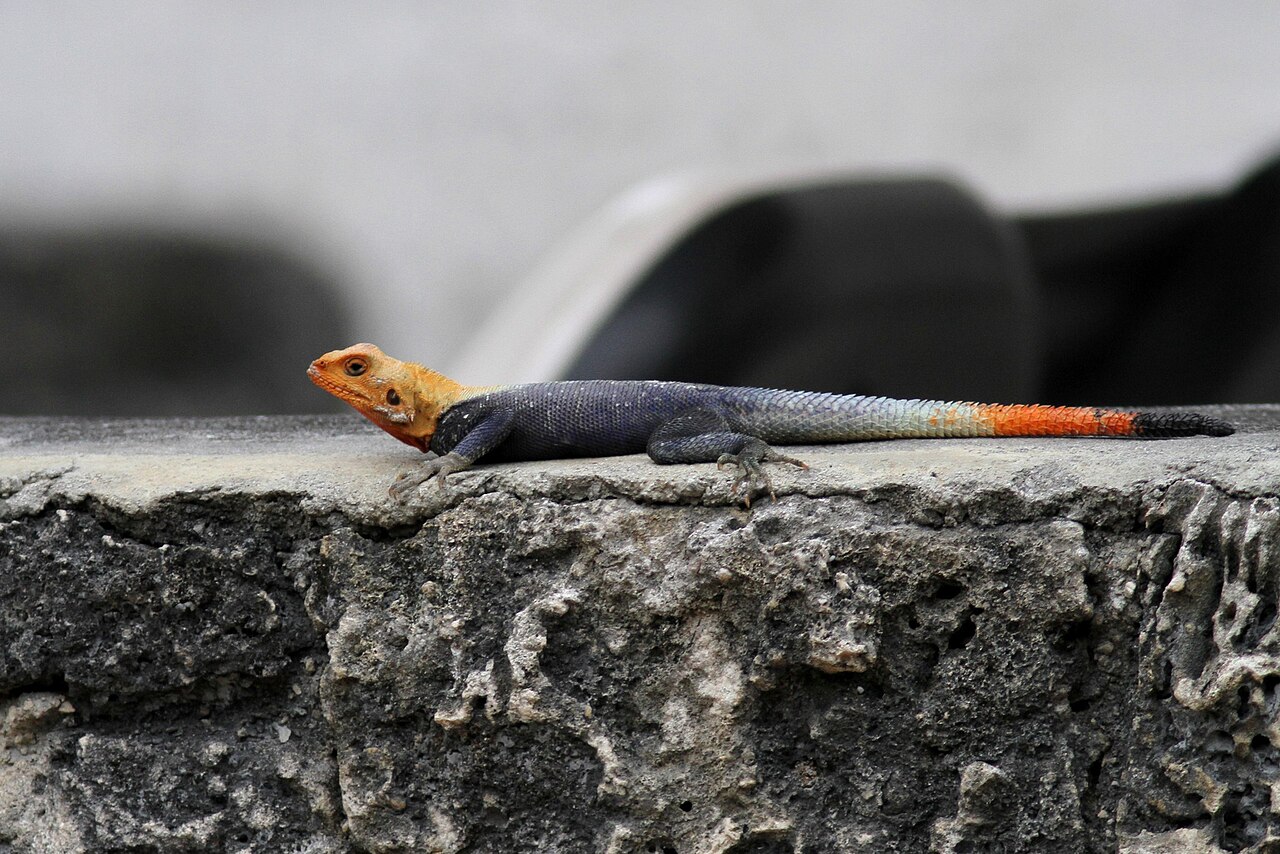
This is the lizard most Floridians mean by red lizard. Males run 10 to 15 in with a brilliant orange red head and tail set against a blue black body, and they display on walls, rock piles, and parking lot curbs with sharp head bobs. Females and juveniles are drab brown with faint spotting and look like a different animal.
The species is African and has been established in Florida since the 1970s, now spread through Miami-Dade, Broward, Monroe, and parts of the Gulf coast. It is diurnal, insect eating, fast, and extremely wary, typically fleeing at 20 ft. Introduced reptile distributions are tracked by the U.S. Geological Survey alongside state wildlife agencies.
Are red-headed agamas aggressive? Toward each other, yes. Males fight over display perches and chase rivals constantly. Toward people they are not aggressive at all and will not approach; a bite only happens to someone who has one in hand.
Red Tegu (Salvator rufescens)
The red tegu is a South American lizard from Argentina, Paraguay, and Bolivia that reaches 30 to 54 in and 15 to 20 lbs, with rusty red flanks and head on mature males. It is not native anywhere in the US and any animal seen loose is an escaped or released pet. Its relative the Argentine black and white tegu is the one that has built established breeding populations in Florida and Georgia.
Tegus are omnivores that dig, and the reason wildlife agencies care is nest predation: they eat the eggs of gopher tortoises, American alligators, and ground-nesting birds. Florida listed tegus as a prohibited species in 2021, which is the short answer to why tegus are illegal there. Existing pets could be kept under permit, but new acquisition and breeding stopped.
Can red tegus be kept as pets? In many states yes, with the right enclosure, but the commitment is real: a 6 by 3 ft floor space minimum, 15 to 20 years of life, and a daily feeding routine. Captive bred red tegus usually cost 300 to 600 USD, with high-color bloodlines well above that. They tame readily, recognize their keeper, and often tolerate handling, which is what people mean when they ask whether tegus bond with humans. Calling them as intelligent as dogs overstates it; they are trainable and curious, with problem solving closer to a clever bird.
Red Morph Bearded Dragon (Pogona vitticeps)
Nearly every red lizard offered in a US pet store is a red morph bearded dragon, a selectively bred color line of the central bearded dragon from Australia. Adults reach 16 to 24 in including tail, with color ranging from dull brick to near blood red in the lines sold as red or hypo red.
Bearded dragons are the standard beginner reptile for good reason: they are slow, diurnal, tolerant of handling, and visibly communicative. They also run on a narrow set of requirements, including UVB lighting, a basking surface near 100 F (38 C), and a varied insect and greens diet. They are quieter than most pets, though not silent, and the noises they do make are explained in bearded dragon sounds.
Desert Spiny Lizard (Sceloporus magister)
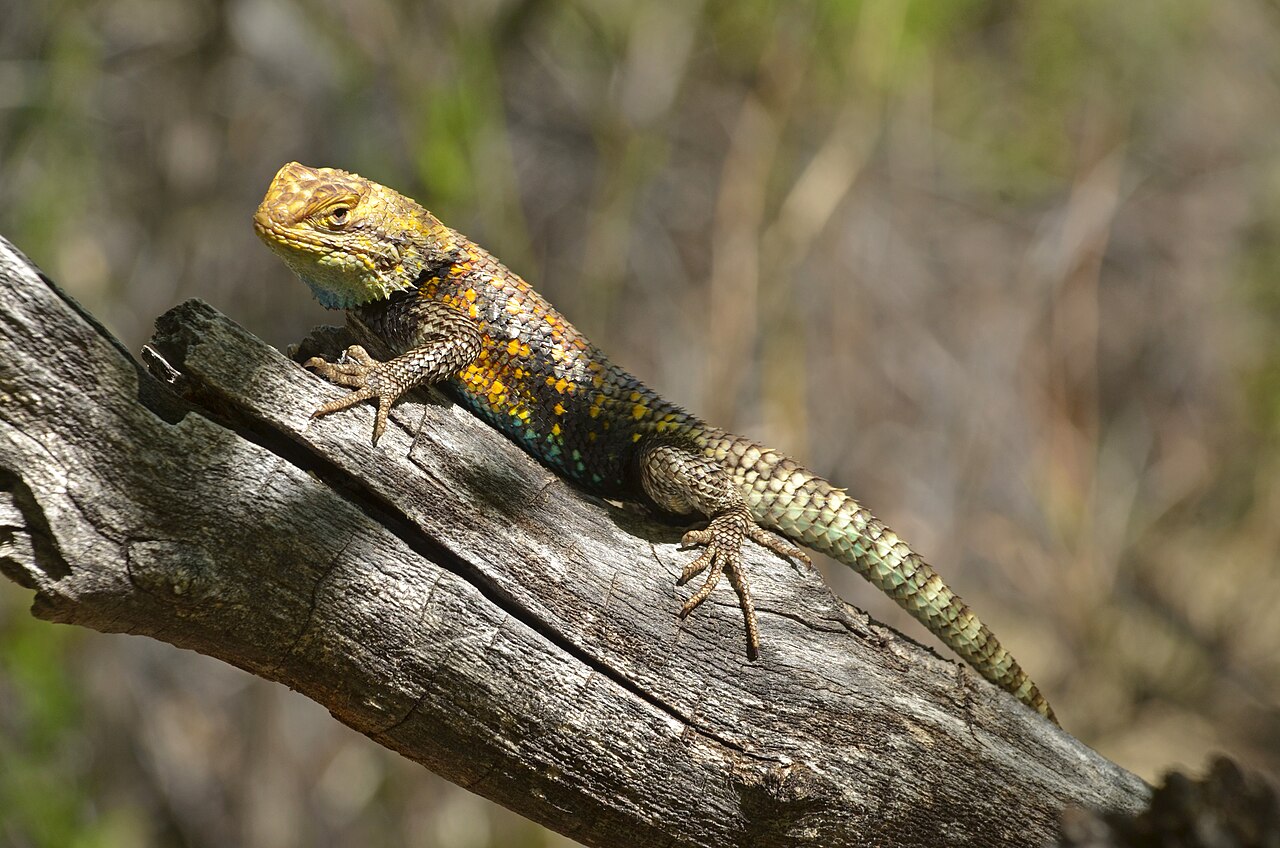
At 7 to 12 in total length, the desert spiny lizard is the red lizard most hikers in Arizona and Nevada actually meet. Adults are yellow brown to coppery with keeled, pointed scales that look like armor and a rusty purple saddle across the shoulders. Breeding males add blue throat and belly patches.
It climbs mesquite, cottonwood, rock piles, and the sides of buildings, and it is active in the hottest part of the morning when most lizards have moved into shade. The species ranges across the Sonoran and Mojave deserts into Texas, Utah, and southern California. It is harmless, insect eating, and will flee into a crevice long before you get close.
Common Chuckwalla (Sauromalus ater)
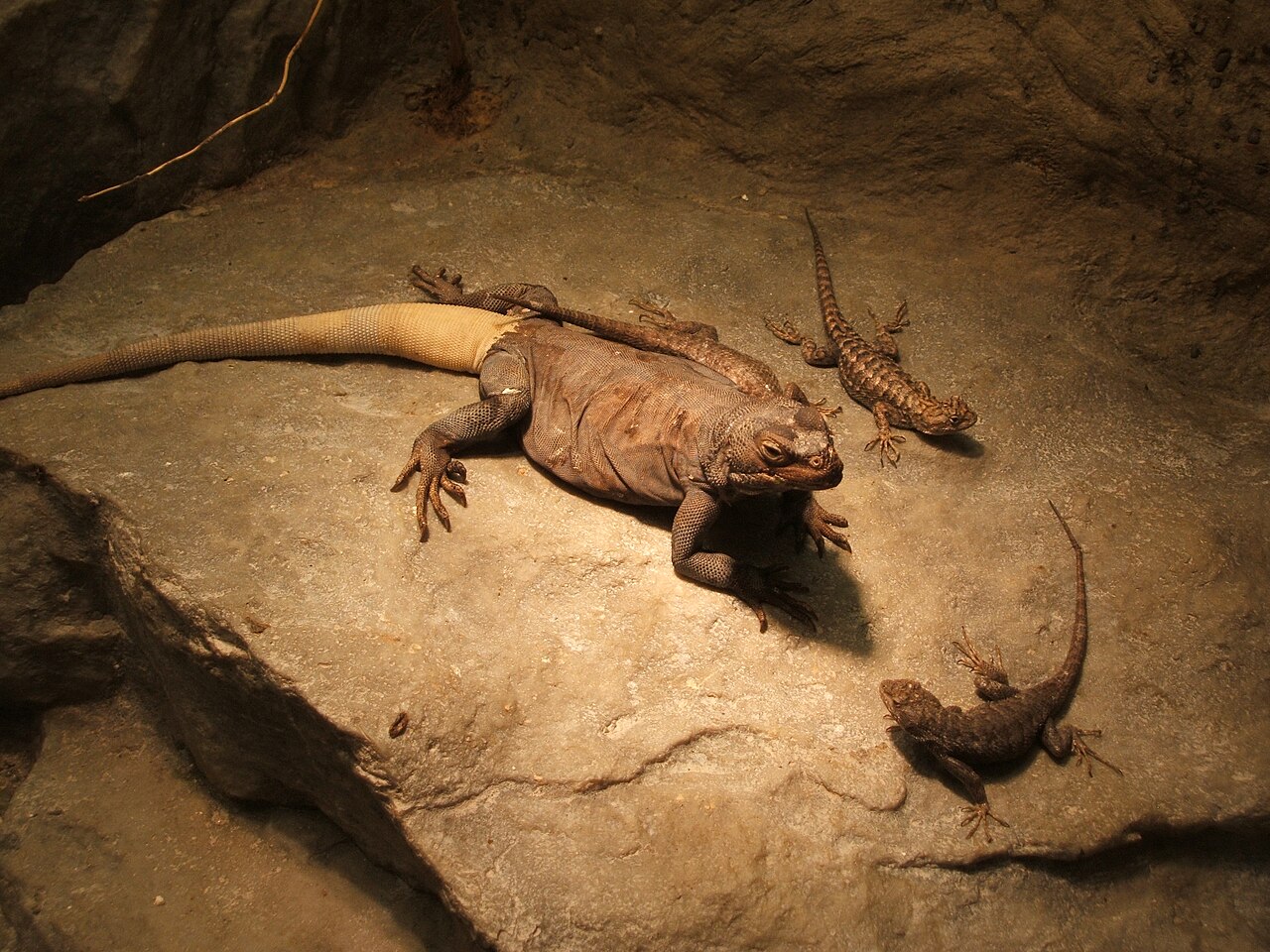
Chuckwallas are flat, loose-skinned, pot-bellied lizards of 11 to 16 in, and in parts of the Mojave and western Arizona adult males carry brick red to orange bodies with a pale tail. They are strictly herbivorous, eating flowers, leaves, and fruit, which makes them one of the few US lizards you will never see chasing an insect.
The signature behavior is defensive, not aggressive. A threatened chuckwalla wedges itself into a rock crack and inflates its lungs until it cannot be pulled out. They need boulder fields with deep horizontal cracks, which is why they appear only in specific rocky habitat and never on open flats.
Broad-Headed Skink (Plestiodon laticeps)
In the Southeast, the red lizard on a tree trunk in April is usually a male broad-headed skink. Breeding males grow to 13 in with a swollen jaw and a bright orange red head on an olive brown body; females keep faint stripes, and juveniles have five pale lines and a blue tail.
These are the largest skinks in the eastern US and they climb, often living in oak cavities 20 ft or more above ground. They are harmless despite the regional nickname scorpion, which attaches to several southeastern skinks and is pure folklore. For the other end of the skink color range, see blue lizard identification.
Crevice Spiny Lizard (Sceloporus poinsettii)
The crevice spiny lizard of west Texas, southern New Mexico, and northern Mexico is the most evenly red lizard native to the US. Adults reach 4 to 11 in, with a rusty orange to pinkish body, a sharp black collar behind the head, and a banded tail that reads like a raccoon’s at a distance.
True to the name, it lives in limestone outcrops and canyon walls and rarely strays more than a few feet from a crack. It bears live young rather than laying eggs, which is unusual among North American spiny lizards. Completely harmless, and worth looking for on Hill Country rock faces in the morning.
Red Lizard Lookalikes: Telling Two Species Apart
Four pairs cause most of the confusion. Use scale texture and where the red sits rather than overall tone, because light and season shift tone constantly.
| Feature | Gila monster | Crevice spiny lizard |
|---|---|---|
| Scales | Beadlike, not overlapping | Keeled, pointed, overlapping |
| Pattern | Pink bands on black | Orange body, one black collar |
| Build | Heavy, thick tail, blunt head | Flat, slim tail, narrow head |
| Movement | Slow waddle | Fast dash into crack |
| Range overlap | AZ, NV, UT, NM | West TX, southern NM |
The other pairs are simpler. A redhead agama has red only on the head and tail with a dark body, while a broad-headed skink has red only on the head with a smooth, glossy, stripeless body and never occurs in the same states. A desert spiny lizard shows rough armored scales and a saddle, while a red tegu is three to five times longer with a thick neck and beaded skin. For purple tinged animals that get called red in poor light, compare purple lizard identification.
Small Red Lizards in the Yard, and Keeping One
Small red lizards around a house, roughly 3 to 6 in, are usually juveniles or females rather than a separate species. In Florida that means young agamas and brown anoles with a reddish wash; in the Southwest, hatchling spiny lizards and side-blotched lizards with rusty flanks. None of them damage property, and all of them eat crickets, roaches, ants, and spiders, so leaving them alone is the cheapest pest control available.
Keeping a wild one is the wrong move. Native lizards are protected in most states, Gila monsters absolutely so, and wild caught animals carry parasites and almost never settle in captivity. If you want a red lizard at home, a captive bred red bearded dragon or a legally sourced tegu is the honest route. A red lizard spotted outside is better recorded than collected, the same way bright birds are, as with birds with red heads.
Frequently Asked Questions
What is the rarest lizard color?
Among wild lizards, true blue is the rarest body color, because blue comes from light scattering rather than pigment and appears in only a handful of species. In captive breeding, solid white and lavender morphs are the scarcest and most expensive. Red is comparatively common, appearing in agamas, spiny lizards, skinks, and chuckwallas.
What is the most toxic lizard on Earth?
By venom potency the Mexican beaded lizard and the Gila monster lead the list, both members of the genus Heloderma. The Gila monster is the only one that reaches the United States. Komodo dragons and some monitors have mildly venomous saliva, but their danger comes from size and bacterial infection instead.
Do tegus carry diseases?
Tegus, like all reptiles, commonly carry Salmonella without showing symptoms, and they can host ticks and internal parasites. Transmission to people comes from hand to mouth contact, not from the animal being sick. Wash hands after any contact, do not bathe a tegu in a kitchen sink, and keep enclosures out of food preparation areas.
How much does a red tegu cost?
Captive bred hatchlings usually run 300 to 600 USD, with selectively bred high red lines reaching 800 USD or more. The enclosure costs more than the animal: a correctly sized adult setup with heat, UVB, and a deep substrate typically totals 600 to 1,200 USD before food.
Does a red lizard bite hurt?
From a small species such as an agama or a skink, a bite feels like a firm pinch and may break skin. From a chuckwalla or an adult tegu it genuinely hurts and can require cleaning and a bandage. A Gila monster bite is severe, hangs on, and is a medical emergency, which is reason enough never to handle one.
What should I do if I find a red lizard in my house?
Open a door to the outside, darken the room, and herd it gently with a broom or guide it into a box. Do not grab it by the tail, since skinks and spiny lizards drop the tail when seized. Lizards indoors are chasing insects and have no interest in staying once the route out is clear.