Scarlet Tanager Song: The Robin With a Sore Throat
The scarlet tanager song sounds like an American robin with a sore throat. The male scarlet tanager (Piranga olivacea) sings it from the tops of eastern deciduous forests, where his red body and black wings stay hidden in the leaves. Learning this one sound is the easiest way to find him.
The scarlet tanager song is a hoarse, burry string of short robin-like phrases, often written as “querit queer query querit queer”, sung from high in leafy treetops. The burr on every note is the identifying feature. The common call is a sharp two-part chick-burr, given by both males and females.
What Does a Scarlet Tanager Song Sound Like?
A scarlet tanager song sounds like a robin singing through a sore throat. The phrasing belongs to the robin, short groups of rising and falling notes. The tone does not. Each note is rough and buzzy, with a burr that never clears. Northern cardinal sounds, from the other bright red bird of eastern woods, are clear whistles with no burr at all.
The male delivers his phrases in a quick, slightly uneven series with short pauses between them. A typical song runs 4 to 5 phrases, and birders remember it with the lyrics “querit queer query querit queer”, one word per phrase. Say each syllable with a burr in your throat. Say it clean and it turns into a robin.
Males sing from high, leafy perches in the mid to upper canopy, and song is most frequent at dawn. That height is why you hear far more tanagers than you see. Bird sound identification works best when you judge tone before melody.
Scarlet Tanager Calls and What the Chick-Burr Means
The chick-burr is the call that most reliably names a scarlet tanager. It has two parts, a sharp “chick” followed by a lower, buzzy “burr”. Once you know it, a single call note is a strong clue, even from a bird that is not singing.
Both sexes give the chick-burr. It is a contact call in dense foliage and can double as an alarm. A tanager that scolds steadily from one spot may be guarding a nest nearby.
Female scarlet tanagers sing too, in a softer and shorter version of the male’s song. Song and calls fill the woods from late spring through summer, with the most activity at dawn. After breeding the song fades. In fall, when the song has faded, the chick-burr can still reveal a tanager passing through.
Scarlet Tanager Song vs Summer Tanager and Other Look-Alike Singers
The summer tanager (Piranga rubra) sings a smoother, more musical song than the scarlet tanager, with far less hoarseness. Its call differs even more, a rapid “pik-i-tuck-i-tuck” rather than a chick-burr. Other North American tanagers have their own songs and calls, so the call note is the first thing to learn for each.
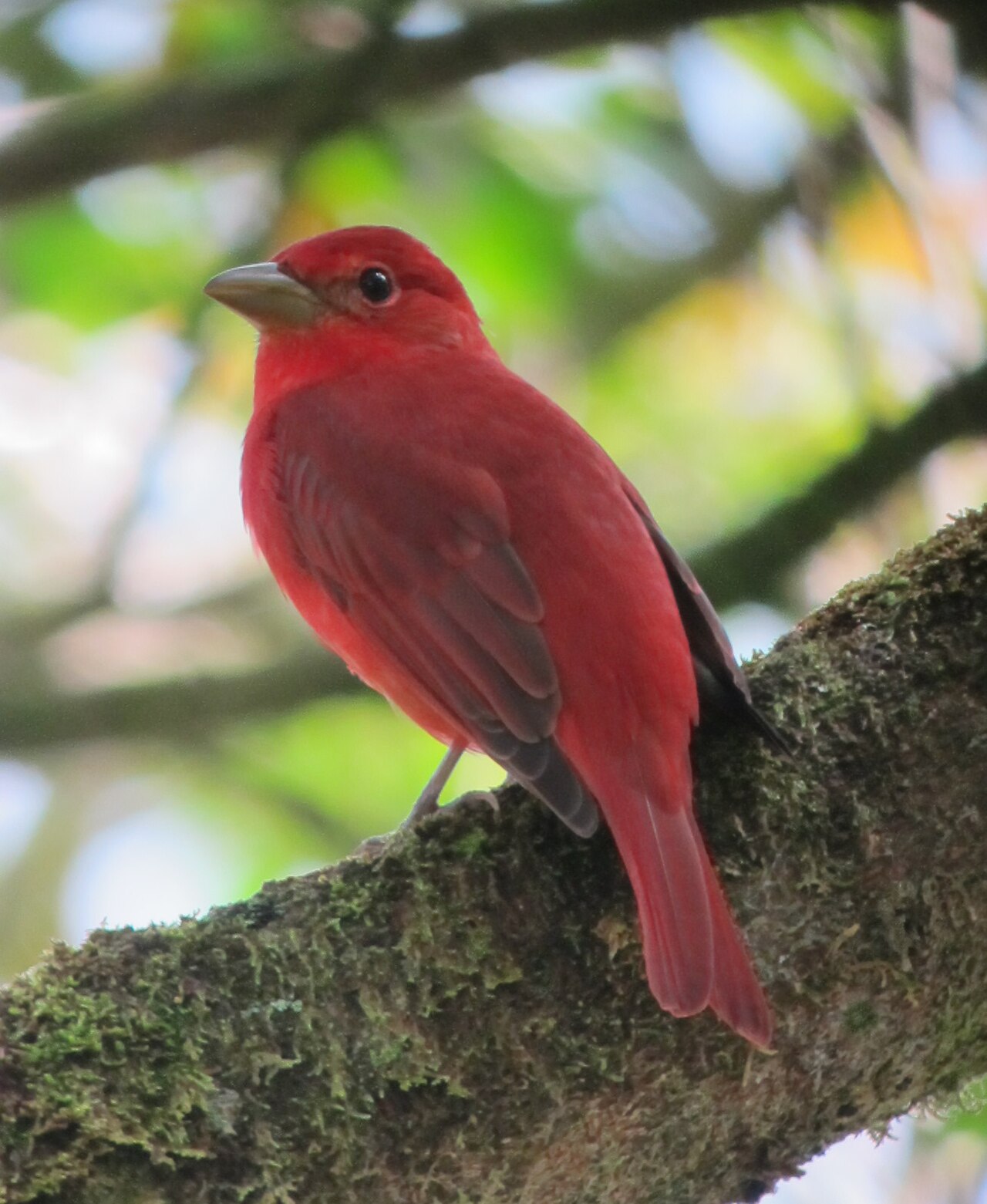
The summer tanager is common across the Southeast but rare north of its breeding range, and where the two ranges overlap, the call settles the question. Even that rule has an exception. A report in Maryland Birdlife documented a scarlet tanager giving a summer tanager call, so check an odd caller for black wings. Female summer tanagers are mustard yellow, and a yellow bird giving pik-i-tuck in a southern forest points to that species.
Two other birds share the robin pattern. The American robin (Turdus migratorius) carols in clear, sweet phrases with no burr at all. The rose-breasted grosbeak (Pheucticus ludovicianus) sounds robin-like as well, but sweeter and more fluid, like a robin that took voice lessons.
| Bird | Song | Call |
|---|---|---|
| Scarlet tanager | Hoarse, burry robin-like phrases | Chick-burr |
| Summer tanager | Smoother, musical robin-like phrases | Rapid pik-i-tuck-i-tuck |
| Western tanager | Burry robin-like phrases, western North America only | Rising pit-er-ick |
| American robin | Clear, sweet caroling | Sharp peek and tut notes |
| Rose-breasted grosbeak | Sweet, fluid robin-like phrases | Squeaky eek, like a sneaker on a gym floor |
Frequently Asked Questions
What kind of bird is red with black wings?
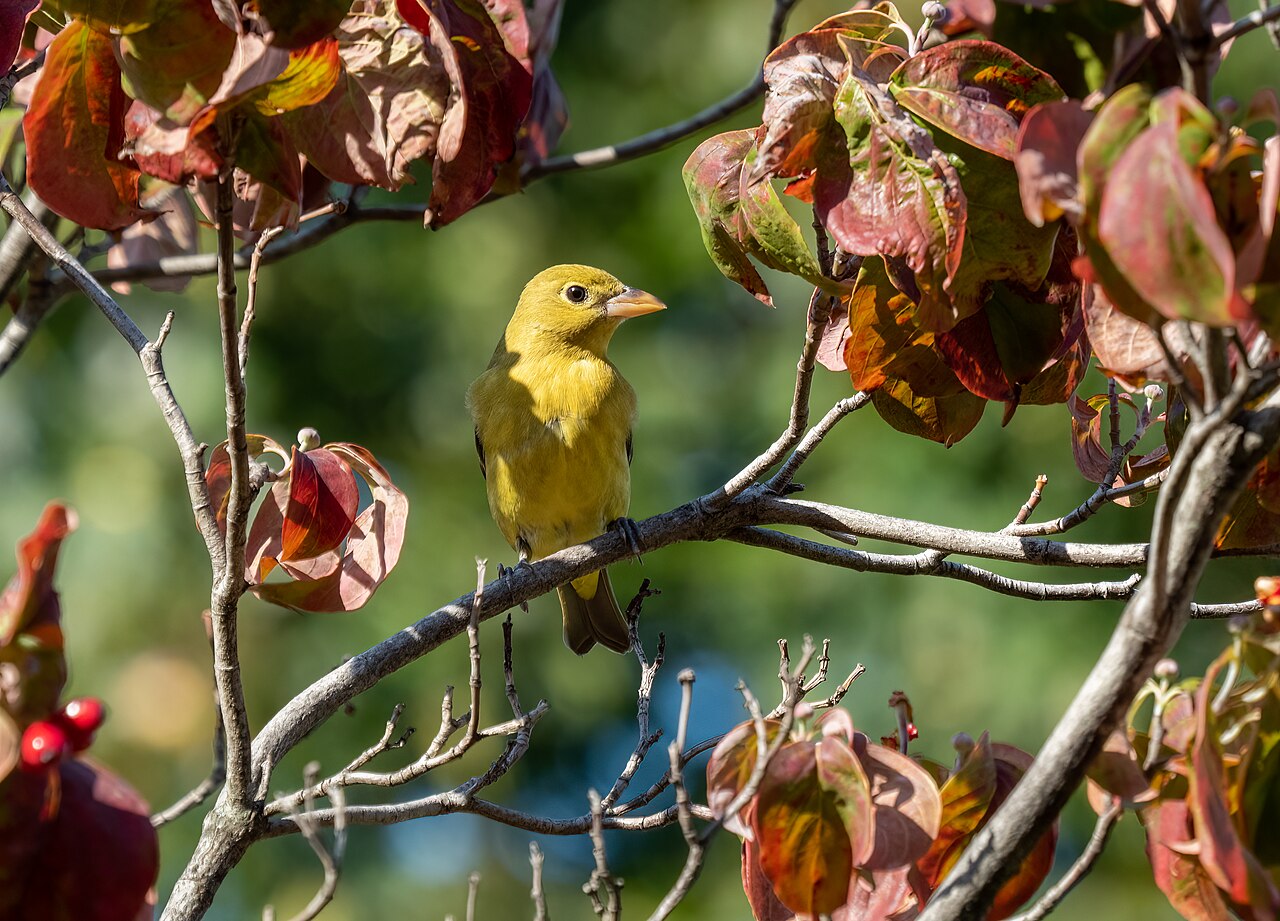
A breeding male scarlet tanager is the classic red bird with black wings in eastern North America. He keeps the black wings all year. In fall he molts into yellow-green body feathers, so an olive bird with jet-black wings in September is often the same species.
How rare is it to see a scarlet tanager?
Scarlet tanagers are fairly common within their range, but they are area-sensitive and generally need large tracts of mature deciduous or mixed forest, so small, fragmented woodlots are less likely to hold them. Hearing one is much easier than seeing one. They are present in eastern North America only from about May to September and spend the winter in South America.
Sources
- Maryland Birdlife (USF Digital Commons), Scarlet Tanager Gives Summer Tanager Call
- Bernheim Arboretum and Research Forest, Why Do Male and Female Scarlet Tanagers Sing?
- xeno-canto, XC422017 Scarlet Tanager (Piranga olivacea)