Brown Thrasher Sounds: Song, Calls and the Mockingbird Test
Brown thrasher sounds are loud, fast and full of doubled phrases, and the song is the reason most people notice the bird at all. The brown thrasher (Toxostoma rufum) stays hidden in hedges and thickets, so you hear it long before you see it.
That hiding habit causes the classic mix-up. A long run of loud phrases from a thicket sounds like a northern mockingbird, and a soft mew from the same hedge sounds like a gray catbird. Brown birds that skulk in brush are hard to name by sight, so the ear does most of the work.
The brown thrasher sings a long, loud string of varied phrases and sings most phrases twice before moving on. A northern mockingbird repeats each phrase three to six times, and a gray catbird rarely repeats at all. A sharp smack note given from cover is one of the thrasher’s most common calls.
What the Brown Thrasher Song Sounds Like
The brown thrasher song is a long run of short, loud, varied phrases with barely a pause between them. A single male can have more than 1,100 song types, one of the largest repertoires of any North American bird. Most phrases come in pairs. The bird sings one twice, then switches to something new, and the string of couplets runs on for a long stretch.
The song includes imitated notes of other birds at times. Borrowed notes turn up in the string, so the doubling is a better clue than any single copied sound.
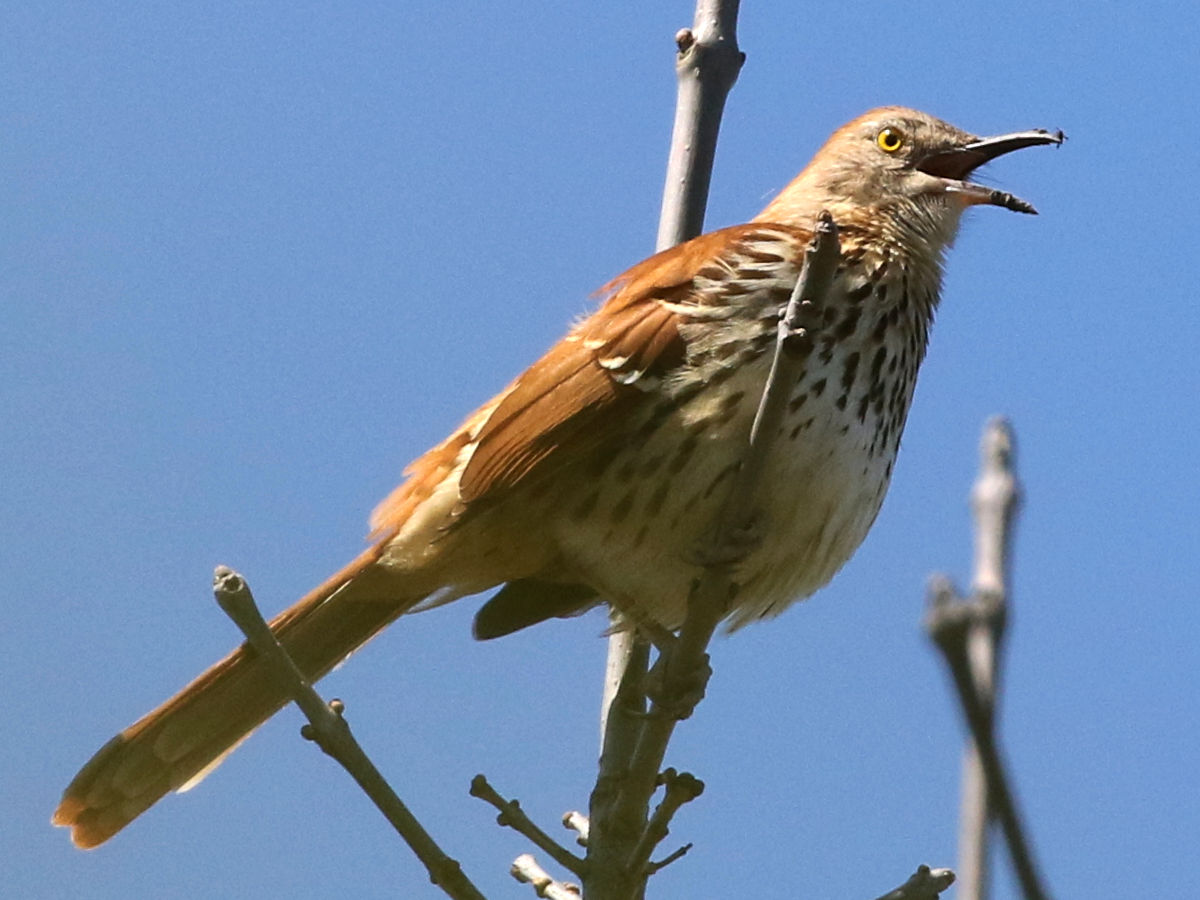
Males sing from an exposed perch in spring, such as a treetop or the top of a tall shrub. Singing from an exposed perch is when the bird is easiest to spot. The song claims a territory and advertises to a mate, so a thrasher singing in the open is announcing ownership of the thicket below. The Cornell Lab brown thrasher sounds page has recordings of full song bouts.
Brown Thrasher Calls and What They Mean
A sharp smack or tchuck is one of the calls you hear most, and it is an alarm. The bird gives it when a person, cat or hawk comes close to its cover. One loud smack from a hedge means a thrasher has seen you before you saw it.
Soft whistles and chirps are also part of the call repertoire. A low churr is another common call, and harsh notes come when the bird is disturbed near cover. Small brown birds such as Carolina wrens scold from the same thickets, but with a dry, rapid chatter instead of a single loud smack.
Calls continue after the singing season ends. In late summer the thicket goes quiet except for calls such as smacks. Many northern thrashers leave for the south in fall, so a call in a northern yard late in the season may come from a bird still on its way. Identifying bird sounds by call type, not only by song, finds these birds once the singing stops.
Brown Thrasher vs. Mockingbird, Catbird and Other Thrashers by Ear
Count the repeats, because that one number separates the three common backyard mimics. The gray catbird (Dumetella carolinensis) also drops cat-like mew calls into its song, a sound neither of the others makes.
The curve-billed thrasher (Toxostoma curvirostre) is a western bird, and birders know it by a sharp, rising whit-wheet call more than by its song. The two species overlap mainly in Texas and Oklahoma, so east of there a thrasher singing couplets is almost always the brown thrasher.
Imitated notes do not settle the ID. Several of these singers borrow sounds from other birds, so a copied whistle tells you nothing about who is copying it. Listen to three phrases in a row and count before you decide. Northern mockingbirds and brown thrashers also differ in looks, which helps once the bird steps into view.
| Singer | Repeats per phrase | Best ear clue |
|---|---|---|
| Brown thrasher | Usually two | Couplets, sharp smack call from cover |
| Northern mockingbird (Mimus polyglottos) | Three to six | Long sets of the same phrase |
| Gray catbird | Rarely repeats | Cat-like mew mixed into the song |
| Curve-billed thrasher | Not the main clue | Sharp, rising whit-wheet call, western range |
Frequently Asked Questions
What time of day do brown thrashers sing?
Brown thrashers sing most at dawn and in the early morning in spring, from an open perch. By midday the song thins out, and brown thrashers rarely sing at night, so a loud mimic singing after dark in spring points to a northern mockingbird.
When do brown thrashers stop singing?
Brown thrashers sing less as the breeding season goes on, and song rate drops sharply by early summer, nearly stopping by July. Northern birds leave for the southern US in September and October, so a silent thicket in late fall in the North usually means the thrasher has gone.
Sources
- Cornell Lab of Ornithology, All About Birds, Brown Thrasher Sounds
- National Audubon Society, Guide to North American Birds, Brown Thrasher
- Cornell Lab of Ornithology, All About Birds, Northern Mockingbird Sounds
- Tennessee Wildlife Resources Agency, Brown Thrasher
- National Geographic, Brown Thrasher