Green Vine Snake: Venom, Bite Risk and the Two Species Behind the Name
The green vine snake is venomous but not dangerous to humans, and the name actually covers two unrelated snakes on two different continents. In the Americas it means Oxybelis fulgidus, a bright green tree snake of Mexico, Central America, and northern South America. In Asia it means Ahaetulla species such as the Asian vine snake, sold in the pet trade under the same label.
Both are pencil-thin, mildly venomous rear-fanged snakes that hunt lizards and small birds from the branches. Neither lives in the United States, so a slender green snake in an American backyard is something else entirely. What follows separates the two species, answers the bite question honestly, and covers size, range, diet, and whether one belongs in a vivarium.
Green vine snakes are mildly venomous rear-fanged colubrids that are not considered dangerous to humans. A bite causes local pain, swelling, numbness, and occasional bruising for a day or two, with no recorded human deaths and no antivenom. Adults reach 5 to 6.5 ft (1.5 to 2 m) but are only as thick as a pencil.
| Feature | American Green Vine Snake | Asian Vine Snake |
|---|---|---|
| Scientific name | Oxybelis fulgidus | Ahaetulla prasina, A. nasuta |
| Range | Southern Mexico to Brazil and Bolivia | India and Southeast Asia to the Philippines |
| Adult length | 5 to 6.5 ft (1.5 to 2 m) | 3 to 6 ft (0.9 to 1.8 m) |
| Venom | Mild, rear-fanged, not dangerous to people | Mild, rear-fanged, not dangerous to people |
| Pupil shape | Round | Horizontal keyhole slit |
| Reproduction | Lays eggs | Live-bearing |
| Main prey | Lizards, nestling birds, frogs | Lizards, tree frogs, small birds |
Is Green Vine Snake Poisonous?
No green vine snake is poisonous, and none is dangerously venomous. Poisonous describes something harmful to eat; these snakes are venomous, which means they inject a toxin through teeth. The distinction matters here because the venom is real but weak, delivered by grooved rear fangs set far back in the jaw rather than by hollow front fangs.
That delivery system is built for lizards. To envenomate anything larger, the snake has to get a chewing grip and hold it, which a person almost always interrupts within seconds. Medical authorities class both Oxybelis and Ahaetulla as snakes of minor medical importance, alongside garter snakes and hognose snakes rather than alongside vipers.
There is no antivenom for a vine snake bite because none is needed. That is a sharp contrast with the coral snake, where getting the identification right is a medical emergency, as our guide to coral snake versus king snake explains.
What Happens If You Get Bitten by a Vine Snake?

Expect local symptoms only. Reported bites produce immediate pain out of proportion to the small puncture marks, then swelling that spreads across the hand or finger, numbness or tingling, and sometimes bruising and stiffness. Symptoms peak within a few hours and usually fade in 24 to 72 hours without treatment.
The saliva has mild anticoagulant activity, which is why some bites bleed longer than the wound size suggests. No systemic envenomation, organ damage, or death has been documented in humans from either genus. The real risk is ordinary wound infection from bacteria in the mouth.
First aid is unglamorous: wash with soap and water, remove rings before swelling sets in, keep the limb comfortable, and see a doctor if swelling climbs past the wrist or fever develops. Do not cut, suck, or apply a tourniquet.
How to Identify a Green Vine Snake

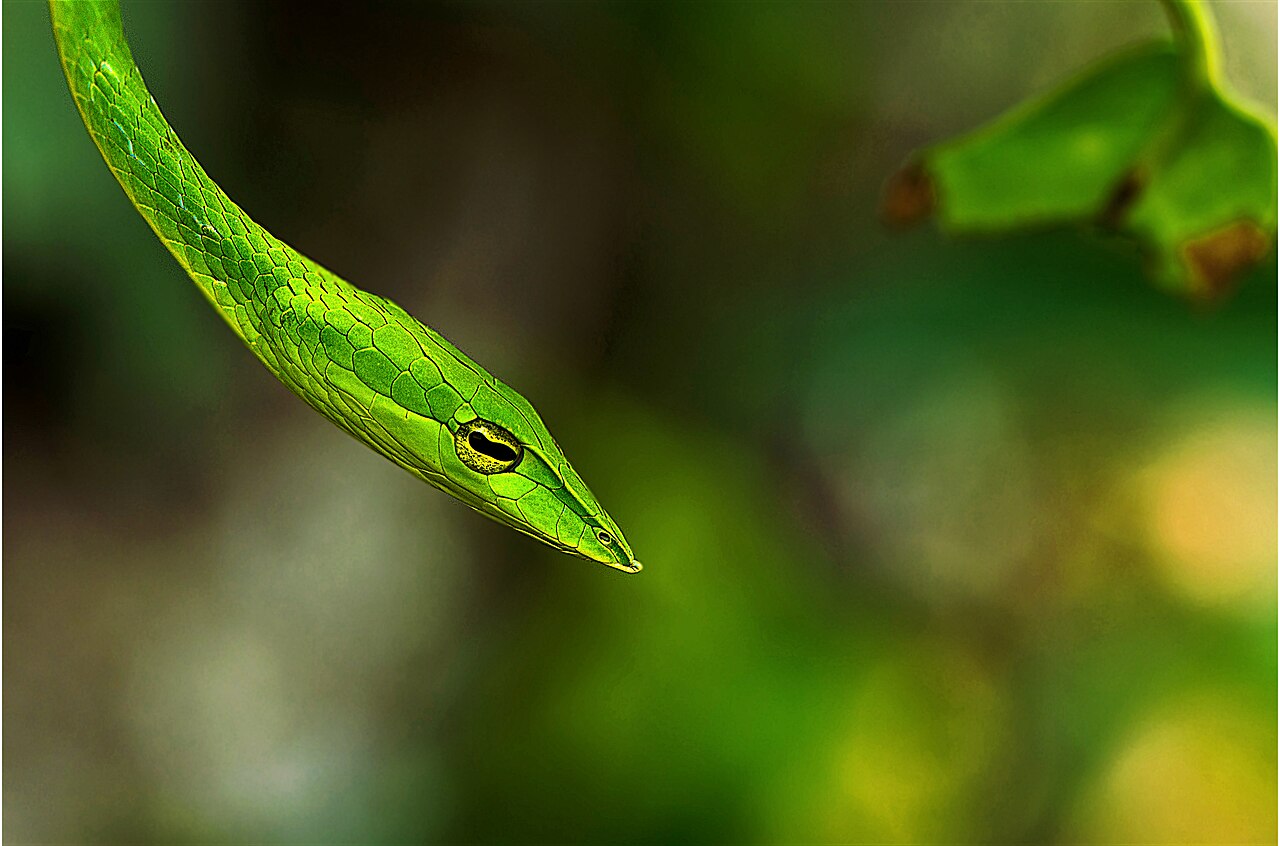
The proportions do the identifying. A green vine snake is extraordinarily long and thin, often 100 times longer than it is thick, with a head that tapers to a sharp point and a tongue that is dark and slow-flicking. The body is bright leaf green above, usually paler yellow-green or cream along the belly and lower sides.
Look at the pupil. Ahaetulla has a horizontal keyhole-shaped pupil, which is unusual among snakes and gives the Asian species its glaring, forward-facing look. Oxybelis fulgidus has a round pupil and a longer, more wedge-shaped snout. Both have a pale line running along the flank where green meets belly.
When threatened, the snake gapes to show a black mouth lining and inflates the front of the body so the pale interscale skin flashes as a warning band. That display is bluff, not prelude to a strike.
Two Different Snakes Share One Name

The label green vine snake is a common-name collision, not a species. Search results mix Ecuadorian rainforest photos with Philippine backyard sightings and Indian temple grounds because at least four species answer to it: Oxybelis fulgidus, Ahaetulla prasina, Ahaetulla nasuta, and the recently split Ahaetulla oxyrhyncha.
They are not close relatives. Oxybelis sits in the New World colubrid radiation and lays eggs; Ahaetulla belongs to an Old World lineage and gives birth to live young. The resemblance is convergent evolution: the same slim green shape solves the same problem of hunting lizards in dense foliage on both sides of the planet.
Practical consequence for keepers and photographers: care sheets, sizes, and even venom notes are not interchangeable between the two. Confirm which genus you are dealing with before trusting any specific claim about it.
Where Do Green Vine Snakes Live?

The American green vine snake ranges from southern Mexico through Central America into Colombia, Venezuela, Ecuador, Peru, Brazil, and Bolivia. It favors the mid-story of humid lowland forest, forest edges, plantations, and overgrown gardens, typically 3 to 20 ft (1 to 6 m) above the ground in vines and thin branches.
Asian vine snakes cover an even wider band: India, Sri Lanka, Nepal, Bangladesh, Myanmar, Thailand, Vietnam, Malaysia, Indonesia, and the Philippines. They handle disturbed habitat well and turn up in hedges, bamboo, and suburban shrubs, which is why so many sighting photos come from private yards.
Neither species occurs naturally anywhere in the United States or Canada. Institutions such as the Smithsonian National Zoo keep them in tropical collections, but there is no wild North American population.
How Big Can a Vine Snake Get?
The American green vine snake is the larger of the two, commonly 5 to 6.5 ft (1.5 to 2 m) with exceptional individuals near 7 ft (2.1 m). Asian vine snakes usually top out around 6 ft (1.8 m), with most adults closer to 4 ft (1.2 m).
Length is misleading because the snake weighs almost nothing. A 6 ft adult may be under 4 oz (115 g), thinner than a marker pen through most of its body. The tail alone accounts for roughly a third of total length and is prehensile enough to hold the snake’s weight while it reaches across a gap.
Females average slightly longer than males in both genera. Hatchlings and neonates emerge around 12 to 18 in (30 to 46 cm) and are already fully independent hunters.
What Green Vine Snakes Eat
Lizards dominate the diet. Anoles, geckos, and small iguanids make up the bulk of prey for Oxybelis fulgidus, while Ahaetulla takes agamas, geckos, and skinks. Both supplement with tree frogs, nestling birds, and occasionally small rodents or eggs when opportunity allows.
Prey is grabbed, chewed to work the rear fangs in, and held while the venom takes effect, which can take a minute or more on a struggling lizard. The snake then swallows head first, and a meal may leave a visible bulge for days in such a narrow body.
Tree frogs are common prey in both ranges, including species similar in habits to the American green tree frog. A wild vine snake may eat only once every week or two.
How Green Vine Snakes Hunt
These are ambush hunters with unusual eyes. The pointed snout has grooves along each side that let the pupils see forward past the nose, giving genuine binocular vision and the depth perception needed to strike accurately at a lizard on a thin branch. Few snakes have this.
The hunting posture is a stiff, extended hold with the front third of the body reaching out unsupported, sometimes swaying gently in a way that mimics vegetation moving in wind. Some individuals slowly protrude and hold the dark tongue, which may act as a lure for curious lizards.
The strike is fast and forward rather than the downward stab of a viper. Compare that with a heavy-bodied constrictor strategy like the bull snake, which overpowers prey with coils instead of precision and venom.
Reproduction and Lifespan
The two genera split here. Oxybelis fulgidus is oviparous, laying clutches of roughly 3 to 12 elongated eggs in leaf litter, tree hollows, or epiphytes, which hatch after about 60 to 70 days with no parental care afterward.
Asian vine snakes are viviparous and give birth to litters of about 4 to 10 fully formed young, an advantage in humid forest where eggs rot easily. Neonates are miniature versions of the adults, sometimes with a brown or yellow phase that greens up as they mature.
Documented lifespan is modest for a snake, roughly 5 to 10 years, and captive records are patchy because wild-caught imports often start in poor condition. That is short compared with a well kept colubrid, as our figures on corn snake lifespan show.
Are Philippine Vine Snakes Venomous?
Yes, the Philippine green vine snake is venomous in the same mild, rear-fanged way as its relatives, and it is not regarded as a threat to human life. The snake widely photographed in Philippine gardens is Ahaetulla prasina, the same species found across Southeast Asia.
Local bite accounts follow the same pattern: sharp pain, swelling of the finger or hand, tingling, and resolution within a couple of days. Hospital treatment, when sought, is wound care and pain relief. There is no vine snake antivenom in the Philippines because none has been required.
The species is harmless to crops and useful in yards, where it removes geckos and skinks. Killing it on sight is the most common cause of injury, since a snake being cornered is a snake being handled.
Is a Vine Snake a Good Pet?
Not for beginners, and the honest answer for most keepers is no. Vine snakes need tall, heavily planted enclosures with strong ventilation, daytime temperatures around 78 to 85 F (26 to 29 C), high humidity, and UVB lighting, and they are nervous, fast, and easily stressed by handling.
The bigger problem is the food. Most individuals want live lizards, which is expensive, legally restricted in some states, and a parasite risk. Wild-caught imports dominate the market and frequently arrive dehydrated, parasitized, and unwilling to feed, so mortality in the first year is high.
Experienced keepers with captive-bred Ahaetulla and a reliable anole supply do succeed. Everyone else is better served by a hardy species, and something like an albino corn snake delivers the same visual appeal with a fraction of the risk.
Green Vine Snake vs Rough Green Snake
If you are in the United States and see a thin bright green snake, it is almost certainly a rough green snake (Opheodrys aestivus), not a vine snake. The rough green snake is shorter at 20 to 32 in (51 to 81 cm), has a blunt rounded head, round pupils, and keeled scales, and it is completely non-venomous.
Behavior separates them too. Rough green snakes hunt insects and spiders rather than lizards, and they freeze and sway in the same way, which is where the confusion starts. Escaped or released vine snakes do not establish populations in temperate North America.
Full identification details are in our profile of the rough green snake. Water-edge sightings of a greenish snake are more often a banded water snake in poor light.
Related reading: Smooth Green Snake.
Frequently Asked Questions
What snake has 100% fatality?
None. No snake kills every person it bites, even untreated. The black mamba and some kraits approach very high untreated fatality rates, but antivenom and modern critical care change the outcome dramatically. Green vine snakes are at the opposite end of that scale with no recorded human deaths at all.
Is a vine snake a good pet for a beginner?
No. Vine snakes are fast, nervous, and usually insist on live lizards, and most available animals are wild-caught with parasite loads. They also need a tall planted enclosure with high humidity and UVB. A captive-bred corn snake or ball python is the sensible first snake.
What is the friendliest snake as a pet?
Corn snakes and ball pythons are the two standard answers, with rosy boas and Kenyan sand boas close behind. Friendly means tolerant of handling and predictable rather than affectionate. All four accept frozen and thawed rodents, which removes the single biggest obstacle vine snakes present.
Do green vine snakes bite people often?
Rarely. They rely on camouflage first and a mouth-gaping bluff second, and they flee upward given the chance. Nearly all recorded bites happen to people picking the snake up or removing it from a garden. Leaving it alone reliably ends the encounter without contact.
Should you let a snake sleep with you?
No. A snake in a bed can be crushed, chilled, or stressed, and it may bite defensively when startled. Snakes do not seek companionship and a stretched-out snake is measuring warmth, not bonding. Keep any pet snake in a secure enclosure with correct heating overnight.
How much does a green vine snake cost?
Asian vine snakes typically sell for about 60 to 150 USD, and American Oxybelis fulgidus is offered less often at 150 to 300 USD. Low prices reflect wild-caught stock rather than easy husbandry. Budget for a quarantine period, a fecal parasite screen, and a steady live lizard supply.