Desert Horned Lizard: 9 Facts About the Real Horny Toad
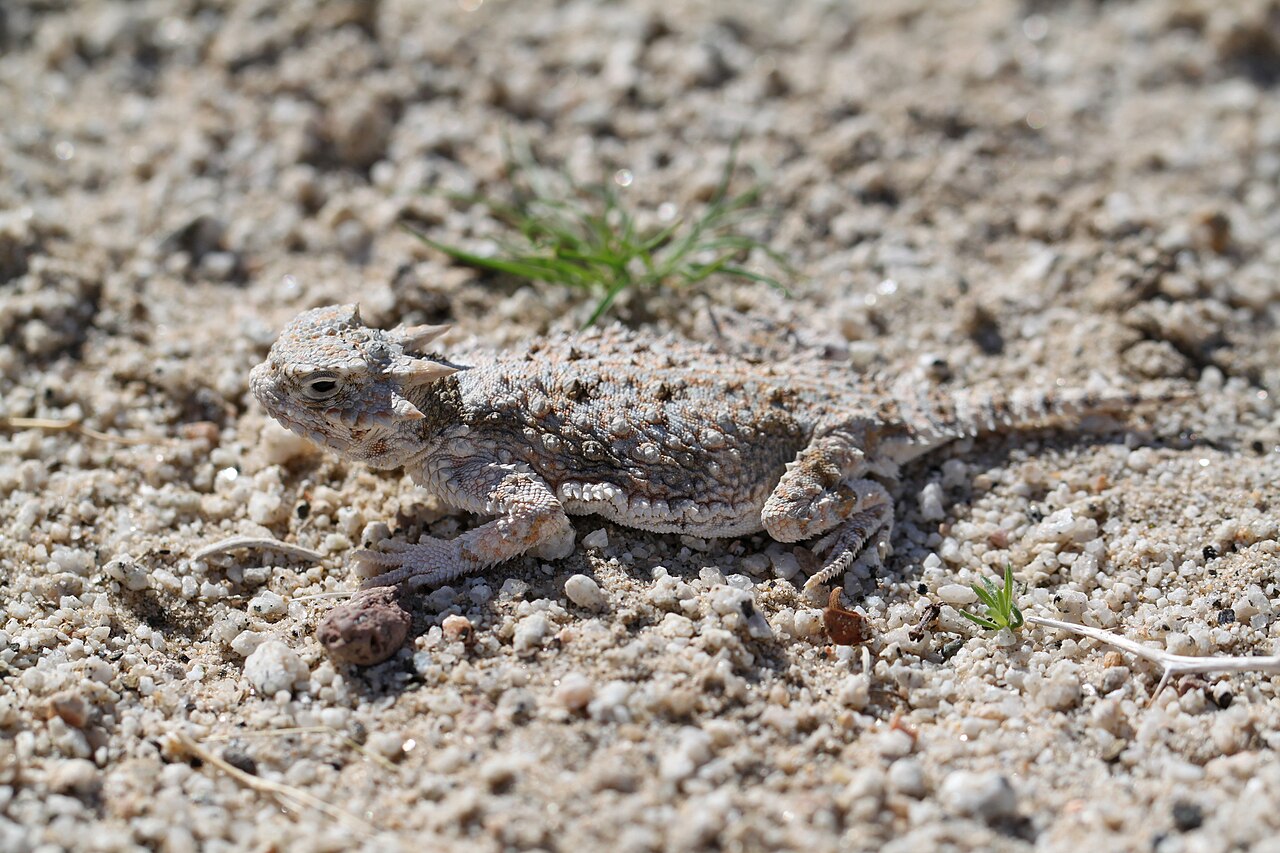
The desert horned lizard is a small, flat, ant eating lizard of the American Southwest that is completely harmless to people: it has no venom, it rarely bites, and its main defense is sitting still while it looks exactly like the gravel around it. Most hikers walk past a dozen of them for every one they notice, usually spotting the animal only when it sprints two feet and stops dead.
Phrynosoma platyrhinos lives from southern Oregon and Idaho through Nevada, Utah, western Arizona, and the California deserts, and it is the species people mean when they say horny toad in the Great Basin and Mojave. This guide covers identification, range, diet, the blood squirting question, heat survival, breeding, legality, and how it differs from its famous Texas cousin.
The desert horned lizard (Phrynosoma platyrhinos) is a flat bodied, spine fringed lizard of the Great Basin, Mojave, and Sonoran deserts. Adults reach 2.5 to 3.75 in (6 to 9.5 cm) of body length, feed mostly on harvester ants, and are not venomous. They defend themselves by freezing, flattening, and burrowing rather than by biting.
| Quick fact | Detail |
|---|---|
| Scientific name | Phrynosoma platyrhinos |
| Body length | 2.5 to 3.75 in (6 to 9.5 cm) snout to vent, to 5.75 in (15 cm) with tail |
| Range | Great Basin, Mojave, and Sonoran deserts, Oregon and Idaho to northern Mexico |
| Main prey | Harvester ants (Pogonomyrmex, Messor), plus beetles and other insects |
| Venomous | No, and bites on humans are very rare |
| Active season | March or April to September, dormant underground in winter |
| Clutch | 2 to 16 eggs laid in early summer, no parental care |
Are Horned Lizards Venomous?
No, horned lizards are not venomous, and the desert horned lizard is not dangerous to handle. It has no venom glands, no toxic skin secretions, and a mouth built for crushing ants rather than defending itself. A cornered individual may gape or puff up, but bites on people are rare enough that most field herpetologists have never taken one.
The horns themselves are bone cored cranial projections, not weapons aimed at humans. Their function is antipredator: they make the lizard hard to swallow and they drive into the throat tissue of a snake attempting it. Whipsnakes have been recorded abandoning horned lizards for exactly that reason.
The real risk in a handling encounter runs the other way. These lizards stress quickly, thermoregulate by pressing their bodies to warm ground, and can be injured by a grip that seems gentle. Photograph the animal where it sits and move on.
How to Identify a Desert Horned Lizard
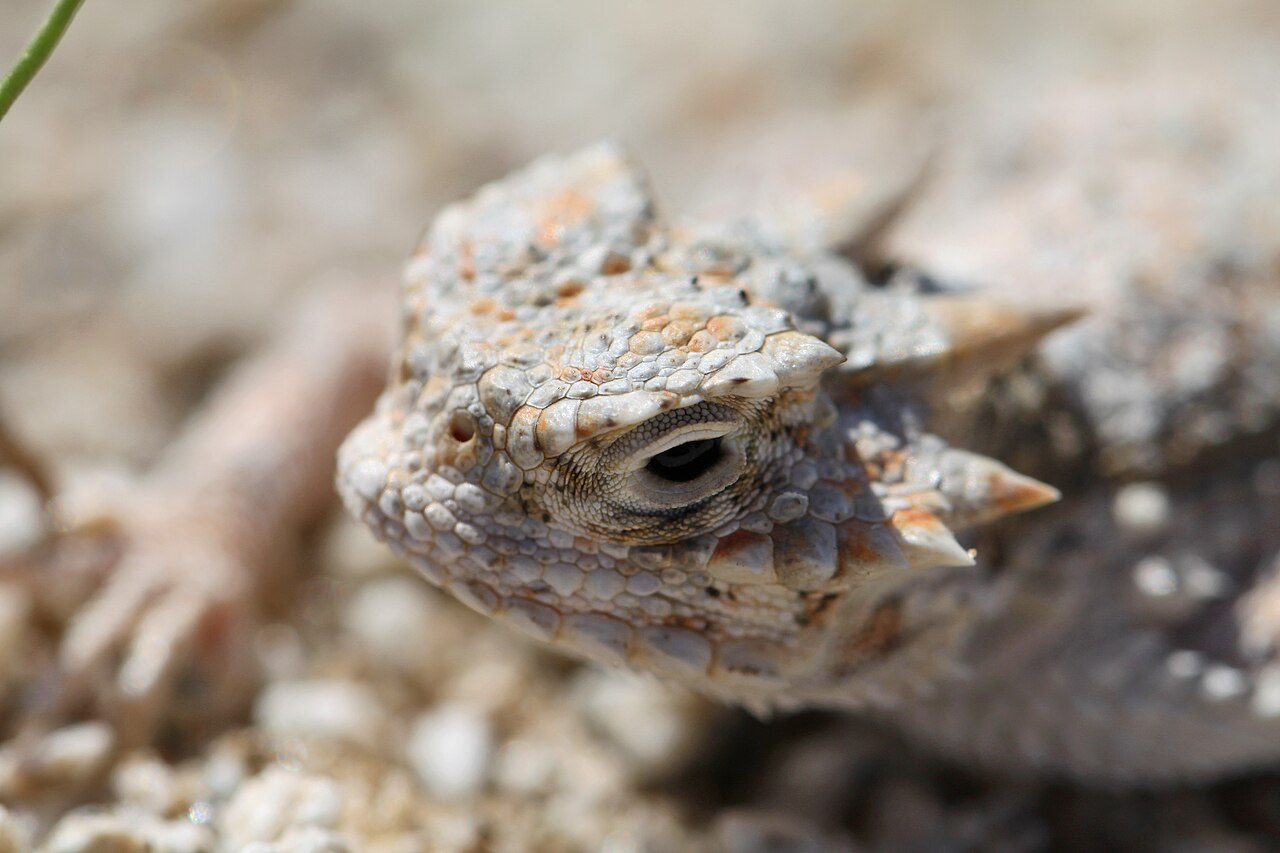
Look for a broad, flattened, almost circular body with a short tail, a crown of four to six horns across the back of the head, and a single row of pointed fringe scales along each side of the belly. Coloration runs gray, tan, or reddish brown to match local soil, with paired dark blotches down the back and a pale midline stripe.
Size rules out most confusion. An adult fits in a palm at 2.5 to 3.75 in (6 to 9.5 cm) of body length, and hatchlings in late summer are barely the size of a quarter. The belly is whitish and usually unmarked, which separates this species from several relatives with speckled undersides.
Other desert lizards in the same habitat look nothing like it once you know the shape. The desert iguana is long bodied with a whiplike tail, and the various spiny and zebra tailed lizards are slender and fast. Nothing else in the Great Basin is a flat disc with horns.
Where Do Desert Horned Lizards Live?
Desert horned lizards live in open, arid, sandy or gravelly flats across the Great Basin, Mojave, and western Sonoran deserts, from southern Oregon and southwestern Idaho through Nevada and Utah into western Arizona, southeastern California, and adjacent Mexico. They favor sparse creosote, saltbush, and sagebrush flats with loose soil for burrowing.
Substrate matters more than plant community. The species needs soil it can shimmy into sideways, which is why it drops out of rocky pavement and hardpan even when everything else looks right. Dune margins, sandy washes, and the shoulders of desert roads are reliable places to find them.
Elevation runs from below sea level in Death Valley to roughly 6,000 ft (1,800 m) in the northern Great Basin. Land managers across this range publish species lists and access rules for the units they administer; the National Park Service is the practical starting point for desert parks and monuments.
Why Does the Horned Lizard Squirt Blood?
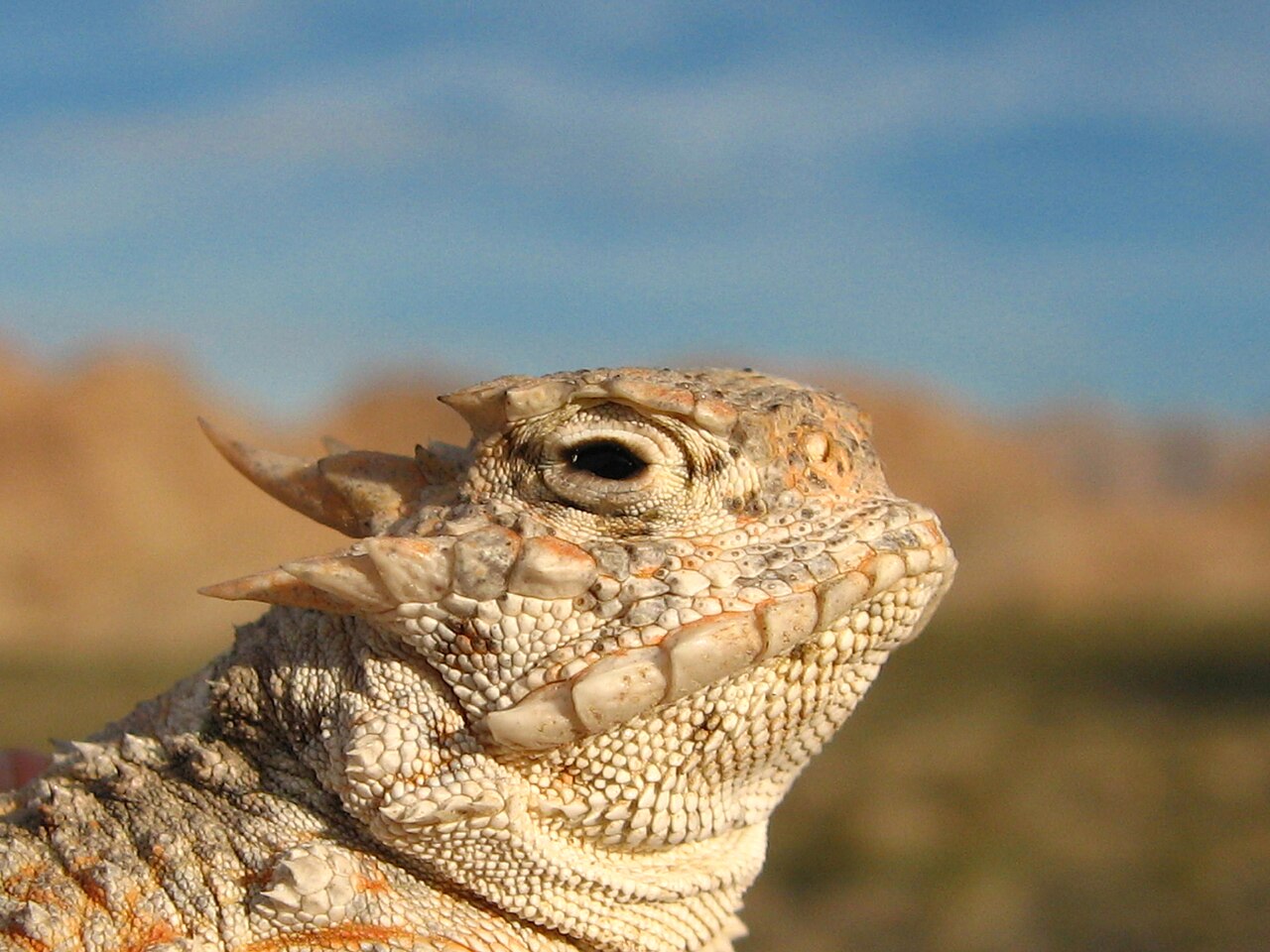
Some horned lizards can rupture small sinuses near their eyes and shoot a stream of blood up to 3 ft (1 m) at a predator. The behavior is called autohemorrhaging, and the blood carries compounds that are distasteful to canids specifically, which is why coyotes and foxes drop the lizard while birds are unaffected by it.
Here the sources need separating honestly. The behavior is well documented in the Texas horned lizard (Phrynosoma cornutum) and the regal horned lizard (Phrynosoma solare). For the desert horned lizard it is reported only rarely, and most field accounts describe freezing, flattening, and hissing instead. Do not expect to see it from this species.
Blood squirting is also a last resort in every species that uses it. The full defense sequence runs camouflage, then immobility, then body flattening and tilting toward the threat, then a short dash, then gaping and inflating, and only then, in the species capable of it, the blood.
What Do Desert Horned Lizards Eat?
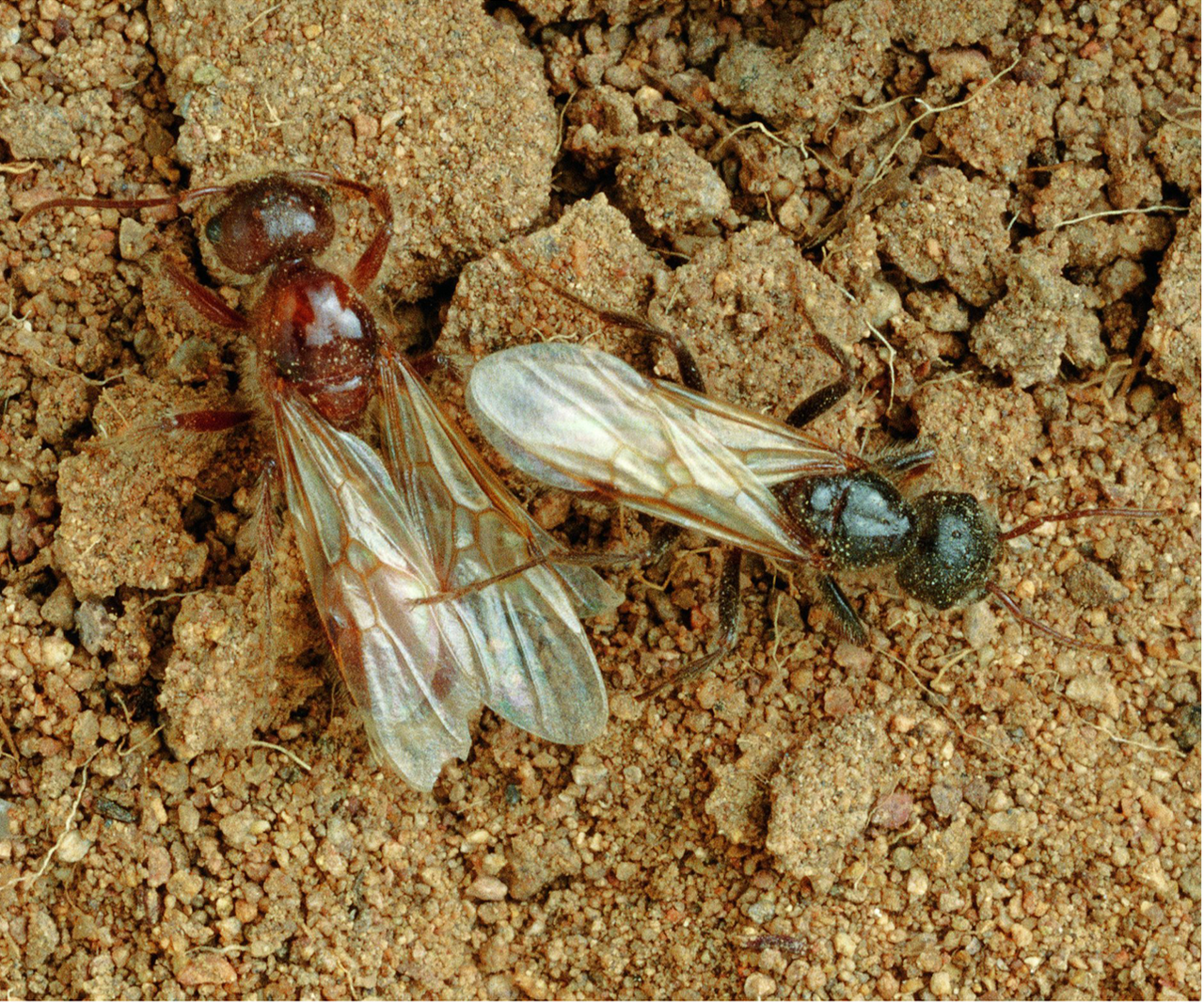
Harvester ants make up the bulk of the diet, often 60 to 90 percent of prey items, taken mostly from foraging trails near a colony entrance. The lizard parks itself beside a trail and picks off workers one at a time with a sticky tongue, swallowing hundreds in a session. Beetles, termites, and the occasional grasshopper fill in the rest.
That specialization explains the body plan. A wide gut is needed to process a low value, high volume, chitin heavy prey item, and a wide gut is easier to carry on a flat, disc shaped frame than on a slender one. Ant venom tolerance comes with it: these lizards eat species that sting hard enough to hurt a human.
The diet also explains why they turn up where they do. No harvester ant colonies means no horned lizards, and pesticide programs or fire ant invasions that wipe out native harvester ants remove the species from otherwise suitable habitat. Broader context on what lizards eat shows how unusual this level of specialization is.
How Desert Horned Lizards Survive Desert Heat
They shuttle. On a typical summer day the lizard emerges mid morning, basks flat against warm soil with ribs spread to catch heat, retreats to shade or a shallow burrow through the afternoon peak, then forages again in the evening. Body temperature is managed by position and posture rather than by sweating or panting.
Two tricks are worth knowing. The flattened body gives a large surface area for fast warming and can be tilted at an angle to the sun to raise or lower heat gain, and color darkens or lightens over minutes to change how much radiation the skin absorbs. A cool lizard is noticeably darker than the same animal at midday.
Water comes almost entirely from prey. Grooves between the scales channel dew and rain droplets toward the mouth by capillary action, a mechanism shared with the Australian thorny devil, so a rain shower is a drinking opportunity even where there is no standing water.
Camouflage and the Rest of the Defense Kit
Camouflage is the primary defense, and it is regional. Populations on pale Mojave sand are nearly white, populations on red Utah soils are rust colored, and the paired back blotches break up the outline further. The lizard reinforces it behaviorally by holding absolutely still, sometimes letting a boot pass inches away.
When stillness fails, the body flattens and tilts edge on toward the threat, which both widens the silhouette and presents the lateral fringe scales as a row of spines. Against a snake this works well, because the target becomes too wide and too spiky to swallow headfirst.
Burrowing is the exit. Using a sideways shimmy of the body and fringe scales, the lizard can bury itself in loose sand in a few seconds, leaving only the eyes exposed. The same movement seals it in overnight and through the winter dormancy.
What Eats a Desert Horned Lizard?
The main predators are snakes, birds, and small carnivores: whipsnakes and rattlesnakes, loggerhead shrikes, greater roadrunners, hawks, kit foxes, and coyotes. Shrikes are the most efficient, since a bird can ignore both the horns and the distasteful blood chemistry that deters mammals.
Nocturnal predators matter less than people assume. Because these lizards are strictly diurnal and buried by dusk, owls encounter them rarely; a great horned owl hunting the same flats takes rodents and rabbits instead. The daytime raptor and shrike pressure is what shapes horned lizard behavior.
Juvenile mortality is high in the first season, which is why clutches run large and growth is fast. A hatchling that reaches its first winter underground has already survived the hardest part of a horned lizard life.
Breeding and Life Cycle
Mating follows emergence from winter dormancy, usually April into May, with males patrolling and displaying by head bobbing. Females lay a single clutch of 2 to 16 eggs in early summer, buried in a shallow nest chamber in loose soil, and provide no care after covering it. Larger females lay larger clutches.
Eggs hatch after roughly 50 to 60 days, so hatchlings appear from late July through September. They emerge under an inch long, already fully formed miniatures with soft horns, and begin taking small ants immediately. Not all Phrynosoma do this: the short horned lizards of cooler climates give birth to live young instead.
Lifespan in the wild is estimated at five to eight years, with sexual maturity at one to two years depending on food and season length. Marked individuals often stay within a home range of a few hundred feet across their whole lives.
Can I Keep a Desert Horned Lizard as a Pet?
In practice, no. The obligate harvester ant diet is the wall almost everyone hits: captive lizards need hundreds of live native ants per week, cricket and mealworm substitutes lead to slow decline, and most captives taken from the wild die within a year. Experienced keepers with a live colony supply are the rare exception.
Legality is the second wall. Many western states protect Phrynosoma outright or set a take limit of zero, and where collection is allowed a hunting or scientific license is generally required. Captive bred stock essentially does not exist in the trade, so an animal offered for sale is usually wild caught and often illegal.
People asking which lizard is the friendliest or the most aggressive are usually shopping for a pet, and this is not the answer to either question. A horned lizard is not aggressive and not tame, just cryptic. If you want a reptile you can actually keep, look at established captive bred species rather than the Mexican alligator lizard or a large monitor lizard without reading up on their needs first.
Is It Illegal to Pick Up a Horned Lizard?
It depends on the state, and in several it is. California prohibits take of horned lizards, Texas protects the Texas horned lizard as a threatened species so handling or possession without a permit is unlawful, and Nevada, Utah, and Arizona regulate collection through license requirements and bag limits. Picking one up briefly and putting it back is a gray zone that some wardens treat as take.
The biological argument is simpler than the legal one. Handling raises body temperature, interrupts foraging at the narrow window when ants are active, and can cause a female to abandon a nest site. Populations are already declining from habitat conversion, off road vehicle traffic, and loss of native harvester ants.
Desert Horned Lizard vs Texas Horned Lizard
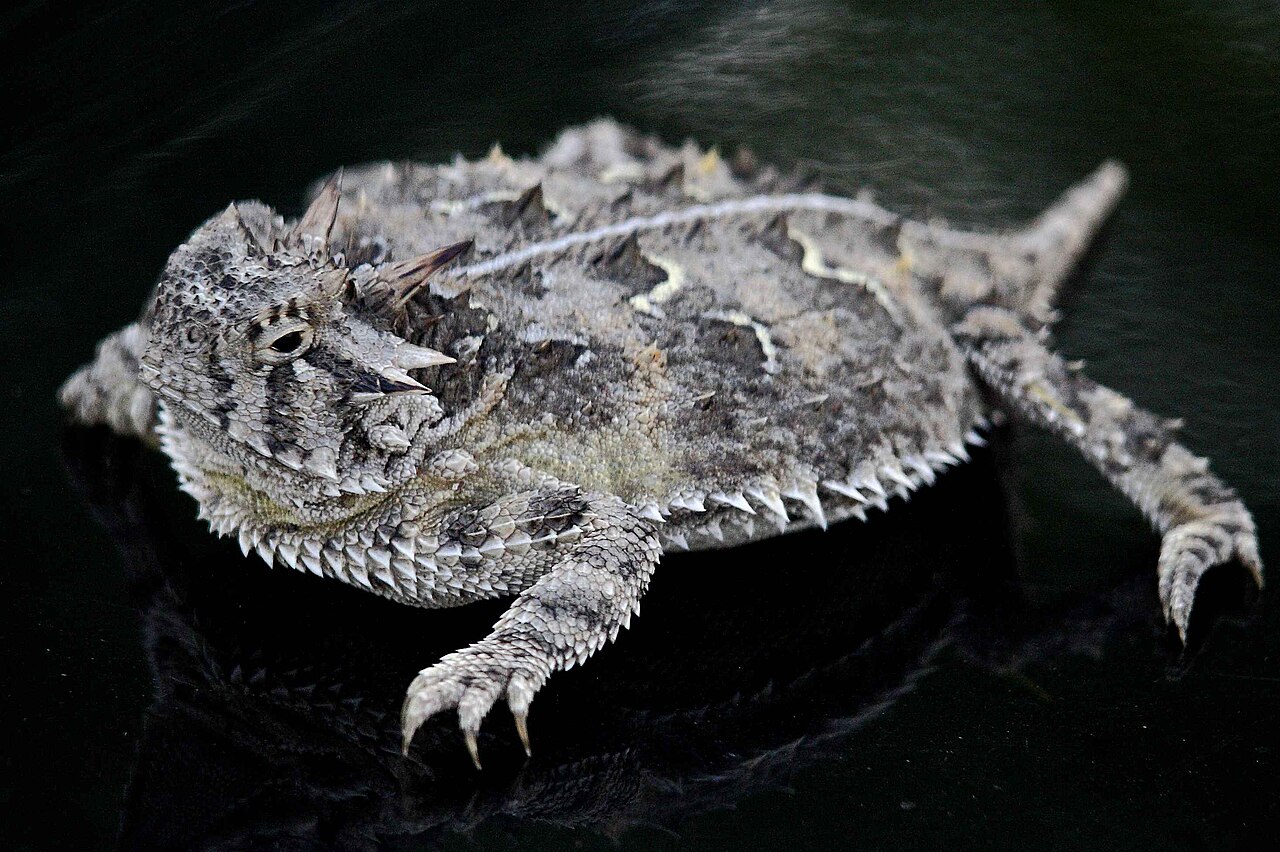
The two are separate species with different ranges and different reputations. Phrynosoma platyrhinos holds the Great Basin, Mojave, and western Sonoran deserts and carries shorter horns with a single row of belly fringe scales. Phrynosoma cornutum occupies the southern Great Plains from Kansas to Texas and northern Mexico, with two rows of fringe scales and long, backward pointing head spines.
Behavior differs in the one detail everyone asks about: the Texas species is the confirmed blood squirter, the desert species almost never does it. The Texas horned lizard is also the one in decline sharply enough to be listed as threatened in Texas, driven largely by fire ants displacing native harvester ants.
Field signs overlap, and scat from either is a dark pellet packed with ant exoskeletons, which is often the first evidence of occupancy on a site. If you are learning to read reptile droppings, the broader guide to lizard poop covers how to tell it from small mammal and bird sign.
Frequently Asked Questions
Are horned lizards venomous?
No. Horned lizards have no venom and no toxic skin secretions, and bites on humans are very rare. The horns are defensive structures against snakes and birds, not weapons used against people. The only substance worth noting is the distasteful blood some species squirt, which deters canids but is harmless to humans.
Why does the horned lizard squirt blood?
To repel canid predators. Sinuses near the eyes rupture under pressure and send blood up to 3 ft (1 m), carrying compounds that taste foul to coyotes and foxes. The behavior is documented mainly in the Texas and regal horned lizards, and is reported only rarely in the desert horned lizard.
Can I keep a desert horned lizard as a pet?
Realistically no. They eat mostly live harvester ants, and substitute insects lead to slow decline, so most wild caught individuals die within a year. Captive bred animals are essentially unavailable, and several western states protect the species or set a take limit of zero.
Is it illegal to pick up a horned lizard?
In several states, yes. California prohibits take of horned lizards and Texas protects the Texas horned lizard, while Nevada, Utah, and Arizona regulate collection through licenses and limits. Even where handling is legal it stresses the animal and interrupts the short daily window when its ant prey is active.
What is the most aggressive lizard, and what’s the friendliest lizard?
Neither label fits a horned lizard. They do not attack and they do not tame, they hide. Among large species, monitor lizards are the ones that defend themselves hard, while bearded dragons and leopard geckos are the reptiles usually called friendly because they tolerate handling.
Where do desert horned lizards live?
Open sandy or gravelly flats in the Great Basin, Mojave, and western Sonoran deserts, from southern Oregon and Idaho through Nevada, Utah, western Arizona, southeastern California, and into northern Mexico. They need loose soil to burrow into and nearby harvester ant colonies, from below sea level to about 6,000 ft (1,800 m).