Grackle vs Starling: How to Tell Them Apart
The quickest way to tell a grackle from a starling is size and tail: Common Grackles are large, roughly 12 inches long, with long, keel-shaped tails and pale yellow eyes, while European Starlings are smaller, about 8 inches, with short tails, speckled winter plumage, and dark eyes. Both look black from a distance and often flock together, which is why they are so easily confused at feeders and in parking lots. Once you know what to look for, though, they are easy to separate. This guide breaks down the key differences in size, shape, eye color, bill, and plumage, and adds the third common look-alike, the Brown-headed Cowbird, so you can identify all three with confidence.
| Feature | Common Grackle | European Starling |
|---|---|---|
| Length | About 11 to 13 in | About 7.5 to 9 in |
| Tail | Long, keel or V-shaped | Short and square |
| Eye color | Pale yellow | Dark |
| Bill | Long, black, pointed | Thin; yellow in breeding season |
| Plumage | Glossy black, bronze/purple sheen | Black with white spots in winter |
| Origin | Native to North America | Introduced, invasive |
At a glance: the fastest way to tell them apart
If you only remember one thing, make it the tail. A grackle’s long tail trails well behind its body and often folds into a distinctive keel or V shape in flight, giving the bird a stretched, elegant look. A starling’s tail is short and stubby, making the bird look compact and almost triangular, with a short tail and pointed wings that create a four-pointed-star silhouette overhead, which is how the starling got its name. Size backs this up: grackles are noticeably bigger, while starlings are closer to the size of a cardinal.
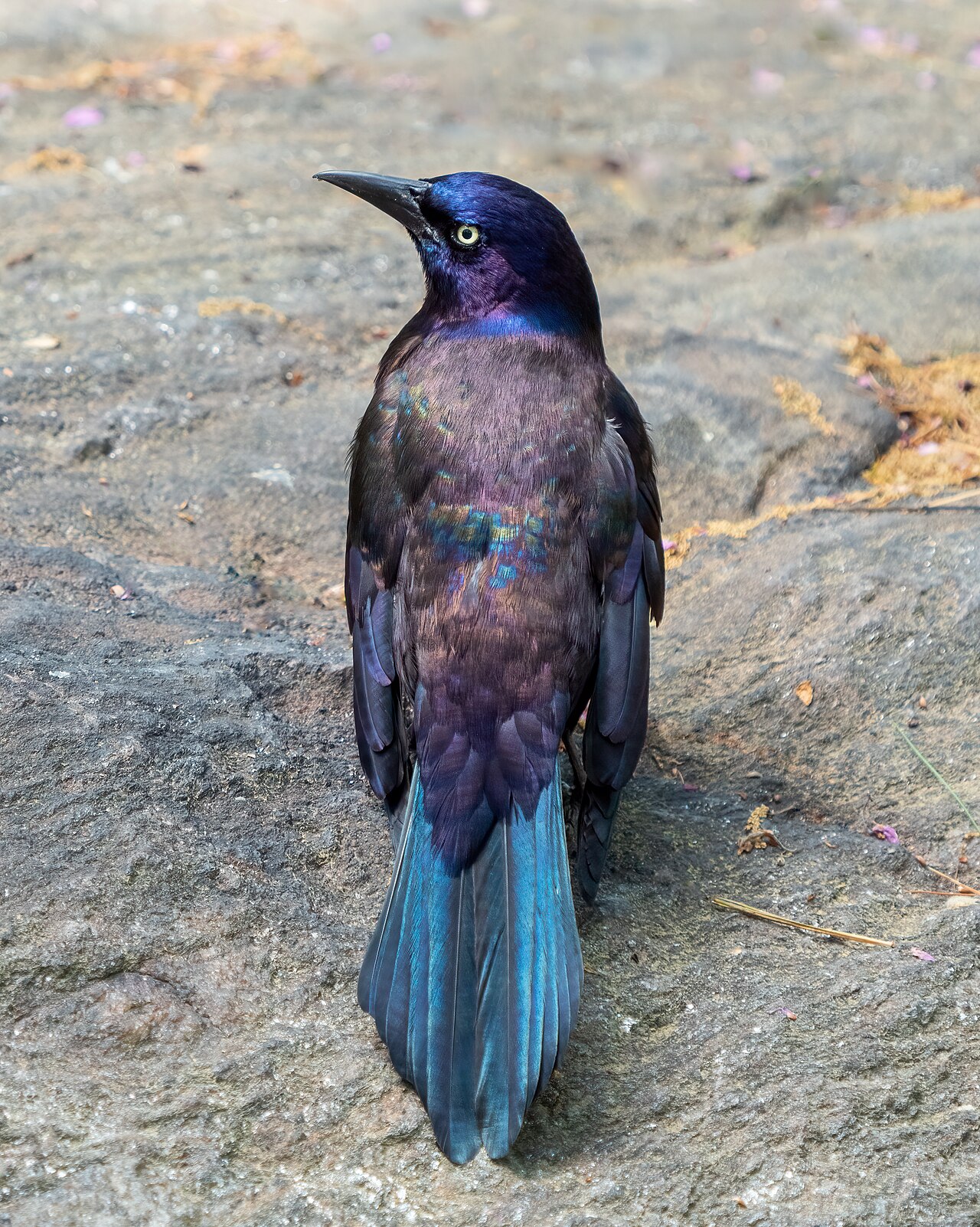
Eye color seals it. A grackle stares with a bright pale yellow eye that stands out against its dark head, while a starling has a plain dark eye. According to the Cornell Lab of Ornithology, that pale eye is one of the most reliable field marks for a Common Grackle. For the wider group, see our guide to types of blackbirds.
How to identify a Common Grackle
The Common Grackle is a large, long-tailed blackbird that looks black until sunlight reveals an iridescent sheen of bronze on the body and glossy blue-purple on the head. Its body is lanky, its bill is long and stout, and its pale yellow eye gives it an alert, almost fierce expression. In flight the long tail and the habit of holding it in a creased keel shape are unmistakable once you have seen it.
Grackles are bold, ground-foraging birds that stride rather than hop, and they gather in noisy flocks, especially in fall and winter. They are native to North America and common across lawns, farm fields, and feeders east of the Rockies. Females are similar but a bit smaller and less glossy; our female grackle guide covers the differences. Grackles are frequent, and sometimes unwelcome, feeder visitors because of their size and appetite.
How to identify a European Starling
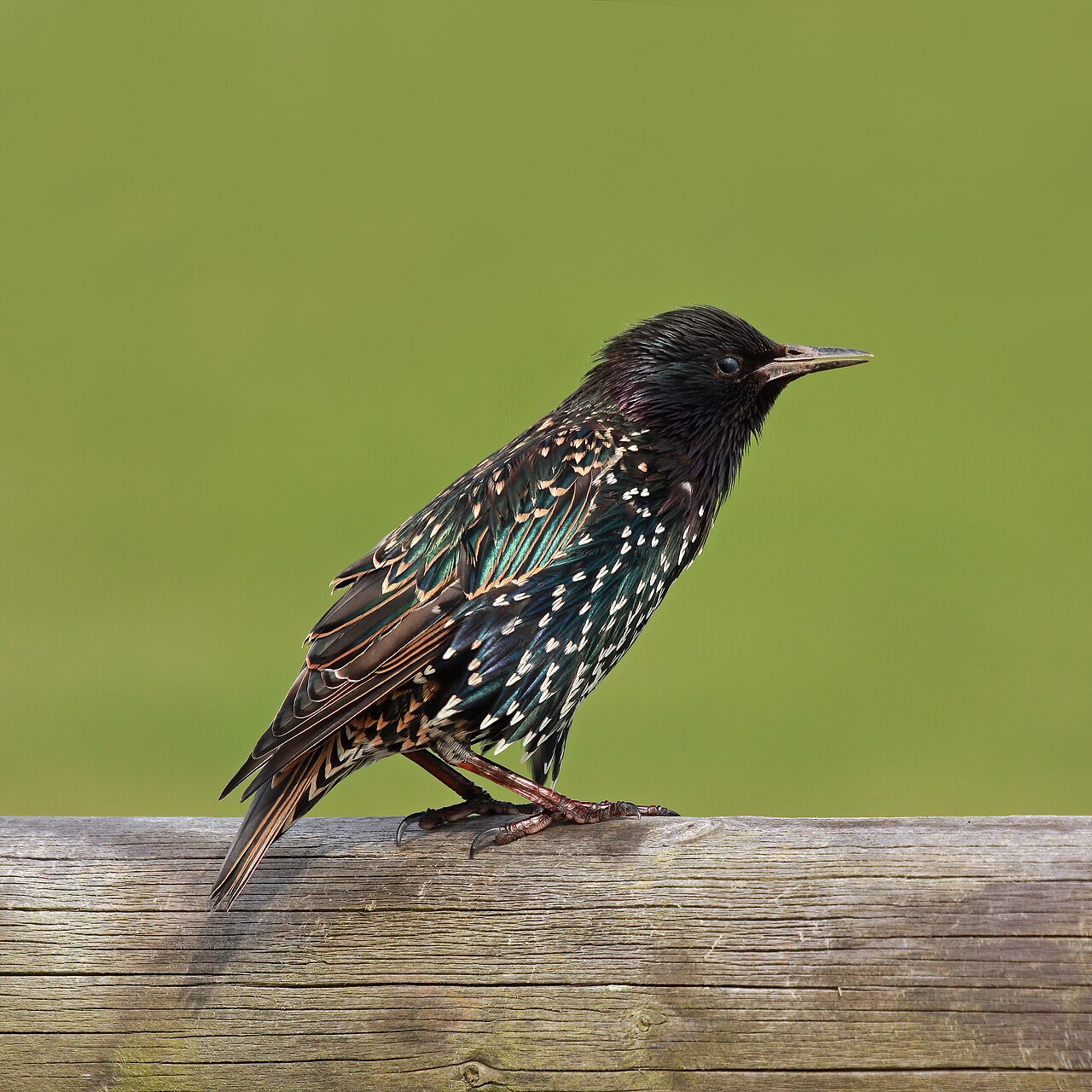
The European Starling is a small, chunky, short-tailed blackbird whose appearance changes dramatically with the seasons. In winter it is covered in crisp white spots on a dark, iridescent body, looking almost galaxy-like up close. By spring those spots wear away to reveal glossy black plumage shimmering with green and purple, and the bill turns bright yellow for the breeding season. The legs are pinkish-red year round, and the eye is dark.
Starlings are famously social, wheeling in huge coordinated flocks called murmurations and chattering with an astonishing range of whistles, clicks, and mimicked sounds. Introduced to North America in the 1890s, they are now one of the continent’s most abundant birds and are considered invasive, competing aggressively with native cavity nesters. Their short tail, spotted winter coat, and seasonal yellow bill separate them cleanly from grackles.
The third look-alike: Brown-headed Cowbird
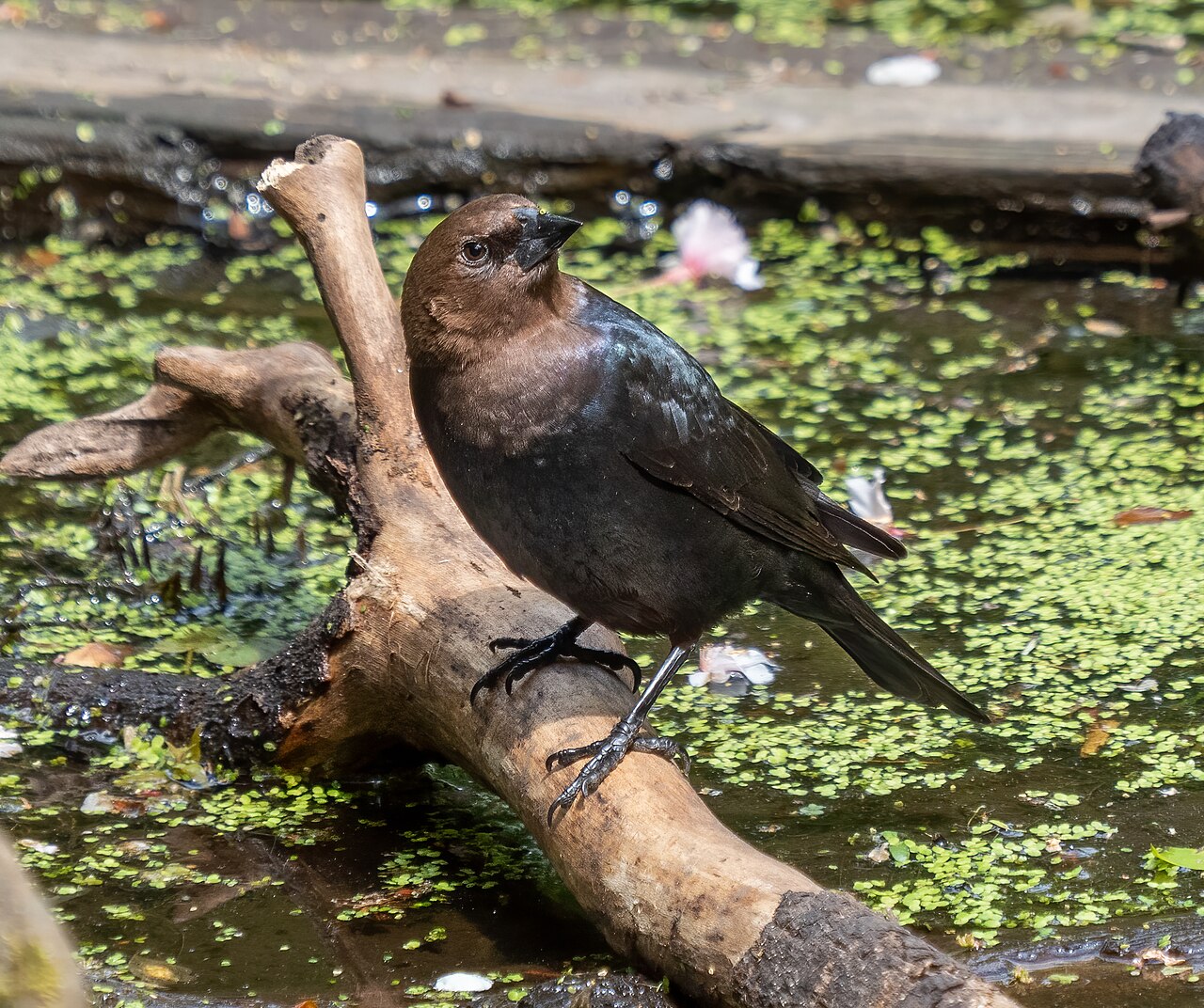
A third dark bird often joins grackle and starling flocks and adds to the confusion: the Brown-headed Cowbird. Cowbirds are smaller than grackles, about the size of a starling, with short tails and, in the male, a distinctive chocolate-brown head on a glossy black body. Their bill is short, thick, and conical, more finch-like than the grackle’s long dagger or the starling’s slender point. Females are plain grayish-brown all over.
Behavior helps too. Cowbirds are brood parasites, laying their eggs in other birds’ nests, and they often forage on the ground near livestock. If you see a compact black bird with a brown head and a stubby seed-cracking bill, you are looking at a cowbird, not a grackle or starling. Sorting all three at once, grackle by size and tail, starling by spots and short tail, cowbird by brown head and thick bill, is the key skill for a mixed winter flock.
Behavior, flocking, and voice
All three species flock, but the flocks feel different. Grackles form loud, sprawling groups that strut across open ground and roost in large numbers, sometimes in the thousands, in fall and winter. Starlings move as tight, fast, shape-shifting clouds, the murmurations that ripple and fold across evening skies. Cowbirds mix into these flocks in smaller numbers. Learning the flight style, the grackle’s loose ranks with trailing tails versus the starling’s dense, synchronized swarm, lets you identify birds too far away to see clearly.
Voice is another clue. Grackles produce a harsh, rusty-hinge readle-eak, starlings deliver a rambling medley of whistles and mimicry (they can imitate other birds and even mechanical sounds), and cowbirds give a liquid, bubbling gurgle followed by thin whistles. Once you connect these sounds to the birds, identification becomes second nature.
Why the difference matters
Beyond curiosity, telling these birds apart has real value. Starlings are a non-native, invasive species that competes with native birds for nest cavities and can dominate feeders, so many people manage their yards specifically to discourage them. Grackles, while sometimes considered a nuisance in large numbers, are a native part of the ecosystem. Cowbirds’ brood parasitism affects the nesting success of songbirds. Knowing which is which helps you make informed, humane decisions about feeding and habitat.
If large blackbird flocks are overwhelming your feeders, the usual approach is switching to feeders and foods they dislike rather than harming the birds. For more on the wider blackbird family and its look-alikes, explore our guides to types of blackbirds, common black birds, and the red-winged blackbird.
Other blackbirds you might confuse them with
Grackles, starlings, and cowbirds are the big three, but a few more dark birds join the mix regionally. The Rusty Blackbird appears in winter with rusty feather edges and a pale eye like a small grackle. Brewer’s Blackbird, common in the West, is glossy with a pale eye (male) and can resemble a compact grackle. In the South, the huge Boat-tailed and Great-tailed Grackles dwarf the Common Grackle with even longer, more dramatic tails.
The Red-winged Blackbird is easy in the male’s case, the red shoulder patch is unmistakable, but females are streaky brown and often mistaken for large sparrows. When a dark bird does not fit grackle, starling, or cowbird, these regional blackbirds are the next candidates. Our guide to black birds sorts the whole confusing group.
A quick field checklist for mixed flocks
When a mixed blackbird flock lands, run through a fast mental checklist. Check the tail first: long and keeled means grackle, short means starling or cowbird. Check the eye: pale yellow points to grackle. Check for spots: a speckled winter coat means starling. Check the head: a brown head on a black body means a male cowbird. Check the bill: long and pointed for grackle, thin and yellow (in spring) for starling, short and thick for cowbird.
Five quick looks, tail, eye, spots, head, bill, will name almost any bird in the flock. Size ties it together, with grackles clearly largest and cowbirds and starlings smaller. With a little practice this checklist runs in seconds, turning an intimidating swarm of “black birds” into a readable group of distinct species. The female grackle guide helps with the trickier duller birds.
Related reading: Raven vs Crow.
Frequently Asked Questions
What is the main difference between a grackle and a starling?
Size and tail. Grackles are larger, around 12 inches, with long keel-shaped tails and pale yellow eyes. Starlings are smaller, around 8 inches, with short tails, dark eyes, and speckled winter plumage.
Do grackles and starlings flock together?
Yes. In fall and winter, grackles, starlings, and cowbirds often gather in large mixed flocks, which is a major reason they get confused with one another.
How do I tell a starling from a grackle in winter?
In winter, starlings are covered in white spots and have short tails, while grackles are glossy black with long tails and pale yellow eyes. The spotted plumage is a giveaway for starlings.
What is the third bird that looks like a grackle and starling?
The Brown-headed Cowbird. Males have a chocolate-brown head on a black body with a short, thick bill, and they are smaller than grackles and similar in size to starlings.
Are starlings invasive?
Yes. European Starlings were introduced to North America in the 1890s and are now considered invasive, competing aggressively with native cavity-nesting birds. Grackles, by contrast, are native.
How can I tell them apart by sound?
Grackles make a harsh, rusty-hinge screech, starlings produce rambling whistles and mimic other sounds, and cowbirds give a liquid, bubbling gurgle followed by thin whistles.
Which is bigger, a grackle or a starling?
A grackle is significantly bigger, roughly 11 to 13 inches long including its long tail, while a starling is about 7.5 to 9 inches with a short tail.
Do grackles have yellow eyes?
Yes. Adult Common Grackles have distinctive pale yellow eyes, one of the most reliable ways to separate them from the dark-eyed starling.