Western Screech-Owl: Identification, Sounds, and Facts
The Western Screech-Owl is a small, ear-tufted owl of western North America, closely resembling its eastern cousin but distinguished by a dark bill and a very different call, a series of short whistles that accelerate like a bouncing ball coming to rest. Mostly gray and beautifully patterned to blend with bark, it is a common but easily overlooked owl of western woodlands, deserts, canyons, and suburbs. Like other screech-owls it is small enough to fit in a cupped hand yet is a capable nocturnal hunter. This guide explains how to identify a Western Screech-Owl, how to separate it from the Eastern Screech-Owl, its distinctive call, diet, nesting, and conservation.
| Feature | Detail |
|---|---|
| Scientific name | Megascops kennicottii |
| Length | 7.5 to 10 in (19 to 25 cm) |
| Wingspan | 21 to 24 in (54 to 61 cm) |
| Weight | 3.5 to 11 oz (100 to 305 g) |
| Bill color | Dark gray to blackish (a key mark) |
| Diet | Insects, small mammals, birds |
| Conservation | Least Concern (some local declines) |
How to identify a Western Screech-Owl
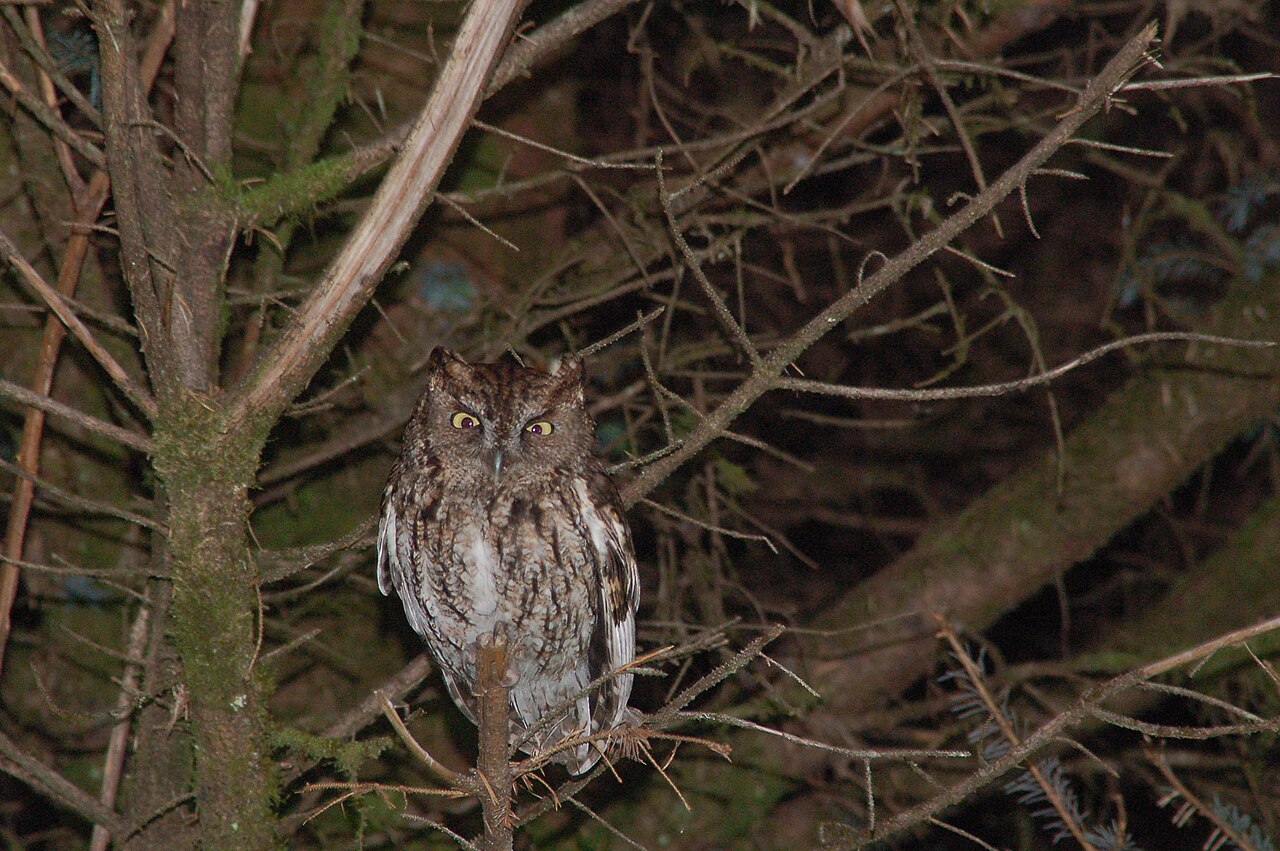
The Western Screech-Owl is a small owl, about eight to ten inches tall, with prominent ear tufts, bright yellow eyes, and dense bark-like patterning of streaks and bars. Most individuals are gray, though brownish birds occur in the Pacific Northwest, and the plumage is superbly camouflaged for roosting against tree trunks. A useful field mark is the bill, which is dark gray to blackish, and the facial disk is often bordered by a dark frame.
It is nearly identical in shape to the Eastern Screech-Owl, and the surest way to tell them apart is range and voice, since the two species barely overlap. Where they do meet, the Western’s dark bill contrasts with the Eastern’s paler, greenish-yellow bill. Its small size easily separates it from larger western owls. To see how it compares with relatives, visit our owl types guide.
Range and habitat
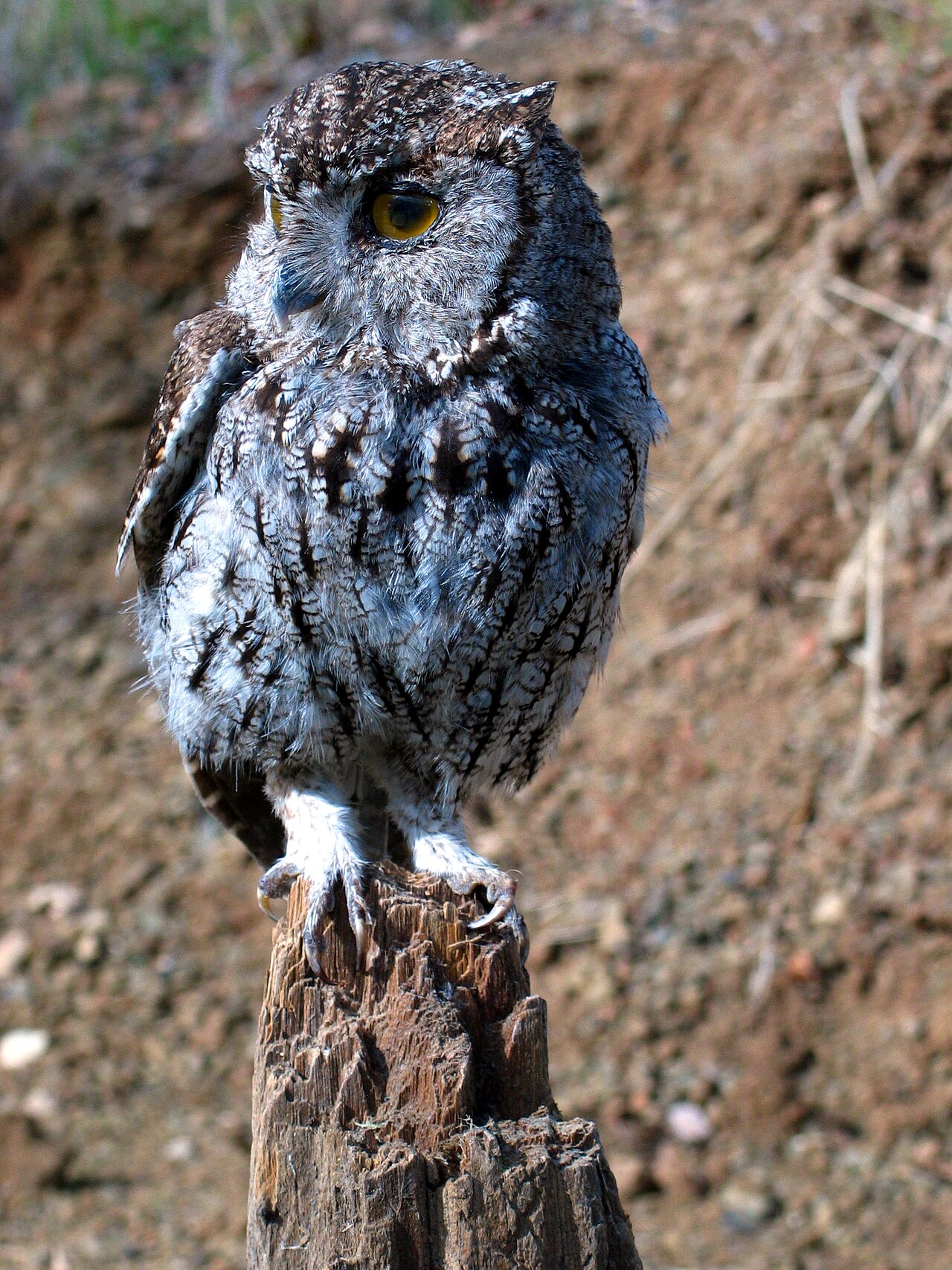
The Western Screech-Owl ranges across western North America, from southern Alaska and British Columbia down through the western United States and into Mexico. It is highly adaptable, occupying a wide variety of habitats including oak and riparian woodlands, desert washes lined with cactus and mesquite, pine-oak canyons, suburban parks, and gardens. In the Southwest it even nests in the holes of large saguaro cacti excavated by woodpeckers.
Like the Eastern Screech-Owl, this species is largely non-migratory and holds a year-round territory, roosting by day in tree cavities, dense foliage, or nest boxes. Its broad habitat tolerance means it lives close to many western communities, often unnoticed. Wherever there are cavities for nesting and open ground for hunting, from wild canyon to leafy backyard, the Western Screech-Owl can thrive.
What Western Screech-Owls eat
The Western Screech-Owl is an opportunistic predator with a varied diet. It hunts large insects such as beetles, moths, and crickets, along with small mammals like mice, voles, and pocket gophers, plus small birds, reptiles, amphibians, and even scorpions and crayfish in some regions. This flexibility allows it to exploit food from desert, woodland, and suburban settings alike, adjusting its menu to whatever is locally abundant.
It hunts at night from a perch, dropping silently onto prey, and swallows small items whole, later coughing up pellets of fur, bone, and insect parts. For its size it is a bold hunter, occasionally taking prey as large as itself. This adaptable feeding, shared by many owls in our guide to owl diets, is a big reason the Western Screech-Owl is so widespread across the varied landscapes of the West.
Western Screech-Owl sounds and calls
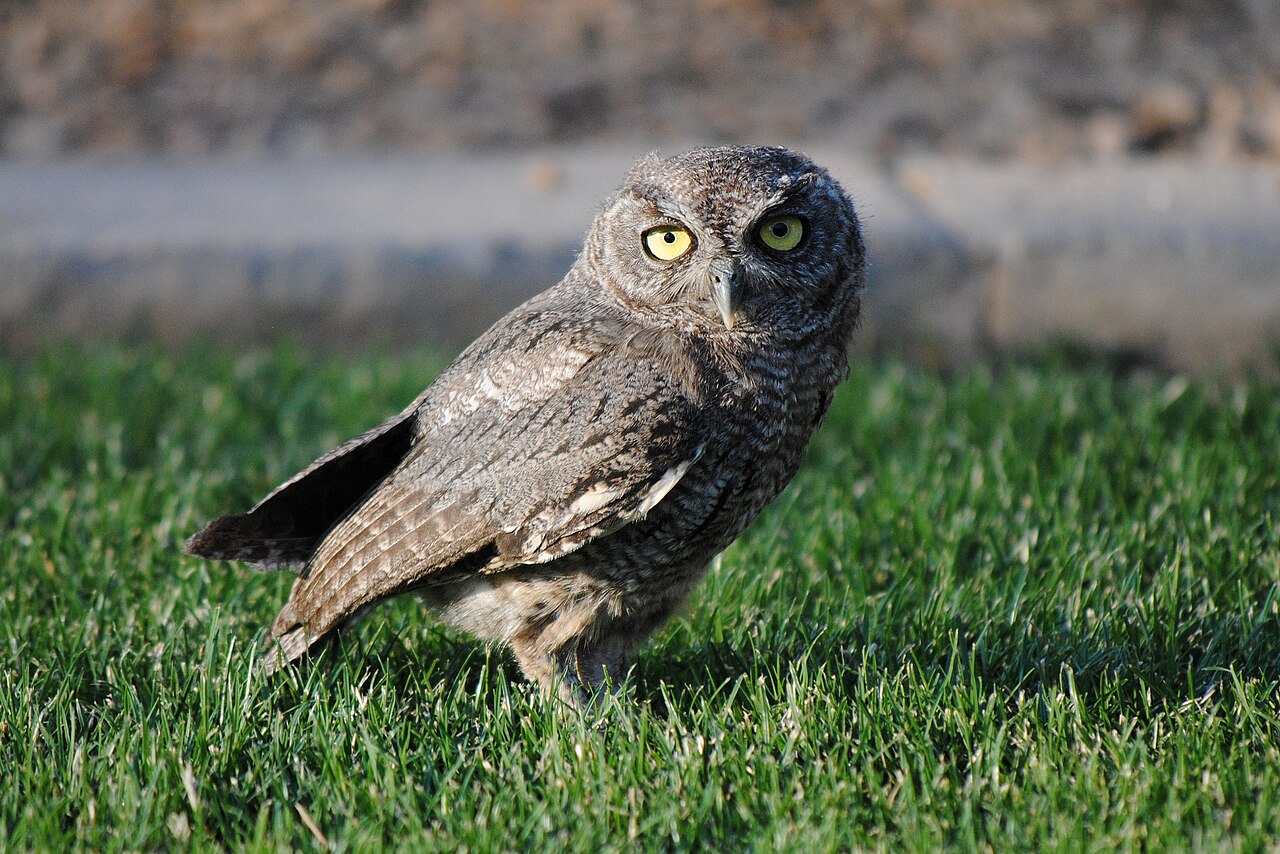
The Western Screech-Owl’s signature call is often described as a “bouncing ball” song: a series of short, hollow whistles that start slowly and accelerate at the end, like a dropped ball settling to rest. This accelerating tremolo is the easiest way to distinguish it from the Eastern Screech-Owl, whose main call is a descending whinny or a steady trill. A second Western call is a short trill followed by a longer one, sometimes given by pairs in a duet.
These calls are given mostly at night and are most frequent during the late-winter and spring breeding season. Because the two screech-owl species look so alike, voice is the single best identification tool where their ranges approach each other. If you hear an accelerating string of whistles in western woodland at night, you are listening to a Western Screech-Owl.
Nesting and life cycle
The Western Screech-Owl is a cavity nester that uses natural tree hollows, old woodpecker holes (including saguaro cavities in the desert), and nest boxes. It does not build a nest, laying its eggs on the debris at the bottom of the cavity. The female lays two to five white eggs, usually in spring, and incubates them for about a month while the male delivers food to the entrance.
The young hatch helpless and downy, then develop quickly, leaving the cavity after roughly four to five weeks and remaining with their parents while they learn to hunt. Pairs are typically monogamous and may reuse a good cavity in successive years. As with the Eastern species, this reliance on cavities means that preserving old trees, and providing boxes, directly supports Western Screech-Owl breeding.
Conservation and interesting facts
The Western Screech-Owl is listed as Least Concern overall, but some regional populations have declined, particularly in areas where riparian woodland has been lost or where the larger, invading Barred Owl has moved in and preys on smaller owls. Habitat loss, vehicle collisions, and rodenticides are the main threats, and according to Audubon, providing nest boxes is one of the most effective ways to help this owl recover locally.
A few facts add to its appeal: it can flatten its body and raise its ear tufts to mimic a broken branch when threatened, it nests inside giant cactus in the Sonoran Desert, and its bouncing-ball song is a classic sound of western nights. Owls of every kind carry rich symbolism, and the beliefs behind seeing an owl span cultures. To discover which owls live near you, explore regional guides such as types of owls in Texas.
Living alongside Western Screech-Owls
Western Screech-Owls are one of the owls most likely to share space with people across the West, from desert suburbs to riverside neighborhoods. They tolerate human company well, hunting insects around lights and rodents in gardens, and roosting quietly by day in a tree cavity, dense foliage, or a nest box. Many residents of the arid West have a resident screech-owl nearby without ever realizing it, betrayed only by the occasional bouncing-ball call after dark.
Encouraging them is straightforward: keep mature trees and cavities where possible, put up a nest box in a shaded spot near open ground or water, and avoid rodenticides that poison the small mammals the owls eat. In the Southwest, Western Screech-Owls even nest inside woodpecker holes in giant saguaro cactus, a reminder of how thoroughly this little owl has adapted to desert life.
Telling it from other small western owls
Several small owls share the Western Screech-Owl’s range, so a few pointers help. The Whiskered Screech-Owl, found in southeastern Arizona’s mountains, is very similar but smaller-footed and gives a different, more even-paced call, again making voice the key. The Northern Saw-whet Owl and the tiny pygmy-owls lack ear tufts entirely, so the Western Screech-Owl’s raised tufts rule them out.
Larger owls like the Great Horned Owl dwarf the screech-owl and have widely spaced tufts, so size settles those quickly. As always with screech-owls, the accelerating bouncing-ball song is the single most reliable identification, since plumage differences between these small gray owls are subtle in the field. Our owl types guide lays out the wider group.
Related reading: Snowy Owl.
Frequently Asked Questions
How do you tell a Western Screech-Owl from an Eastern Screech-Owl?
They look nearly identical but barely overlap in range. The Western has a dark gray-to-black bill and a bouncing-ball call that accelerates, while the Eastern has a paler bill and a descending whinny or steady trill.
What does a Western Screech-Owl sound like?
Its main call is a ‘bouncing ball’ song, a series of short whistles that start slow and speed up at the end. It is the best way to distinguish it from the Eastern Screech-Owl by ear.
How big is a Western Screech-Owl?
It is small, 7.5 to 10 inches tall with a 21 to 24 inch wingspan, weighing 3.5 to 11 ounces. It is roughly the size of its eastern cousin.
What do Western Screech-Owls eat?
Large insects, small mammals like mice and pocket gophers, small birds, reptiles, and even scorpions and crayfish. Their varied diet suits desert, woodland, and suburban habitats.
Where do Western Screech-Owls live?
Across western North America from Alaska to Mexico, in oak and riparian woodland, desert washes, canyons, and suburbs. In the Southwest they even nest in cavities inside saguaro cactus.
Do Western Screech-Owls use nest boxes?
Yes. Like the Eastern Screech-Owl, they readily accept nest boxes. Placing a box in shade near water improves your chances in dry western yards.
Are Western Screech-Owls gray or brown?
Most are gray, which aids bark camouflage, but brownish individuals occur in the humid Pacific Northwest. Color does not indicate the bird’s sex or age.
Are Western Screech-Owls endangered?
They are listed as Least Concern overall, but some regional populations have declined due to habitat loss and predation by the expanding Barred Owl. Nest boxes help local recovery.