White-Tailed Kite: Hovering Hunter
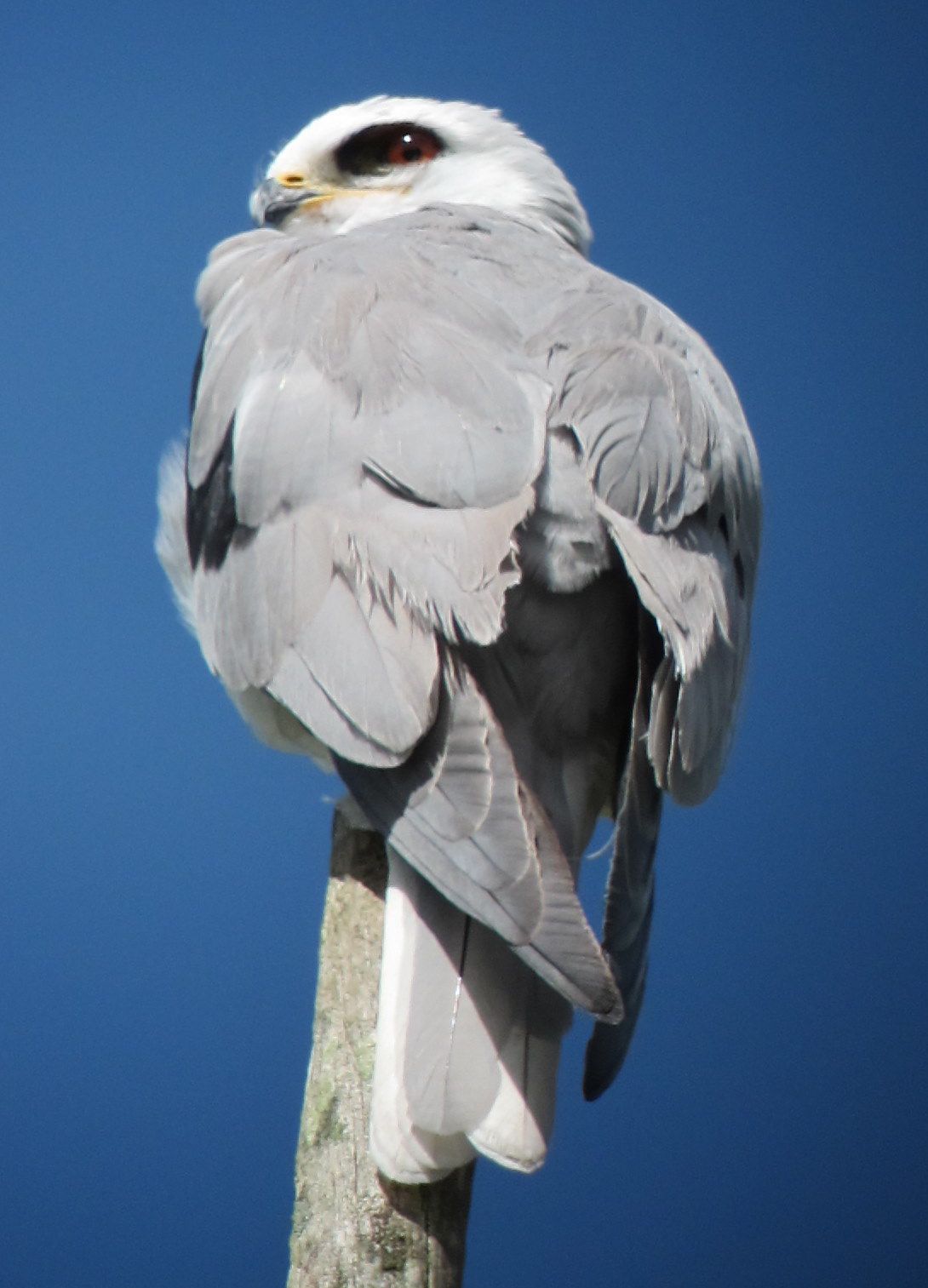
The white-tailed kite is a pale gray-and-white raptor of open grasslands and savanna, best known for hovering in place high over a field, wings beating and body held steady, before dropping straight down onto prey below. With its clean white underparts, gray back, black shoulder patches, and piercing red eyes, this graceful mid-sized raptor is a distinctive sight over open country in California, the Southwest, Texas, and Florida.
| Fact | Detail |
|---|---|
| Wingspan | About 3.3 ft |
| Weight | Around 0.75 lb |
| Diet | Small rodents, especially voles |
| Hunting style | Hovers in place, then drops on prey |
| Habitat | Open grassland, savanna, farmland in the West and South |
| Key field mark | Black shoulder patches, white tail, red eyes |
Size and Appearance
The white-tailed kite is a slender, medium-sized raptor with a wingspan of roughly three and a third feet and a light body weight under a pound, giving it a buoyant, floating quality in flight that suits its hovering hunting style. Its overall build is more delicate and less heavily muscled than a similarly sized buteo hawk, reflecting a lifestyle built around patient, precise rodent hunting rather than powerful pursuit or the taking of large prey. Adults are pale overall, with a soft gray back, clean white head, underparts, and tail, and a set of bold black patches on the shoulders that stand out sharply against the otherwise pale plumage, both perched and in flight. The eyes are a striking deep red in adults, a detail visible at close range that adds to the bird’s distinctive appearance. From below in flight, the combination of white underparts, black wingtips, and small dark patches near the bend of the wing gives the white-tailed kite a clean, unmistakable pattern quite unlike any hawk or falcon sharing its range.
The Hovering Specialist
The white-tailed kite is one of the most accomplished hovering hunters among North American raptors, capable of holding a fixed position in the air for extended stretches while it scans the ground directly below. This behavior, sometimes called kiting, involves the bird facing into the wind and beating its wings just enough to stay motionless relative to the ground, head angled down, before folding its wings and dropping straight onto prey in a controlled, parachute-like descent. While the American kestrel also hovers, the white-tailed kite does so more persistently and gracefully, often working the same field methodically from a series of hovering positions, a behavior that outlasts even the brief hovering of the smaller American kestrel. This hunting style makes the species especially easy to identify at a distance, since few other raptors hover so consistently and for so long over open grassland, and a distant white raptor hanging motionless in the air is often a white-tailed kite before any other field mark can even be made out. The hover itself is remarkably steady, with the bird holding its head and eyes locked on a single spot on the ground even as its wings work continuously to counter the wind.
Diet and Hunting
White-tailed kites feed almost entirely on small rodents, with voles making up the bulk of their diet across most of their range, supplemented by other small mammals and the occasional insect or small reptile. Their reliance on voles is so strong that local white-tailed kite numbers often rise and fall in step with vole population cycles, concentrating where rodent populations are high and thinning out when prey becomes scarce, a boom-and-bust relationship that shapes much of the species’ local movement and breeding success from one year to the next. A single kite can consume several voles in a day, and a breeding pair feeding hungry chicks must capture a substantial number of rodents daily to keep the nest supplied through the demanding weeks of chick rearing. The hovering hunting technique is perfectly suited to this diet, letting the kite spot the small movements of a vole in dense grass from directly above before dropping precisely onto it. Because they focus so heavily on rodents, white-tailed kites provide a genuine benefit to farmers and ranchers, functioning as natural rodent control over agricultural land, much like the ground-hunting red-tailed hawk, and a resident pair working a field can remove a considerable number of crop-damaging voles over the course of a single breeding season.
Range and Habitat
In the United States, white-tailed kites are found mainly in California, where they are most numerous, along with parts of the Southwest, Texas, and Florida, favoring open grassland, savanna, agricultural land, and marsh edges with scattered trees for perching and nesting. They tend to avoid dense forest and heavily developed areas alike, needing both open hunting ground rich in rodents and at least a few trees or tall shrubs for roosting and raising young. The species is largely non-migratory across most of its US range, though local populations can shift in response to changing prey availability, sometimes appearing in an area for a season and moving on as vole numbers change. White-tailed kite populations in North America went through a significant decline followed by a strong recovery and range expansion over the twentieth century, and according to the Cornell Lab of Ornithology the species has notably expanded and recolonized parts of its historic range in recent decades. For other open-country raptors that share similar hunting grounds, see our guide to hawk species and birds of prey.
Nesting and Behavior
White-tailed kites build stick nests in the upper branches of trees or large shrubs near open hunting grounds, and a pair will raise its young on a steady diet of voles and other small rodents delivered by both parents throughout the breeding season. Outside of nesting, white-tailed kites are notably social for a raptor, gathering in communal roosts of dozens of birds during the non-breeding season, sometimes sharing a single stand of trees with many other kites through the night before dispersing to hunt at dawn. This roosting behavior sets them apart from most solitary hawks and falcons and can make a known roost site a reliable place to observe multiple birds at once. Their close tie to vole populations also means white-tailed kites can appear somewhat nomadic, settling and breeding where rodent numbers are high one year and moving on when local prey declines, a flexibility that has helped the species recolonize former range. Compared with a fast, bird-hunting accipiter like the Cooper’s hawk, the white-tailed kite is a specialized, patient rodent hunter rather than an agile pursuer of other birds.
A Conservation Comeback
The white-tailed kite has one of the more encouraging population histories among North American raptors, having declined severely in the early twentieth century, particularly in California, to the point where the species was considered quite rare across much of its former range. Shooting and habitat loss drove much of that early decline, but with reduced persecution and shifting land use, white-tailed kite numbers rebounded strongly through the middle and later decades of the century, and the species recolonized areas where it had disappeared. This recovery and range expansion has continued into recent decades, with white-tailed kites now found in parts of the Southwest, Texas, and Florida that were outside their range during the low point of their decline. The species’ close dependence on vole populations means numbers still fluctuate locally from year to year, but the overall trajectory of recovery stands as a quiet success story, reflecting how quickly a specialized predator can rebound when persecution eases and suitable open grassland with abundant rodents remains available.
Related reading: Northern Goshawk.
Related reading: Mississippi Kite.
Frequently Asked Questions
What does a white-tailed kite look like?
A white-tailed kite is a pale gray-and-white raptor with black shoulder patches, a white tail, black wingtips, and striking red eyes in adults.
Why do white-tailed kites hover?
White-tailed kites hover to hunt, holding a fixed position in the air while scanning the grass below for rodents, then dropping straight down onto prey once it is spotted.
What do white-tailed kites eat?
They feed almost entirely on small rodents, especially voles, supplemented occasionally by other small mammals, insects, or small reptiles.
Where do white-tailed kites live?
In the US they are found mainly in California, along with parts of the Southwest, Texas, and Florida, in open grassland, savanna, and farmland with scattered trees.
How big is a white-tailed kite?
A white-tailed kite has a wingspan of about 3.3 feet and weighs around three-quarters of a pound, making it a slender, lightweight, medium-sized raptor.
Are white-tailed kites rare?
They are localized but not rare within their range, and the species has expanded and recolonized parts of its historic range in recent decades after an earlier decline.
Do white-tailed kites migrate?
They are largely non-migratory across most of their US range, though local populations can shift in response to changing rodent prey availability.