Coyote vs Wolf: Key Differences Explained
Coyotes and wolves are closely related canid species that are frequently confused, especially at a distance or without a size reference, but they differ substantially in size, build, social structure, and habitat. A wolf typically outweighs a coyote by two to three times and lives in structured packs, while a coyote is smaller, more solitary or family-oriented, and dramatically more adaptable to human-altered landscapes. This guide covers the key visual, behavioral, and track differences that reliably separate the two.
| Trait | Coyote | Wolf |
|---|---|---|
| Weight | 20 to 50 lbs | 70 to 150 lbs |
| Shoulder height | ~24 inches | Up to 30 inches |
| Snout/muzzle | Narrow, pointed | Broad, blocky |
| Ears | Large relative to head, pointed | Smaller, rounded relative to head |
| Social structure | Solitary or small family groups | Structured packs of 6-10+ |
| Track size | ~2 to 3 inches | 4 to 5 inches |
Coyote vs Wolf Size Comparison
Size is the single biggest and most reliable difference between the two species, though it can be genuinely difficult to judge without something for scale nearby. Adult coyotes typically weigh between 20 and 50 pounds, standing around 24 inches at the shoulder and measuring roughly 3.3 to 4.3 feet long, while adult wolves are significantly larger, commonly weighing 70 to 150 pounds, standing up to 30 inches at the shoulder, and reaching lengths of up to 6.6 feet. A useful rule of thumb offered by wildlife biologists: if an animal looks roughly the size of a German Shepherd or larger, it is very likely a wolf, while something closer to the size of a slim medium dog is much more likely a coyote.
Coyote vs Wolf Howls
Vocal differences offer another reliable, if less commonly relied-upon, identification clue. Coyote howls and yips tend to be higher-pitched, shorter, and delivered in rapid, chattering bursts that can make a small group sound far larger than it actually is, an acoustic illusion researchers have documented and measured directly. Wolf howls, by contrast, are lower, longer, and more sustained, typically without the sharp yipping interspersed throughout a coyote’s characteristic vocal style, making sound itself a genuinely useful, if situational, way to tell the two species apart even without a visual sighting.
Physical Differences: Face, Ears, and Build
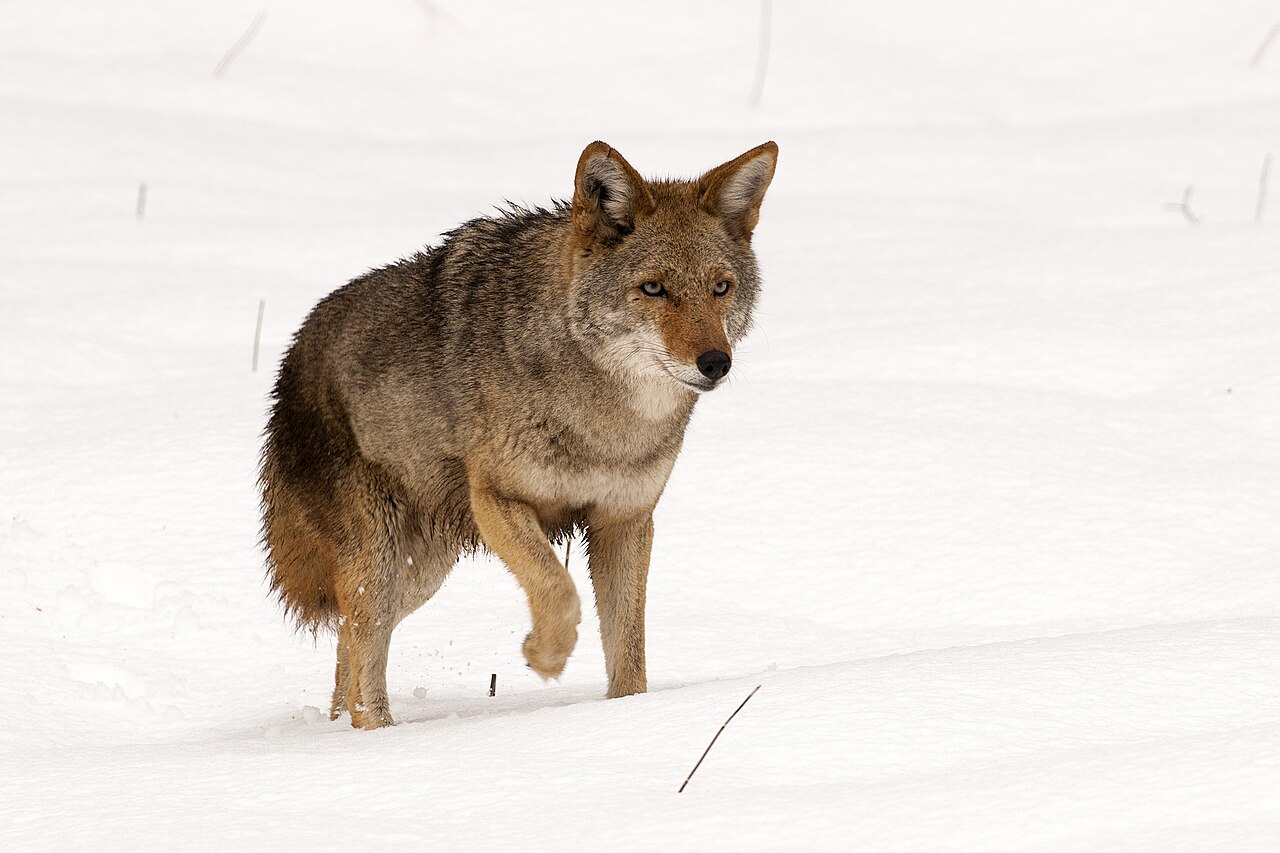
Beyond overall size, several facial and body features reliably distinguish the two species even when a size reference is not available. Wolves have broad, blocky snouts and larger, more powerful jaws built for tackling large prey, while coyotes have a narrower, more pointed muzzle suited to foraging and catching smaller prey. Coyote ears are notably large relative to their head size and stand pointed, while wolves have comparatively smaller, more rounded ears relative to their bigger heads. Build differs too: wolves have longer legs and noticeably larger paws relative to body size, giving them a leggier, more powerful appearance built for covering long distances, while coyotes look more compact and gangly by comparison, with a bushy tail typically held low while walking, in contrast to a wolf’s tail, which is often held level with the back.
Coyote vs Wolf Tracks
When a direct sighting is not possible, tracks offer a reliable way to identify which species has passed through an area. Coyote tracks measure roughly 2 to 3 inches across, while wolf tracks run considerably larger at 4 to 5 inches, nearly double the size, according to wildlife agency guidance. Wolf tracks also tend to show a longer, more splayed, circular impression from their larger, more padded paws, with claw marks less pronounced than on a coyote track. Beyond size, movement pattern matters too: both wild wolves and coyotes tend to travel in a purposeful, fairly straight line toward a destination, unlike domestic dogs, which typically meander, sniff around, and double back toward their owners.
Coyote vs Wolf Scat
Droppings offer another identification clue when tracks or direct sightings are not available. Wolf scat is generally larger, at least an inch in diameter and up to 7 inches long, with tapered ends and visible fur, sometimes containing bone fragments from the large ungulates like deer or elk that make up a significant part of a wolf’s diet. Coyote scat looks broadly similar in overall shape but runs smaller, typically under an inch in diameter, and tends to contain more hair from small furbearers and rodents, reflecting a coyote’s typically smaller prey base. Domestic dog scat looks distinctly different from either wild species, since it is generally uniform and full of dog food rather than showing the fur and bone content typical of a genuinely wild predator’s diet.
Social Structure: Packs vs Solitary Living
Wolves are deeply social animals that live in structured, hierarchical packs typically composed of an alpha breeding pair and their offspring, usually numbering 6 to 10 members though larger packs occur; cooperation within this structure is essential for hunting the large prey wolves typically pursue. Coyotes, by contrast, are considerably more flexible in their social arrangements, often living solitarily or in small family groups rather than large, rigid packs, though they can and do form temporary larger groups when a substantial food source, like a large carcass, justifies the cooperation. This difference in social structure is directly tied to prey size: wolves need pack cooperation to bring down large ungulates, while a coyote’s typically smaller prey base of rodents, rabbits, and birds requires far less coordinated group effort.
Habitat and Range Differences
Wolves generally prefer remote wilderness habitats such as forests, tundra, and mountain ranges well away from concentrated human activity, and their range across the United States has been considerably reduced from its historical extent due to habitat loss and past persecution. Coyotes, in sharp contrast, are remarkably adaptable and thrive across an enormous range of environments, from wildlands to dense urban centers, which is a major reason coyotes remain common and widespread even in areas where wolves have long been extirpated. In regions where wolf populations are actively recovering, such as parts of the Rocky Mountains and Great Lakes region, the two species’ ranges can overlap, requiring extra caution and expertise to correctly identify which animal is actually present, particularly since misidentifying a wolf as a coyote can carry real legal consequences given that wolves are federally protected in many areas.
Behavioral Differences Beyond Diet and Social Structure
Beyond diet and pack structure, coyotes and wolves show meaningfully different behavior around humans and human-altered landscapes. Wolves generally avoid direct human contact and tend to retreat well before an encounter becomes close, a caution reinforced by decades of persecution across much of their historical range. Coyotes, while still naturally wary, have adapted far more readily to human presence, regularly denning near suburban neighborhoods, golf courses, and even city parks, a flexibility that directly parallels their broader adaptability compared with wolves.
Coyote and Wolf Diet Differences
Diet reflects the same size and social differences seen elsewhere between the species. Wolves, hunting cooperatively in packs, regularly take down large ungulates like deer, elk, and even moose, prey that would be impossible for a solitary or small-group predator to bring down safely. Coyotes, working alone or in much smaller groups, focus primarily on smaller prey: rodents, rabbits, birds, and other small mammals, though they are opportunistic enough to scavenge carrion or occasionally take down larger prey like a deer fawn when the opportunity arises, particularly when working cooperatively with a mate or small family group.
Do Coyotes and Wolves Interbreed?
Yes, and this hybridization has produced a well-documented result: since the late 1960s, scientists have tracked the emergence of “eastern coyotes,” sometimes nicknamed “coywolves,” which carry primarily coyote DNA alongside meaningful genetic contributions from both wolves and domestic dogs. These hybrids tend to be noticeably larger and bulkier than typical western coyotes, blurring some of the standard size-based identification cues in regions where this hybridization has been most prevalent, particularly in parts of the northeastern United States and eastern Canada. This genetic overlap is one more reason that definitive identification in genuinely ambiguous cases sometimes requires more than visual assessment alone, occasionally necessitating DNA testing to resolve with real certainty.
Related reading: Baby Raccoon.
Related reading: Wolf Sounds.
Frequently Asked Questions
What is the main difference between a coyote and a wolf?
Size is the biggest difference: wolves typically weigh 70 to 150 pounds versus 20 to 50 pounds for coyotes. Wolves also have broader snouts, smaller rounded ears, and live in structured packs, while coyotes are more solitary or in small family groups.
How can you tell coyote and wolf tracks apart?
Coyote tracks measure roughly 2 to 3 inches across, while wolf tracks run 4 to 5 inches, nearly double the size. Wolf tracks also show a more splayed, rounded shape from their larger, more padded paws.
Do coyotes and wolves live in the same areas?
Their ranges can overlap in places like the Rocky Mountains and Great Lakes region where wolf populations are recovering, but wolves generally prefer remote wilderness while coyotes thrive in a much wider range of habitats, including cities.
Can coyotes and wolves interbreed?
Yes, this has produced documented hybrids called eastern coyotes or coywolves, which carry mostly coyote DNA with meaningful wolf and domestic dog ancestry, and tend to be larger than typical western coyotes.
Do wolves and coyotes live in packs the same way?
No, wolves live in structured, hierarchical packs of typically 6 to 10 members built around an alpha breeding pair. Coyotes are more flexible, often solitary or in small family groups rather than large rigid packs.
How can you tell coyote and wolf scat apart?
Wolf scat is larger, at least an inch in diameter and up to 7 inches long, often containing bone from large prey. Coyote scat is smaller, under an inch in diameter, with more small-mammal hair reflecting a coyote’s smaller typical prey.
Why does it matter whether I’m looking at a coyote or a wolf?
Correct identification matters both for safety and legally, since wolves are federally protected in many areas and mistaking one for a coyote, particularly while hunting, can carry serious legal consequences.
Whether the goal is safe identification while hiking, understanding local wildlife regulations, or simply satisfying curiosity after a distant sighting, the combination of size, facial features, and behavioral context covered here reliably separates these two closely related but genuinely distinct canid species in the vast majority of real-world encounters.
For anyone hoping to distinguish these two species based on their distinctive calls alone, a closer look at other backyard canids covers the howls, yips, and barks in far more detail than a size and appearance comparison alone can offer, since sound is often the very first clue available long before any visual sighting occurs.
Beyond the two species covered here, a wider comparison against other backyard predators, from reptile hunters to birds of prey, rounds out a fuller picture of the predator hierarchy sharing space across most North American landscapes.
Wildlife agencies and biologists continue to monitor both species closely across North America, and understanding these core differences helps outdoor enthusiasts, hunters, and curious observers alike engage with genuine confidence rather than guesswork the next time either animal, or a similarly easy-to-misidentify smaller mammal, crosses their path.
Photographs and trail camera footage comparing the two species side by side, when available, remain the single most reliable way to confirm identification with real certainty, since even experienced observers occasionally find themselves second-guessing a distant or partially obscured sighting, not unlike the careful visual comparison needed to tell apart similar-looking raptor species in the field.