Buzzard vs Vulture: Why the Answer Depends on Where You Are
The answer to buzzard versus vulture depends entirely on which country you are standing in. In North America, buzzard is a common nickname for the turkey vulture, so the two words describe the same bird. In Britain and across Europe, a buzzard is a Buteo hawk that hunts live prey and has nothing to do with vultures at all.
That transatlantic split causes constant confusion, and it is not a case of one usage being wrong. Both are established, both are centuries old, and the mismatch traces back to early English colonists applying a familiar name to an unfamiliar bird. This guide sorts out the terminology, then covers how to identify a turkey vulture in flight, the black vulture comparison, where condors fit, and why vultures matter far more than their reputation suggests.
| Term | In North America | In Britain and Europe |
|---|---|---|
| Buzzard | Nickname for turkey vulture | Buteo hawk, a live-prey raptor |
| Vulture | Turkey and black vulture, Cathartidae | Griffon, cinereous and Egyptian vultures |
| Buteo equivalent | Called a hawk, e.g. red-tailed hawk | Called a buzzard, e.g. common buzzard |
| Feeds on | Vultures: carrion almost exclusively | Buzzards: live prey plus some carrion |
| Head | Vultures: bare skin, red or black | Buzzards: fully feathered |
| Feet | Vultures: weak, chicken-like | Buzzards: strong talons for killing |
In North America, buzzard is a nickname for the turkey vulture, so the two words mean the same bird. In Britain and across Europe a buzzard is a Buteo hawk, a different family entirely. The word travelled with settlers and attached itself to the wrong bird.
It Depends Which Country You Are In
In the United States and Canada, calling a turkey vulture a buzzard is entirely normal usage, especially in the south, and turkey buzzard is a long-established regional name. Nobody is being imprecise, and the bird meant is Cathartes aura.
In Britain, Ireland, and most of Europe, buzzard means a member of the genus Buteo, principally the common buzzard (Buteo buteo). That is a medium-sized raptor with a feathered head and strong talons that hunts rabbits, voles, and other live prey, and it is the ecological counterpart of the North American red-tailed hawk.
The confusion originated with early English settlers in North America. Seeing large soaring birds overhead, they reached for the familiar English word, and the name attached to a completely different family. The result is that a British birder and an American birder can use the same word about entirely unrelated birds without either noticing.
What Americans Call a Buzzard
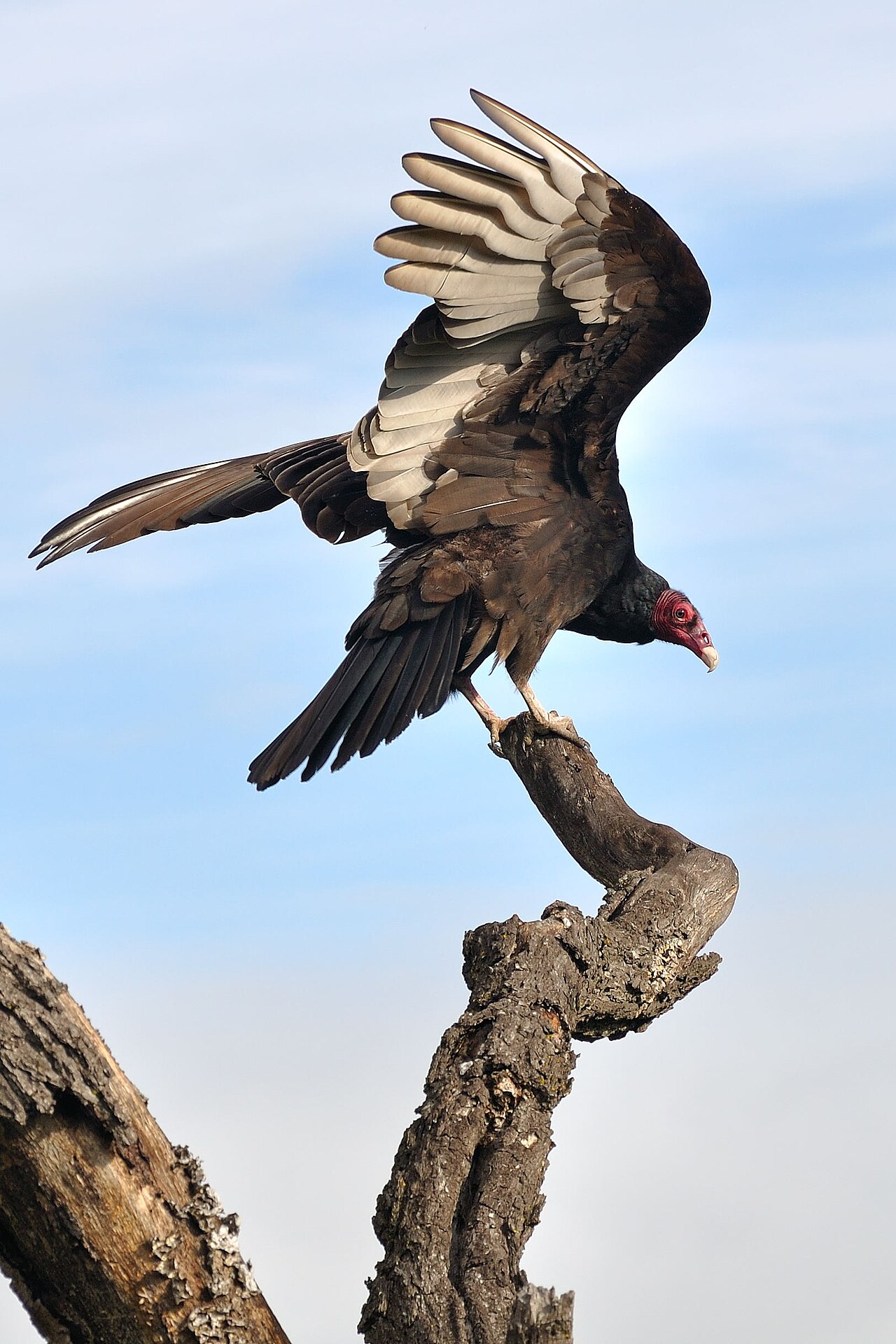
The turkey vulture is the bird meant in North American usage. It has a wingspan of 5.5 to 6 ft, dark brown-black plumage, and a small bare red head that gives it the turkey comparison. Juveniles have grey heads, which causes some misidentification as black vultures.
It feeds almost exclusively on carrion and is remarkable for how it finds it. Turkey vultures have an exceptionally developed sense of smell, unusual among birds, and can detect ethyl mercaptan, a gas released by decomposing tissue, from considerable distances. Gas utilities have historically injected that same compound into pipelines and located leaks by watching where vultures circled.
Their feet reveal the lifestyle. Turkey vulture feet are weak and relatively flat, closer to a chicken’s than to a hawk’s, because they never need to kill or carry prey. That is one of the clearest physical distinctions from any true raptor, including the European buzzard.
What a Buzzard Is in Europe
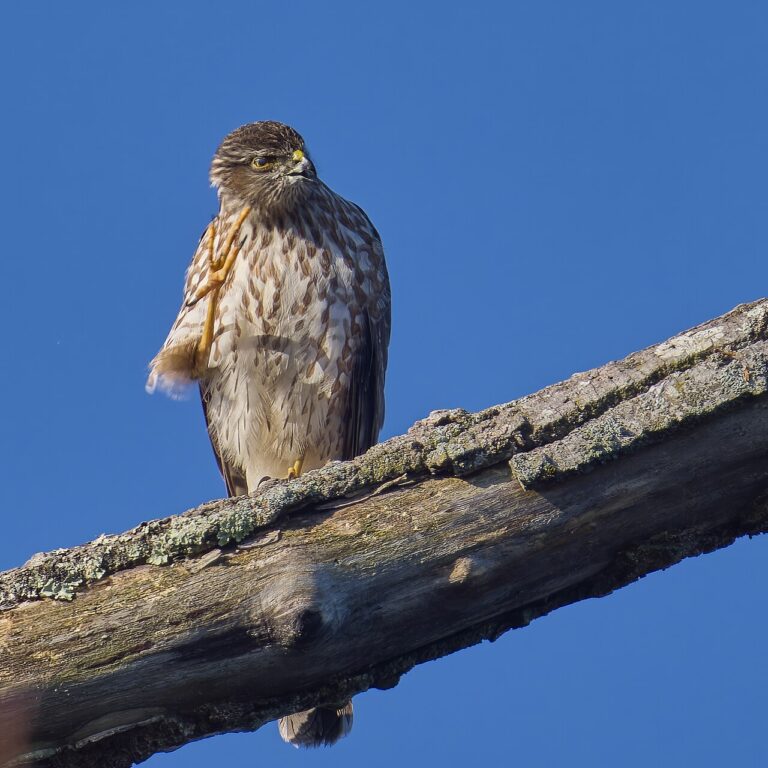
The common buzzard is a Buteo with a wingspan of about 3.5 to 4.5 ft, broad rounded wings, a short fanned tail, and highly variable plumage from nearly white to dark brown. It is the most abundant raptor in much of Europe and is frequently seen perched on fence posts and lamp standards along roadsides.
It hunts live prey. Voles, rabbits, small birds, reptiles, and large insects make up the bulk of the diet, taken by dropping from a perch or a low hover, and it will also take carrion opportunistically, particularly roadkill in winter.
Structurally it is a hawk in every respect that matters. Fully feathered head, powerful gripping talons, hooked killing bill, and the hunting behavior to match. Anyone in North America wanting the equivalent bird should look at the red-tailed hawk, which our guide to the red-tailed hawk covers, and our guide to hawk vs falcon handles a related identification question.
Turkey Vulture or Hawk? Reading the Flight
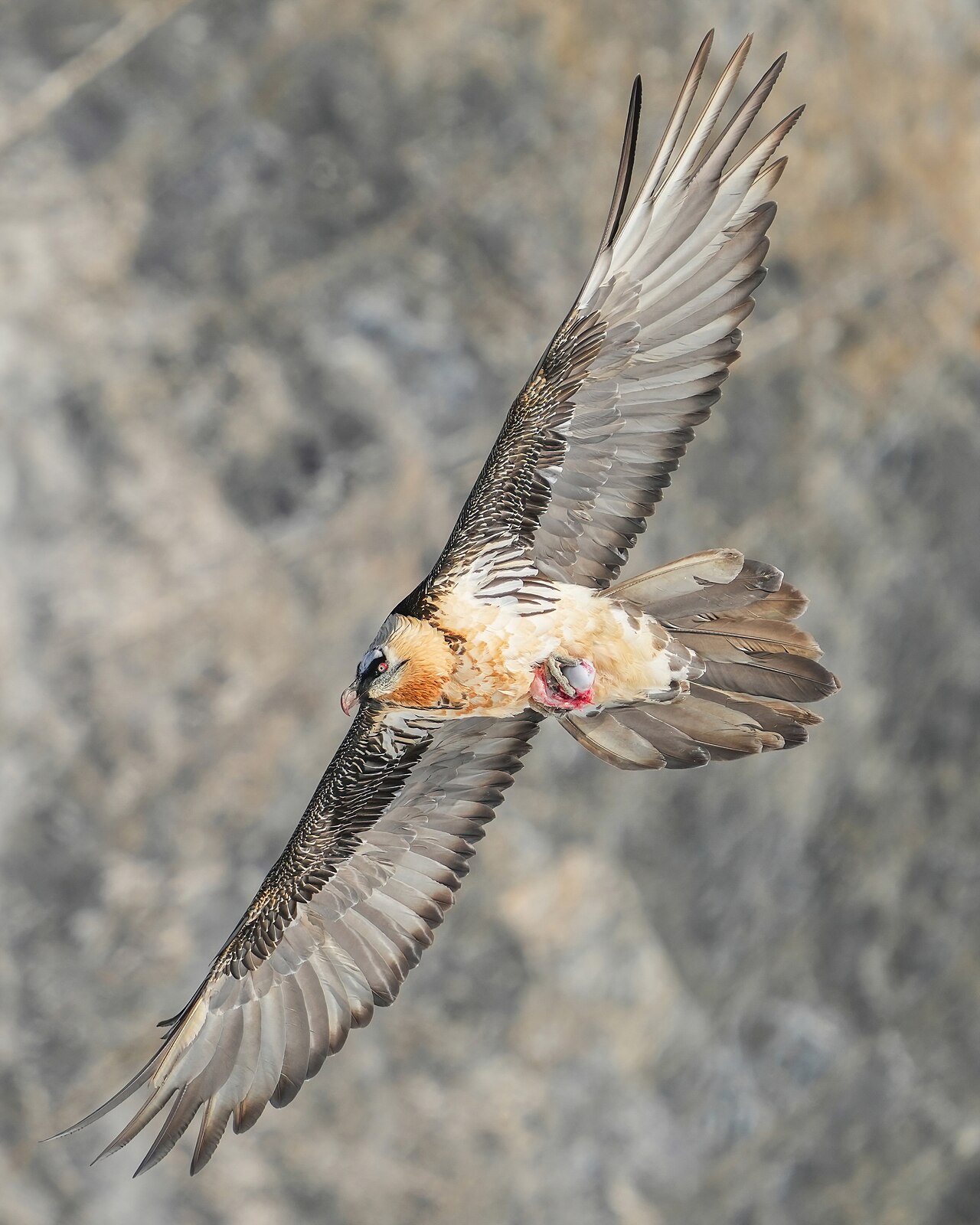
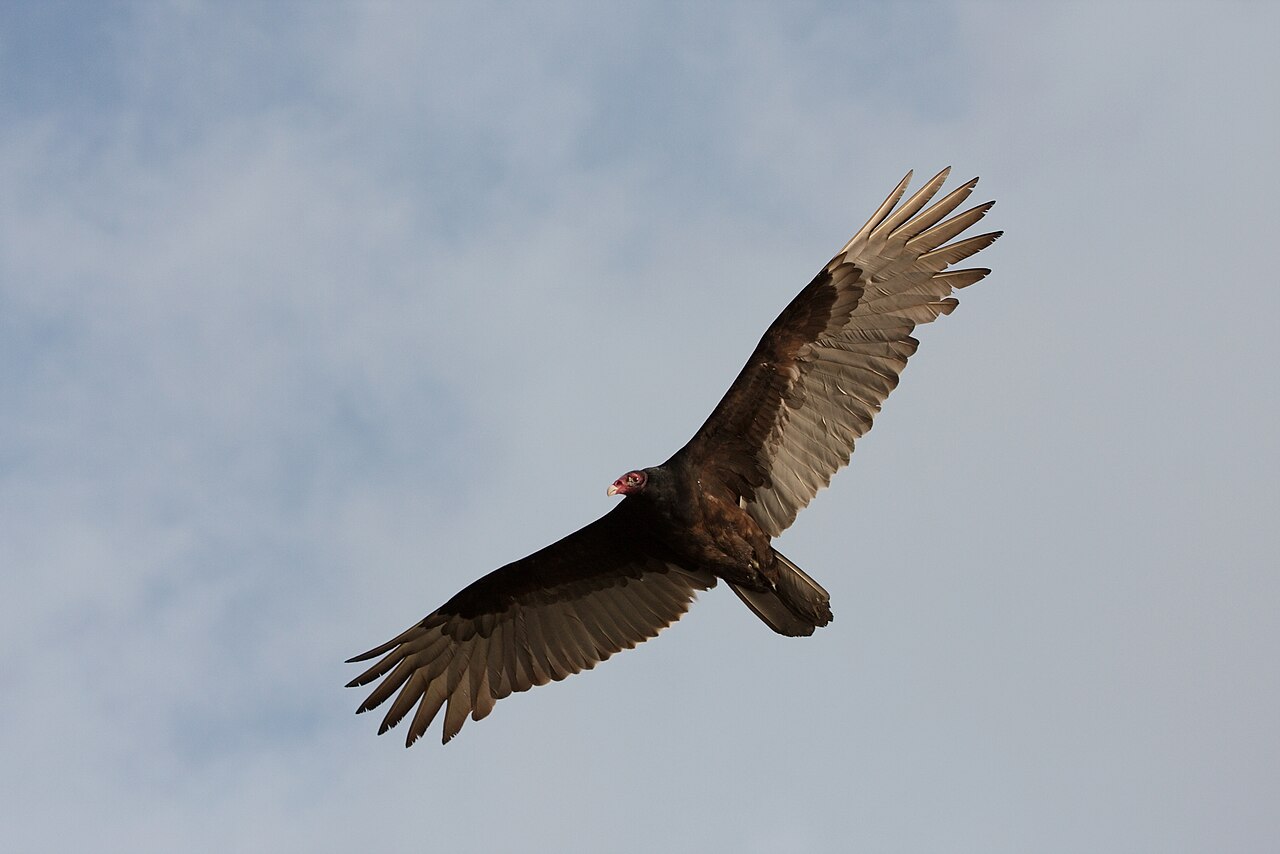
Flight style separates them at any distance, and it is more reliable than plumage. Turkey vultures soar with their wings held in a pronounced V, called a dihedral, and they rock and teeter noticeably as they ride thermals, adjusting constantly.
Hawks hold their wings flat or nearly flat and fly with a steadier, more stable profile. A large dark bird wobbling across the sky in a shallow V is a turkey vulture almost every time, and this single cue resolves the majority of sightings without binoculars.
Wing shape and underwing pattern confirm it. Turkey vultures show two-toned underwings, dark along the leading edge with paler silvery flight feathers behind, and they have long fingered primaries and a long tail. They also rarely flap, using thermals with remarkable efficiency and covering long distances on almost no wingbeats. Our guide to birds that look like hawks covers the wider set of confusions this produces.
Turkey Vulture vs Black Vulture
Both occur across the southern and eastern United States and are frequently seen together at carcasses. The head settles it: turkey vultures have a bare red head as adults, black vultures a bare grey-black head at all ages.
Flight differs too. Black vultures have shorter, broader wings, a short square tail, and a distinctly choppier flight with frequent bursts of flapping between glides, and they hold their wings flatter. In the air they show white patches at the wingtips only, rather than the turkey vulture’s silvery trailing edge along the whole wing.
Behavior is the most practical difference. Black vultures have a poor sense of smell and often locate food by watching turkey vultures, then displace them at a carcass because they arrive in groups and are more aggressive. They are also known to attack weak or newborn livestock, which turkey vultures do not, and that behavior is behind most vulture conflict with farmers. Our guide to types of vultures covers the full range of species.
New World and Old World Vultures Are Not Related
This is the fact that surprises most people. The vultures of the Americas, family Cathartidae, and the vultures of Europe, Africa, and Asia, in the family Accipitridae alongside eagles and hawks, are not close relatives. They evolved similar bodies and habits independently.
Convergent evolution explains the similarity. Scavenging on large carcasses selects for the same solutions everywhere: broad wings for efficient soaring, a bare head that stays cleaner when feeding inside a body cavity, corrosive stomach acid that neutralizes pathogens, and excellent long-distance vision. Two unrelated lineages arrived at nearly the same design.
The differences show where the shared pressure did not reach. New World vultures have perforate nostrils, meaning you can see through the beak from one side to the other, and several species including the turkey vulture have a strong sense of smell. Old World vultures have solid nasal septa and locate carcasses almost entirely by sight. The exact placement of Cathartidae on the bird family tree has been revised repeatedly, and current genetic work places them close to, but distinct from, the hawks and eagles.
Where Condors Fit
Condors are New World vultures, members of the same family Cathartidae as turkey and black vultures, and simply the largest of them. The California condor has a wingspan approaching 10 ft and the Andean condor is heavier still, making them among the largest flying birds alive.
Behaviorally they are vultures in every respect, feeding on carrion, soaring on thermals, and carrying bare heads. The main practical differences are scale and rarity, and a condor is unmistakable next to a turkey vulture once seen.
The California condor is also one of conservation’s most expensive case studies. The population fell to 22 individuals in the 1980s, every remaining bird was taken into captivity, and a captive breeding and release program has since brought the wild population back into the hundreds. Lead poisoning from ammunition fragments in carcasses remains the leading cause of death, which is why non-lead ammunition matters in condor range.
Why Vultures Matter
Vultures are a public health service performed for free. A group can strip a large carcass within hours, removing material that would otherwise support flies, rodents, and feral dogs and leach pathogens into soil and water. Their stomach acid is extraordinarily corrosive, letting them consume tissue carrying anthrax, botulinum toxin, and cholera without becoming infected or spreading it.
The value became measurable when the service was removed. Vulture populations across South Asia collapsed by more than 95 percent from the 1990s onward after the veterinary drug diclofenac, given to cattle, proved fatal to birds feeding on treated carcasses. Feral dog populations rose in the vacuum, and studies have linked the collapse to a substantial increase in human rabies deaths, with the total economic and health cost estimated in the tens of billions of dollars.
North American vultures face milder but real pressures. Vehicle strikes, lead poisoning from ammunition, secondary poisoning from rodenticides, and deliberate persecution all take a toll, and all vultures in the United States are protected under the Migratory Bird Treaty Act, making it illegal to kill or harass them without a federal permit.
Are Vultures Dangerous?
No. Vultures have weak feet unsuited to grasping, they do not hunt live prey, and there are no documented attacks on people. A vulture on a roof or a fence post is looking for thermals and carrion, not opportunity.
Their defense is memorable rather than dangerous. A threatened vulture vomits, producing a foul and highly acidic projectile that both deters the threat and lightens the bird for a fast takeoff. They also practice urohidrosis, defecating on their own legs to cool by evaporation, which is unhygienic in appearance but harmless.
Property damage is the genuine complaint, and it is almost entirely black vultures. Roosting groups pull at rubber roofing, window seals, and vehicle wiper blades, and large roosts create real mess. Deterrence rather than removal is both the legal and effective route, using effigies, lighting, and habitat modification, since killing them requires a federal permit. Our guide to discouraging hawks at feeders covers a similar principle for a different protected raptor.
What Is a Flock of Buzzards Called?
The collective nouns for vultures are unusually specific and depend on what the birds are doing. A group circling in the air is a kettle, from the way rising thermals make them look like something boiling in a pot. A group perched together in a tree or on a roof is a committee. A group feeding on the ground at a carcass is a wake.
Kettle is the one worth knowing, because it describes the behaviour that most often prompts the question. Turkey vultures are poor flappers and superb soarers, so they gather where thermals rise, spiral upward together to gain height for free, then glide off along the ridge. A kettle of dozens is normal in autumn migration and is not a sign that something has died nearby.
In Britain, where buzzard means a Buteo hawk, none of these apply and the term used is simply a wake or a flock. That mismatch is a small illustration of the underlying problem: the same word points at two unrelated birds with completely different habits. Audubon’s Turkey Vulture account covers the soaring and roosting behaviour behind the names.
Frequently Asked Questions
What is the difference between a buzzard and a vulture?
It depends on the country. In North America, buzzard is a nickname for the turkey vulture, so they are the same bird. In Britain and Europe, a buzzard is a Buteo hawk that hunts live prey and is unrelated to vultures.
Is a turkey buzzard the same as a turkey vulture?
Yes. Turkey buzzard is a long-established regional name in the United States for Cathartes aura, the turkey vulture. Both names refer to the same species, and neither is incorrect in American usage.
How do I tell a turkey vulture from a hawk in flight?
Turkey vultures soar with wings held in a pronounced V and rock or teeter constantly, while hawks hold their wings flat and fly steadily. Vultures also show two-toned underwings with silvery trailing edges and rarely flap.
How do I tell a turkey vulture from a black vulture?
Adult turkey vultures have a bare red head, black vultures a bare grey-black head. Black vultures also have shorter broader wings, a short square tail, white only at the wingtips, and a choppier flight with frequent flapping.
Are New World and Old World vultures related?
Not closely. American vultures are Cathartidae while African, Asian, and European vultures are Accipitridae alongside hawks and eagles. The resemblance is convergent evolution, since scavenging large carcasses selects for the same body plan everywhere.
Are vultures dangerous to people or pets?
No. They have weak feet, do not hunt live prey, and no attacks on people are documented. Their defense is projectile vomiting. Black vultures occasionally attack weak or newborn livestock and damage roofing and vehicle rubber, which is a property issue rather than a safety one.
Why do vultures matter?
They remove carcasses quickly and their corrosive stomach acid destroys pathogens including anthrax and cholera rather than spreading them. When South Asian vulture populations collapsed by over 95 percent after diclofenac poisoning, feral dog numbers rose and human rabies deaths increased measurably.