Pied Ball Python: Genetics, Price, and Care
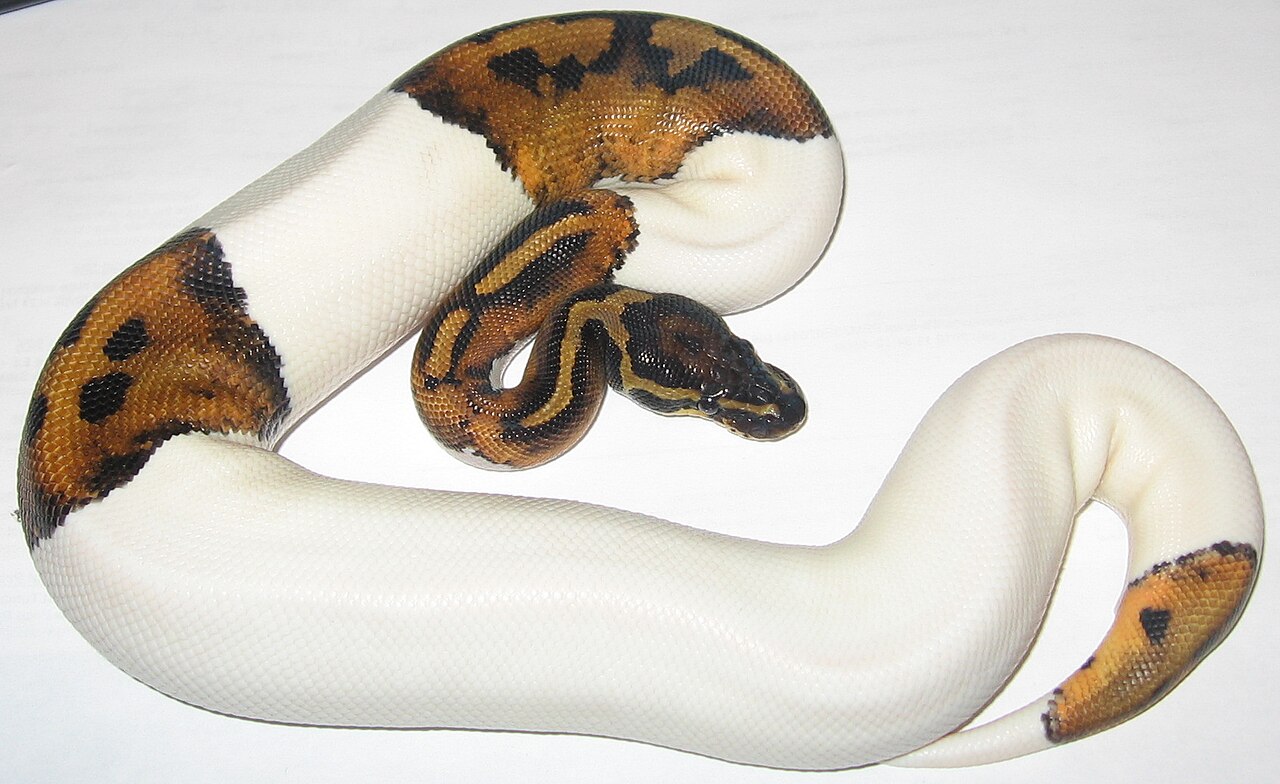
A pied ball python, short for piebald, is a Python regius carrying a recessive mutation that produces irregular patches of pure unpigmented white skin alongside areas of completely normal pattern. The result looks like two snakes joined together, and the proportion of white varies enormously between individuals, from a few small patches to animals that are almost entirely white.
It was the morph that changed ball python breeding economics. The first pied was reproduced in captivity in the late 1990s, single animals sold for tens of thousands of dollars, and prices then collapsed as breeders established the line, which is now the standard trajectory every new recessive morph follows. This guide covers the genetics, what determines how much white an animal shows, care, price, and the health questions worth asking about morph breeding generally.
| Quick Facts | Pied Ball Python |
|---|---|
| Genetics | Simple recessive |
| Appearance | Unpigmented white patches with normal-patterned areas |
| Adult size | Females 4 to 5 ft, males 3 to 3.5 ft |
| Lifespan | 20 to 30 years, record over 60 |
| Price range | Roughly 300 to 800 US dollars for a basic pied |
| Health | No known defect linked to the pied gene itself |
What Piebald Actually Is
Piebaldism is a pigmentation pattern in which certain areas of skin have no pigment cells at all, producing pure white regions with sharp boundaries against normally colored areas. It occurs across many animal groups, and the same term describes patterned horses, dogs, and birds.
The mechanism involves pigment cells failing to migrate to parts of the body during embryonic development. Where they arrive, normal color and pattern develop, and where they do not, the skin remains white, which is why the boundaries are so crisp rather than gradual.
This distinguishes it from albinism, which affects pigment production across the whole animal rather than pigment cell distribution. An albino ball python is uniformly white and yellow with red eyes, while a pied has normal brown and black pattern in the pigmented areas and normal dark eyes. Our guide to the albino ball python covers that comparison in full.
How the Genetics Work
Pied is a simple recessive trait, which has specific consequences for breeding. An animal needs two copies of the gene to display the pattern, and an animal with one copy looks entirely normal while carrying it invisibly.
Those single-copy animals are called hets, short for heterozygous, and they are sold at a premium over normal ball pythons despite being visually identical. Breeding two hets together produces statistically one visual pied in four, two hets, and one normal, and the normal-looking offspring cannot be distinguished without genetic testing or test breeding.
The practical consequence is that documentation matters enormously. An animal sold as a het pied is worth substantially more than a normal, and the only assurance is the breeder’s records of its parentage, which is why buying hets from established breeders with verifiable lines is standard advice. Animals sold as possible hets, meaning offspring from a pairing where het status is statistically likely but unproven, cost less and carry corresponding risk.
Why Some Pieds Are Mostly White
The variation in white coverage is the most striking thing about the morph and it is not directly controlled by the pied gene itself. Two siblings from the same clutch can differ dramatically, one showing a few small patches and the other being three-quarters white.
Breeders have selected for high white expression over decades, and lines exist that reliably produce animals with extensive white. The mechanism appears to involve modifier genes and possibly incubation conditions rather than a single controllable factor, and predicting a specific outcome from a specific pairing is not currently possible.
Very high white animals command higher prices, and the extreme end produces snakes that are nearly entirely white with only small colored patches. There is no evidence that high white expression carries health consequences in this species, which distinguishes it from some other reptile and animal piebald lines where extreme white is associated with problems.
Price and What Drives It
Basic pied ball pythons typically run from around 300 to 800 US dollars, which is remarkable given that the first captive-bred animals in the late 1990s sold for figures reported in the tens of thousands.
That collapse is the standard pattern. A new recessive morph is scarce, breeders pay heavily for founding stock, the line establishes over several generations, supply rises, and prices settle at a level reflecting production cost rather than novelty. Every morph follows the curve, and it is worth understanding before treating a snake purchase as an investment.
Combinations still command premiums. Pied combined with albino, with lavender albino, or with pattern genes such as clown or leopard produces animals in the four-figure range and higher, and high-white pieds sit above standard ones. Females cost more than males, since females are the limiting factor in any breeding project, and the ongoing cost of housing and feeding a snake for twenty-plus years exceeds the purchase price of a basic pied regardless.
Care Requirements
Pied ball pythons need exactly what any ball python needs, since the morph affects appearance only. An adult wants a minimum of a 40 gallon enclosure with 4 by 2 ft of floor space being a better target, and a securely locking lid, because ball pythons are strong and persistent.
Temperature and humidity are the areas where this species is less forgiving than a corn snake. Provide a warm side around 88 to 92 F and a cool side near 78 F, regulated by a thermostat without exception, and maintain humidity at 55 to 65 percent rising toward 70 during a shed. Unregulated heat mats cause severe burns and low humidity causes retained shed on the eyes and tail.
Provide two snug hides, one on each side, so the animal never chooses between security and correct temperature. Use aspen, cypress mulch, coconut husk, or paper towel, never cedar or pine, and give a water bowl large enough to soak in. Our guides to the banana ball python and the albino corn snake cover the same husbandry from the perspective of different morphs and a more forgiving species.
Feeding and Hunger Strikes
Appropriately sized frozen-thawed rodents are the entire diet. Hatchlings start on small mice or rat pups and adults typically take a medium to large rat every 10 to 14 days, following the rule that prey should be roughly the width of the snake at its thickest point.
Never feed live rodents. A hesitant snake gets injured, and rats in particular inflict serious wounds on snakes that decline to strike, which is a common and entirely avoidable cause of veterinary bills.
Then there is the behavior that alarms every new keeper. Ball pythons refuse food for extended periods, and a healthy adult can go two to six months without eating, particularly in winter and breeding season. Weigh the animal every two weeks and record it, verify temperatures, humidity, and hide security, and treat a fast with normal weight and behavior as normal. Substantial weight loss, lethargy, or a sunken appearance warrant a reptile veterinarian.
Handling and Temperament
Ball pythons are among the most tolerant snakes in captivity and pieds are no different. Most individuals accept regular handling within weeks, bites are rare and trivial, and the defensive response is to curl into a ball rather than to strike, which is where the name comes from.
Support the body rather than gripping. Let the snake move through your hands with weight supported at several points, keep sessions to 10 or 15 minutes a few times a week, and leave a new animal alone for a week or two to settle in.
Skip handling for 48 hours after a meal, since a disturbed snake may regurgitate, and during a shed when vision is impaired and temperament is at its worst. A snake with cloudy blue eyes is in shed and should be left alone until it clears and the skin comes off.
Morph Health Questions
This deserves honest treatment because the ball python trade includes genes that do cause problems, and prospective buyers rarely hear about them. The pied gene itself has no known associated defect, and pieds are as healthy as normal ball pythons.
Other popular morphs are different. The spider gene is associated with a neurological condition producing head wobble and coordination problems, present to some degree in essentially all spider animals. Several combinations are lethal, meaning that pairing two copies produces non-viable offspring, and the super forms of certain genes have documented issues including eye deformities and kinking.
Asking a breeder directly about the health implications of any morph is reasonable rather than rude, and a good breeder will answer plainly. Buying a pied is uncomplicated on this front, which is part of why it remains popular after nearly thirty years. Our guides to the king snake and Texas rat snake cover species where morph breeding has gone less far.
Is a Pied a Good First Snake?
Yes, with the same caveats that apply to any ball python. They are docile, feed reliably on frozen-thawed rodents once established, tolerate handling, and stay a manageable size at 3 to 5 ft.
The humidity and temperature requirements are stricter than for corn snakes, which are generally the better recommendation for an absolute beginner, and the hunger strikes cause more anxiety in new keepers than any other behavior in the hobby.
The real caveat is duration. Twenty to thirty years is a commitment closer to a parrot than to a hamster, and the record for the species is over 60 years, held by an animal at the Saint Louis Zoo that laid eggs at 62. Buy from a breeder who provides feeding records and weights rather than from a shop that cannot, since a documented feeding history is the best single predictor of an uncomplicated first year.
Frequently Asked Questions
What is a pied ball python?
A ball python carrying a recessive mutation that produces patches of pure unpigmented white skin alongside areas of completely normal pattern, with sharp boundaries between them. The proportion of white varies enormously, from a few small patches to nearly all-white animals.
How much does a pied ball python cost?
Roughly 300 to 800 US dollars for a basic pied, with high-white animals and combination morphs costing considerably more. The first captive-bred pieds in the late 1990s sold for reported figures in the tens of thousands before the line established.
What is a het pied?
An animal carrying one copy of the recessive pied gene, which looks entirely normal but can produce pied offspring. Breeding two hets gives statistically one visual pied in four. Het status is a claim about parentage, so documentation from the breeder is essential.
Why do some pieds have more white than others?
The pied gene determines that patches occur, but the extent appears to be governed by modifier genes and possibly incubation conditions. Siblings from one clutch can differ dramatically, and breeders have selected lines that reliably produce high white expression.
Are pied ball pythons healthy?
Yes. The pied gene has no known associated defect, unlike some other popular morphs. The spider gene is linked to a neurological wobble, and several combinations are lethal, so asking a breeder about health implications of any morph is worth doing.
How big do pied ball pythons get?
Females reach 4 to 5 ft and males 3 to 3.5 ft, the same as any ball python since the morph affects appearance only. They are heavy-bodied, with adult females weighing 3 to 5 lb.
Why won’t my ball python eat?
Extended fasting is normal for the species, and a healthy adult can refuse food for two to six months, especially in winter. Weigh it every two weeks, check temperatures, humidity, and hide security, and consult a reptile veterinarian if it loses substantial weight or becomes lethargic.