Carolina Wren Sounds: The Teakettle Song and the Duet
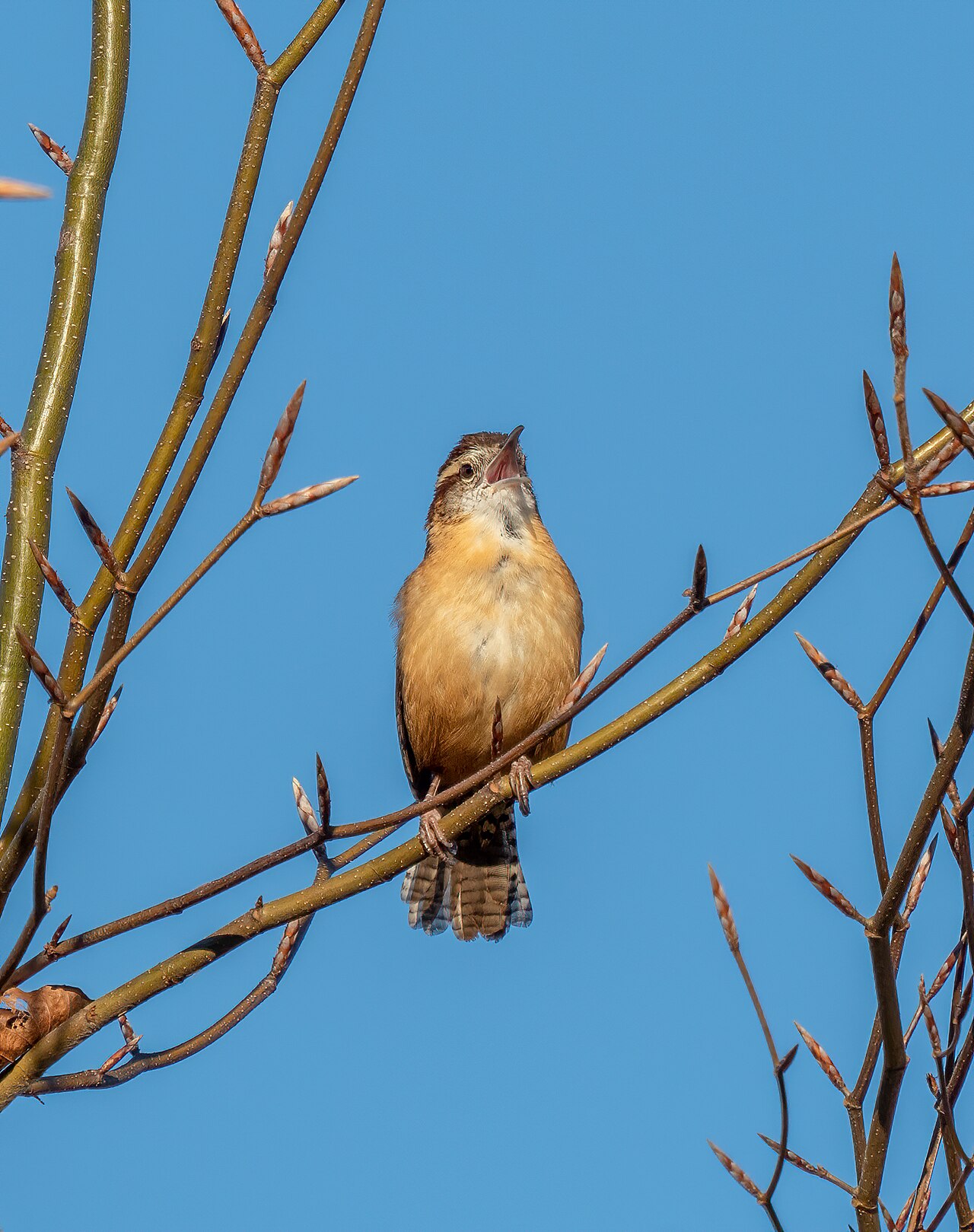
A Carolina wren says teakettle-teakettle-teakettle, a loud rolling three-syllable phrase repeated three to five times in a row. The volume is the surprising part: a bird weighing about 20 grams, smaller than a house sparrow, produces a song audible from several hundred metres and loud enough at close range to be startling. Only males sing it, and they sing it year round rather than only in spring.
Beyond the song, Carolina wrens have one of the larger call repertoires among small songbirds. A harsh mechanical rattle serves as the main alarm, a rapid cheer works as contact, and pairs perform coordinated duets in which the female answers the male’s song with a chatter, so precisely timed that the two sound like one bird.
| Sound | Meaning |
|---|---|
| Teakettle song | Male territory, sung year round |
| Female chatter | Duet response, overlaps the male’s song |
| Harsh rattle | Alarm, predator or intruder near the nest |
| Cheer call | Contact between paired birds |
| Buzzy scold | Close-range agitation |
| Song repertoire | Up to 30 to 40 phrase types per male |
| Singing rate | Several thousand songs on a good day |
What Carolina Wrens Say
The teakettle song is a three-syllable phrase repeated in quick succession, and different individuals produce versions that people transcribe as teakettle, cheeseburger, video, or germany. All are the same song type with slight variation in emphasis, and once you have one of the transcriptions in your head the pattern is unmistakable.
Delivery is rapid and emphatic. A phrase lasts under half a second, the series runs three to five repetitions, and the bird pauses briefly before starting again. A singing male can produce several thousand songs in a day, working through a repertoire of 30 to 40 distinct phrase types and switching between them.
The volume relative to body size is genuinely exceptional. Carolina wrens weigh around 20 grams and out-sing birds several times their mass, which is possible because song volume depends on air pressure and syrinx efficiency rather than on body size alone. Our species guide to the Carolina wren covers the bird itself.
Only Males Sing, and They Sing Constantly
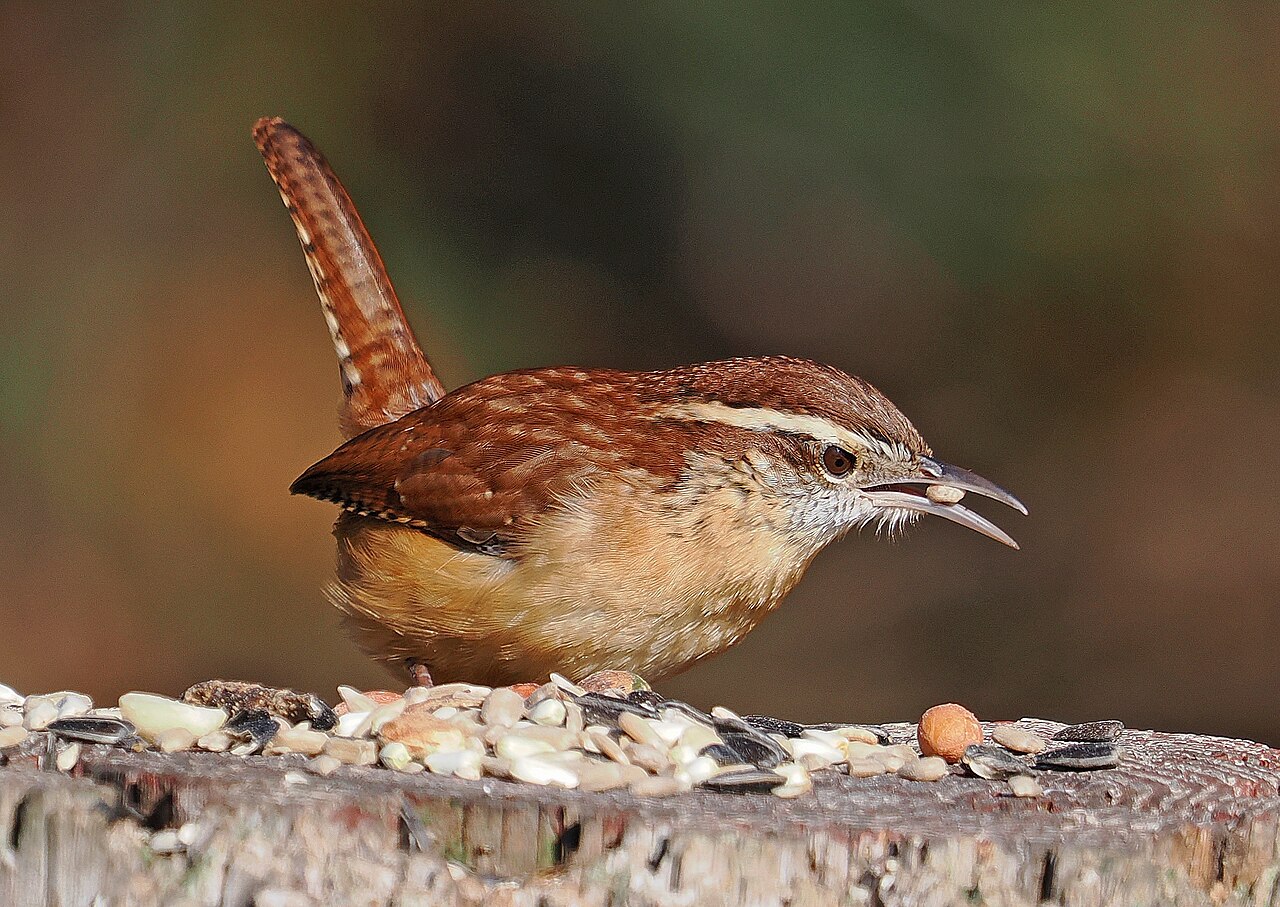
Full song is male-only in Carolina wrens, and unlike most temperate songbirds they sing throughout the year rather than only during the breeding season. Males hold territories permanently and pairs stay together year round, so the song keeps working outside spring.
Singing rate peaks in the hours after dawn and again in late afternoon, and it rises sharply in early spring and after any territorial intrusion. A male responding to a rival, or to a recording, will sing almost continuously for several minutes.
Each male’s repertoire is learned from neighbours during his first year, which produces local song dialects. Two males on adjacent territories often share most of their phrase types and will match each other, singing the same type back and forth, which functions as a direct territorial challenge.
Song matching escalates in a predictable way. A male that answers with the same phrase type is engaging directly, one that switches to a different type is de-escalating, and one that falls silent has usually conceded. Watching two neighbours work through that sequence over a boundary is one of the more readable pieces of bird behaviour in a garden.
The Duet
Carolina wren pairs duet, and it is one of the more remarkable things a common backyard bird does. The female does not sing the teakettle phrase but responds to the male’s song with a rapid chatter or trill, timed so precisely that it overlaps or immediately follows his phrase.
To an unprepared listener the combined result sounds like a single bird producing an unusually complex song. Recognising that two birds are involved usually requires either seeing both or listening for the moment the timing slips slightly, which happens when one bird moves. Recordings slowed down make the two voices obvious immediately, and it is worth doing once simply to retrain your ear.
Function appears to be pair bond maintenance and joint territory defence, and duetting increases when a rival pair is nearby. It is far more common in tropical birds than in North American species, which makes the Carolina wren a notable exception in its range. The species reaches its northern limit in the mid-Atlantic and lower Midwest, and duetting behaviour appears equally developed across the whole range rather than fading toward the edge.
Alarm Calls and What They Mean
The main alarm is a harsh mechanical rattle, dry and buzzy, sounding more like a wind-up toy than a bird. It is given when a cat, snake, hawk, or person approaches a nest, and the intensity and repetition rate rise as the threat gets closer.
A rapid repeated cheer or pip serves as general contact and mild agitation, and paired birds exchange it constantly while foraging apart. It is much quieter than the song and is usually the sound you hear when a wren is close but out of sight.
Close-range agitation produces a buzzy scolding series delivered with the bird bouncing between perches, tail cocked high. If you are getting this treatment, you are within a few metres of a nest. Backing off ends it immediately, and the nest is usually in the direction the bird keeps returning to.
Do Carolina Wrens Make Noise at Night?
Rarely. Carolina wrens are firmly diurnal, roosting in cavities, dense vines, or nest boxes overnight, and they typically go quiet well before full dark. A wren singing at 2 a.m. is unusual enough to be worth noting.
When it does happen the usual cause is disturbance at the roost. A cat, raccoon, or snake investigating a roosting cavity triggers alarm rattling in darkness, and it stops once the threat moves on. Artificial light near a roost can also produce occasional pre-dawn song.
Night sound in a garden is far more likely to come from mockingbirds, robins near streetlights, or owls. Our guides to robin sounds and why birds chirp at night cover the species genuinely responsible for most nocturnal singing.
Carolina Wren vs House Wren by Sound
These are the two wrens most people hear, and they sound nothing alike once compared. The Carolina wren produces the clear rolling teakettle phrase, loud and structured, with distinct repeated units.
The house wren produces a bubbling, tumbling cascade of rapid notes with no repeated phrase structure at all, rising and falling and running down at the end. It is busier, thinner, and less musical, and it lacks the emphatic quality of the Carolina wren’s delivery.
Timing separates them too. House wrens are migratory across most of their range and sing only from spring through midsummer, while Carolina wrens are resident and sing in every month. A loud wren song in January in the eastern United States is a Carolina wren. Our guides to the house wren and types of wrens cover the rest of the family.
What Attracts Carolina Wrens
Cover comes first. Carolina wrens need dense low vegetation, brush piles, woodpiles, and cluttered edges, and they avoid open lawn entirely. A yard with a tangled corner will hold them where a manicured one will not, regardless of what is on offer at the feeder.
They are among the few wrens that use feeders, taking suet, peanut pieces, mealworms, and hulled sunflower. Suet is the strongest draw, particularly in winter, and a suet feeder placed near shrub cover rather than in the open gets far more use.
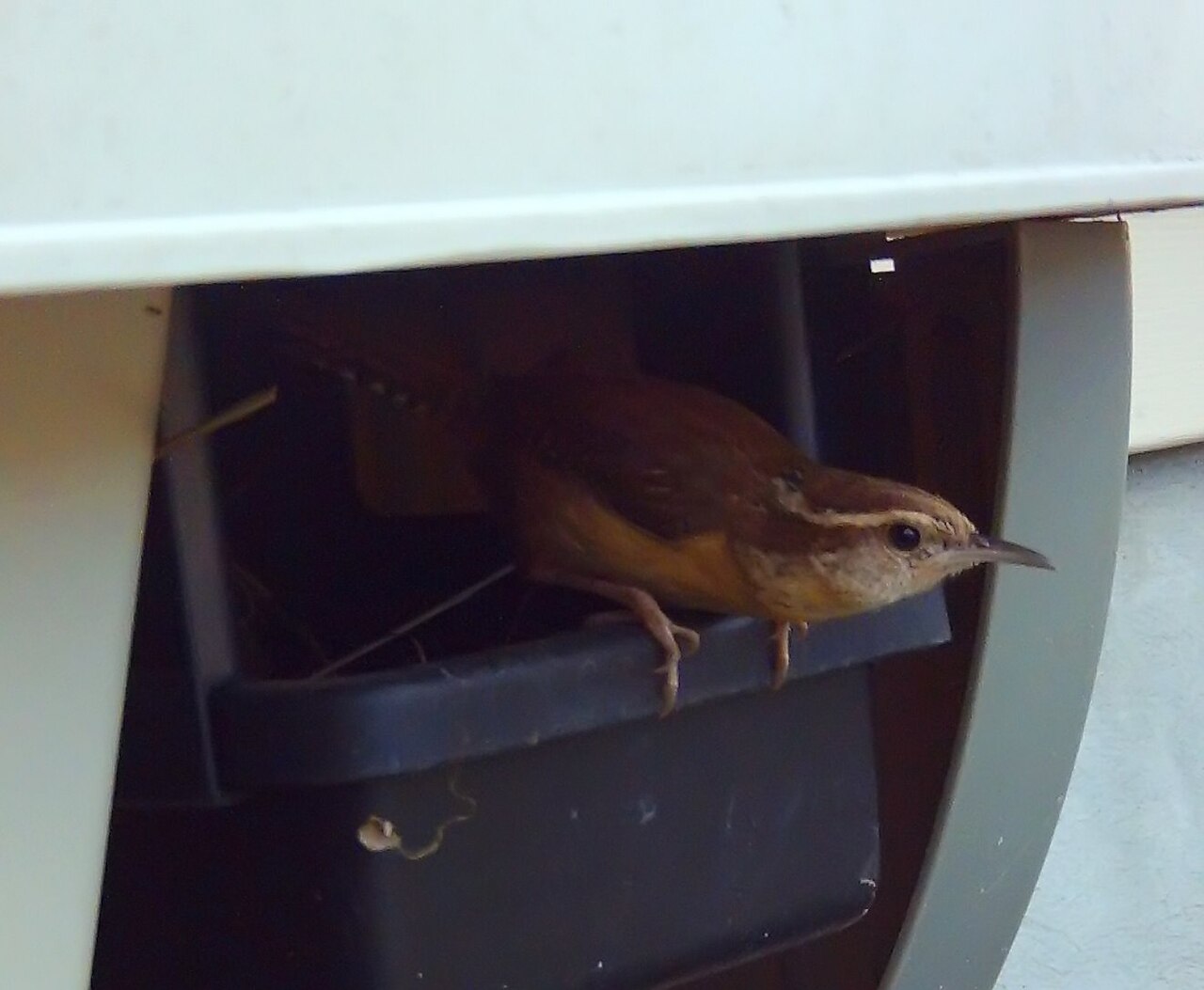
Nest sites are the third lever and the most entertaining. Carolina wrens nest in almost any cavity: hanging baskets, garage shelves, mailboxes, coat pockets, flowerpots, and boots left on a porch. Nest boxes work, but so does simply leaving a sheltered ledge undisturbed through spring. Males build several partial nests and the female selects one, so finding an abandoned half-built nest does not mean the pair has left the area.
Do Carolina Wrens Like Humans?
They tolerate people unusually well and are among the boldest common backyard birds. They will forage a metre from someone working in a garden, investigate open sheds and garages, and nest in structures in daily use, which suggests genuine habituation rather than mere indifference.
That boldness has a cost. Wrens nesting in a garage or a shed can be trapped inside if the door closes, and a pair that has committed to a site will keep returning to it. Anyone who finds a nest in a working space is generally best leaving it until the chicks fledge, which takes about two weeks from hatching.
Pairs are also territorial year round and remain in the same area for life, so a household that hosts a pair usually hosts the same individuals for several years. Their populations crash after severe winters at the northern edge of the range and recover over subsequent mild years, which is why abundance swings noticeably from decade to decade. Because they do not migrate, a hard freeze with deep snow cuts off access to the crevices and leaf litter they forage in, and mortality in those winters can be severe at the range edge.
Frequently Asked Questions
What do Carolina wrens say?
A loud rolling three-syllable phrase usually written as teakettle-teakettle-teakettle, repeated three to five times. Some people hear it as cheeseburger, video, or germany, all the same song with slight variation. Only males sing it, and they sing throughout the year rather than only in spring.
What is the Carolina wren’s warning call?
A harsh mechanical rattle, dry and buzzy, sounding more like a wind-up toy than a bird. It is given when a cat, snake, hawk, or person approaches a nest, and it speeds up and intensifies as the threat gets closer. A buzzy scolding series means you are within a few metres of the nest.
How can I identify a wren by sound?
Carolina wrens produce a loud, structured, repeated teakettle phrase. House wrens produce a bubbling tumbling cascade with no repeated units that trails off at the end. Season helps too, since house wrens are migratory and Carolina wrens sing in every month of the year.
Do Carolina wrens make noise at night?
Rarely. They are firmly diurnal and roost in cavities or dense vines, going quiet before full dark. Night alarm rattling usually means a predator is investigating the roost. Most nocturnal garden singing comes from mockingbirds, robins near streetlights, or owls instead.
What attracts Carolina wrens to your yard?
Dense low cover above all, including brush piles, woodpiles, and untidy edges. They are among the few wrens that use feeders, taking suet, peanut pieces, mealworms, and hulled sunflower, with suet the strongest draw. They also nest in almost any sheltered cavity.
Do Carolina wrens like humans?
They tolerate people unusually well, foraging a metre from someone gardening and nesting in garages, sheds, hanging baskets, and boots left on porches. Pairs hold the same territory for life, so a household that hosts a pair often hosts the same birds for several years.
Do wrens nest in the same spot every year?
Often, yes. Carolina wren pairs are resident and territorial year round and reuse favoured sites across seasons, though they build a fresh nest each time and frequently start several before the female chooses one. Leaving a used site undisturbed makes reuse more likely.