Zebra Swallowtail Butterfly: ID, Range, and Pawpaw
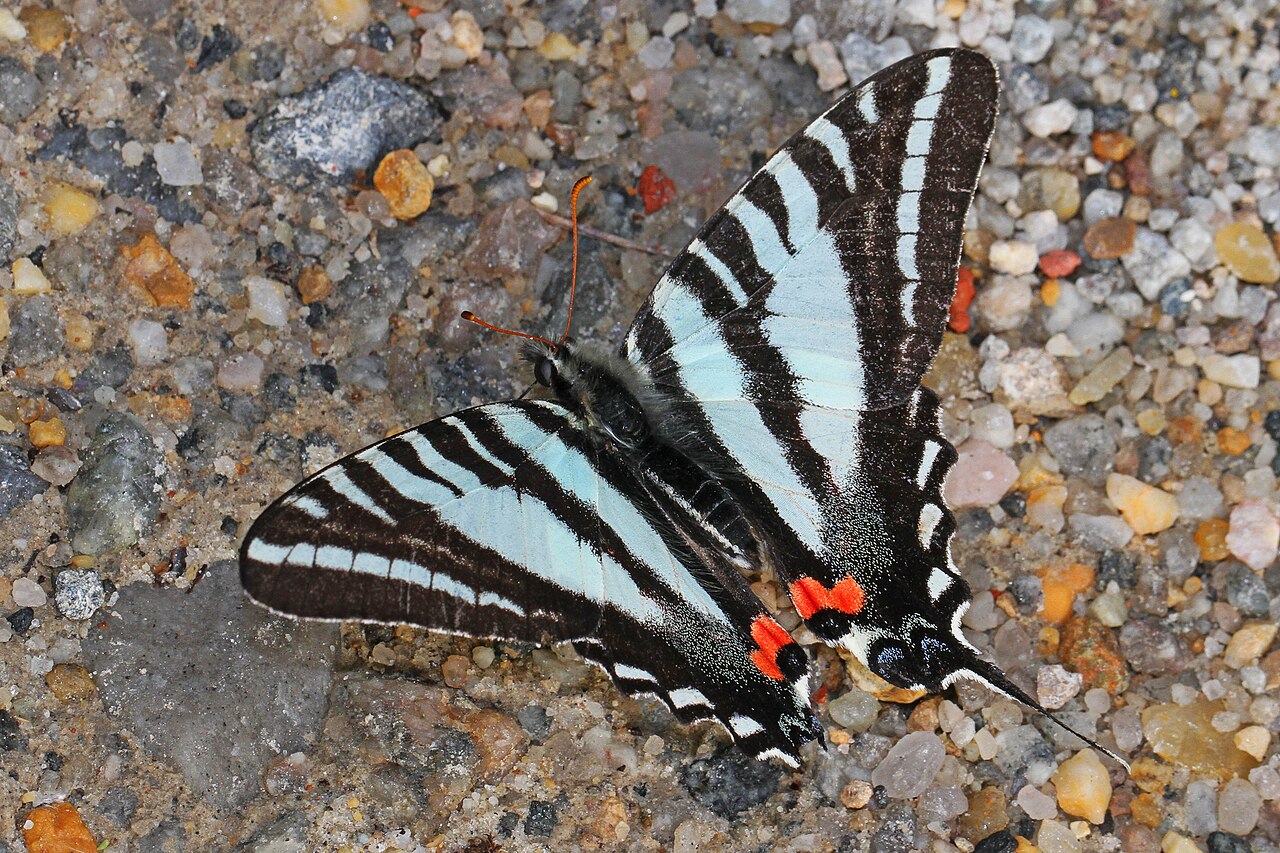
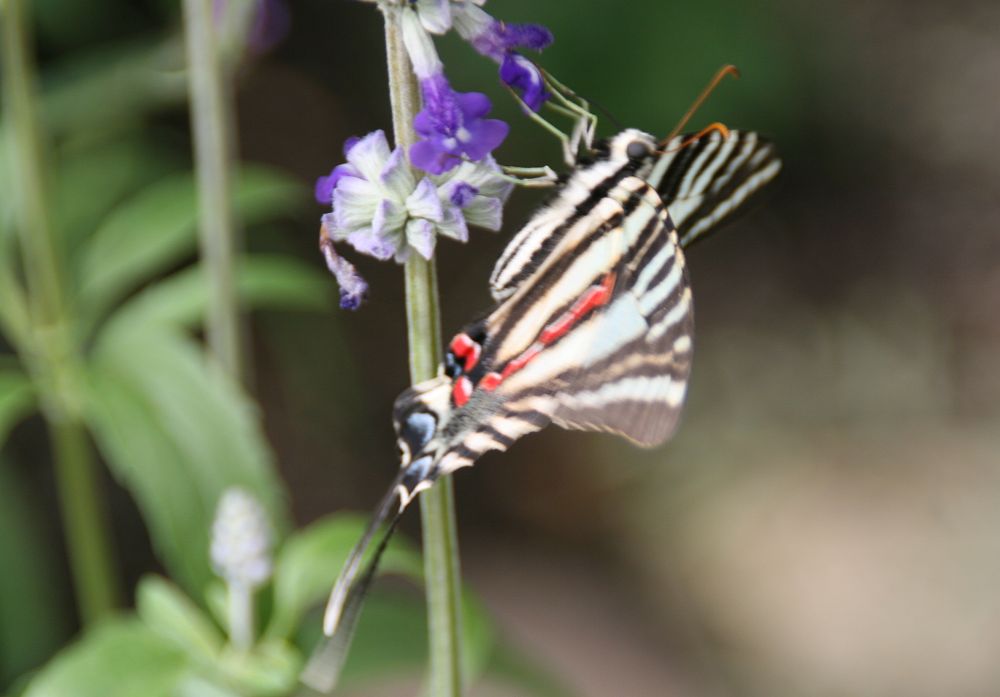
The zebra swallowtail is a black and white striped butterfly of the eastern United States with long sword-like tails and red and blue markings near the base of the hindwings. It is unmistakable in flight, roughly three to four inches across, and it is tied absolutely to one group of plants: pawpaw. Wherever pawpaw trees grow, zebra swallowtails can occur, and wherever they do not, the butterfly is absent no matter how good the habitat looks.
That single dependency explains almost everything people notice about the species, including why it seems rare in some counties and common in others just a few miles away, why it stays close to wooded stream bottoms rather than open gardens, and why planting for it means planting a tree rather than a flower bed. This guide covers identification, the pawpaw connection, seasonal forms, symbolism, and how to actually attract one.
The zebra swallowtail is a black and white striped butterfly with long tails and red and blue hindwing markings, found across the eastern United States wherever pawpaw trees grow. Pawpaw is its only caterpillar host plant, so it stays near wooded stream bottoms and river floodplains. It is not rare within that range, just local.
| Feature | Zebra Swallowtail |
|---|---|
| Wingspan | 2.5 to 4 in |
| Pattern | Black and white stripes, long tails |
| Hindwing marks | Red spot and blue patches near body |
| Host plant | Pawpaw only (Asimina species) |
| Range | Eastern US, Great Lakes to Gulf |
| Broods | 2 to 3 per year, spring through summer |
| Adult lifespan | About 6 days in summer form |
What Does a Zebra Swallowtail Look Like?
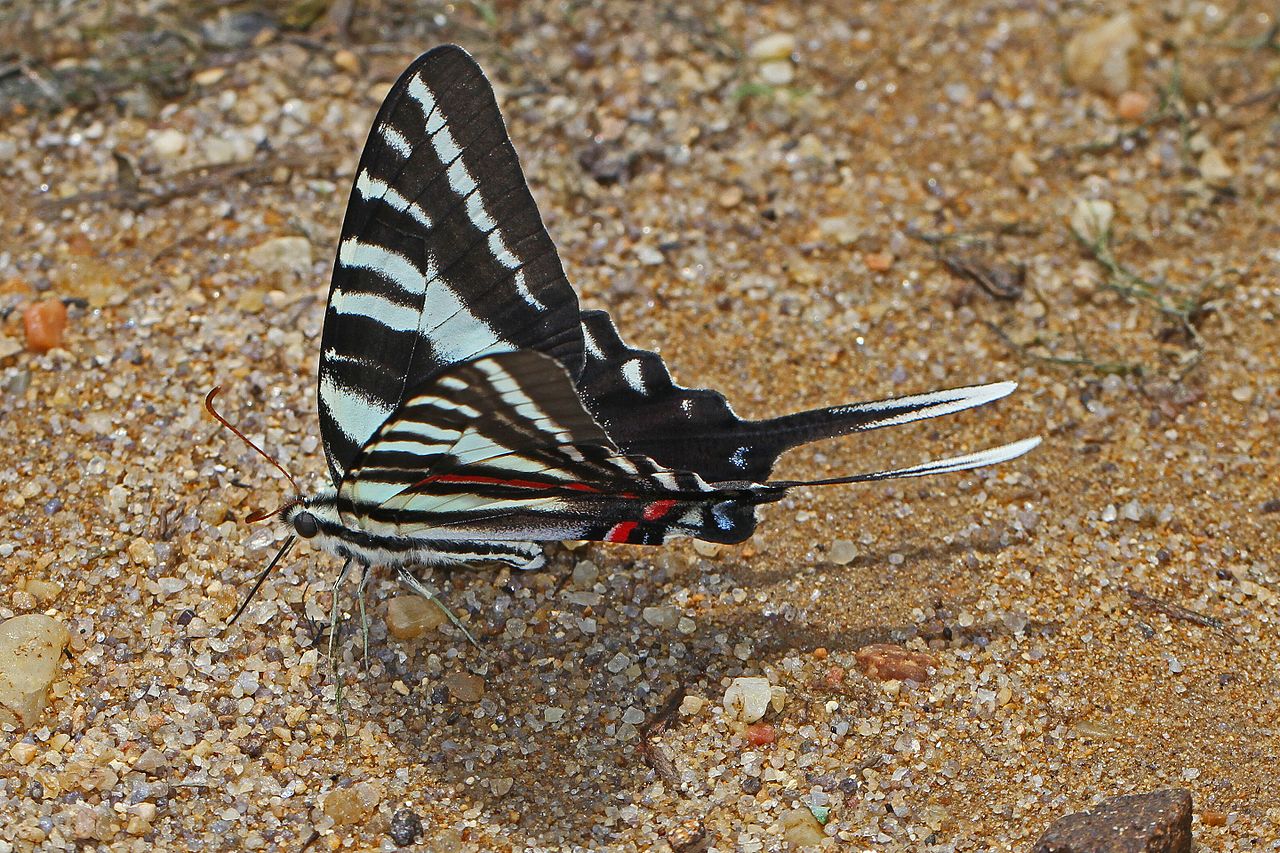
A zebra swallowtail is a white to greenish-white butterfly crossed by bold black stripes, with a pair of very long, thin tails trailing from the hindwings. The tails are proportionally longer than on any other North American swallowtail and are usually edged in white, giving the butterfly a distinctly elongated, kite-like outline that is recognisable at a distance before any pattern is visible.
Close up, the hindwings carry the details that confirm it. There is a bright red spot near the inner margin of each hindwing, close to the body, along with two blue patches, and a red stripe runs along the underside of the hindwing. Those colours are absent from the forewings, which are purely black and white, so a resting butterfly with folded wings shows the red and blue while a flying one mostly does not.
Size and shape separate it from the other black and white butterflies people encounter. The wings are noticeably triangular rather than rounded, and the flight is fast, low, and direct rather than fluttering. Anything black and white with short tails or no tails at all is something else entirely, and the black and white butterfly guide covers the alternatives, including the red-spotted purple and various admirals.
Are Zebra Swallowtails Rare?
They are not rare, but they are extremely local, which is why so many people assume they are. Within their range the species is often common, sometimes abundant, and the population is considered secure across the eastern United States. What limits them is not scarcity of butterflies but scarcity of pawpaw, and pawpaw grows in patches rather than continuously.
The practical result is that a woodland with a pawpaw patch may have dozens of zebra swallowtails while a similar-looking woodland two miles away has none at all. Suburban gardens, open meadows, and dry upland forests will not hold them regardless of how many nectar plants are planted, because the caterpillars have nowhere to feed. This is a host-plant limit, not a habitat quality one.
At the edges of the range the species genuinely is scarce. In parts of the Great Lakes states and in New England, where pawpaw reaches its northern limit or is absent, zebra swallowtails are rare strays or absent entirely, and several states list them as species of conservation concern. In Florida, Georgia, Kentucky, and the Ohio and Mississippi valleys they are one of the more familiar large butterflies.
What Is the Host Plant for Zebra Swallowtails?
Pawpaw, and nothing else. Zebra swallowtail caterpillars feed exclusively on plants in the genus Asimina, principally the common pawpaw (Asimina triloba) in most of the range and several smaller Asimina species in Florida and the southeastern coastal plain. No other plant family will do, and females will not lay eggs on anything else.
Pawpaw is a small understorey tree of rich, moist bottomland forest, growing along creeks and river floodplains and spreading by root suckers into dense clonal patches. It carries the largest edible fruit native to North America, with a custard-like flavour somewhere between banana and mango, and it has become popular with foragers and small orchardists, which is quietly good news for the butterfly.
Females prefer to lay on young pawpaw leaves, typically on small shoots or the low suckers at the edge of a patch rather than on mature trees. Eggs are laid singly, pale green and spherical, and the caterpillars are cannibalistic, so one caterpillar per shoot is the norm. Pawpaw leaves contain acetogenins, compounds toxic to most insects and to many vertebrates, which the caterpillars tolerate and which make both larvae and adults distasteful to birds.
Where Are Zebra Swallowtails Found?
The range covers the eastern United States from the Gulf Coast north to the Great Lakes and southern New England, and west into eastern Texas, Oklahoma, and Kansas, mirroring the distribution of pawpaw very closely. The species is most numerous in the Ohio, Tennessee, and Mississippi river systems and throughout the southeastern coastal plain.
Within that range the butterflies stay near their host. Look for them along wooded creeks, in river bottom forest, on the edges of floodplain woods, and along trails and dirt roads that cut through those habitats. They visit open areas to nectar and puddle, but rarely stray far, and a zebra swallowtail in a suburban yard usually means pawpaw within a few hundred yards.
Males patrol pawpaw patches through the morning and gather at damp ground, mud puddles, and stream edges to take up minerals, a behaviour called puddling that is shared with other swallowtails. Groups of several males at a wet gravel road edge on a warm morning are a common sight where the species is numerous. The swallowtail butterfly guide covers the family as a whole.
Why Do Spring and Summer Zebra Swallowtails Look Different?
Zebra swallowtails come in two seasonal forms, and the difference is striking enough that people regularly report them as separate species. The spring form is smaller, paler and whiter, with narrower black stripes and shorter tails. The summer form is larger, more heavily marked with broader black bands, and has considerably longer tails, sometimes half the length of the body again.
The trigger is day length and temperature experienced by the caterpillar and pupa. Larvae developing under short spring days produce the small pale form, while those developing under long summer days produce the large dark form. The same phenomenon, called seasonal polyphenism, occurs in several other butterflies and is a straightforward developmental response rather than a genetic difference.
Timing follows from that. The spring brood emerges from overwintering chrysalides in March or April in the south and April or May further north, and two or sometimes three broods follow through the summer, with the last generation pupating in autumn and overwintering. Chrysalides are green or brown, well camouflaged, and attached to stems near the ground rather than high in the tree.
What Does the Zebra Swallowtail Caterpillar Look Like?
The caterpillar is plump, humped behind the head, and banded in fine black, yellow and blue-green lines on a green body, with one broad black and yellow band across the thorax. Early instars are darker and have a bumpier texture; later instars smooth out and become the pale green form most people find. A dark morph, blackish-brown with the same banding, also occurs.
Like all swallowtail larvae it carries an osmeterium, a forked orange gland that everts from behind the head when the caterpillar is disturbed, releasing a sharp chemical smell that deters ants and small predators. It looks like a snake’s tongue, which is the point, and it is entirely harmless to handle though the smell lingers on skin.
Zebra swallowtail caterpillars are notably cannibalistic, and a larva that encounters another on the same shoot will often eat it, which is why eggs are laid singly and spaced out. The monarch caterpillar guide covers a very different larval strategy on an equally specific host plant, where dozens can share a plant without conflict.
What Does It Mean to See a Zebra Swallowtail?
In symbolic terms, a zebra swallowtail is read much as other butterflies are, as a sign of transformation, renewal, and the presence of a departed loved one, with the black and white pattern adding a reading about balance and about holding two opposing things at once. The long tails and swift flight also attract associations with freedom and with moving quickly through a change.
The species has no distinct traditional folklore of its own, which is worth saying plainly. Butterfly symbolism in North America is largely generic across species, and specific readings attached to the zebra swallowtail online are modern constructions rather than inherited tradition. That does not make them meaningless to the person who finds them useful, but they are not ancient.
What the sighting does reliably mean is ecological. A zebra swallowtail tells you there is intact bottomland forest with a healthy pawpaw understorey nearby, which is a genuinely good indicator of habitat quality. The guide to a butterfly landing on you covers the broader symbolism people apply to these encounters.
How Do You Attract Zebra Swallowtails?
Plant pawpaw. There is no substitute, and no combination of nectar flowers will hold the species without it. Pawpaw is available from native plant nurseries and from fruit tree suppliers, tolerates shade when young, and needs moist well-drained soil. Two genetically different trees are needed for fruit, though a single tree will still support caterpillars.
Position matters more than quantity. Females favour young shoots in warm, partly sunny edge positions, so a small group of pawpaws at a woodland edge or in a partly shaded corner outperforms a specimen tree in deep shade or full open lawn. Allowing root suckers to form a patch rather than pruning to a single trunk creates exactly the structure the butterflies use.
Adults nectar readily on blueberry, blackberry, milkweed, verbena, redbud, and dogbane, so flowering shrubs and native perennials near the pawpaws help hold them. A damp gravel patch or a shallow depression that stays wet gives males somewhere to puddle. The U.S. Fish and Wildlife Service (fws.gov) and state extension programmes both publish regional native plant lists worth checking before buying. The giant swallowtail guide covers a relative with an entirely different and far more widespread set of host plants.
What Else Is Black and White With Tails?
The most frequent confusion is with the black and white pattern of a black swallowtail, which is a dark butterfly with pale spot bands rather than a pale butterfly with dark stripes, and which has short broad tails rather than long thin ones. Once seen side by side the two are not similar, but from a photograph or a fast glimpse the mistake is easy.
Zebra longwing is the other common mix-up, driven by the name. It is a Florida and Gulf Coast species with long narrow wings, black with yellow stripes rather than white, no tails at all, and a slow drifting flight completely unlike the zebra swallowtail’s fast direct one. It also belongs to a different family and uses passionflower as its host.
Various white butterflies and the pale-form females of other species get reported as zebra swallowtails when seen at a distance. The tails settle it: long, thin, sword-like tails on a striped triangular butterfly is a combination nothing else in North America produces. The moth vs butterfly guide covers how to separate the broader groups when the identification is not obvious.
Related reading: Tiger Swallowtail Butterfly.
Frequently Asked Questions
Is the zebra swallowtail rare?
Not rare, but very local. It occurs only where pawpaw trees grow, so it can be common in one woodland and absent from a similar one nearby. It is genuinely scarce at the northern edge of its range.
What is the host plant for zebra swallowtails?
Pawpaw and nothing else. Caterpillars feed only on Asimina species, mainly common pawpaw, a small understorey tree of moist bottomland forest that spreads into dense patches by root suckers.
Where are zebra swallowtail butterflies found?
Across the eastern United States from the Gulf Coast to the Great Lakes and west to eastern Texas and Kansas, concentrated along wooded creeks, river floodplains, and bottomland forest edges where pawpaw grows.
What does it mean to see a zebra swallowtail butterfly?
Symbolically it is read as transformation, renewal, and balance, with the black and white pattern suggesting holding opposites together. Ecologically it reliably indicates healthy bottomland forest with pawpaw nearby.
Why do zebra swallowtails look different in spring and summer?
They have two seasonal forms. Spring butterflies are smaller, whiter, and short-tailed; summer ones are larger, more heavily banded, and long-tailed. Day length and temperature during larval development determine which form appears.
What attracts zebra swallowtails?
Pawpaw trees above all, ideally as a patch of young suckers at a warm woodland edge. Nectar sources such as blackberry, milkweed, and verbena and a damp patch for puddling males help hold them nearby.
What month do zebra swallowtails lay eggs?
From March or April in the south and April or May further north, continuing through summer across two or three broods. Eggs are laid singly on young pawpaw leaves, usually on low shoots rather than mature trees.