Katydid Sounds: The Katy-Did Call of Summer Nights
Katydids make a harsh, raspy, rhythmic call that in the true katydid sounds like the phrase katy-did katy-didn’t repeated through the night, and other species produce clicks, ticks, buzzes, shuffles, and long dry rattles. The sound comes from stridulation, scraping a file on one forewing against a scraper on the other, and it is almost entirely a nocturnal chorus that starts around sunset.
Most people meet katydids by ear rather than by eye, because they are green, leaf-shaped, and sit motionless in foliage all day. The night sound of late summer in eastern North America is largely theirs, layered with crickets, and the loud daytime droning that gets confused with it belongs to cicadas. This guide covers each sound, what the calls mean, how to separate katydids from crickets and cicadas, and whether they cause any harm.
Katydid sounds are harsh raspy calls made by rubbing the forewings together, most famously the true katydid’s rhythmic katy-did katy-didn’t repeated after dark. Other species produce clicks, ticks, and dry rattles. Katydids sing at night, cicadas during the day, and crickets produce clear musical chirps rather than raspy phrases.
| Sound | Source |
|---|---|
| Katy-did katy-didn’t | True katydid, males, after dark |
| Dry rattling buzz | Coneheads and meadow katydids |
| Sharp single ticks | Bush katydids, spaced seconds apart |
| Soft shuffling zips | Angle-wing katydids in shrubs |
| Faint answering click | Female reply in some species |
| Peak season | Late July through first frost |
| Peak hours | Sunset to well after midnight |
What Do Katydids Sound Like?
The true katydid produces the sound the whole family is named for: a harsh, grating, two or three pulse phrase repeated over and over, heard as katy-did, katy-didn’t, or katy-she-did. It is loud, mechanical, and completely unmusical, delivered from high in deciduous trees, and in the eastern United States a summer night chorus of them can drown out conversation on a porch.
Other katydids sound nothing like that. Coneheaded katydids produce a continuous dry rattling buzz that can run for minutes without a break and is easily mistaken for an electrical fault. Meadow katydids give a soft ticking followed by a buzzy trill from grass and marsh vegetation. Bush katydids give isolated sharp ticks, sometimes several seconds apart, which is one of the harder sounds to trace.
Angle-wing katydids, the big leaf-mimicking species most often found on porches, produce quiet shuffling zips and tics rather than anything carrying. Volume varies enormously across the family, from calls audible half a mile away to ones inaudible more than a few feet from the insect.
How Do Katydids Make Sound?
Katydids stridulate, rubbing a ridged file on the underside of the left forewing across a hardened scraper on the right forewing. Each pass produces a train of pulses, and a thin membrane on the wing called the mirror amplifies them. Only males sing in most species, and they raise the wings slightly to let the mirror resonate.
Temperature controls the tempo directly, because the insect is ectothermic and the wing muscles run faster when warm. This is the same relationship behind Dolbear’s law, the well-known cricket thermometer, and katydid chorus rate slows noticeably on cool nights and speeds up during warm spells, changing the character of the whole chorus.
The ears are on the front legs, just below the knee, a pair of slit-like tympanal organs that are sensitive into ultrasonic frequencies. That sensitivity is not for hearing each other so much as for hearing bats: many katydids stop singing instantly when they detect bat echolocation, which is why a chorus can fall silent all at once. The bat sounds guide covers the calls they are listening for. The cricket sounds guide covers the closely related insects using the same mechanism.
Am I Hearing Katydids or Cicadas?
Time of day settles it almost every time. Katydids sing at night, starting near sunset and continuing past midnight, and go quiet by morning. Cicadas sing in daylight and peak in the heat of the afternoon, falling away at dusk. A loud insect drone at two in the afternoon is a cicada; the same at two in the morning is a katydid.
Sound quality separates them further. Cicada song is continuous, tonal, and mechanical, a droning buzz or rising whine with no audible individual pulses. Katydid song is scratchy and rhythmic, with clearly separated raspy phrases and obvious gaps, and the true katydid’s phrasing is so distinct that it reads as speech.
Crickets are the third element in the same chorus and are easy to separate once you listen for it: clear, musical, pure-toned chirps or steady trills at a higher pitch, from ground level, grass, and cracks in paving. Katydids call from shrubs and tree canopy, cicadas from trunks and high branches. The cicada sounds guide covers the daytime half of the summer soundscape.
What Does It Mean If You Hear a Katydid?
Practically, hearing katydids means late summer. Most species mature and begin calling from mid to late July in the eastern United States, and the chorus builds through August and September until the first hard frosts kill the adults. Rural folklore in parts of North America holds that the first katydid call means six weeks or three months to frost, and the timing is loosely accurate.
The katy-did katy-didn’t phrase generated its own folk story, an old tale in which a woman named Katy is accused by the insects of a deed they cannot agree on, and the argument continues nightly. The story is a nineteenth-century American invention built to explain the sound rather than an older tradition, and versions of it appear in period poetry and children’s books.
Symbolically, katydids are read much as crickets are: as signs of good luck, patience, intuition, and attentive listening, with the emphasis on hearing something before seeing it. The insect is heard constantly and seen rarely, which shapes the reading. There is no negative traditional interpretation attached to them.
Are Katydids Harmful?
No. Katydids do not bite in any meaningful way, do not sting, carry no disease, and do not infest houses. A large angle-wing katydid handled roughly may pinch with its mandibles, which can be felt but does not break skin, and the spines on the legs of some species can scratch. Neither is a real hazard.
Garden damage is minor in almost every case. Most katydids feed on leaves, flowers, and occasionally fruit, and the chewing is scattered rather than concentrated, so a garden supports them without visible loss. A few species are predatory and eat other insects, and coneheads will take aphids and small caterpillars.
The exceptions are agricultural rather than domestic. Some species damage citrus and cotton in commercial settings, and outbreak years can matter in orchards, but a katydid on a porch screen or in a hedge is doing nothing worth acting on. Killing them removes food for birds, bats, and spiders. The cricket vs grasshopper guide covers the wider group and which relatives actually cause problems.
Why Do Katydids Stop and Start Together?
Katydids synchronise, and the true katydid does it more precisely than almost any other insect. Neighbouring males alternate or fall into step with each other, producing waves of sound that sweep through a woodland, and the timing is accurate enough that researchers use the species to study how simple nervous systems achieve coordination.
Two forces drive it. Chorusing carries much further collectively than any individual call, so a synchronised group attracts females over a wider area, and singing in unison makes it harder for a predator to locate any single insect. Males also compete within the chorus, and leading the phrase rather than following it appears to be preferred by females in several species.
Sudden silence usually means a predator. A bat passing overhead, a light turned on, footsteps, or an owl calling can drop a whole chorus at once, and it resumes tentatively with one or two males before the rest rejoin. That collapse and rebuild is one of the most noticeable features of listening to them for any length of time.
What Does a Katydid Look Like?
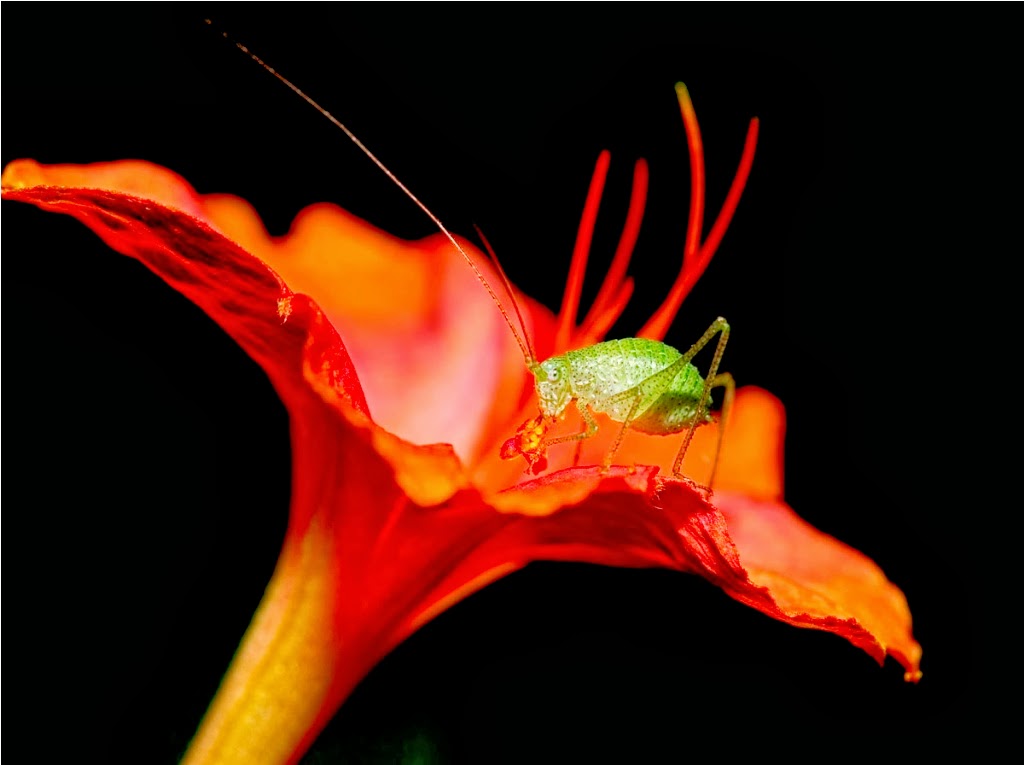
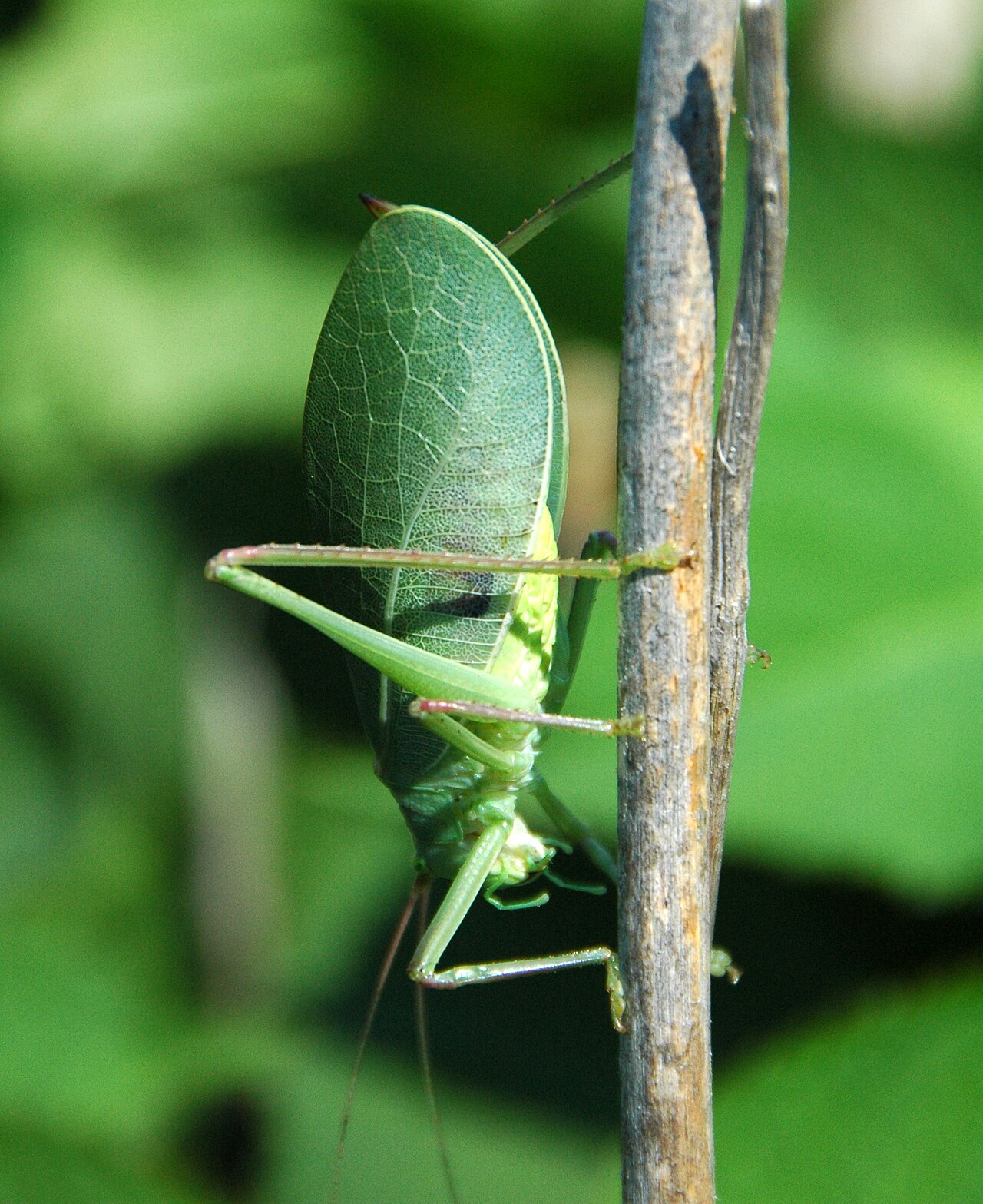
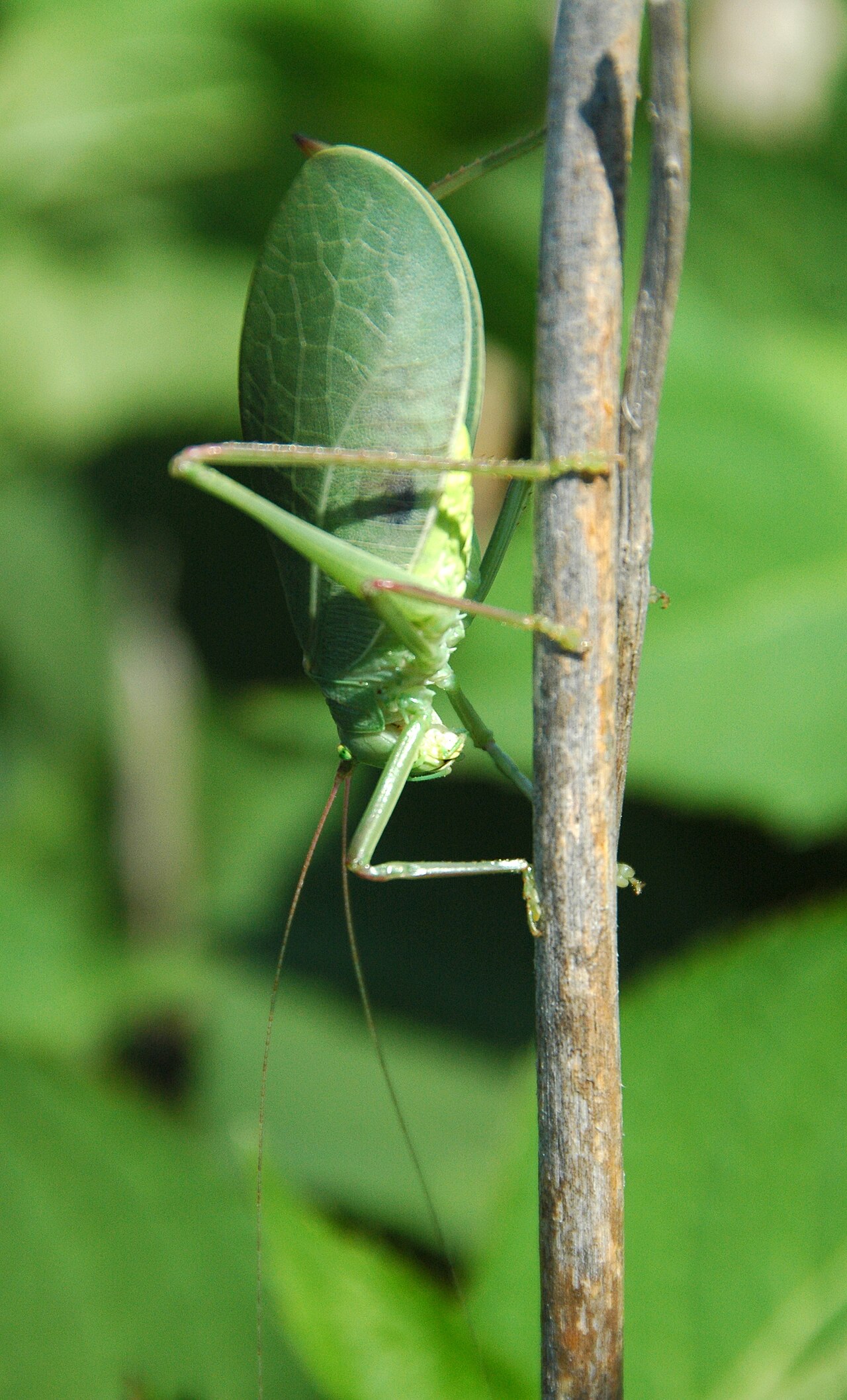
Most katydids are bright green and shaped like leaves, with wings that carry veins mimicking leaf venation and sometimes brown patches resembling damage or fungus. They have extremely long thread-like antennae, longer than the body, which is the single feature that separates them from grasshoppers at a glance.
Size ranges from under an inch in meadow katydids to over two and a half inches in the largest angle-wings and coneheads. Females carry a long curved or blade-like ovipositor at the rear, often mistaken for a stinger, which is used to insert eggs into plant tissue, stems, or soil depending on species. It is harmless.
Camouflage in the family goes well beyond simple green colouring. Some tropical species carry wings that reproduce leaf shape down to the notched edges, brown blotches, and even the appearance of holes chewed by other insects, and several North American angle-wings match the exact shade of the plants they favour. The disguise works against birds, which hunt by shape as much as by movement, and it is the reason a katydid singing loudly from a shrub can be impossible to spot from two feet away.
Pink and yellow individuals turn up occasionally and get reported widely. The pink form results from a genetic condition affecting pigment, and it was long assumed to be seasonal camouflage but is now understood as a colour polymorphism that is usually a disadvantage, since pink insects are conspicuous against green foliage. Over 6,000 katydid species are described worldwide, with roughly 250 in North America.
When Do Katydids Stop Singing?
The chorus ends with the first hard frosts, typically in October across much of the eastern United States and later in the south. Adults do not overwinter in most species; they die with the cold, having laid eggs on twigs, in bark crevices, or in soil, and the eggs hatch the following spring.
Within a single night, calling usually peaks in the first few hours after dark and thins after midnight, though the true katydid often continues until dawn. Cool nights suppress the chorus, and a temperature drop of a few degrees produces a noticeably slower, sparser sound that some people mistake for the season ending early.
Nymphs appear in late spring and go through several moults before reaching adulthood in midsummer, which is why nothing is heard until July despite the insects being present for months. The Songs of Insects project and the University of Florida entomology department (ufl.edu) both host reference recordings that make species identification by ear practical. The guide to birds chirping at night covers the other common source of unexplained night sound.
Frequently Asked Questions
What do katydids sound like?
Harsh, raspy, rhythmic phrases, most famously the true katydid’s katy-did katy-didn’t repeated after dark. Other species produce dry rattling buzzes, isolated ticks, or soft shuffling zips.
Am I hearing cicadas or katydids?
Katydids sing at night with scratchy rhythmic phrases; cicadas sing in daylight with a continuous mechanical drone that peaks in afternoon heat. Crickets add clear musical chirps at night from ground level.
How do katydids make sound?
By rubbing a ridged file on one forewing against a scraper on the other, amplified by a membrane called the mirror. Only males sing in most species, and the tempo speeds up as temperature rises.
What does it mean if you hear a katydid?
Late summer, since most species start calling in mid to late July. Folklore holds that the first call means roughly six weeks to frost. Symbolically they are read as luck, patience, and attentive listening.
Are katydid bugs harmful?
No. They do not sting or transmit disease, and a large one may pinch if handled roughly but cannot break skin. Leaf feeding is scattered and rarely noticeable in a garden.
Why do katydids all stop at once?
Usually a predator. Their ears are sensitive to ultrasound and detect bat echolocation, so a passing bat, a light, or footsteps can silence an entire chorus, which then rebuilds from one or two males.
When do katydids stop singing?
At the first hard frosts, usually October in the eastern United States. Adults do not overwinter; they die with the cold after laying eggs that hatch the following spring.