Tiger Swallowtail Butterfly: ID, Dark Females, and Hosts
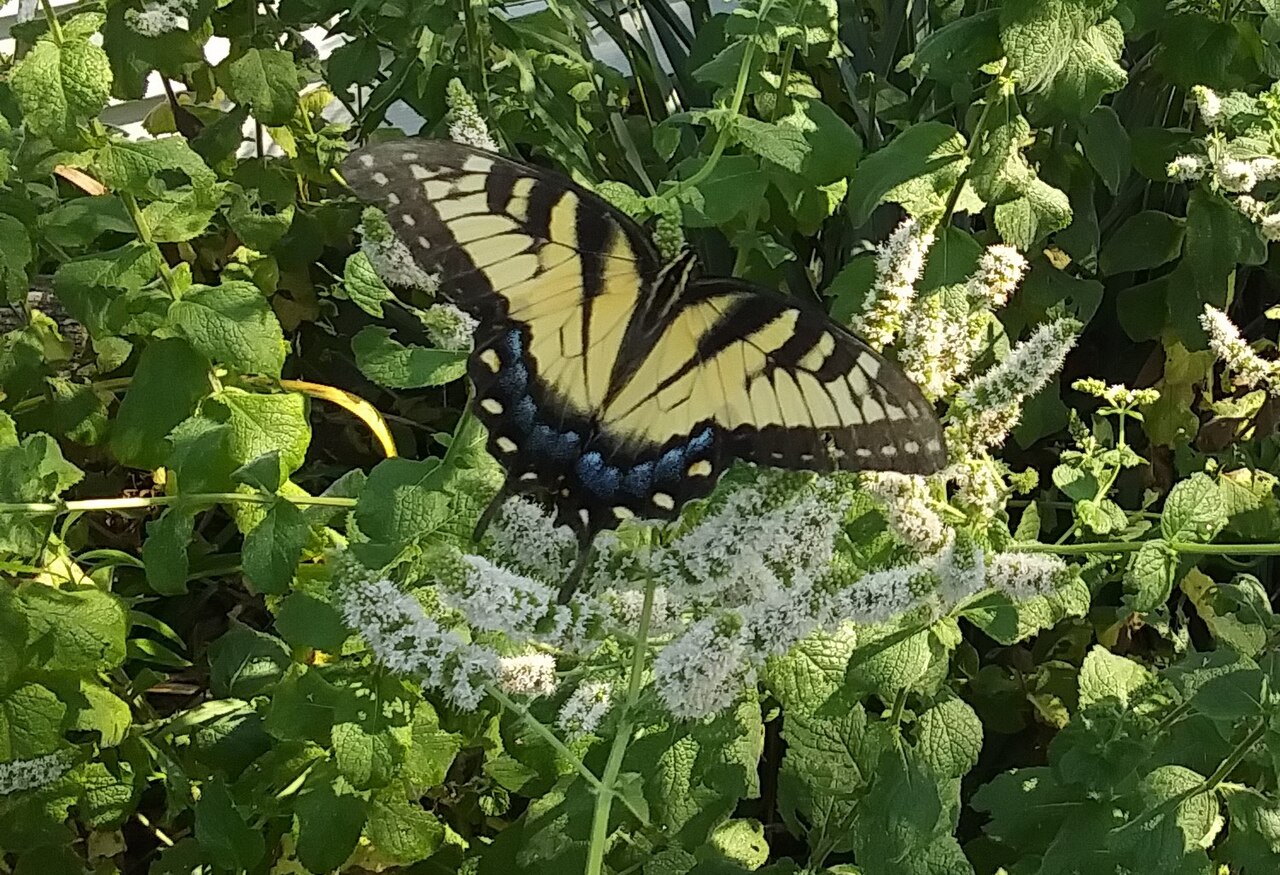
The eastern tiger swallowtail is a large yellow butterfly with four black tiger stripes on each forewing, black wing borders, and long tails, spanning three to five and a half inches. It is one of the most familiar butterflies in the eastern United States, common in gardens, along roadsides, and at the tops of trees, and it is the state butterfly or insect of five states.
The complication is that not all of them are yellow. Females occur in two forms, one yellow like the male and one entirely dark, and the dark form is a mimic of the toxic pipevine swallowtail. That means a black butterfly in a garden may be a tiger swallowtail, which catches out most people trying to identify one. This guide covers identification, both female forms, host plants, the caterpillar, and how to attract them.
The eastern tiger swallowtail is a large yellow butterfly with four black stripes on each forewing and long tails, spanning three to five and a half inches. Females come in a yellow form and a dark form that mimics the toxic pipevine swallowtail. Caterpillars feed on tulip tree, wild cherry, and ash, and mimic snakes with false eyespots.
| Feature | Eastern Tiger Swallowtail |
|---|---|
| Scientific name | Papilio glaucus |
| Wingspan | 3 to 5.5 in |
| Male | Yellow with four black forewing stripes |
| Female | Yellow form with blue hindwing, or all dark form |
| Host plants | Tulip tree, wild cherry, ash, sweetbay |
| Caterpillar | Green with large false eyespots |
| Overwinters | As a chrysalis |
How Do You Identify a Tiger Swallowtail?
Yellow wings with four bold black stripes running down each forewing, a broad black border studded with yellow spots, and long tails trailing from the hindwings. The hindwing carries orange and blue spots near the inner margin and near the tail, and the whole butterfly is large enough to register as a bird at a distance.
Sex is straightforward on yellow individuals. Females have a broad band of iridescent blue scaling across the outer part of the hindwing; males have little or none. Females are also slightly larger on average.
The dark female form throws people. It is black or very dark brown above with the tiger stripes just visible as darker shadow lines in raking light, a blue hindwing wash, and the same long tails. The underside retains a row of orange spots. The swallowtail butterfly guide covers the family and the black species it can be confused with.
Why Are Some Females Black?
Because they mimic the pipevine swallowtail, which is toxic from the aristolochic acids its caterpillars store from pipevine. A dark female gains protection from birds that have learned to avoid that pattern, while a yellow one does not, and the trait is inherited through the female line.
The distribution matches the model closely. Dark-form females are common in the southern and eastern parts of the range where pipevine swallowtails occur, and scarce or absent in the north and west where they do not, which is what mimicry theory predicts and one of the cleaner field demonstrations of it.
There is a cost to the disguise. Studies have found that males prefer yellow females, so dark females trade some mating success for reduced predation, and the balance between those pressures is what maintains both forms in the same population. The giant swallowtail guide covers a relative that never took up the disguise.
What Plants Do Tiger Swallowtails Lay Eggs On?
Tulip tree above all, plus wild black cherry, ash, sweetbay magnolia, birch, cottonwood, and willow. Unlike many swallowtails, this is a generalist that uses trees from several unrelated families, which is a large part of why it is so widespread and common.
Eggs are laid singly on the upper surface of leaves, usually on the outer parts of a tree in sun, and they are round, green, and about a millimetre across. Because the host plants are canopy trees, most of the life cycle happens well out of reach, which is why caterpillars are found far less often than the adults suggest they should be.
That generalism separates it sharply from its relatives. The zebra swallowtail needs pawpaw, the spicebush swallowtail needs spicebush or sassafras, and the black swallowtail needs carrot-family plants; the tiger swallowtail will use whatever suitable tree is present. The zebra swallowtail guide covers the opposite extreme, a species tied to one plant genus.
What Does the Caterpillar Look Like?
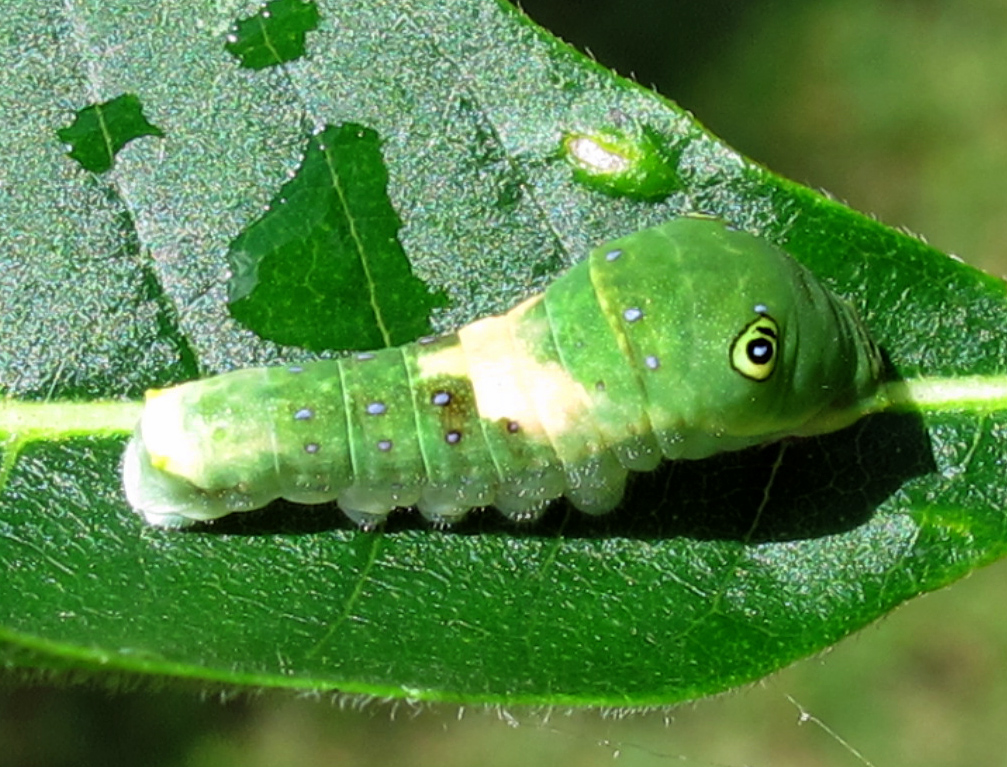
Bright green with a swollen thorax bearing two large false eyespots, black and yellow with blue pupils, which makes it look like a small snake or a tree frog. A narrow yellow and black band crosses behind the eyespots, and the body tapers toward the rear.
Younger instars are brown and white and mimic bird droppings instead, switching to the green snake mimic at around the fourth instar when they become too large for the dropping disguise to work. Before pupation the caterpillar turns brown and leaves the host plant to find a pupation site.
It rests on a silk mat on the upper surface of a leaf, drawing the edges up slightly, and when disturbed it rears the front end and everts an orange osmeterium from behind the head, which looks like a forked tongue and smells sharply of rancid butter. The gland is harmless. The monarch caterpillar guide covers a larva with an entirely different defensive strategy.
Are Tiger Swallowtails Rare?
Not at all. The eastern tiger swallowtail is one of the most common large butterflies in the eastern United States, ranging from southern Canada to Florida and west to the Great Plains, and it turns up in city gardens, suburbs, farmland, and woodland alike.
Its abundance comes from the generalist diet. A butterfly that can use tulip tree, cherry, ash, birch, and willow has host plants available almost everywhere in its range, and unlike specialists it does not disappear when one plant does. Two to three broods run from spring into September, with more in the south.
Related species fill out the rest of the continent. The Canadian tiger swallowtail is smaller and occupies the north, the western tiger swallowtail covers the west, and the two-tailed and pale swallowtails occur in the southwest and mountain west. Together the group covers nearly all of North America.
What Does It Mean to See a Tiger Swallowtail?
General butterfly symbolism applies: transformation, renewal, hope, and in many modern readings a message from someone who has died. Yellow adds associations with joy, optimism, and new beginnings, which is the most common colour reading applied to it.
There is no distinct traditional folklore for the species, and specific meanings circulated online are recent constructions rather than inherited belief. The butterfly’s cultural presence in the United States is more official than folkloric: it is the state butterfly of Alabama, Delaware, Georgia, and South Carolina, and the state insect of Virginia.
It also has a claim to being the first North American butterfly recorded by Europeans. A drawing made by John White at the Roanoke colony in 1587 is generally accepted as depicting this species, which makes it the earliest illustrated American butterfly. The guide to a butterfly landing on you covers the symbolism of the encounter itself.
What Attracts Tiger Swallowtails?
Large nectar flowers in sun. Tiger swallowtails favour tall plants with substantial blooms they can grip or hover at, including butterfly bush, joe-pye weed, milkweed, phlox, zinnia, lilac, thistle, ironweed, and bee balm. Small flat flowers are largely ignored.
Host trees turn visitors into residents. Tulip tree, wild black cherry, and ash are all substantial native trees, so this is a longer-term planting decision than putting in a shrub, but a mature tulip tree supports the species reliably and does a great deal else besides.
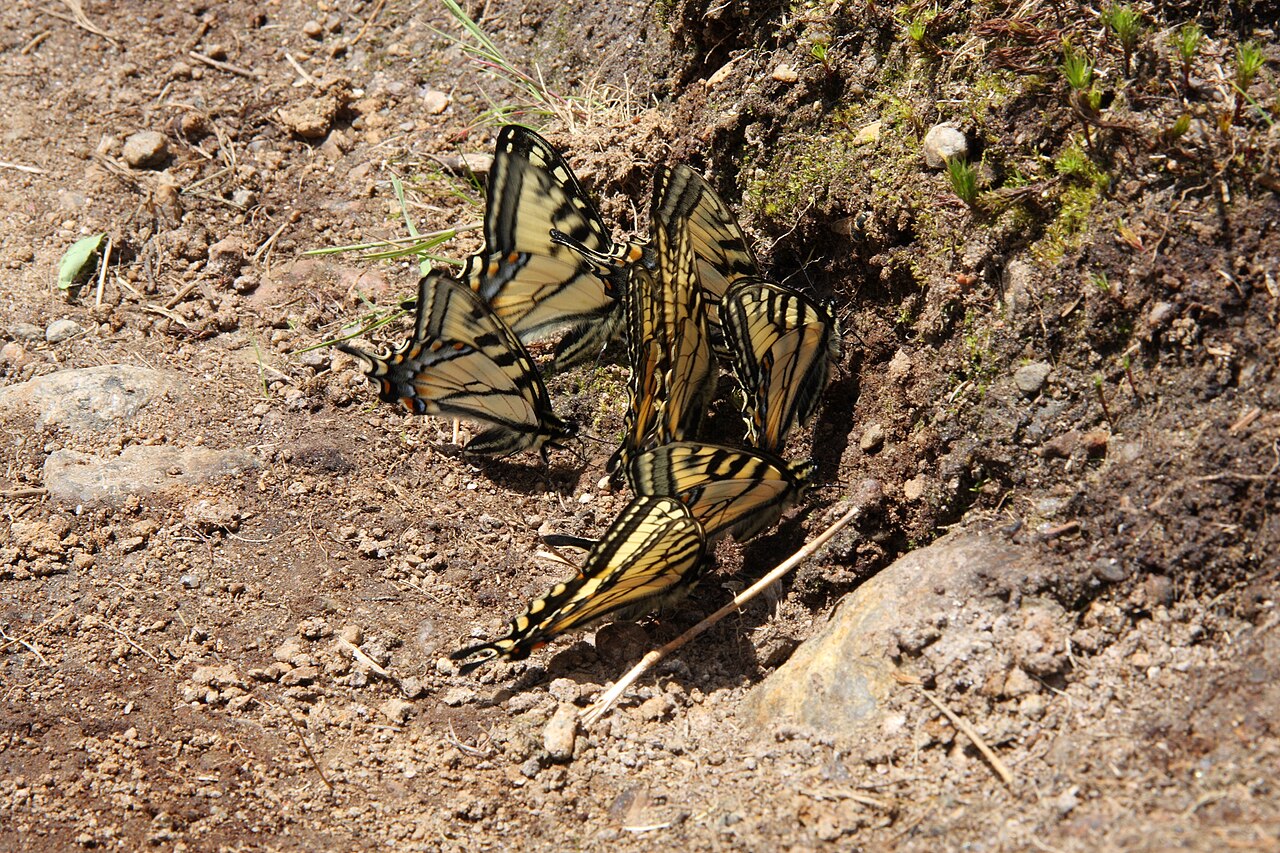
Damp ground matters for males. They puddle in groups at mud, damp gravel, stream edges, and animal urine, taking sodium that is transferred to females at mating, and a wet patch or a shallow sand depression kept damp draws them. Avoiding insecticides, particularly systemic products on host trees, protects the eggs and larvae the planting is meant to support. The painted lady guide covers a species with overlapping nectar preferences.
Where Do They Spend the Winter?
As a chrysalis. The final generation of the season pupates in autumn and overwinters attached to a stem, twig, tree trunk, or piece of debris, coloured brown to match bark, and emerges the following spring. Adults do not overwinter and do not migrate.
That makes autumn cleanup consequential. Chrysalides sit on the kind of standing stems, leaf litter, and untidy stem ends that get cut back and bagged in October, and there is no practical way to spot one in advance. Leaving perennial stems standing until spring and leaving leaf litter under trees protects them along with a great deal else.
Emergence timing follows temperature, with the first adults appearing in March in the deep south and May in the north. Early-season tiger swallowtails are noticeably smaller than midsummer ones, since spring caterpillars develop on less nutritious early foliage, which is a common pattern in butterflies with multiple broods.
How Do You Tell the Tiger Swallowtail Species Apart?
Range does most of the work. The eastern tiger swallowtail covers the east, the Canadian tiger swallowtail the boreal north, the western tiger swallowtail the west, and the two-tailed swallowtail the southwest, with limited overlap zones.
Where eastern and Canadian overlap, size and underside markings separate them. Canadian tiger swallowtails are noticeably smaller, with a continuous yellow band along the forewing underside margin rather than separate spots, and they fly earlier in a single brood.
Two-tailed swallowtails have, as the name says, two tails on each hindwing and narrower black stripes. Western tiger swallowtails are very similar to eastern ones but occur west of the Rockies and use willow, cottonwood, and alder as hosts. Hybrid zones exist where ranges meet, which makes some individuals genuinely ambiguous, and university extension and museum keys such as those from the University of Florida (ufl.edu) handle the details.
Frequently Asked Questions
How do you identify a tiger swallowtail?
Large yellow wings with four black stripes on each forewing, a black border with yellow spots, and long tails. Females have a broad blue band on the hindwing; males have little or none.
Why are some tiger swallowtails black?
They are dark-form females mimicking the toxic pipevine swallowtail. The form is common where pipevine swallowtails occur and scarce where they do not, exactly as mimicry theory predicts.
What plants do tiger swallowtails lay eggs on?
Tulip tree, wild black cherry, ash, sweetbay magnolia, birch, cottonwood, and willow. The species is a generalist across several plant families, which is why it is so widespread.
Is a tiger swallowtail rare?
No. It is one of the most common large butterflies in the eastern United States and appears in gardens, suburbs, farmland, and woodland from southern Canada to Florida.
What does the caterpillar look like?
Bright green with a swollen thorax and two large false eyespots, resembling a snake or tree frog. Younger instars are brown and white and mimic bird droppings instead.
What attracts tiger swallowtails?
Large nectar flowers in sun such as butterfly bush, joe-pye weed, phlox, and bee balm, host trees including tulip tree and wild cherry, and damp ground where males puddle for minerals.
What does it mean to see a tiger swallowtail?
Transformation and renewal in general butterfly symbolism, with yellow adding joy and new beginnings. It is the state butterfly of four states and the state insect of Virginia.

Similar Posts
Giant Moth: The World’s Largest Species and How to ID Them
The largest moths span up to 12 inches, and most cannot eat at all as adults. Here are the record holders, the North American giants and what you found.
Green Caterpillar: Species Identification Guide
Hornworm, tiger swallowtail, luna moth, and more. How to identify a green caterpillar and which species are safe to touch.
What Do Moths Eat? Adults, Caterpillars, and Clothes
Adult moths drink nectar and sap, and some never eat at all. Here is what moths eat at every stage, which fabrics larvae damage, and what pantry moths target.
Groundhog Sounds: The Whistle and Every Other Call Explained
Groundhog sounds decoded: the alarm whistle behind the whistle pig nickname, teeth chattering, distress squeals, and why night noise is almost never a groundhog.
Armadillo Poop: Identification Guide
Armadillo scat is a hard clay-packed marble, rarely found in the open. The digging signs that identify them, the leprosy question, and how to check a burrow before filling it.
Bullet Ant: The World’s Most Painful Sting Explained
How to identify the bullet ant, why its sting rates as the world’s most painful, and where these rainforest ants are found.