Black and Yellow Snake: Species Identification Guide
A black snake with yellow markings crossing a lawn or garden path is almost always one of a small number of harmless, common species, and the exact pattern, stripes running lengthwise versus bands wrapping around the body, is usually enough to identify it in seconds.
This guide covers the black-and-yellow snakes most commonly found in US yards, how each pattern differs, and directly addresses the question people ask first: whether any of them are dangerous.
Most black-and-yellow snakes in US yards are harmless garter snakes or kingsnakes, identified by yellow stripes running the length of the body (garter and ribbon snakes) versus yellow bands or chains wrapping around it (kingsnakes). None of the common black-and-yellow patterns in the US are venomous.
| Species | Pattern |
|---|---|
| Eastern Garter Snake | Yellow stripes running lengthwise on a black or dark body |
| Ribbon Snake | Thinner build, similar yellow stripes, often near water |
| Eastern Kingsnake | Yellow chain-like bands crossing a glossy black body |
| Speckled Kingsnake | Black body flecked with small yellow spots |
| Milk Snake | Red, black, and yellow bands, often confused with coral snake |
How to Identify a Black-and-Yellow Snake
The pattern layout is the fastest identifying feature. Stripes that run the full length of the body from head to tail point to a garter or ribbon snake, while bands, chains, or speckles that wrap around the body point to a kingsnake or milk snake. Body build matters too: garter snakes are relatively stout, ribbon snakes are noticeably slimmer, and kingsnakes are thick-bodied and often longer than either, sometimes reaching four to five feet as adults. Habitat is a useful secondary clue, since ribbon snakes rarely stray far from water while the other species covered here range across yards, fields, and woodland edges alike. Head shape offers one more quick check: all of the species on this page have narrow, rounded heads roughly the same width as the neck, unlike the broad, triangular heads typical of venomous pit vipers, which is one of the fastest general safety cues herpetologists recommend for any unfamiliar snake.
Eastern Garter Snake
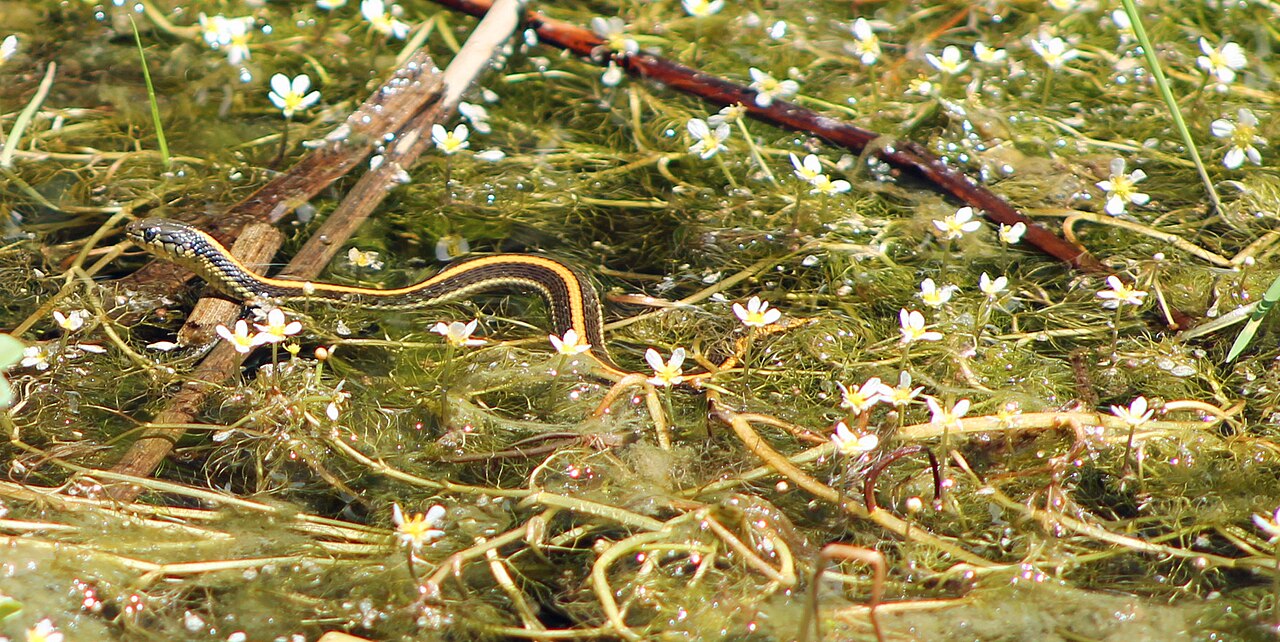
Garter snakes are the single most common black-and-yellow snake encountered in US yards, easily identified by one or three yellow stripes running the full length of a black, brown, or dark olive body. They’re harmless, feed mainly on worms, slugs, and small amphibians, and are often found basking near garden edges, woodpiles, or compost piles where prey is abundant. A garter snake bite, while rare and generally defensive, is not dangerous, and the species is not venomous in any medically significant way for humans. The National Wildlife Federation lists garter snakes among the most beneficial backyard reptiles precisely because of how broadly they range and how much garden pest control they provide without any real risk to people or pets. Newly hatched garter snakes show the same striped pattern as adults from birth, just at a fraction of the size, and a single female can give live birth to dozens of young in a single litter.
Ribbon Snake
Ribbon snakes look similar to garter snakes at a glance, sharing the same yellow-striped pattern on a dark body, but their build is noticeably slimmer and their tail proportionally longer, often making up close to a third of the snake’s total length. They stick close to water, ponds, streams, and marshy yard edges, far more consistently than garter snakes, which range more broadly across dry ground. Diet reflects this habitat preference too, ribbon snakes feed heavily on small fish and amphibians rather than the more varied garter snake diet, and they’re often seen swimming along the surface of a pond rather than basking on open ground the way garter snakes typically do.
Eastern Kingsnake
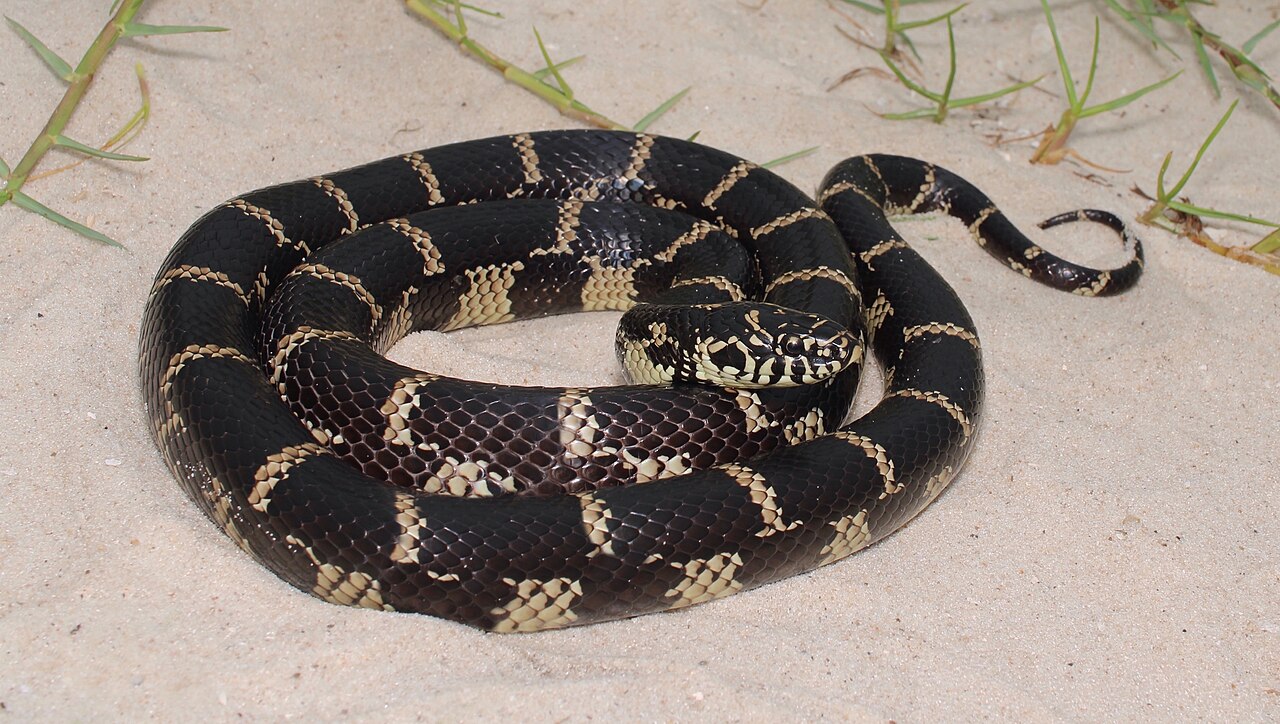
The eastern kingsnake shows a completely different pattern from the striped species above, a glossy black body crossed by narrow yellow or white bands that form a chain-like pattern, which is why this form is sometimes called the chain kingsnake. Kingsnakes are constrictors and, notably, immune to the venom of several venomous species they prey on, including copperheads and rattlesnakes, making them one of the more genuinely useful snakes to have on a property. Young kingsnakes hatch already showing the full adult banding pattern and are capable of hunting small prey almost immediately, growing quickly toward their eventual adult length of three to four feet.
Speckled Kingsnake
The speckled kingsnake carries the same black base color but trades bands for small, scattered yellow spots across nearly every scale, giving it a salt-and-pepper appearance sometimes described as looking dusted with paint. Like its banded relative, it’s a non-venomous constrictor that preys heavily on rodents, making it a genuinely beneficial snake to find near a home or barn rather than one worth relocating. It’s most common across the central and south-central US, and its speckled pattern tends to become more pronounced with age, so younger individuals sometimes show less contrast than a mature adult.
Milk Snake and the Coral Snake Look-Alike Rule
Milk snakes complicate the black-and-yellow category slightly, since their pattern is technically tricolor, red, black, and yellow bands, which leads to frequent confusion with the venomous coral snake. The well-known rhyme “red touches yellow, kill a fellow; red touches black, friend of Jack” distinguishes them: on a milk snake, red bands touch black, while on a coral snake, red bands touch yellow. The full comparison covers this distinction in more detail, including regional pattern variations where the classic rhyme doesn’t reliably hold. Milk snakes are found across a much wider range than true coral snakes, which are largely confined to the southeastern US, so geography alone rules out a coral snake across most of the country even before checking the band pattern.
Is a Black-and-Yellow Snake Venomous?
In the vast majority of US backyard encounters, no. Garter snakes, ribbon snakes, and both kingsnake forms covered here are entirely non-venomous and pose no significant threat to humans or pets. The one pattern worth extra caution around is the tricolor red-black-yellow banding of milk snakes and coral snakes, since one of those two is genuinely venomous, but a snake that’s simply black with yellow stripes or bands, with no red in the pattern at all, can be identified with confidence as one of the harmless species on this page. It’s also worth noting that even a bite from one of these non-venomous species is not medically dangerous, though any snake bite that breaks the skin is still worth cleaning and monitoring the way you would any small puncture wound.
How These Snakes Defend Themselves
None of the species on this page rely on venom for defense, and their actual defensive behaviors are far less dramatic than their reputation suggests. Garter snakes release a foul-smelling musk from glands near the tail when handled, an effective deterrent that requires no bite at all. Kingsnakes may vibrate their tail against dry leaves to mimic a rattlesnake’s warning sound, a bluff that works surprisingly well on predators without actually being dangerous. Most species in this group will also flee toward cover long before resorting to any defensive display, and a direct bite from any of them is a last resort rather than a first response. Some kingsnakes take defense a step further by flattening their body and hissing loudly, a display meant to look larger and more threatening than the snake actually is, again with no venom or real danger behind it.
Where You’re Most Likely to See One
Garter snakes are the most widely distributed of this group, found in nearly every US state and comfortable in yards, gardens, and vacant lots alike. Kingsnakes favor the southern and eastern US, particularly areas with a healthy rodent population to sustain them, while speckled kingsnakes are more concentrated in the central and south-central states. Ribbon snakes track closely with wetlands and water features, so a yard without a pond, stream, or marshy low spot is unlikely to host one regardless of region. Time of day matters as well: most of these species are active during daylight hours, especially in the morning when they bask to raise their body temperature, which is also the most common time homeowners report a sighting.
What to Do If You Find One in Your Yard
The safest response with any of these species is simply to leave it alone and let it move along on its own, since all of them are more interested in escaping than confronting a person. If a snake has taken up residence somewhere inconvenient, like a garage or crawl space, a broom used to gently guide it toward an open door works better than direct handling, which risks a defensive bite even from a harmless species. Removing brush piles, sealing gaps under sheds, and keeping woodpiles away from the house reduces how attractive a yard is to snakes generally, without needing to target or harm the animal that’s already there. Calling a local wildlife removal service is a reasonable option too if a snake has settled somewhere you genuinely can’t wait out, though for the species on this page relocation is rarely medically necessary given how harmless an encounter actually is.
Why These Snakes Are Good to Have Around
Every species on this page provides real pest control value. Garter and ribbon snakes keep slug, worm, and small amphibian populations in check, while kingsnakes prey on rodents and, notably, on other snakes, including venomous species. A yard hosting a resident kingsnake is, somewhat counterintuitively, less likely to have a venomous snake problem, since kingsnakes actively hunt and eat copperheads and young rattlesnakes within their territory.
Related reading: Black Snake in Florida.
Related reading: Black Snake With Yellow Stripe.
Frequently Asked Questions
Is a black and yellow striped snake dangerous?
Generally no. Garter and ribbon snakes, the most common black-and-yellow striped species in US yards, are non-venomous and pose no significant danger to people or pets, though any snake can deliver a defensive bite if it feels cornered or threatened.
What kind of snake is black with yellow bands rather than stripes?
Banded rather than striped patterns usually point to a kingsnake, either the chain-patterned eastern kingsnake or the spotted variation seen in the speckled kingsnake, both of which are non-venomous constrictors.
How do I tell a milk snake from a venomous coral snake?
Check whether red bands touch black or yellow: on milk snakes red touches black, while on coral snakes red touches yellow, though when in doubt it’s safest to treat any red-black-yellow snake with caution and keep a safe distance rather than getting close enough to check the band order.
Are kingsnakes actually helpful to have around?
Yes, kingsnakes control rodent populations and are immune to the venom of several dangerous snake species they prey on, making them one of the more beneficial snakes to leave undisturbed on a property.
What should I do if I find a black and yellow snake in my house?
Gently guide it toward an open door or use a container to relocate it outdoors rather than handling it directly, since even non-venomous snakes may bite defensively if grabbed or cornered.
Do garter snakes bite?
They can, though bites are rare, mild, and purely defensive, and garter snakes are not considered dangerous to humans in any meaningful sense beyond the minor discomfort of the bite itself.