Chicken Poop: Color Chart, Normal vs Sick, and 3 Lookalikes
Healthy chicken poop is a firm brown or greenish brown lump about 0.5 to 1 in (1.3 to 2.5 cm) across, topped with a chalky white cap. That white part is urate, the bird version of urine, and it is the single fastest way to tell chicken poop from the droppings of a mammal. A laying hen produces 25 to 50 of these a day, so a small backyard flock leaves a steady record of its own health on the coop floor every morning.
Reading that record is a practical skill. Color, firmness and content shift within hours when a bird picks up coccidia, eats something new or sits on a clutch of eggs, and those shifts show up on the droppings board days before a hen looks sick.
Chicken poop is a brown to greenish brown dropping roughly 0.5 to 1 in (1.3 to 2.5 cm) wide, capped with white urate paste. Once or twice a day a hen also passes a soft, strong smelling mustard brown cecal dropping, which is normal. Watery, bloody, foamy yellow or pure white runny droppings are signs of disease.
| Dropping type | Look and color | Size | How often | What it means |
|---|---|---|---|---|
| Normal intestinal | Firm brown coil with white cap | 0.5 to 1 in (1.3 to 2.5 cm) | 25 to 50 per day | Healthy gut |
| Cecal | Sticky mustard to chocolate brown, no cap, strong smell | 1 to 1.5 in (2.5 to 4 cm) | 1 to 2 per day | Normal, cecum emptying |
| Broody | Huge, loose, very smelly | 2 to 3 in (5 to 8 cm) | 1 to 2 per day | Hen sitting on eggs |
| Green and loose | Grass green, little form | Variable | Several per day | Lots of greens, or not eating |
| Bloody | Red streaks or dark clots | Variable | Any | Coccidiosis, treat at once |
| Foamy yellow | Frothy, sulfur yellow | Variable | Any | Worms or bacterial infection |
What Does Healthy Chicken Poop Look Like?
Healthy chicken poop holds its shape when it lands. It sits as a brown coil or lump with a distinct white urate cap on one end, and it does not spread into a puddle on the droppings board. The brown ranges from milk chocolate to a dull olive depending on feed, and birds on pasture with plenty of clover and grass pass noticeably greener droppings than birds on pellets alone.
Firmness matters more than color. Pick the dropping up with a gloved finger or a stick and it should stay in one piece rather than smear. A thin ring of clear liquid around the dropping on a hot afternoon is normal, because hens drink far more water above 85 F (29 C) and dump the surplus through the droppings.
Chicken Poop Color Chart: What Each Color Means
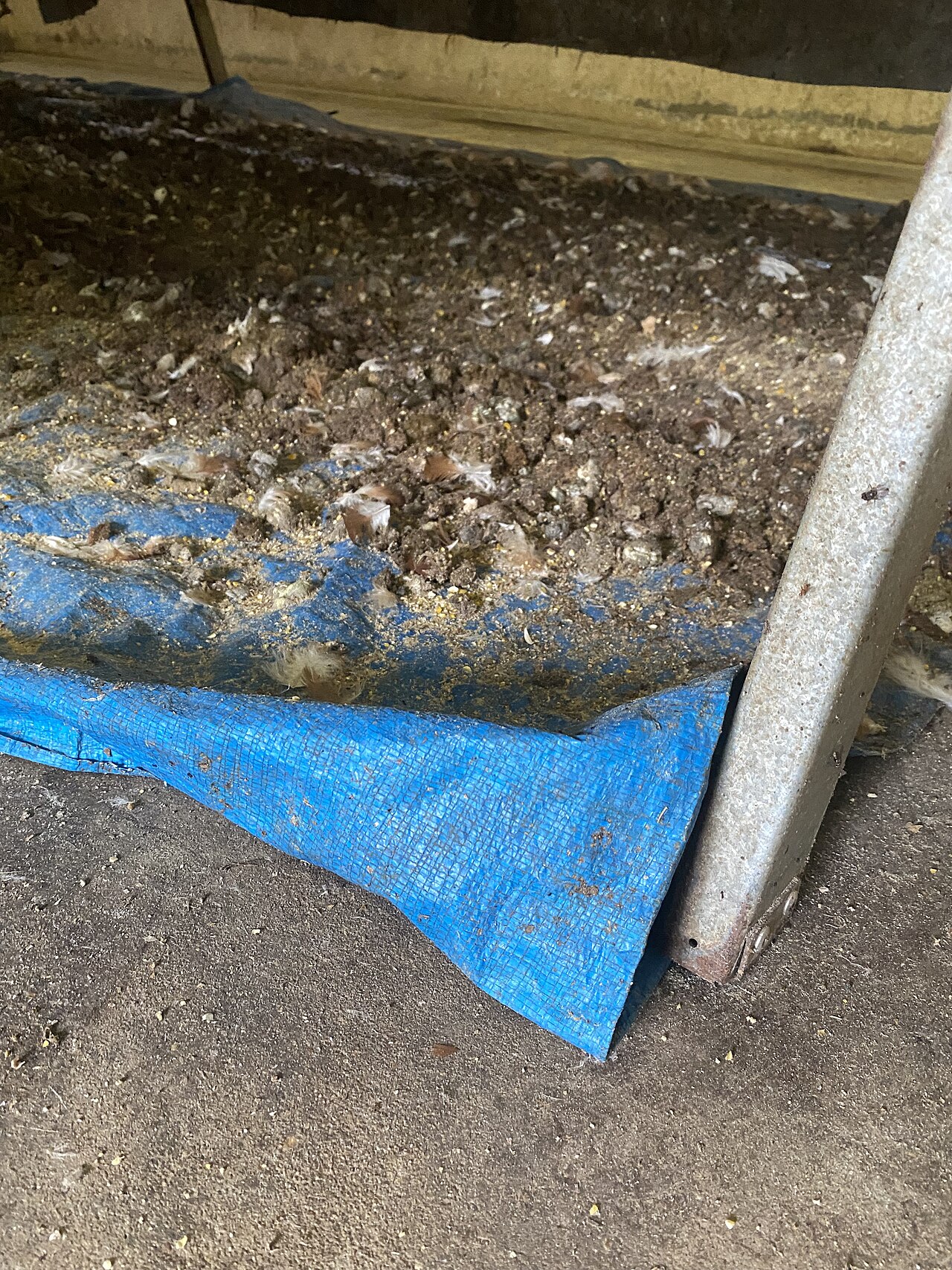
A chicken poop color chart is useful as long as you treat color as a question and not a diagnosis. Green droppings usually mean a heavy green diet, but in a bird that refuses feed they mean bile with nothing to color it. Yellow and foamy points to internal parasites or an infection. Pure white, runny droppings with no solid part suggest a kidney or urate problem, while an all white dropping with a normal brown core is simply a urate heavy one.
Black or very dark droppings follow blackberries, elderberries and blueberries, and they also follow bleeding high in the gut. Rust red to brick red droppings in young birds are the classic coccidiosis sign, because the parasite strips the intestinal lining and the shed tissue comes out with the manure.
Cecal Poop: The Normal Dropping That Smells Wrong
Once or twice a day a chicken empties its ceca, two blind pouches where fiber ferments, and the result looks nothing like the rest. Cecal droppings are smooth, sticky, mustard brown to near chocolate, have no white cap, and smell far worse than ordinary manure. New keepers find one on the coop floor and assume diarrhea.
Cecal droppings make up roughly one in ten of a bird’s daily output. They should still be paste thick rather than liquid, and uniform in color. Runny cecal droppings, or ones that are foamy and yellow, are the exception that genuinely signals trouble, usually worms or a bacterial overgrowth.
Chicken Poop vs Duck Poop

Duck droppings are wetter, longer and greener than chicken droppings almost without exception. Ducks drink heavily and dabble, so their manure arrives as a loose green brown slick 2 to 4 in (5 to 10 cm) long that spreads on contact, and the white urate is streaked through it instead of sitting as a neat cap. Chicken poop stacks, duck poop runs.
Location settles the rest. Duck droppings concentrate within a few feet of water and along the route between pond and shelter, and they sour the grass there. Chicken droppings cluster under the roost bar, which is where 60 to 70 percent of a flock’s nightly output lands in a tidy line. If you also want to rule out wild birds, our guide to identifying bird droppings covers the splash shaped droppings that fall from above.
Chicken Poop vs Goose Poop
Goose poop is the easiest confusion to settle, because geese produce tubes. A Canada goose dropping is a firm green cylinder 2 to 3 in (5 to 8 cm) long and about 0.5 in (1.3 cm) thick, often with a white tip, and the color is dominated by the grass the bird has clipped. Chicken droppings are shorter, wider and lumpier, and far browner on any normal feed.
Numbers help too. A single Canada goose leaves one to two pounds of droppings a day, laid down in long trails across mown lawns, sports fields and dock edges. Chickens rarely range that far from cover, so a dense scatter of green tubes in open turf 200 ft (60 m) from any coop is geese, not an escaped hen.
Chicken Poop vs Rat Poop
Rat droppings turn up in chicken coops constantly, because spilled feed is exactly what brings rats in. A rat dropping is a dark, dry, spindle shaped pellet 0.5 to 0.75 in (1.3 to 1.9 cm) long with blunt or slightly pointed ends, and it carries no white urate at all. Chicken poop is three to five times bulkier, moister and always capped with white when fresh.
Pattern separates them further. Rats leave 40 to 50 pellets a night in runs along walls, behind feeders and inside nest boxes, scattered as a trail rather than dropped in a pile. If you find those pellets, check for the other signs too: rat tracks in dust, mud or snow and the grease smears rats leave on timber. For the finer distinction between the two rodents most likely to raid a coop, see rat poop versus mouse poop. Mammal droppings in general lack the urate cap, which is also how deer and rabbit pellets separate from bird droppings at a glance.
When to Be Concerned About Chicken Poop
Three patterns justify acting the same day. What coccidiosis poop looks like in chickens is the first: watery droppings with rust red streaks, dark clotted blood or shreds of orange tissue, usually in birds three to twelve weeks old, alongside a hunched posture and ruffled feathers. Coccidiosis kills fast in young stock, and amprolium in the drinking water is the standard response.
What Salmonella poop looks like in chickens is harder, and that is the problem. Infected birds often pass normal looking droppings while shedding bacteria, and when droppings do change they turn watery, yellow green and foul. There is no visual test you can trust, which is why the handling rules below apply to every flock. The guidance from the Centers for Disease Control and Prevention is to wear gloves, keep coop shoes outside, and wash hands after any contact with birds, eggs or bedding.
What stress poop looks like in chickens is the mildest of the three: loose, pale and shapeless droppings from a bird that has just been moved, transported, chased by a dog or pushed through a heat wave. Stress droppings resolve within a day or two once the cause stops. If they do not, or if any bird passes blood, treat it as disease and not as nerves.
How to Clean Up Chicken Droppings Safely
Droppings dry into dust, and dust is how the bacteria reach you. Wear nitrile gloves and an N95 mask before you scrape a roost bar or sweep a coop floor, mist caked litter lightly with water first to keep it down, and keep coop boots outside the house. Use a dedicated scraper and bucket that never come indoors.
Clean the roost area weekly and strip the bedding every four to eight weeks, more often in wet weather. Wash hands with soap for 20 seconds afterward, and do not eat, drink or handle a phone between scraping and washing.
Is Chicken Poo Good for the Garden?
Chicken poo is one of the richest garden manures available, at roughly 1.1 percent nitrogen, 0.8 percent phosphorus and 0.5 percent potassium, which beats cow and horse manure on all three. Fresh, that strength is a liability: the ammonia and the salt load scorch roots and seedlings on contact, so raw droppings never go straight onto a bed in production.
Composting fixes it. Mix the droppings and bedding at roughly two parts carbon to one part manure, keep the pile moist, and turn it so the center holds 130 to 150 F (54 to 66 C) for several days. Give it three to six months and you get a crumbly, earth smelling amendment safe for vegetables. The feed side of the same loop is worth getting right as well, and what chickens can and cannot eat shapes both the manure and the bird. For bats, which produce another prized garden fertilizer, bat guano follows comparable composting logic.
Related reading: Pigeon Poop.
Related reading: Crow Poop.
Related reading: Eagle Poop.
Related reading: Seagull Poop.
Related reading: Hawk Poop Identification.
Related reading: Hummingbird Poop.
Frequently Asked Questions
Does apple cider vinegar deworm chickens?
No. Apple cider vinegar does not deworm chickens, and no controlled study supports it as a wormer. It mildly acidifies drinking water and may discourage algae in waterers, which is the whole of its value. Confirmed worms need a licensed product such as fenbendazole, dosed on a veterinarian’s instruction.
What is the biggest killer of chickens?
Predators kill more backyard chickens than anything else, with raccoons, foxes, hawks and loose dogs leading the list. Among diseases, coccidiosis takes the most young birds, and Marek’s disease the most adolescents. Hardware secured runs and vaccinated chicks remove most of both risks.
Can a chicken still poop if it is egg-bound?
Usually yes, at least at first. An egg stuck in the oviduct presses on the gut and slows output, so droppings get smaller and wetter rather than stopping outright. Complete absence of droppings in a straining hen is an emergency and needs a warm bath, calcium and a vet within hours.
What is chicken poop called?
The polite term is chicken manure, and in poultry literature droppings is the standard word. Keepers distinguish intestinal droppings from cecal droppings, the soft smelly type passed once or twice daily. Caked bedding mixed with manure is called coop litter.
How long does chicken poop stay dangerous?
Salmonella and Campylobacter can survive weeks in dry droppings and months in cool damp bedding. Properly hot composted manure is considered safe after three to six months. Treat any dried dust in a coop as infectious and wear a mask when you sweep.