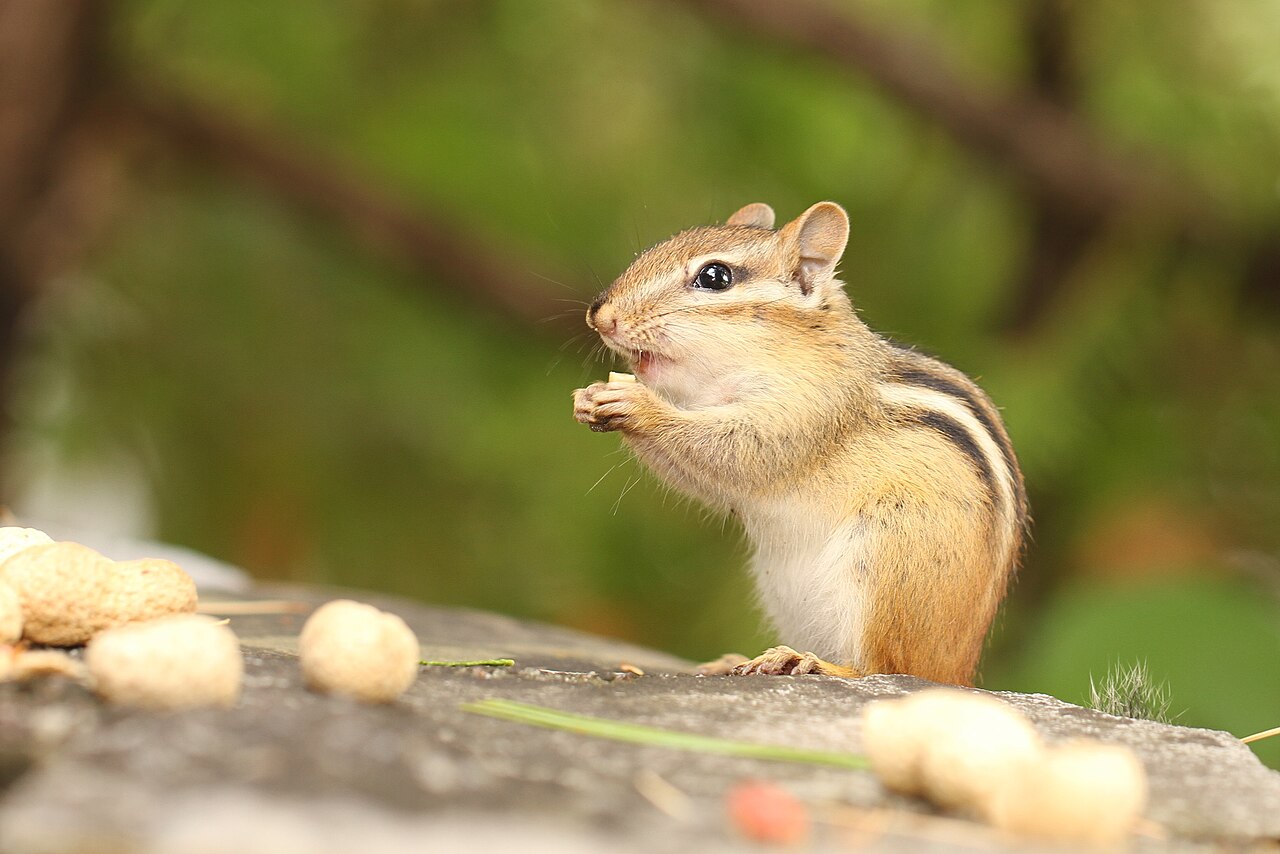
Chipmunk vs Rat Droppings: 3 Checks That Settle It
Size settles chipmunk vs rat droppings in about two seconds: a chipmunk pellet is roughly the size of a grain of rice, while a rat pellet is the size of a raisin or an olive pit. Chipmunk droppings run 0.25 to 0.33 in long (6 to 8 mm), rat droppings 0.5 to 0.75 in (12 to 19 mm), and nothing in between is common in a US yard or basement.
Where you find them matters almost as much. Chipmunks (Tamias striatus) leave a few scattered pellets outdoors near stone walls, foundation gaps and burrow mouths, and they use latrine chambers underground, so surface finds stay sparse. Rats produce 40 to 50 pellets a night each and drop them along the same travel routes every night, which is why a rat problem announces itself as a pile and a chipmunk almost never does.
Chipmunk droppings are 0.25 to 0.33 in long (6 to 8 mm), thin, dark and tapered at both ends, found in small scattered amounts outdoors. Rat droppings are 0.5 to 0.75 in (12 to 19 mm), thick and capsule shaped with blunt ends, found in concentrated piles along indoor runways.
| Feature | Chipmunk droppings | Rat droppings |
|---|---|---|
| Length | 0.25 to 0.33 in (6 to 8 mm) | 0.5 to 0.75 in (12 to 19 mm) |
| Thickness | About 0.1 in, rice grain slim | About 0.25 in, pencil thick |
| Ends | Tapered to a point at both ends | Blunt and rounded (Norway rat) |
| Color | Dark brown to black, dull | Black and glossy when fresh, grey when old |
| Contents | Seed hulls, nut fragments, insect parts | Mixed food waste, grain, no visible hulls |
| Typical find | 2 to 10 pellets, outdoors | Dozens to hundreds, indoors along walls |
| Where | Stone walls, burrow mouths, deck edges | Behind appliances, attics, crawlspaces, pantry |
What Chipmunk Droppings Look Like
A chipmunk pellet is a slim dark cylinder about as long as a grain of rice and tapered at both ends. Fresh pellets are soft and almost black, and they dry to a dull dark brown within a day or two. Break one with a stick and you often see seed coats and chewed shell fragments, because the diet is nuts, seeds, berries and insects.
The amount is the real tell. Chipmunks keep latrines in their burrow systems, so what reaches the surface is a handful of pellets near an entrance hole, along a stone wall or on a deck board they use as a lookout. Finding two or three pellets and no more is normal for chipmunks, and it is covered in more depth in our guide to chipmunk poop.
What Rat Droppings Look Like

Norway rat droppings (Rattus norvegicus) are capsule shaped, 0.5 to 0.75 in long and about as thick as a pencil, with ends that look cut off rather than pointed. Roof rat droppings are slightly smaller, more curved and tapered at the ends. Both are shiny and putty soft on the day they are dropped, then harden and fade to grey in about three days.
Rats are creatures of habit and deposit along fixed runways: the base of a wall, the top of a joist, behind a stove, inside a drawer. A single rat leaves 40 to 50 pellets in 24 hours, so an active infestation produces concentrations you cannot miss. Our breakdown of rat poop covers freshness, age and what each location means.
Chipmunk Poop vs Mouse Poop

Mouse droppings are the genuine lookalike, not rat droppings. House mouse pellets measure 0.125 to 0.25 in (3 to 6 mm) and taper at both ends, so they have the same shape as chipmunk pellets at about half to two thirds the size. Side by side the chipmunk pellet is noticeably thicker and longer, but a single pellet on a basement floor is a coin flip.
Location breaks the tie. Mice live indoors and scatter 50 to 75 pellets a night across counters, drawers and insulation. Chipmunks almost never enter a house and do not nest in walls, so pellets found inside a kitchen cabinet are mouse, not chipmunk. The same size question comes up between the two biggest offenders, which we compare in rat poop vs mouse poop.
Chipmunk Poop vs Squirrel Poop
Gray squirrel droppings sit between the two: about 0.375 in long (9 mm), barrel shaped with rounded ends, and lighter brown than either chipmunk or rat pellets. They turn pale and chalky as they age, while chipmunk pellets stay dark. Squirrels drop them on attic insulation, roof lines, deck rails and tree branches, places chipmunks rarely reach.
Because squirrels also get mistaken for rats in attics, the shape test matters: rounded squirrel ends against blunt but straight sided rat capsules, and a lighter color in the squirrel pellet. The full comparison is in squirrel poop vs rat poop, and in an attic you should also rule out the small, crumbly pellets described in bat poop vs mouse poop.
Where You Find Them and What That Tells You
Treat the location as evidence of equal weight to the pellet itself. Chipmunk droppings turn up outdoors: at the 2 in burrow holes that have no soil mound beside them, along dry stone walls, under bird feeders, on patio steps and in garage corners next to an open door. Indoor finds are limited to garages and sheds that stand open during the day.
Rat droppings turn up on runways in enclosed space: along baseboards, on joists, behind the refrigerator, in the back of pantry shelves, in crawlspaces and in insulation. Grease smears, gnawed holes the size of a quarter and scratching at night confirm it. Another animal leaving large droppings near crawlspaces is covered in opossum poop vs rat poop.
Health Risks and How to Clean Up Safely
Rat droppings carry the heavier risk. Norway rats can transmit leptospirosis, salmonella and rat bite fever through urine and feces, and in the US they are the reservoir for Seoul virus, a hantavirus that is rare here. Chipmunks can carry salmonella, and in the western states their fleas can carry plague bacteria, which is the reason not to handle a sick or dead one.
The CDC guidance for any rodent droppings is the same: do not sweep or vacuum, because that puts particles into the air. Wear gloves and an N95, spray the droppings with a disinfectant or a mix of one part bleach to ten parts water, wait five minutes, wipe up with paper towels, then bag and wash your hands.
Frequently Asked Questions
What could be mistaken for rat poop?
Squirrel droppings are the most common mix up, at 0.375 in with rounded ends and a lighter brown color. Large cockroach droppings, bat guano and dried raisins or coffee grounds fool people too. Chipmunk pellets are far too small at 0.25 to 0.33 in, which is closer to mouse size than rat size.
Do all rat droppings carry hantavirus?
No. In the United States, hantavirus pulmonary syndrome comes mainly from deer mice, white footed mice, cotton rats and rice rats, not from the Norway rats found in cities and basements. Norway rats can carry Seoul virus, another hantavirus, but documented US cases are rare. Treat any rodent droppings with the same cleanup precautions.
Is cleaning rat droppings toxic?
The droppings are not toxic to touch through gloves, but disturbing them dry is the risk, since sweeping or vacuuming sends virus and bacteria particles into the air you breathe. Wetting the material with disinfectant first removes almost all of that hazard. Use gloves, an N95 mask and paper towels, and ventilate the room for 30 minutes.
Do chipmunks hate rats?
Chipmunks do not hate rats so much as avoid them. Both compete for seeds and spilled birdseed, and a rat will raid a chipmunk burrow for young, so chipmunks give ground where rats are established. You rarely find both sets of droppings in one place, which itself helps confirm which animal you have.
Explore more: Animal Poop Identification: A Field Guide by Species