Cobra Symbolism: Spiritual Meaning and Signs
Symbolically, a cobra stands for protection, power, danger and transformation. Cobra symbolism takes its shape from one posture, the raised body and spread hood of a snake that is fully alert and ready to defend itself. Egyptian pharaohs wore that posture on their crowns, and Hindu shrines honor it with offerings.
The cobra guards and threatens in the same gesture. Wadjet protected the kings of Lower Egypt, the serpent king Muchalinda spread his hood over the meditating Buddha, and Vergil made a hidden snake the image of a danger you cannot see. The meaning shifts with the tradition, but the hood always signals a creature on watch.
As a sign, a cobra points to protection and alertness, a call to guard what matters and to watch for danger before you act. A cobra in a dream points to a threat you sense but have not named. A real cobra in front of you calls for distance first and meaning later.
What Does a Cobra Symbolize?
A cobra symbolizes protection, power, danger and transformation, and each theme belongs to a tradition that gives it weight. Protection comes from Egypt, where the cobra goddess Wadjet guarded the king. Power comes from the same crown and from Hindu images of Shiva. Danger and transformation come from the animal itself, a venomous snake that sheds its skin.
The raised hood is the center of the symbol. A cobra spreads it when it feels threatened, so the image is vigilance, not aggression. It stands tall, faces the threat and warns before it strikes. The lesson is plain. Set a boundary out loud before you have to defend it.
Transformation follows from shedding, which every snake does as it grows. The cobra adds a sharper edge, since the same animal that renews itself carries a bite that is a medical emergency. Animal spiritual meanings for 18 animals follow the same logic of tying each meaning to real behavior.
| Tradition | Figure or text | Core meaning |
|---|---|---|
| Ancient Egypt | Wadjet and the uraeus | Royal protection |
| Hinduism | Shiva, Vasuki, Nag Panchami | Power held under control |
| Buddhism | Muchalinda | Shelter at a threshold |
| Bible | Genesis 3, Isaiah 11:8 | Temptation, then peace restored |
| Roman poetry | Vergil, Eclogue 3 | Hidden danger |
| Norse myth | Jörmungandr | Chaos and the end of the world |
Cobra Safety Comes Before Symbolism
A cobra is a venomous snake, and that fact comes before any meaning. True cobras belong to the genus Naja. The Egyptian cobra (Naja haje) and the Indian cobra (Naja naja) are separate species with separate symbolic histories. The king cobra (Ophiophagus hannah) carries the name but sits in its own genus.
Never approach, corner or try to catch a cobra. Back away slowly, keep pets and children behind you and call emergency services or animal control. A cobra bite is a medical emergency, and the World Health Organization classifies snakebite envenoming as a neglected tropical disease in its snakebite envenoming fact sheet.
Distance is the whole rule. A cobra that has room to leave usually will. Read the symbol after you are safe, never while the snake is still in front of you.
Cobra Symbolism in Hinduism
In Hindu tradition, the cobra stands for divine power held under control. Shiva wears a cobra coiled around his neck, a creature of lethal force resting calmly on the god of destruction and renewal. The serpent king Vasuki is identified with that snake. In the story of the churning of the ocean, the gods and demons used Vasuki as their rope.

Nag Panchami is the festival that honors snakes. Worshippers offer milk and prayers at snake images and shrines, and the day honors nagas, the serpent beings, rather than cobras alone. Naga and cobra overlap in art, since nagas are shown with cobra hoods, but a naga is a divine being, not a species.
Kundalini adds an inner meaning. Tantra and yoga texts describe kundalini as energy coiled like a serpent at the base of the spine. Its rising marks awakening. The coiled snake becomes a picture of potential that waits until it is called.
Cobra Symbolism in Buddhism
In Buddhist tradition, the hooded serpent is a guardian of the awakened mind. The best known story is Muchalinda, a naga king who sheltered the Buddha after his enlightenment. A storm broke while the Buddha sat in meditation, and Muchalinda coiled beneath him and spread his hood over his head.
Statues in Thailand, Cambodia and Laos show this scene as the naga-protected Buddha. The serpent’s coils form a seat and its hood forms a canopy. The image turns a feared creature into a shield. Bear symbolism carries the same idea of a fearsome animal turned guardian.
The meaning here is protection at a threshold. Muchalinda guards the Buddha at the moment between seeking and teaching. Seen through this story, a hood raised over your path marks a time to stay still while something important takes shape.
The Cobra in Ancient Egypt: Wadjet and the Uraeus
In ancient Egypt, the cobra was the protector of the king. Wadjet, the cobra goddess, guarded Lower Egypt from her cult center at Buto in the Nile Delta. She was paired with Nekhbet, the vulture goddess of Upper Egypt, and the two together stood for the united land.
The uraeus is Wadjet in the form of a rearing cobra worn on the pharaoh’s brow. Egyptian texts describe it spitting fire at the king’s enemies. It appears on royal headdresses and on the funerary mask of Tutankhamun, where a cobra and a vulture head sit side by side.
The model for the image is the Egyptian cobra (Naja haje), but the uraeus is a royal emblem, not a field portrait. Artists drew the hood, the raised body and a stylized face to show readiness. The Indian cobra plays no part in this tradition, so its hood markings do not belong in Egyptian readings.
Cobra Symbolism and Death
The cobra stands for death because its bite can kill, and Egyptian, Hindu and Buddhist imagery all keep that fact in view. The same hood that shelters the Buddha warns before a fatal strike. Death and protection sit in one animal. That double edge gives the cobra its weight as a symbol.

Nagas guard thresholds in Hindu and Buddhist art. Their images flank temple stairs and causeways in Cambodia and Thailand, where the serpent marks the passage from the ordinary world into sacred space. Crossing that line is a small death of the old self, and the serpent stands at the gate. Bat symbolism works the same ground of night, fear and rebirth.
Cleopatra’s death belongs here with care. Plutarch reports that she died from the bite of an asp, then admits that no one knows what really happened. The species is uncertain, and the Egyptian cobra is only one candidate. Treat the story as legend shaped by the uraeus, not as a record.
What Does Seeing a Cobra Mean?
Seeing a cobra means stepping back first. Outside a zoo or a licensed collection, the sighting is a safety event, and the right response is distance and a call to professionals. Only after you are safe does the moment carry meaning.
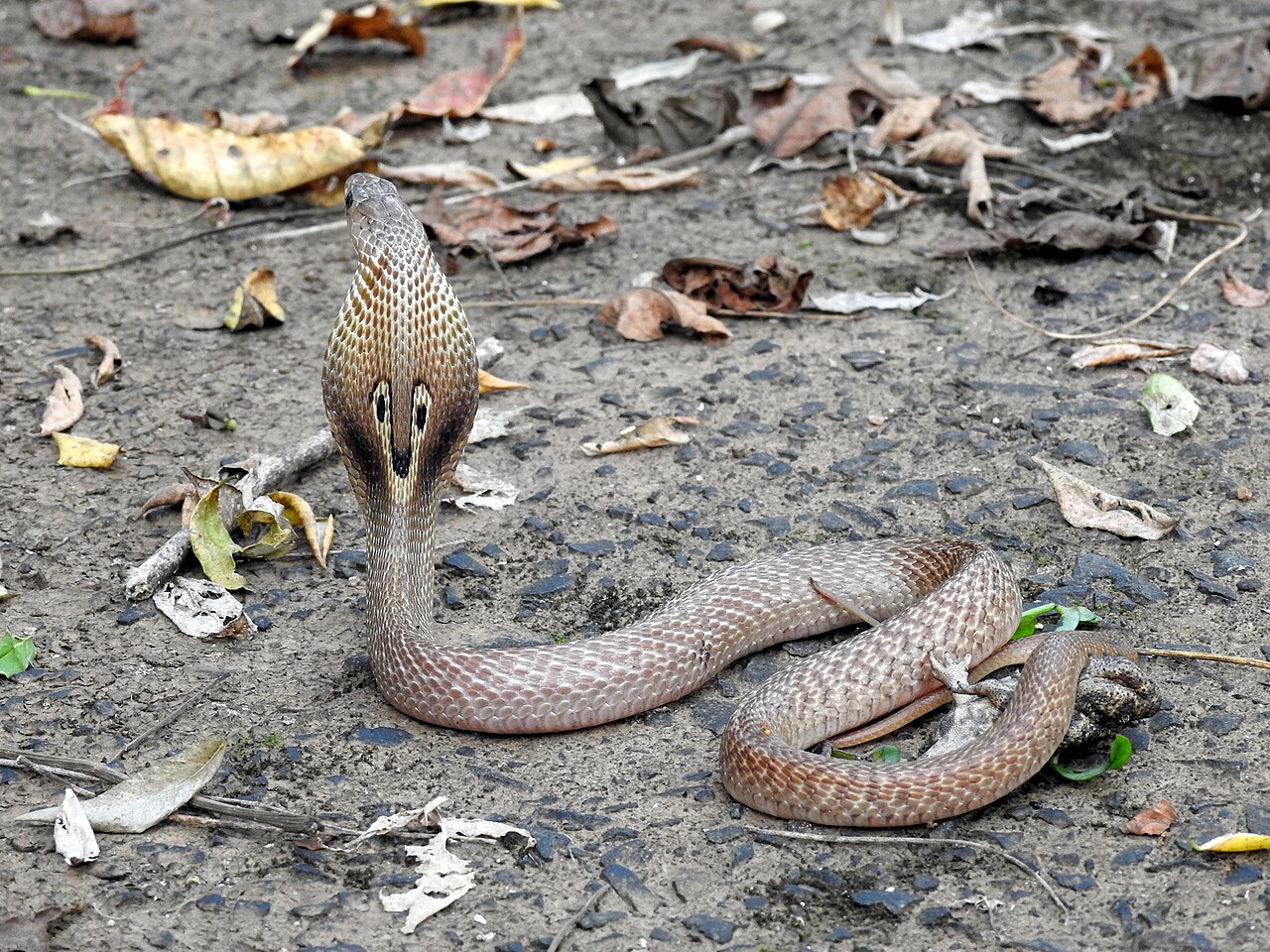
A cobra sighting points to a guarded threshold. The snake rose, it warned and it gave you room to leave. That sequence matches the moment you are in, a boundary that needs defending or a danger that announced itself before it struck. Heed the warning and act on it now.
Seeing a snake crossing your path carries a broader reading that covers every species. The cobra narrows it. Its message is vigilance and self-protection, not luck.
What Does a Cobra Mean in a Dream?
In modern dream interpretation, a cobra stands for a danger your mind has noticed before you have. The raised hood mirrors an inner warning. Something in your waking life has reached the point where it is ready to strike, and the dream puts it in front of you.
The action in the dream shapes the reading. A cobra that watches without striking points to vigilance and a choice still open. A cobra that bites points to a hurt that already landed, a betrayal or a decision that cost you. A cobra you calm or walk past points to a fear you have mastered.
The setting adds detail. A cobra in your home points to tension close by, in family or in a shared space. A cobra at work points to rivalry or pressure. Ask what in your life matches the posture, then deal with it while you still have room.
Cobra and Snake Metaphors in Language
In English, a snake is a traitor, someone who smiles while planning harm. Calling a person a snake accuses them of falseness. The cobra sharpens the image into speed and precision, a rival who strikes once and does not miss.
The phrase “snake in the grass” goes back to Vergil. In his third Eclogue, a shepherd warns boys picking flowers and strawberries with the Latin line “latet anguis in herba,” a snake lurks in the grass. The danger in Vergil is literal. English kept the words and turned them into a hidden enemy.
The cobra also lends its name to speed and force. The AH-1 Cobra attack helicopter and a long list of sports teams borrow it for a fast, decisive strike. The metaphor praises the same quality the traitor reading fears.
Snakes in Mythology: Eden, Apep and Jörmungandr
The most influential snake in Western mythology is the serpent of Genesis 3, which tempts Eve in the Garden of Eden. That serpent fixed the snake as a figure of deceit in Jewish and Christian tradition. The Bible later restores the image. Isaiah 11:8 pictures a young child playing near the den of the cobra, a sign of peace in a healed world, and the King James Version names the snake an asp where the ESV and NIV say cobra.
In ancient Egypt, Apep was the giant serpent of chaos. Each night he attacked the sun god Ra as Ra’s boat passed through the underworld, and each night he was defeated. Greek myth adds Python, the serpent Apollo killed at Delphi before he founded his oracle there.
Animal symbolism by culture and sign shows how one creature turns hero or villain from tradition to tradition. The snake makes that swing plain. It is a guardian in Egypt and India, a tempter in Eden and the enemy of the sun as Apep.
What Is the Significance of Snakes in Celtic Mythology?
In Celtic tradition, the snake marks the turning of the seasons and renewal. The Carmina Gadelica, a collection of Scottish Highland prayers and charms gathered by Alexander Carmichael, records a rhyme about the serpent coming from its hole on the day of Brigid. The day falls at the start of February and marks the waking of spring.
The antlered figure on the Gundestrup cauldron, identified with the god Cernunnos, holds a ram-horned serpent in one hand. The ram-horned serpent pairs the horns of a ram with the body of a snake. Its exact meaning is uncertain, because the Celts left no written explanation.
Cobras play no part in Celtic lore. The Highland rhyme speaks of a native serpent, not a cobra. The ouroboros, the snake biting its own tail, belongs to Egyptian and Greek sources, not Celtic ones.
Frequently Asked Questions
What is the significance of a cobra snake?
The cobra’s significance rests on its hood display, a warning given before any strike. The Indian cobra (Naja naja) carries a spectacle-shaped mark on the back of its hood, and snake charmers in India made that display famous. The hood turns the snake into a symbol of guarded power.
What is the omen of seeing a snake?
Wild cobras live only in Africa and Asia. In the United States, a cobra you see is an escaped pet or a zoo animal, so the sighting is an emergency first. Back away, keep others clear and call 911 or animal control. The omen comes second, a warning to guard your boundaries.
What is the most famous snake in mythology?
Jörmungandr, the Midgard Serpent of Norse mythology, ranks among the most famous. He circles the world and grips his own tail. At Ragnarök, Thor kills him and then dies from his venom. The Eden serpent of Genesis 3 rivals him in fame within Jewish and Christian tradition.
What is a famous quote about snakes?
“Be wise as serpents and innocent as doves” comes from Matthew 10:16, where Jesus sends out his disciples. The line pairs the serpent’s shrewdness with the dove’s purity. It praises the snake for once, treating caution as a virtue rather than a mark of deceit.
What do snakes symbolize?
The rod of Asclepius, a staff with a single snake, stands for healing in Greek medicine and remains a symbol of medicine today. Snakes also stand for renewal through shedding, for temptation in Genesis and for royal power in Egypt. The species and the story decide which meaning applies.
Do all cobras spit venom?
No. Spitting cobras are their own species, such as the Mozambique spitting cobra (Naja mossambica), and they spray venom toward the eyes of a threat. Non-spitting cobras such as the Egyptian cobra (Naja haje) deliver venom only by biting. Treat every cobra as dangerous and back away to protect your eyes and skin.
Sources
- World Health Organization, Snakebite envenoming
- Encyclopaedia Britannica, Wadjet
- Encyclopaedia Britannica, Uraeus
- Encyclopaedia Britannica, Naga