Frog Symbolism: What It Means to See One, in Dreams and as an Omen
Seeing a frog is read across most traditions as a sign of transformation and cleansing, a nudge that something stale in your life is ready to move. That is the short version of the frog spiritual meaning, and it holds whether the frog turned up on your porch step, in a dream, or three nights running at the same window.
Frogs earned that reputation honestly. They start life in water as something that looks nothing like the adult, they shed their skin as they grow, and in much of the world they call loudest when the rains arrive and end a dry spell. People who watched that happen built their omens around it.
A frog symbolizes transformation, emotional cleansing, fertility and renewal, and in most folk traditions it is read as good luck rather than a warning. Seeing one is usually taken as a sign that a change you have been putting off is ready, or that rain, money and fresh starts are on the way.
| Where you saw the frog | Common reading | Tradition it comes from |
|---|---|---|
| In your garden or yard | Prosperity, healthy land, fertility | European and African folk belief |
| At a window or on the doorstep | News or a visitor arriving soon | European folk belief |
| At night | Intuition, buried feelings surfacing | Modern spiritual practice |
| The same frog repeatedly | A decision you keep postponing | Modern spiritual practice |
| A frog jumping on you | Luck landing on you directly | Caribbean and Southern US folk belief |
| A dead frog | A cycle closing, release rather than loss | Modern spiritual practice |
| In a dream | Emotions in motion, often money | Biblical and modern dream reading |
What Do Frogs Signify Spiritually?
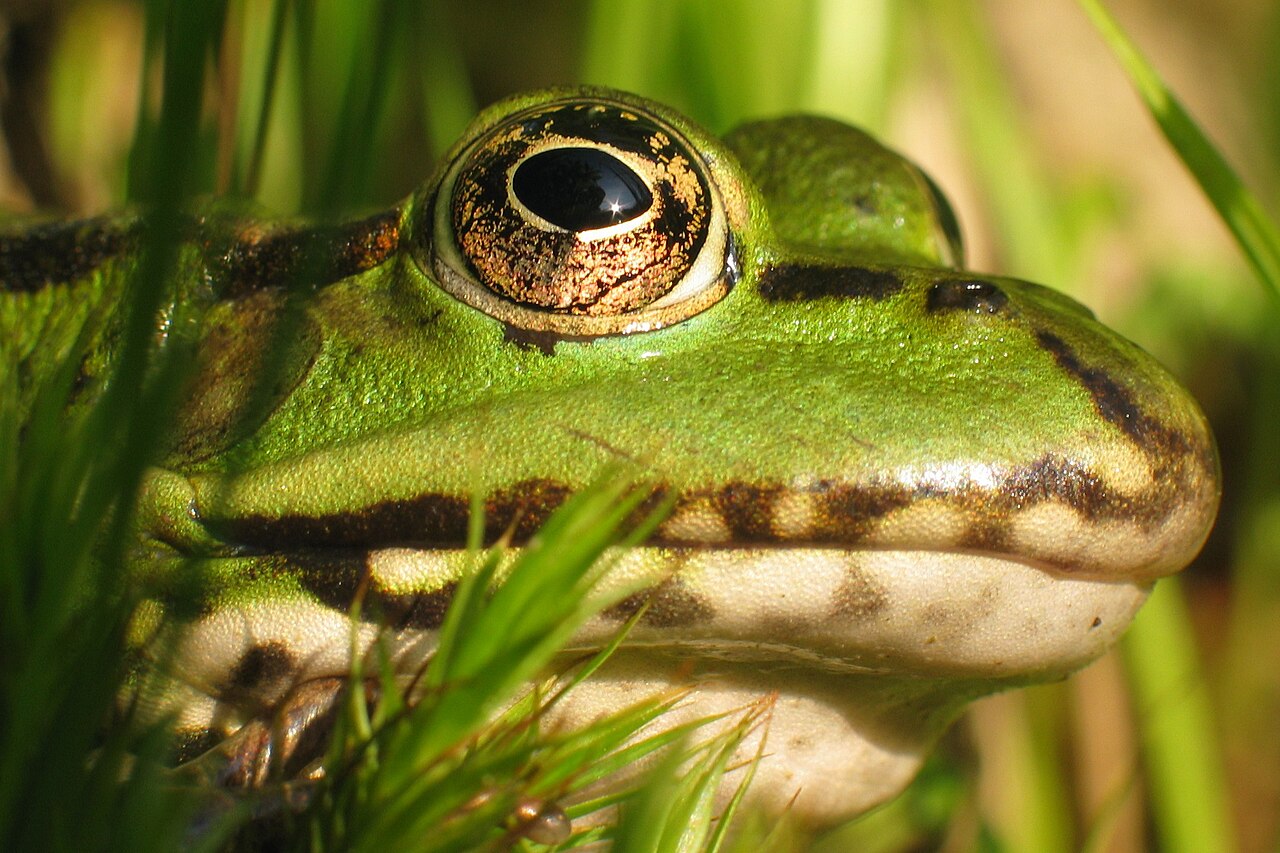
Frogs signify change that has already begun. The animal itself is the argument: a tadpole is a gilled swimmer with no legs, and the adult it becomes breathes air and hunts on land. Nothing else in a North American backyard rebuilds itself that completely in a single season, so when people look for a symbol of becoming something new, the frog keeps coming up.
Four meanings do most of the work. Transformation covers career changes, recovery and the end of a relationship. Cleansing comes from the frog’s permeable skin, which absorbs water and anything dissolved in it, and which makes frogs the first animals to vanish from a polluted pond. Fertility and abundance come from the egg masses, thousands at a time. Rain and luck come from the chorus that starts when the weather breaks.
Where traditions differ is in the tone. Folk belief in Europe and West Africa treats the frog as plainly lucky, biblical reading treats frogs as a plague, and modern spiritual practice treats the sighting as a prompt to look at your own emotional state. Those are three different claims about one animal. Bat symbolism splits along almost identical lines.
Frog Symbolism in Native American Traditions

Native American frog symbolism is not one belief but hundreds, and it tracks water. In many Southwestern Pueblo traditions, including Hopi and Zuni practice, frogs and toads are associated with rain and with the ceremonies that ask for it, because their calls mark the arrival of the summer monsoon. In that context the frog brings life to dry land, which is why frog figures appear on pottery and in jewelry.
On the Northwest Coast, among Haida, Tlingit and Kwakwaka’wakw artists, the frog appears as a crest animal and is often described as a communicator, the being that moves between water and land. Those figures belong to specific families and lineages, so their meaning is tied to those histories rather than to a general symbol dictionary. Any single sentence claiming to give the Native American meaning of frogs is worth doubting: water, rain and transformation recur, and the details belong to the nations that hold them.
What the Bible Says About Frogs
The Bible treats frogs as an instrument of judgment, not as a blessing. The second plague of Egypt in Exodus 8 fills the land, the houses, the beds and the kneading bowls with frogs until Pharaoh relents. Frogs appear again in Revelation 16:13, where three unclean spirits come out of the mouths of the dragon, the beast and the false prophet looking like frogs. Both passages use the animal as a sign of something unwanted that multiplies.
So what does God say about frogs in the plainest reading? That they were sent, that they came in overwhelming numbers, and that they died in heaps once the plague ended. Under the dietary law in Leviticus 11, frogs also fall outside what is clean to eat. People asking what frog stands for in God are usually looking for a positive emblem, and the text does not offer one.
What does the Bible say about dreaming of frogs? Nothing directly, because Scripture records no frog dream. Christian dream interpretation that reads frogs as deceiving spirits is drawing on Revelation 16 by analogy, which is interpretation rather than text. The honest summary is that frogs in Scripture mark a situation that has gotten out of hand and needs to be let go of.
Celtic and Egyptian Frog Beliefs

In Celtic tradition the frog belongs to wells and springs, which were treated as healing places and as openings to the otherworld. Folklore from Ireland and Scotland connects frogs and toads with the guardians of water, and a frog at a holy well was read as a good sign. The frog there is a healer and a keeper of clean water, which is close to how modern ecologists treat it.
Ancient Egypt gave the frog a goddess. Heqet, shown as a frog or as a woman with a frog’s head, was associated with fertility, childbirth and the annual Nile flood that made farming possible, and frog amulets were worn for safe delivery. The hieroglyph for one hundred thousand was a tadpole. Both traditions point the same way: where a culture depends on a river, the animal that announces water becomes a sign of life, and bird symbolism runs on the same logic.
Frog Symbolism in East Asian Traditions and Feng Shui

In Chinese tradition the frog and the toad are wealth animals. The money frog, Jin Chan, is the three-legged toad shown sitting on a pile of coins with a coin in its mouth, and it is one of the most common prosperity figures sold for homes and shops. Placement advice in feng shui practice puts it near the entrance facing inward, so that money comes in rather than leaves.
Do frogs attract money? In that tradition the figure is believed to; a live frog in the yard is not what the belief is about. Japanese practice runs on a pun: kaeru means both frog and return, so frog charms are carried so that money, travelers and lost things come back. The through line across the region is practical, since frogs mean rain for the rice and rain means a harvest.
Seeing a Frog in Your Garden or Inside Your House
A frog in your garden is traditionally the best version of this omen: steady prosperity, a household that is cared for, and land in good shape. The folk reading matches the biology, since frogs only settle where there is moisture, insects and no heavy pesticide use. European farm folklore held that killing the garden frog brought bad luck, which worked as a quiet conservation rule.
A frog inside the house is read as a message arriving, and often as a visitor you have not heard from in a while. In parts of the American South a frog that gets indoors is said to bring rain within a day or two. The less mystical reading is that frogs come inside when it is hot and dry or just after a storm, which is also when weather is changing.
What you do with it matters more than what it means. Pick the frog up with wet hands or a damp cloth, since dry skin and hand sanitizer damage the mucus layer frogs breathe through, and release it in shade near water. Young frogs fresh out of metamorphosis dry out fastest, so move quickly with the small ones.
Seeing a Frog at Night or at Your Window
A frog seen at night is read as intuition and as feelings coming to the surface, because night is when frogs are most active and most audible. The traditional reading of the spiritual meaning of seeing a frog at night is that something you have been avoiding in daylight is asking for attention. Green frogs, tree frogs and bullfrogs all call after dark, so the sighting is common rather than rare.
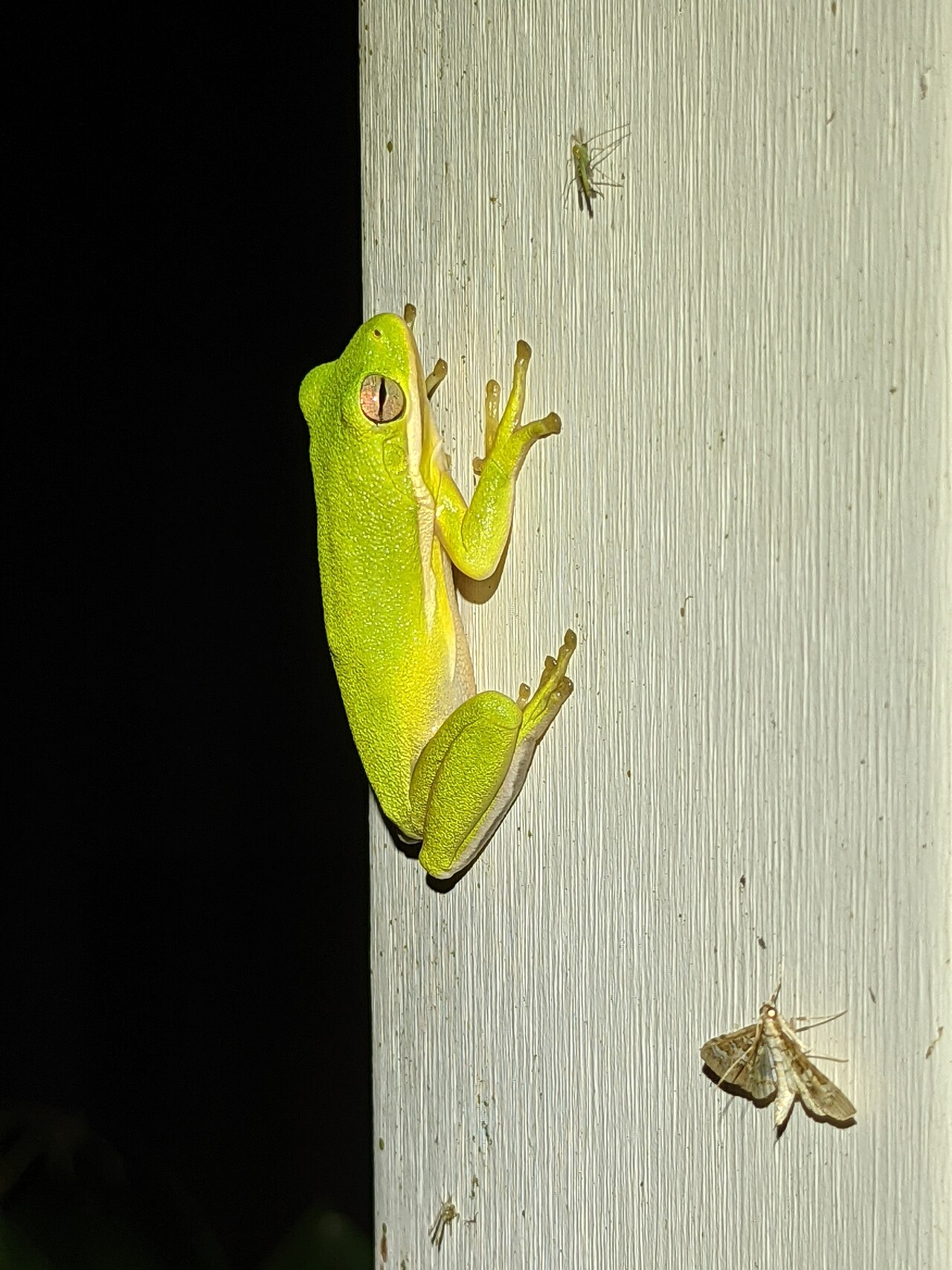
A frog at your window is the more specific omen. Tree frogs climb glass to hunt the insects drawn by indoor light, which is why this happens on warm humid nights and almost never in a dry spell. Folk tradition reads it as news on the way and as a sign that what you are waiting on is closer than it looks.
What Does a Frog Symbolize in Dreams?
In dreams a frog usually stands for an emotion that is moving, and the water it sits in says which way. Clear water is typically read as feelings you understand, muddy water as ones you do not. Dream interpreters from Freud onward connect the frog to transformation and to things you find distasteful about your own situation, which is why it shows up around career changes and breakups.
Common variants have settled meanings in popular dream reading. A frog that jumps away is an opportunity you are letting pass, a frog that speaks is advice you already know you need, and a kitchen full of frogs, the Exodus image, is a problem that has multiplied past ignoring. Catching a frog is read as money. None of it predicts anything: dream content tracks what you were thinking about before sleep, so the usable question is what in your life is mid-change.
Frog Spirit Animal, Totem and Omen
In modern spiritual practice the three terms do different jobs. A frog spirit animal is a guide that shows up for a stretch of your life, usually one involving a reset. A frog totem is a lifelong identification; the word is borrowed from Ojibwe doodem, where it means a clan identity rather than a personality type. A frog omen is a single sighting read as a sign. People drawn to the frog as a power animal are told they adapt well and need periods of retreat, which is worth testing against your own behavior rather than accepting.
The reptile and amphibian side of this subject runs along the same lines. Alligator symbolism is read as ancient power and patience, axolotl symbolism as regeneration, and cardinal symbolism as a visit from someone who has died. Frogs sit at the renewal end of that range. For what frogs actually do in their habitats, including the declines that put a third of amphibian species at risk, the US Geological Survey amphibian monitoring program is the primary source in the United States.
Frequently Asked Questions
What is the meaning of a frog jumping on you?
A frog jumping on you is read in Caribbean and Southern US folk belief as luck landing on you directly, with no delay and no middleman. The usual interpretation is that a change you have been circling is now yours to act on. Practically, frogs jump toward dark shaded surfaces, which is often a person’s shoe or leg.
What does a dead frog mean spiritually?
A dead frog is generally read as a cycle that has finished rather than as a bad omen, and modern practice frames it as release. A dead frog in the house is sometimes read as a situation you have already outgrown. Several dead frogs outdoors is worth taking literally instead: it often signals pesticide use or a drying pond.
Are frogs good luck or bad luck?
Frogs are good luck in most traditions, including Chinese, Japanese, Egyptian, Celtic and European farm folklore, where they bring rain, money and safe childbirth. The main exception is the biblical reading, where frogs are a plague and an unclean spirit. No tradition treats the frog as a death omen the way owls and ravens are sometimes treated.
Do frogs attract money?
In feng shui practice the three-legged money frog figure is believed to draw wealth toward a home or business, which is why it is placed near an entrance facing inward. In Japanese tradition frog charms are carried so money returns. The belief attaches to the charm, not to live frogs in your yard, though both go back to rain and harvests.
What does it mean to see the same frog repeatedly?
Repeat sightings are read in modern spiritual practice as a decision you keep postponing, on the logic that a message gets louder until it is heard. The ordinary explanation is territory: many frogs use the same perch and the same hunting spot for weeks. Check for a light, a damp corner or a water source before reading further.
What is the definition of a frog?
A frog is a tailless amphibian in the order Anura, with a short body, long hind legs built for jumping, webbed feet and moist permeable skin. Frogs hatch as gilled tadpoles and change into air breathing adults. Toads belong to the same order, so every toad is technically a frog, which is why their folklore overlaps so heavily.