Bear Poop: What It Looks Like and How to Identify It
Bear poop is large, tubular, and usually 1.5 to 2.5 inches in diameter, with blunt ends and a texture that changes completely with the season. Black bear poop in summer and fall is often a loose pile full of visible berries, seeds, and apple skins, while spring scat tends to be firm, greenish, and packed with grass. Grizzly bear poop is similar in shape but larger, sometimes 2.5 inches or more across, and a single deposit can weigh well over a pound. The most reliable way to identify bear poop is not the shape alone but the combination of size, blunt ends, and recognizable plant matter, which sets it apart from dog, coyote, and moose droppings.
Finding bear poop in your yard or on a trail is a clear signal that a bear has passed through recently, and how fresh it looks tells you roughly when. This guide covers what bear poop looks like across the seasons, how to tell black bear scat from grizzly scat, how to separate it from the dog and coyote poop it is most often confused with, what it means when you find it near your home, and how to clean it up safely. It also explains what bear scat reveals about what a bear has been eating, which is the information wildlife biologists read from every pile they find.
Bear poop looks like a large tubular pile 1.5 to 2.5 inches thick with blunt ends, usually 5 to 12 inches long or deposited as a loose mound. Summer and fall bear scat is loose and full of berries, seeds, and fruit skins; spring scat is firm, green, and grassy. Its size and visible plant matter distinguish it from dog and coyote poop.
| Feature | Bear Poop |
|---|---|
| Diameter | 1.5 to 2.5 in (black bear); 2 to 3 in (grizzly) |
| Shape | Tubular with blunt ends, or a loose pile |
| Spring appearance | Firm, green to black, packed with grass |
| Summer and fall appearance | Loose, dark, full of berries and seeds |
| Smell | Mild, often fruity or grassy; rarely foul |
| Confused with | Large dog, coyote, moose, elk |
| Health risk | Low; wear gloves, avoid dust |
What Does Bear Poop Look Like?
Bear poop looks like an oversized version of dog poop with blunt, rounded ends instead of tapered points, and it is usually deposited either as a segmented tube or as a formless mound. The typical black bear dropping measures 1.5 to 2.5 inches in diameter and 5 to 12 inches in total length, though a bear that has been feeding heavily on soft fruit may leave a flattened pile the size of a dinner plate with no tubular structure at all. Color runs from black through dark brown to green or even bluish purple depending on diet, and the surface often has a slightly shiny, moist look when fresh.
The defining feature is the visible content. Because bears are omnivores that do not chew their food thoroughly and have a relatively short digestive tract, much of what they eat passes through recognizably. Whole blueberries, huckleberry skins, chokecherry pits, acorn fragments, apple peel, corn kernels, and grass blades are all common finds. In late summer, when a bear may eat 20,000 calories a day of berries, the scat can look like a pile of partially crushed fruit held together with a little dark paste. This is the single most useful field mark, because no other large animal in North America leaves droppings packed with intact berries.
Fresh bear poop is soft and moist and darkens as it dries. Within a day or two the surface develops a crust and the color fades toward gray-brown, and after a week or more of dry weather the pile becomes crumbly and starts to break apart, exposing seeds and hair. In wet weather the timeline is faster. Learning to judge freshness matters because a steaming pile means the bear is likely within a few hundred yards, while a dried, sun-bleached one may be weeks old and tells you only that the area is on a bear’s travel route.
How Bear Scat Changes With the Seasons
Bear scat changes so much through the year that spring and fall droppings from the same bear can look like they came from different species. In spring, when bears emerge from dens and feed almost entirely on new grass, sedges, clover, and skunk cabbage, the scat is firm, dense, and green to greenish black, with a fibrous texture much like horse manure. It holds its tubular shape well and often shows the clear segmentation of a compact digestive tract working on high-fiber food. Insect parts, especially ant and wasp fragments, begin to appear as the season warms.
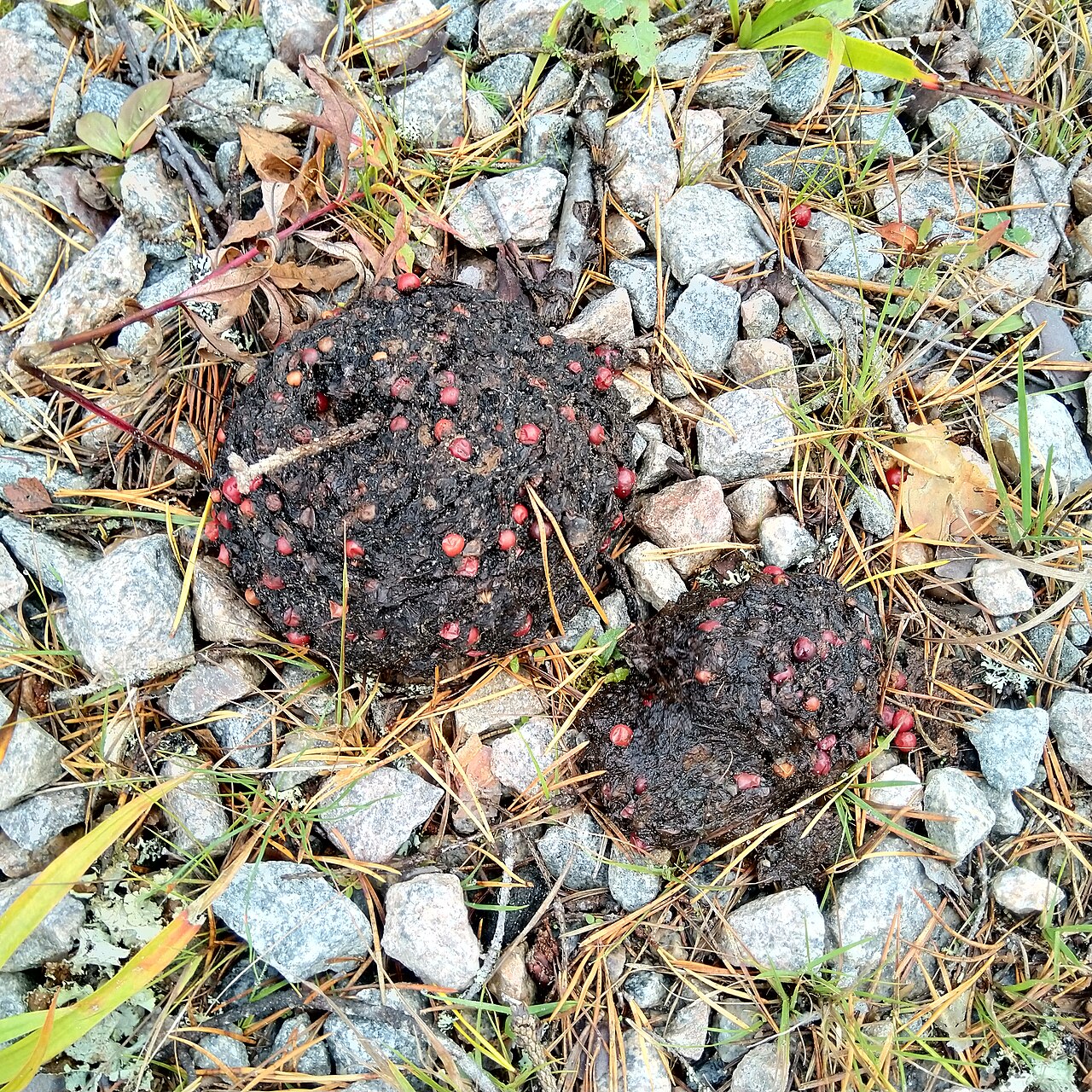
By midsummer the diet shifts to berries and the scat loosens dramatically. Serviceberry, blueberry, huckleberry, raspberry, and blackberry dominate depending on region, and the droppings become soft mounds colored by whatever fruit is ripe, from deep purple to reddish brown. The National Park Service (nps.gov) notes in its Yosemite bear guidance that a bear on a berry diet can leave scat that is almost entirely fruit, and the piles are frequently so loose that they spread out on impact. Apple orchards and backyard fruit trees produce the same effect in suburban areas.
Fall brings hard mast, meaning acorns, beechnuts, hickory nuts, and in the West, whitebark pine seeds. The scat firms up again and turns dark brown to black, often full of nut shell fragments and looking granular when broken apart. This is also when bears raid corn fields and garbage, so late-fall droppings near homes may contain kernels, bits of plastic, or foil. The seasonal pattern is so consistent that experienced trackers can estimate the month from a pile of scat alone, and the guide to what bears eat explains each diet phase in detail.
Black Bear Poop vs Grizzly Bear Poop
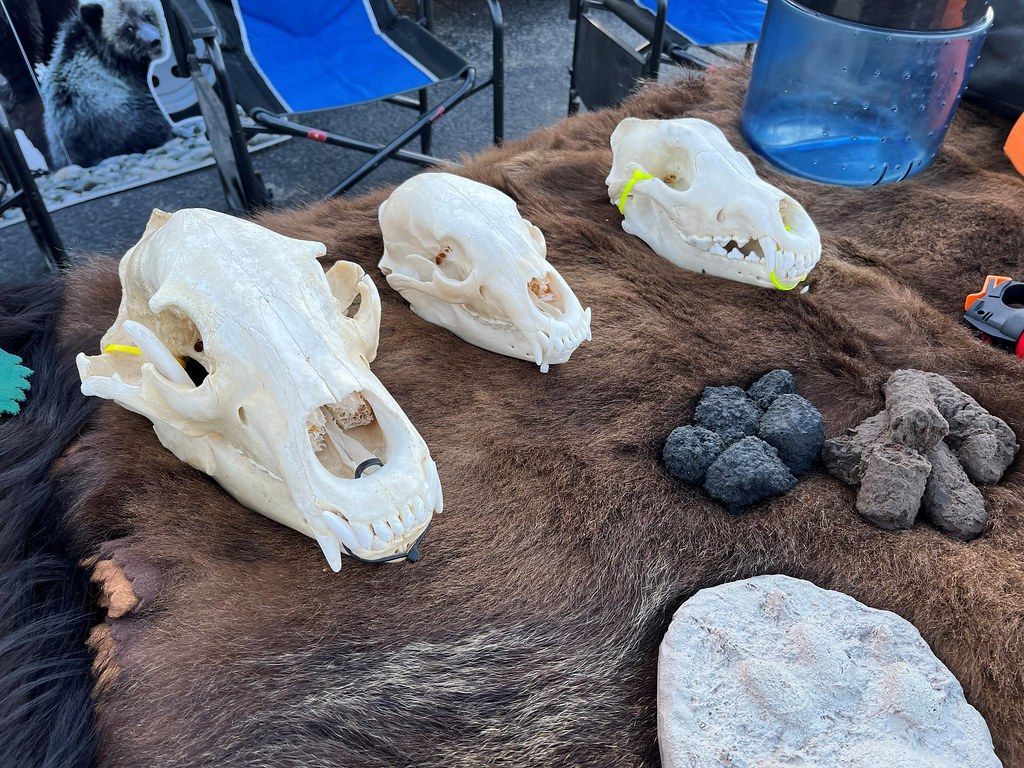
Black bear poop and grizzly bear poop are nearly identical in shape and content, and the honest answer is that most droppings cannot be assigned to one species with certainty. Size is the main clue. Grizzly scat tends to be larger, frequently 2 to 3 inches in diameter, and a single deposit may be twice the volume of a black bear’s. Anything over 2.5 inches across is more likely grizzly, though a large male black bear can overlap with a small female grizzly. In most of the United States the question does not arise, because grizzlies live only in parts of Montana, Wyoming, Idaho, Washington, and Alaska, while black bears range across roughly 40 states.
Diet differences help in some areas. Grizzlies dig extensively for roots, bulbs, and ground squirrels, so their scat more often contains soil, root fibers, and rodent hair. In coastal Alaska and British Columbia, salmon-eating brown bears leave scat that is pale, foul-smelling, and full of fish bones and scales, which is unmistakable. Black bears in the same regions eat far less fish and more vegetation and berries. Inland, both species eat the same berries and nuts, and the scat converges.
Because the two species cannot be reliably separated by scat, wildlife agencies recommend using tracks, hair, and claw marks together with droppings. Grizzly front tracks show long, straight claw marks extending 2 to 4 inches beyond the toes and a toe line that forms a nearly straight arc; black bear claws are shorter and more curved and the toe arc is more rounded. Where both species occur, treating any large fresh scat as possible grizzly sign and carrying bear spray is the practical approach regardless of what the pile looks like.
Bear Poop vs Dog Poop vs Coyote Poop
Bear poop is most often confused with dog poop, and the confusion is reasonable because a large dog can produce droppings of similar diameter. The differences are in the ends, the content, and the volume. Dog poop tapers to a point at one or both ends and is smooth and uniform inside, because commercial dog food is fully processed. Bear poop has blunt ends and is packed with visible seeds, berries, grass, or nut shells. A big dog also rarely leaves the loose, plate-sized fruit mounds that a bear produces in berry season, and a bear pile is typically several times the volume of even a Great Dane’s.
Coyote poop is easier to rule out. It is much smaller, usually 0.75 to 1.25 inches in diameter, rope-like, and tapered to a twisted point, and it is dominated by fur, small bones, and occasionally fruit pits. Coyote scat is also deliberately placed on trails, rocks, and trail junctions as a territorial marker, whereas bears drop wherever they happen to be. The coyote poop guide shows the twisted, fur-filled form clearly, and once you have compared the two side by side the size gap alone settles the question.
Two other animals leave large droppings that occasionally get mistaken for bear. Moose and elk produce pellets in winter, but in summer on lush green food both can leave soft, formless piles that look superficially like bear scat. The difference, covered in the deer poop guide for the smaller cervids, is that moose and elk summer droppings are uniformly green and fibrous with no seeds, insect parts, or fruit skins, and they have the sweet, grassy smell of cow manure. The Alaska Department of Fish and Game (adfg.alaska.gov) publishes a field comparison of bear and moose sign precisely because this mix-up is common in the north.
What Does Bear Poop in Your Yard Mean?
Bear poop in your yard means a bear has found something worth eating on or near your property, and the contents of the pile usually tell you what. Scat full of birdseed and sunflower hulls points to a feeder. Corn kernels and bits of plastic wrap point to garbage or a compost bin. Apple or pear skins mean a fruit tree is dropping ripe fruit. In most cases the bear has visited at night and left before dawn, and the scat is the only evidence, along with perhaps a tipped trash can or a bent feeder pole.
The practical response is to remove the attractant immediately, because bears that find food at a home return, and a bear that is rewarded repeatedly becomes a safety problem for the whole neighborhood. Take down bird feeders from late March through November in bear country, store garbage in a locked shed or bear-resistant container until the morning of pickup, pick fruit as it ripens and rake up windfalls, and never leave pet food outside. State wildlife agencies across bear range, including the New Jersey Division of Fish and Wildlife and Colorado Parks and Wildlife, report that the overwhelming majority of yard conflicts trace back to these four sources.
A single pile of bear scat is not a reason for alarm. Black bears are shy, and a bear passing through a yard is behaving normally if it moves on. Repeated fresh droppings over several days, daytime sightings, or a bear that does not leave when people appear are the signs that warrant a call to your state wildlife agency. The bear droppings also tell you something about your property’s place in the landscape: if the scat is full of wild berries or acorns rather than human food, the bear is simply crossing between natural feeding areas and your yard is on its route.
How to Tell if a Bear Is Nearby From Its Sign
Fresh bear poop is the clearest sign that a bear is nearby, and freshness is judged by moisture, temperature, and insects. Scat that is still glistening wet, warm to the touch through a glove, or has no flies on it yet is minutes to a couple of hours old, and the bear may be within a few hundred yards. Scat with a dry skin and a moist interior is roughly a day old. Fully dried, cracked, or crumbling scat is several days to weeks old. Multiple piles of different ages along a trail indicate a regular travel corridor rather than a bear that is currently present.
Other sign confirms the picture. Bear tracks show five toes on both front and hind feet, with the hind track looking like a wide human footprint 7 to 9 inches long for a black bear and up to 12 inches for a grizzly. Look for claw marks and rubbed bark on trees, overturned logs and rocks where a bear has dug for insects, torn-up ant mounds, flattened patches in berry thickets, and daybeds, which are shallow scooped depressions under dense cover. Broken branches high in fruit trees, well above where a deer could reach, are also a reliable bear indicator.
At night, the sounds that suggest a bear are heavy, deliberate footfalls, branches breaking under real weight, and a low huffing or jaw-popping when a bear is nervous. Bears are not silent, but they are also not noisy in the way a herd of deer crashing away is noisy. If you find very fresh scat on a trail, the safe response is to make noise, keep bear spray accessible, and avoid areas of dense brush where you could surprise the animal at close range. Bears that hear you coming almost always leave before you see them.
Is Bear Poop Dangerous, and How Do You Clean It Up?
Bear poop is not especially dangerous, but it should be handled with the same care as any wild animal feces. Bears can carry roundworm species and, in some regions, the parasite Trichinella, and their scat can contain E. coli and Salmonella like that of any omnivore. The risk of transmission from a pile in the yard is low as long as you do not touch it with bare hands or breathe dried dust from it. The Centers for Disease Control and Prevention (cdc.gov) advises the same basic precautions for all wildlife droppings: gloves, no dry sweeping, and thorough handwashing afterward.
To clean up bear scat, put on disposable gloves, and if the pile is dry, mist it lightly with water or a disinfectant spray first so that no dust rises. Scoop it with a shovel or a thick layer of paper towels into a plastic bag, seal the bag, and put it in your regular trash. Rinse the area with water and, on hard surfaces like a deck or patio, follow with a household disinfectant. Wash your hands and forearms with soap for at least 20 seconds. If the scat is on lawn or garden soil, removing the bulk of it and letting rain do the rest is sufficient.
Pets deserve a mention because dogs are drawn to bear scat and will roll in it or eat it. Dogs can pick up intestinal parasites this way, so it is worth removing scat promptly from areas where a dog runs. Compared with the hazards of bat poop in an attic or mouse poop in a kitchen, both of which carry more serious disease concerns, bear scat in the yard is a minor issue. Clean it up, remove whatever attracted the bear, and the problem generally resolves itself.
What Bear Poop Tells Biologists
Bear poop is one of the most valuable tools in bear research, because it can be collected without ever seeing or disturbing the animal. Diet studies rely on scat analysis to determine what percentage of a population’s food comes from berries, nuts, insects, vegetation, and meat, and to track how that mix shifts with weather and mast crops. A poor acorn year, for example, shows up immediately in fall scat as a shift toward corn, garbage, and late fruit, and it predicts a rise in human-bear conflicts before the complaints come in.
Modern genetics has expanded what scat can reveal. Bear feces contain cells shed from the intestinal lining, and DNA extracted from those cells can identify the individual bear, its sex, and its relationship to other bears in the area. Researchers with the U.S. Geological Survey and university programs use scat and hair samples collected along trails to estimate population size and density in places where trapping and collaring would be impractical or too disruptive. A single hiking trail surveyed for scat over a summer can yield dozens of individual genetic profiles.
Scat also records the passage of seeds, which makes bears important dispersers of fruiting plants. A bear that eats several pounds of berries and then travels a mile before defecating has planted thousands of seeds in a pile of natural fertilizer. Studies of black bears in Appalachian and Pacific Northwest forests have found viable seeds of dozens of plant species in their droppings, which is one reason berry-producing shrubs cluster along bear travel routes. The next time you find a pile of bear scat full of blueberries, you are looking at next decade’s blueberry patch.
Frequently Asked Questions
What does bear poop look like?
Bear poop is a large tubular dropping or loose mound 1.5 to 2.5 inches in diameter with blunt ends. It is usually dark brown to black and packed with visible plant matter such as berries, seeds, grass, or nut shells. In berry season it can be a soft, plate-sized pile of partially digested fruit.
How can I tell bear poop from dog poop?
Bear poop has blunt ends and visible seeds, berries, or grass inside, and it is typically several times the volume of a dog’s. Dog poop tapers to a point at the ends and is smooth and uniform inside because commercial dog food is fully processed.
How do you tell black bear poop from grizzly poop?
The two are nearly identical in shape and content. Grizzly scat tends to be larger, often 2 to 3 inches across, and more often contains soil, roots, and rodent hair from digging. In most cases scat alone cannot separate the species, so use tracks and range as well.
What does bear poop smell like?
Bear poop usually has a mild smell that reflects the diet: grassy in spring and sweet or fermented in berry season. It is rarely foul. Scat from salmon-eating coastal bears is the exception and smells strongly of fish.
Does bear poop in my yard mean a bear lives nearby?
It means a bear passed through, usually at night, and found food such as birdseed, garbage, or fallen fruit. Remove the attractant and the bear will typically move on. Repeated fresh scat over several days or daytime sightings are the signs to report to your state wildlife agency.
Is bear poop dangerous to humans or dogs?
The risk is low. Bear scat can carry parasites and bacteria like any wild animal feces, so wear gloves, wet it before removal to avoid dust, and wash your hands. Dogs that eat or roll in bear scat can pick up intestinal parasites, so clean it up promptly where pets run.
How fresh is the bear poop I found?
Wet, glistening scat with no flies is minutes to a couple of hours old. A dry skin with a moist center suggests about a day. Fully dried, cracked, or crumbling scat is several days to weeks old and indicates a travel route rather than a bear currently present.