Backyard Birds of Georgia: 15 Common Species (2026 Identification Guide)
Georgia’s geographic spread from the Blue Ridge Mountains in the north to the Atlantic coastal plain in the south creates one of the most diverse backyard bird communities in the eastern United States. The state hosts 350+ recorded bird species, with 40-50 commonly visiting suburban yards depending on region and season. Georgia’s mild winters, abundant native forests, and position along the Atlantic Flyway make it both a year-round bird-watching paradise and a major spring/fall migration hotspot. This guide covers the 15 most common backyard birds across Georgia, featuring the state’s distinctive Brown Thrasher (one of America’s most unique state birds), along with field marks, regional ranges from Atlanta suburbs to coastal Savannah, and proven attraction strategies for the state’s subtropical climate.
Quick Reference: 15 Common Backyard Birds of Georgia
| Species | Size | Key ID Feature | Where in GA |
|---|---|---|---|
| Brown Thrasher (state bird) | 11.5″ | Rich rust-brown + heavy spots below + yellow eye | Statewide year-round |
| Northern Cardinal | 8.5″ | All red (male) + crest + black face mask | Statewide year-round |
| Carolina Chickadee | 4.75″ | Black cap + white cheeks + black bib | Statewide year-round |
| Carolina Wren | 5.5″ | Rust-brown + bold white eyebrow | Statewide year-round |
| Tufted Titmouse | 6.5″ | Gray crest + buff flanks + black eye | Statewide year-round |
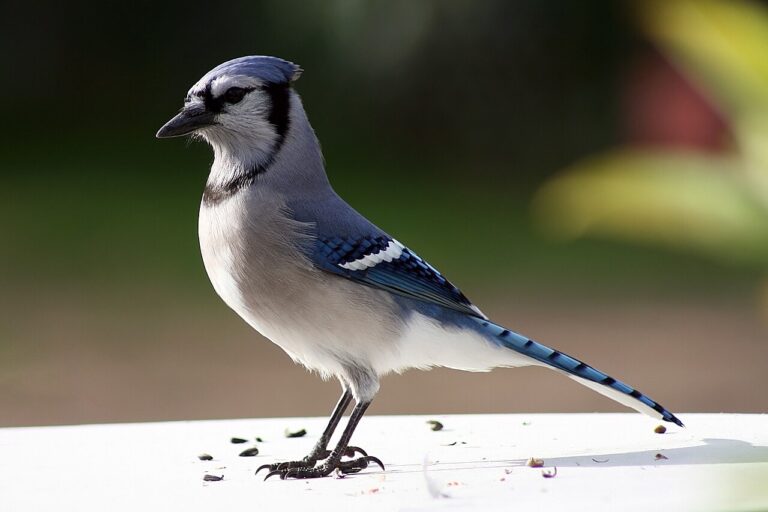
| Blue Jay | 11″ | Blue crest + black necklace + white below | Statewide year-round |
| Mourning Dove | 12″ | Tan + long pointed tail + small head | Statewide year-round |
| House Finch | 5.5″ | Red head/breast (male) + streaky belly | Statewide year-round |
| American Goldfinch | 5″ | All yellow (summer male) + black wings | Year-round (winter most common) |
| Downy Woodpecker | 6.75″ | Small + short bill + checkered wings | Statewide year-round |
| Red-Bellied Woodpecker | 9.25″ | Red cap + zebra back + tan belly | Statewide year-round |
| Pileated Woodpecker | 16.5″ | Crow-sized + flaming red crest | Forested areas year-round |
| Eastern Bluebird | 7″ | Blue back + rust breast + white belly | Statewide year-round |
| Painted Bunting | 5.5″ | Multi-color (male) red/green/blue | Summer (May-Sep) coast |
| Ruby-Throated Hummingbird | 3.5″ | Iridescent green + ruby throat (male) | Summer (Apr-Oct) |
Species Identification
Brown Thrasher (State Bird)
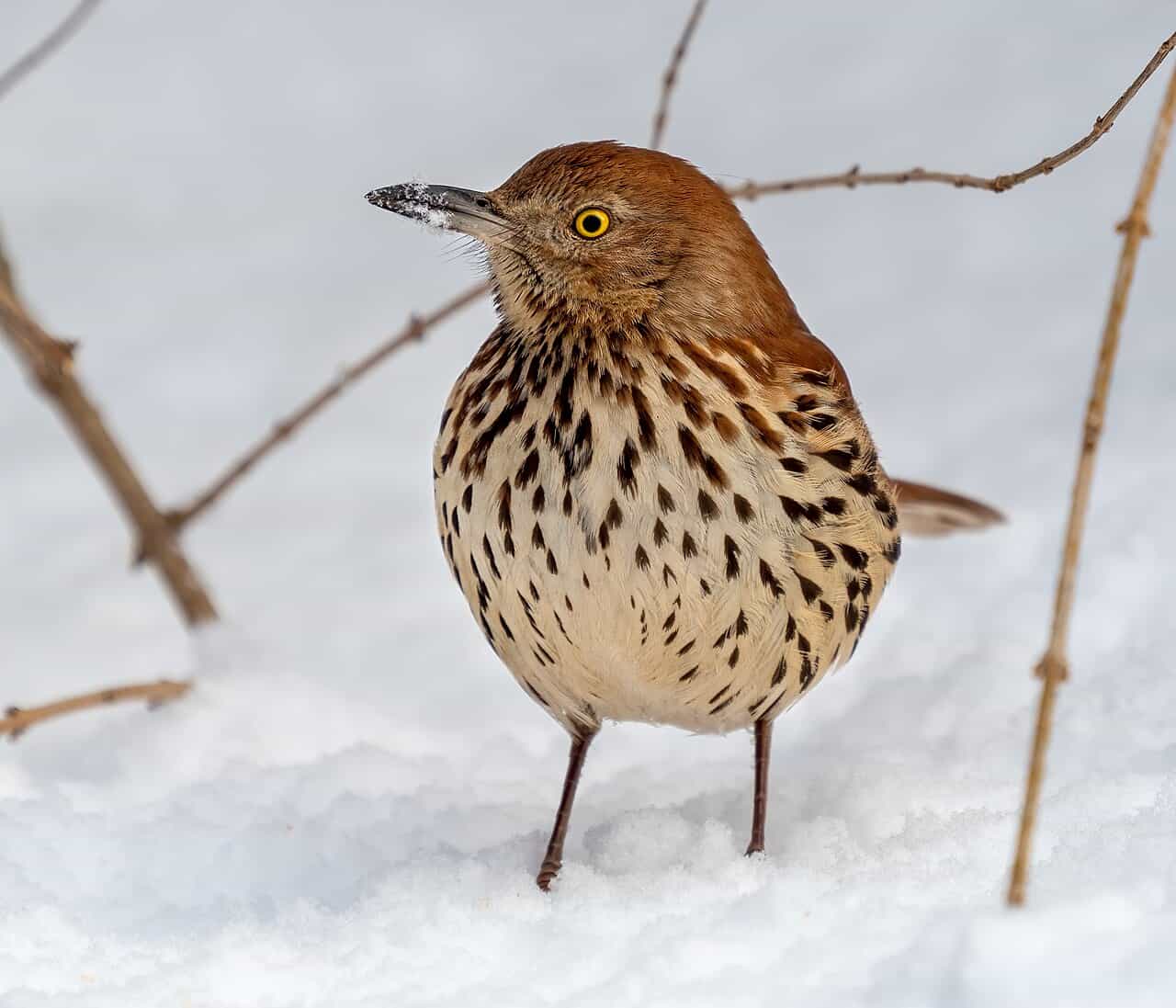
Georgia’s official state bird, designated in 1970, and one of the most distinctive state bird choices in the country. Brown Thrashers are large (11.5 inches), rich rust-brown above with white underparts heavily streaked in black, a long tail, slightly curved bill, and brilliant yellow eyes. They have one of the largest known song repertoires of any North American bird, up to 1,100 different song types, surpassing even the Northern Mockingbird.
Range in Georgia: Statewide year-round.
Habitat: Brushy areas, woodland edges, suburban yards with dense shrubs, hedgerows.
Key ID: Large size + rich rust-brown back + heavy black spots/streaks on white underparts + yellow eye + long tail. Often seen scratching in leaf litter.
Where to see: Brown Thrashers prefer ground feeders or platform feeders with millet, sunflower, and peanuts. Plant dense native shrubs for cover. They’re more skittish than mockingbirds but can become regular yard visitors with patience and consistent food.
Northern Cardinal
Georgia’s most iconic year-round red bird. Male Northern Cardinals are brilliant red overall with a pointed red crest, black face mask, and thick orange-red bill. Females are tan-brown with red highlights on crest, wings, and tail. Cardinal pairs mate for life and stay together year-round in Georgia yards.
Range in Georgia: Statewide year-round.
Habitat: Yards with shrubby cover, parks, woodland edges, urban areas with brush.
Key ID: Brilliant red + pointed crest + black face mask + thick orange-red bill (male).
Where to see: Hopper or platform feeders with sunflower or safflower seed. Cardinals prefer dawn/dusk feeding. Plant native shrubs (American Beautyberry, native viburnums) for nesting cover.
Carolina Wren
Georgia’s loudest backyard voice. Carolina Wrens have rich rust-brown upperparts, buff underparts, and a striking bold white eyebrow stripe. Their loud, ringing ‘tea-kettle tea-kettle tea-kettle’ song carries throughout Georgia yards year-round. They nest in unexpected places, flower pots, garage corners, hanging baskets.
Range in Georgia: Statewide year-round.
Habitat: Wooded yards, gardens with brush, edges of forests.
Key ID: Rich rust color + bold white eyebrow + loud voice. Larger than House Wrens.
Where to see: Common at suet feeders. Will visit platform feeders. Provide brush piles for cover. Will use small nest boxes.
Carolina Chickadee
Georgia’s small year-round companion. Carolina Chickadees have a black cap, black throat/bib, white cheeks, gray back, and buffy flanks. Smaller than the Black-Capped Chickadee (which doesn’t occur in Georgia). Their faster, higher-pitched ‘chick-a-dee’ call distinguishes them by voice.
Range in Georgia: Statewide year-round.
Habitat: Wooded yards, parks, forests.
Key ID: Black cap + black bib + white cheeks + small size. The only chickadee species in Georgia.
Where to see: Common at sunflower, peanut, and suet feeders. Will use small nest boxes (1.125 inch hole).
Painted Bunting (Summer Visitor)
Georgia’s most spectacular summer bird, especially along the coast. Male Painted Buntings have vivid green backs, blue heads, red eye-rings, and bright red underparts, a four-color spectacular. Females are uniformly olive-green. Georgia’s coastal counties host substantial breeding populations.
Range in Georgia: Coastal Georgia (especially Tybee Island, Jekyll Island, St. Simons Island) in summer (April-September). Less common inland.
Habitat: Brushy areas, woodland edges, coastal hammocks, suburban yards with dense shrubs.
Key ID: Multi-color male (green back + blue head + red body) is unmistakable. Female olive-green throughout.
Where to see: White millet on ground or platform feeders during summer. Plant native shrubs for cover. Coastal Georgia yards are the prime location.
Pileated Woodpecker
Georgia’s largest woodpecker, and one of the most spectacular sights at a forested backyard. Pileated Woodpeckers are crow-sized (16.5 inches), mostly black with bold white neck stripes, white underwings flashing in flight, and a brilliant flaming-red crest. Males have a red ‘mustache’ stripe; females have black mustache stripes.
Range in Georgia: Statewide in forested areas, most common in north Georgia mountains and south Georgia swamps.
Habitat: Mature forests with large dead trees. Backyards adjacent to or within mature forest cover.
Key ID: Very large + black with bold white neck + flaming red crest. The largest woodpecker most Georgia residents will see.
Where to see: Will visit suet feeders if your yard is near mature forest. Plant native trees and leave dead standing trees (‘snags’) if safe.
Tufted Titmouse
Georgia’s perky crested feeder companion. Tufted Titmice have a clean gray back, white underparts with buff flanks, a pointed gray crest, large black eyes, and a small black forehead patch. Loud ‘peter-peter-peter’ calls fill Georgia woodlands year-round.
Range in Georgia: Statewide year-round.
Habitat: Mature deciduous forests, parks, suburban yards.
Key ID: Gray crest + buff flanks + black eye + small size. Distinctive crest separates from chickadees.
Where to see: Common at backyard feeders with sunflower seed, peanuts, and suet. Often in mixed flocks with Carolina Chickadees.
Blue Jay
Georgia’s familiar crested blue bird. Blue Jays have bright blue heads, wings, and backs (with black markings), white chests, and a prominent blue crest. Loud, intelligent, and dominant at feeders. Georgia Blue Jays cache thousands of acorns each fall.
Range in Georgia: Statewide year-round.
Habitat: Forests, parks, suburban backyards with mature trees.
Key ID: Blue + black necklace + prominent crest + white below.
Where to see: Platform feeders with peanuts in shell, sunflower seed, and corn. Bird baths regularly.
Eastern Bluebird
Georgia’s bluebird species. Male Eastern Bluebirds have brilliant royal-blue heads and backs, rust-orange throats and breasts, and clean white bellies. Females are paler with brown-blue tints. Cavity nesters that readily use nest boxes, Georgia has active bluebird nest box programs across the state.
Range in Georgia: Statewide year-round.
Habitat: Open habitat with scattered trees, pastures, golf courses, parks, suburbs with old trees.
Key ID: Bright blue back + rust-orange breast + clean white belly. Eastern form has white belly (Western with rust on flanks doesn’t occur in Georgia).
Where to see: Install NABS-approved bluebird nest boxes on poles in open areas. Provide mealworms. Plant native berry shrubs (Eastern Red Cedar, Winterberry Holly).
Ruby-Throated Hummingbird (Summer Visitor)
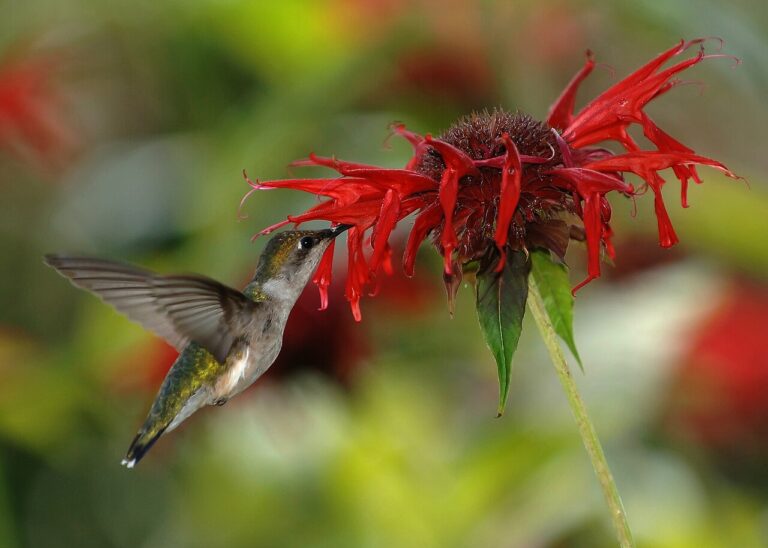
Georgia’s only common breeding hummingbird. Male Ruby-Throated Hummingbirds have an iridescent green back and a brilliant ruby-red throat (gorget), appears black in poor light, flashes ruby-red in good light. Females have green backs with white throats. Migrate to Central America for winter (October-March).
Range in Georgia: Statewide in summer (April-October).
Habitat: Gardens, parks, woodland edges with flowering plants.
Key ID: Iridescent green back + ruby throat (male, requires good light) + tiny size. Females green-and-white.
Where to see: Hummingbird feeders (4:1 water-to-sugar ratio, no red dye). Plant native flowers (cardinal flower, bee balm, native salvias, coral honeysuckle).
Red-Bellied Woodpecker
Georgia’s medium woodpecker with a confusingly-named feature. Red-Bellied Woodpeckers have a red cap and nape (males) or just red nape (females), a barred black-and-white (zebra-pattern) back, and tan-buff underparts. The ‘red belly’ is actually a faint pinkish wash rarely visible.
Range in Georgia: Statewide year-round.
Habitat: Wooded yards, parks, forests with mature trees.
Key ID: Red cap/nape + zebra-pattern back + tan belly. The red is on the HEAD, not the belly.
Where to see: Common at suet feeders. Will also eat peanuts and sunflower seed at platform feeders.
Mourning Dove
Georgia’s most widespread dove. Mourning Doves have sleek tan-brown bodies, small heads, and long pointed tails with white edges. Their distinctive whistling wing sound on takeoff is recognizable in every Georgia yard.
Range in Georgia: Statewide year-round.
Habitat: Open habitat, suburbs, parks, agricultural areas.
Key ID: Tan-brown + long pointed tail + small head. Whistling wing-sound in flight.
Where to see: Ground feeders or platform feeders with mixed seed, sunflower, or cracked corn. Often in pairs.
Regional Variations Across Georgia
Georgia’s geographic spread creates distinct backyard bird communities by region. North Georgia mountains (Blue Ridge, Cohutta) host higher-elevation species: Black-Capped Chickadees occur in the northernmost mountain areas (rare for Georgia), Dark-Eyed Juncos breed locally, plus Common Ravens, Black-Throated Blue Warblers (summer), and Hermit Thrushes (winter). Mountain yards see Cedar Waxwings in larger flocks.
Piedmont region (Atlanta metro, Athens, Macon, Augusta) is the most populated part of Georgia and shares characteristics across yards: Carolina Wrens, Cardinals, Chickadees, Titmice, Bluebirds, plus suburban-adapted Mockingbirds. Spring brings migrant warblers, vireos, and tanagers.
Coastal Georgia (Savannah, Brunswick, Tybee Island, Jekyll Island, St. Simons Island) hosts the most distinctive bird community: Painted Buntings breed in summer, plus year-round Brown Pelicans, herons, egrets, and various wading birds. Wood Storks are reliable in coastal yards near wetlands. Spring/fall migration is spectacular at coastal sites.
South Georgia (Valdosta, Albany, Tifton) shares characteristics with Florida: Year-round warmer temperatures support Brown-Headed Nuthatches in longleaf pine woods, plus winter sparrows in agricultural fields. Some Painted Buntings winter in extreme south Georgia.
The Okefenokee Swamp region hosts unique habitat, Sandhill Cranes wintering in nearby areas, Anhingas in waters, plus various wading birds in adjacent yards.
The Brown Thrasher: Georgia’s Master Singer
The Brown Thrasher (Toxostoma rufum) was designated Georgia’s official state bird on April 6, 1970. The choice was unusually distinctive, Brown Thrasher is the only US state bird in this species, making Georgia’s choice unique among the 50 states.
Brown Thrashers possess perhaps the largest known song repertoire of any North American bird species. Research has documented over 1,100 different song types from individual male Brown Thrashers, surpassing the Northern Mockingbird’s repertoire. Males sing complex songs with each phrase typically repeated twice (a key distinguishing feature: ‘mockingbirds repeat 3+ times, thrashers 2, catbirds once’).
Despite their loud voices, Brown Thrashers are surprisingly secretive. They prefer dense cover, thickets, hedgerows, brush piles, native shrub plantings. Most of their foraging happens on the ground, scratching through leaf litter for insects, fruit, seeds, and acorns. Their slightly curved bills are adapted for this scratching behavior.
Georgia’s Brown Thrashers are nonmigratory, the same individuals stay in your yard year-round. Pairs are monogamous within a breeding season, and territories are vigorously defended. Males will attack their own reflections in windows during territorial periods.
Plant dense native shrubs to attract Brown Thrashers: American Beautyberry, native viburnums, Wax Myrtle (also great for warblers), Wild Plum. Provide brush piles. Avoid pesticides, Brown Thrashers eat large quantities of insects, including caterpillars, beetles, and grasshoppers. Their preference for ground-feeding means scatter-feeding works better than tube feeders. Patient yard owners often have generations of Brown Thrashers visiting reliably.
How to Attract Georgia Backyard Birds
Georgia’s subtropical climate (hot summers, mild winters in most of the state) creates year-round backyard birding opportunities. Unlike northern states, Georgia birds don’t face winter starvation, but they do face Georgia’s intense summer heat and frequent droughts.
Water is the #1 attractant in Georgia, especially during the dry summer months. A quality bird bath with daily fresh water brings 3x more species than feeders alone during summer. Add a dripper or fountain, moving water dramatically increases visitation. Shaded baths under trees stay cooler and cleaner.
For seed feeders, focus on Georgia favorites: black oil sunflower seed (universal), safflower seed (cardinals love it, squirrels avoid it), white millet (for buntings, doves, sparrows). Position feeders within 10 feet of cover so smaller birds can retreat from hawks.
Hummingbird feeders are critical Georgia equipment April through October. Ruby-Throated Hummingbirds breed statewide. Use 4:1 water-to-sugar ratio, no red dye. Multiple feeders reduce male territorial fighting. Clean every 3-4 days during summer heat (sugar water spoils quickly in Georgia humidity).
Native plant gardening multiplies attraction. Georgia natives (American Beautyberry, native viburnums, Eastern Red Cedar, Live Oak, Wax Myrtle, Wild Plum) support 10-100x more bird food (insects, caterpillars, berries) than non-native landscaping. Native plants also tolerate Georgia heat better.
Brown Thrashers (state bird) require special attention. They prefer ground feeding, scatter millet, sunflower, and peanuts on the ground or on a low platform. They love brush piles for cover.
Painted Buntings (coastal Georgia summer) require white millet specifically. Painted Buntings prefer ground or low platform feeders. Plant dense native shrub thickets for cover.
Manage outdoor cats. Georgia outdoor cats kill an estimated 100-300 million birds annually nationwide. Keeping cats indoors or in ‘catios’ is the single most effective way to protect your yard’s bird population.
Avoid pesticides if possible. Most lawn ‘pests’ (grubs, caterpillars) are actually critical food for nesting birds.
Top Native Georgia Plants for Backyard Birds
**Live Oak (Quercus virginiana):** Georgia’s iconic native tree, especially in central and south Georgia. Live Oaks support hundreds of caterpillar species. Acorns feed Blue Jays, woodpeckers, and many other species. Provides essential evergreen cover.
**American Beautyberry (Callicarpa americana):** Native shrub producing dramatic clusters of bright purple-violet berries in fall. Feeds Northern Mockingbirds, Cardinals, Brown Thrashers, and 40+ other Georgia bird species. Tolerates Georgia heat and humidity.
**Eastern Red Cedar (Juniperus virginiana):** Native conifer producing blue-gray berries that feed Cedar Waxwings (named for them), American Robins, Yellow-Rumped Warblers (winter), and many other species. Provides essential winter cover.
**Coral Honeysuckle (Lonicera sempervirens):** Native vine with tubular red flowers attracting Ruby-Throated Hummingbirds. Spring through summer bloom. Trains easily on fences and trellises. Native (not the invasive Japanese honeysuckle).
**Wax Myrtle (Morella cerifera):** Native shrub producing waxy berries that Yellow-Rumped Warblers can uniquely digest (a key winter food source for warblers in Georgia). Salt-tolerant, perfect for coastal Georgia yards. Provides dense evergreen cover.
**Native Viburnum species (Viburnum dentatum, V. nudum, V. rufidulum):** Native shrubs producing berries that feed dozens of bird species. Spring flowers attract pollinators. Among the most productive native plantings for Georgia yards.
Related reading: Backyard Birds of Maryland.
Related reading: Backyard Birds of Colorado.
Frequently Asked Questions
What’s the most common backyard bird in Georgia?
Northern Cardinal, Carolina Chickadee, Carolina Wren, Mourning Dove, Tufted Titmouse, House Finch, Blue Jay, and Brown Thrasher (the state bird) are all extremely common across Georgia year-round. American Goldfinches become more abundant in winter. The exact most-common species varies by season and habitat.
What’s that loud singing bird in my Georgia yard with many different songs?
Most likely a Brown Thrasher (Georgia’s state bird) or a Northern Mockingbird. Brown Thrasher: rich rust-brown back, heavy spots below, yellow eye, repeats each song phrase twice. Mockingbird: gray-white, white wing flashes, repeats each song phrase 3+ times. Gray Catbird: gray with rust undertail, songs phrases just once.
When do hummingbirds arrive in Georgia?
Ruby-Throated Hummingbirds typically arrive in Georgia in mid-to-late March (south Georgia first, north Georgia by mid-April). They breed throughout the state and stay through October before migrating to Central America for winter. Have feeders up by mid-March in south Georgia and early April in north Georgia.
How do I attract Painted Buntings to my Georgia yard?
Painted Buntings are primarily summer visitors to coastal Georgia (April-September). Offer white millet on ground or low platform feeders. Plant dense native shrubs for cover (wax myrtle, beautyberry, native viburnums). They prefer rural and coastal yards over urban locations. Coastal Georgia (Tybee, Jekyll, St. Simons, Cumberland Island) is the prime location.
What’s that huge crow-sized bird with the red crest in my Georgia woods?
Pileated Woodpecker, Georgia’s largest woodpecker, about crow-sized. Mostly black with bold white neck stripes and a brilliant flaming-red crest. Males have a red ‘mustache’; females have black. Common in Georgia mature forests. Will visit suet feeders in yards near mature forest.
Why do I hear so many birds singing in Georgia year-round?
Georgia’s mild climate supports a much larger year-round bird population than northern states. Cardinals, Chickadees, Titmice, Carolina Wrens, and Brown Thrashers all sing year-round (though most intensely during spring breeding season). Northern Mockingbirds and Brown Thrashers occasionally sing through warm winter nights.
How do I attract Brown Thrashers (Georgia’s state bird) to my yard?
Plant dense native shrubs (American Beautyberry, Wax Myrtle, native viburnums, wild plum). Provide brush piles for cover. Offer ground feeding, scatter millet, sunflower, and peanuts on the ground or low platforms. Brown Thrashers are more skittish than mockingbirds but become reliable yard visitors with consistent food and good cover. Avoid pesticides, they eat large quantities of insects.
What native plants attract the most Georgia birds?
Live Oak is the single most productive planting for Georgia yards (especially in central and south Georgia), supporting hundreds of caterpillar species. Other top natives: American Beautyberry, Wax Myrtle, Eastern Red Cedar, Coral Honeysuckle, and native viburnums. Plant native, not non-native ornamentals, native plants support 10-100x more bird food.