Red and Black Snake: Identification and the Coral Snake Rule
A red and black snake seen in the US without any yellow banding is most often a red-bellied mud snake, a scarlet snake, or a young ring-necked snake showing its bright underside. This pattern is distinct from the venomous coral snake, which always includes yellow rings between the red and black, a difference summed up in a classic mnemonic rhyme used across the southeastern US. Confirming which bands touch which color is the fastest way to rule out danger entirely.
The presence or absence of yellow is the single most important detail when a red and black pattern is involved, since it separates several completely harmless native species from the one venomous look-alike people worry about most. The sections below cover the common red and black species and exactly how to apply the color-order rule with confidence.
A red and black snake in the US without yellow bands is typically a red-bellied mud snake, scarlet snake, or ring-necked snake, all nonvenomous. The venomous coral snake always shows yellow rings touching red, so a pattern with only red and black, and no yellow involved, safely rules out a coral snake.
| Species | Pattern | Venom | Habitat | Key Trait |
|---|---|---|---|---|
| Red-Bellied Mud Snake | Black top, red-black sides | None | Wetlands, swamps | Red visible on sides/belly |
| Scarlet Snake | Red, black, white/cream bands | None | Sandy woodlands | No yellow present |
| Ring-Necked Snake | Black top, red-orange belly | Mild, rear-fanged | Under logs, rocks | Belly only, not banded |
| Coral Snake | Red, yellow, black rings | Yes, dangerous | Woodlands, southeast US | Red touches yellow |
What Kind of Snake Is Red and Black
Several nonvenomous US species show red and black coloring without yellow, most commonly the red-bellied mud snake, the scarlet snake, and the ring-necked snake in its underside coloring. Each has a distinct pattern arrangement that, once learned, makes rapid identification straightforward even from a brief sighting.
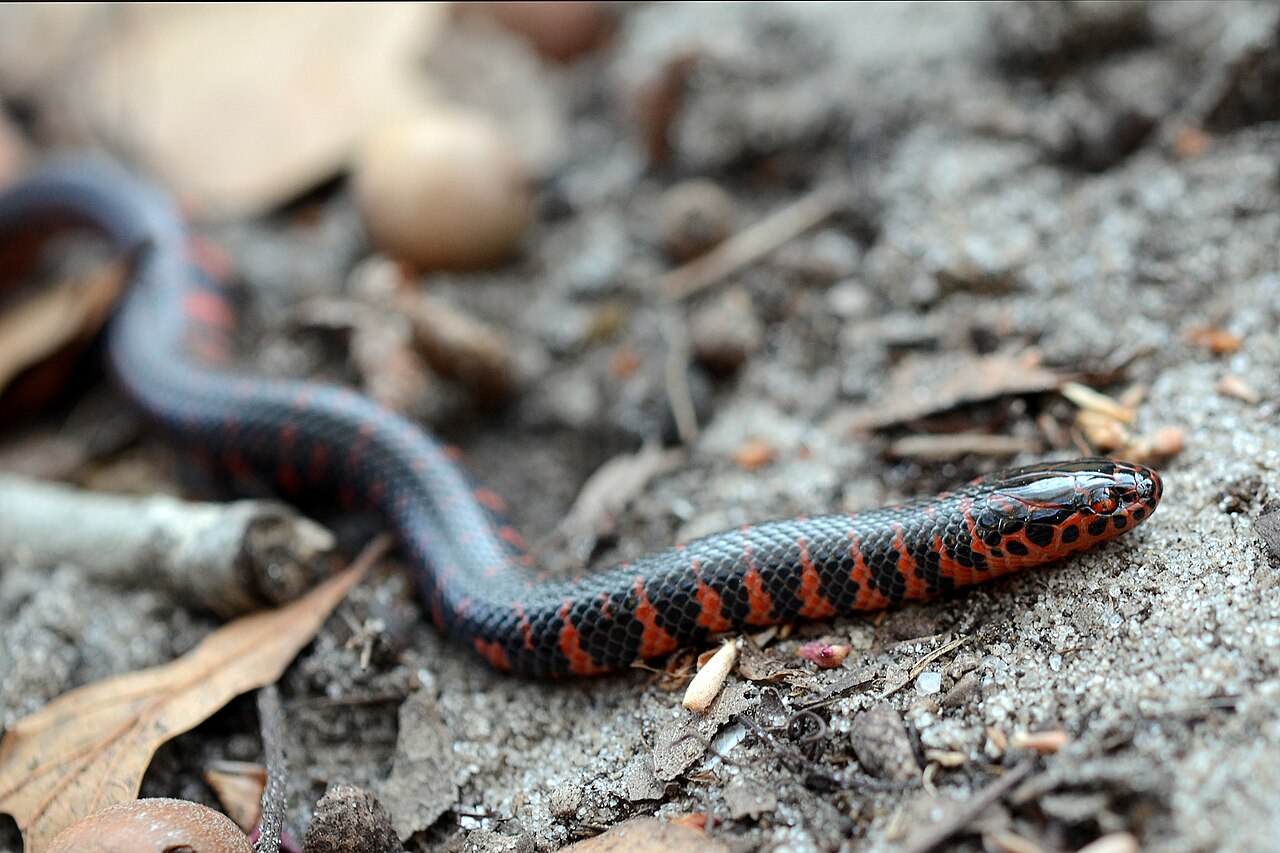
The red-bellied mud snake appears mostly black from above but reveals bold red or pink barring along the sides and belly, most visible when the snake is partially coiled or moving through shallow water. The scarlet snake shows distinct red, black, and white or cream bands running the full width of the body in a clean, repeating pattern.
Ring-necked snakes are black or dark gray on top with almost no visible red until the snake is disturbed, at which point the bright red-orange belly is displayed as a startle response, curling the tail to expose the underside rather than showing banding along the back.
The Red Touches Black Rhyme and Coral Snakes
The widely known mnemonic, red touches yellow kills a fellow, red touches black venom lack, is a useful field guide for distinguishing venomous coral snakes from harmless mimics in the regions where coral snakes are found. This rhyme applies specifically to snakes showing red, yellow, and black together in ringed bands.
A snake showing only red and black, with no yellow present anywhere in the pattern, falls outside what the rhyme is even describing, since the entire mnemonic exists to separate coral snakes from similarly patterned but harmless species like the scarlet kingsnake. This means red-and-black-only patterns are not coral snake mimics at all.
It is worth noting that this rhyme applies only to snakes native to the Americas, since coral snake species in other parts of the world can have different color rules entirely, making the mnemonic a regional tool rather than a universal one.
Red-Bellied Mud Snake Identification
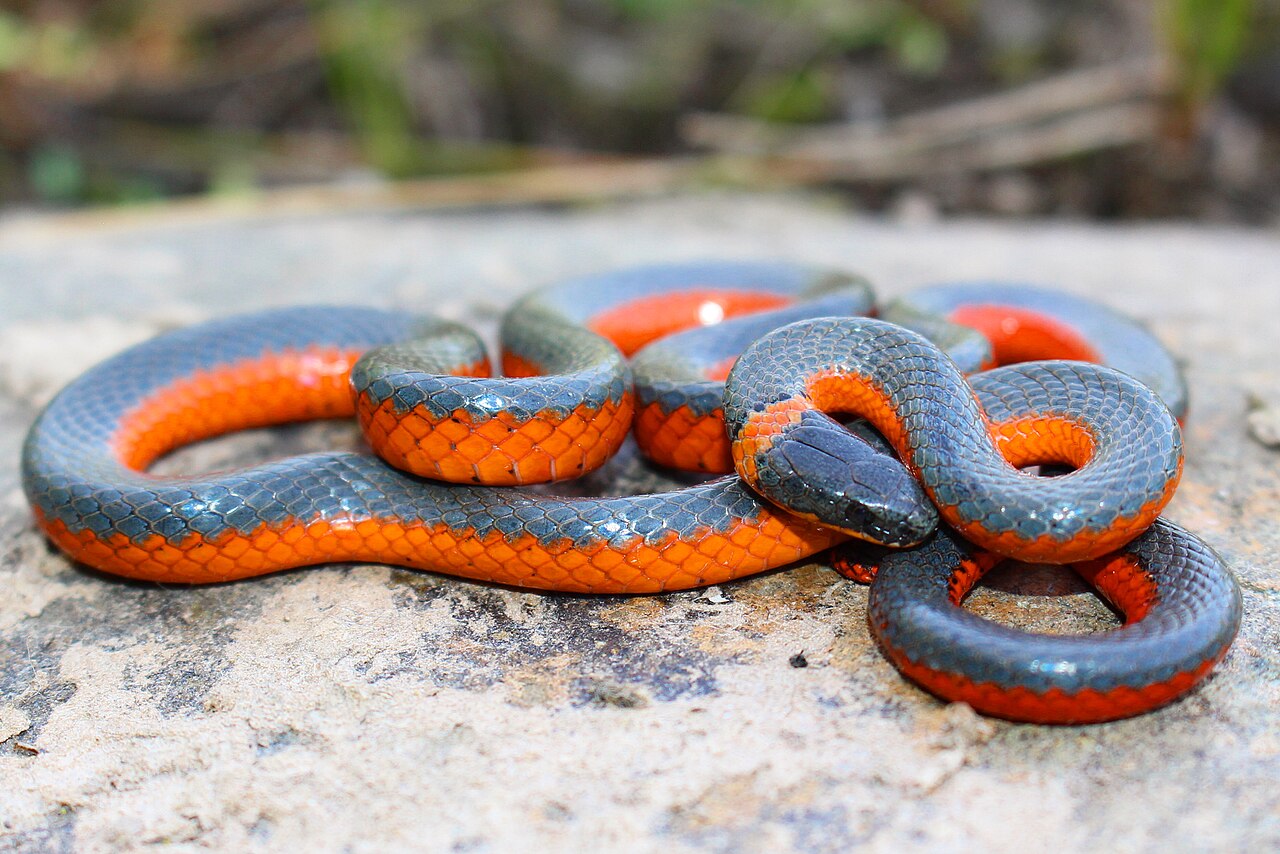
The red-bellied mud snake is a large, glossy, semi-aquatic species found in swamps, marshes, and slow-moving wetlands across the southeastern US, with a body that appears almost entirely black from above. The vivid red or pink barring along the sides and belly becomes visible mainly when the snake is in shallow water or partially exposed while moving.
This species is secretive and spends most of its time in mud, dense aquatic vegetation, or shallow water, which means sightings are relatively uncommon despite the snake being reasonably widespread within suitable wetland habitat. Its diet consists mainly of aquatic salamanders, particularly amphiuma, a large eel-like salamander it specializes in hunting.
Old folklore describes the mud snake as a hoop snake capable of grabbing its tail and rolling like a wheel, a myth with no basis in the species’ actual movement, which is a standard undulating crawl typical of most snakes.
Scarlet Snake Identification
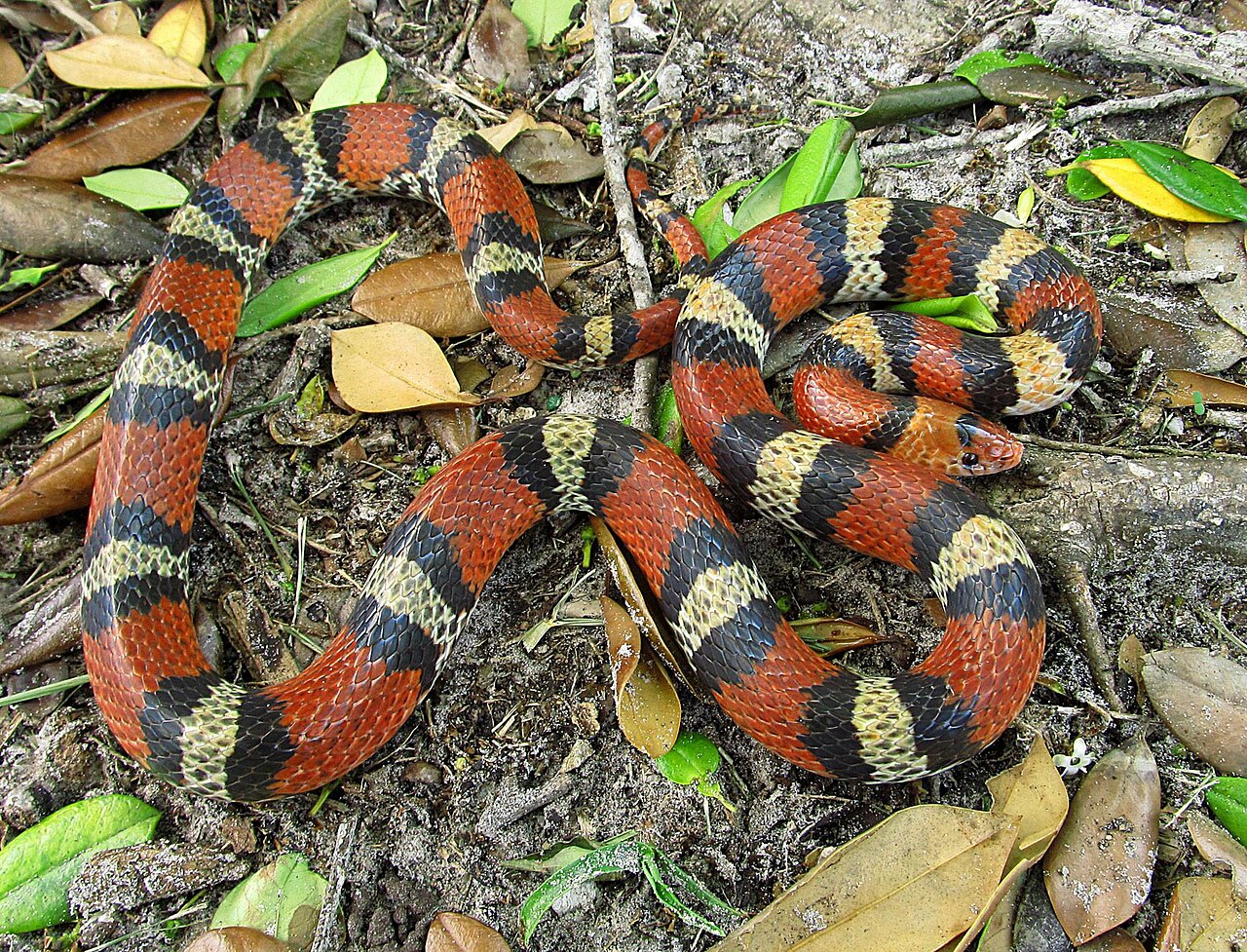
The scarlet snake shows a clean, repeating pattern of red, black, and white or cream bands running around the entire body, with a pointed snout used for digging through loose, sandy soil. This species is small, rarely exceeding 20 inches, and is almost never seen above ground during the day.
Scarlet snakes are frequently confused with both coral snakes and milk snakes due to overlapping color use, though the absence of yellow and the snake’s small size and burrowing habits help separate it from both lookalikes fairly reliably. Its diet consists mainly of reptile eggs, particularly those of other snakes and lizards.
Because scarlet snakes spend most of their time underground or under loose debris, encounters typically happen when digging in a garden or turning over logs and rocks rather than through casual observation during normal outdoor activity.
Ring-Necked Snake Red Belly Display
Ring-necked snakes are small, secretive, and dark gray to black on top with a distinctive yellow or orange neck ring, but the belly is a striking red-orange that is only revealed when the snake feels threatened. This defensive tail-curl display exposes the bright underside while the head remains hidden.
This behavior functions as a startle display rather than a true warning of toxicity, since ring-necked snakes are mildly venomous only to small prey through rear fangs and pose no meaningful danger to humans. The species is common across much of the eastern and central US, typically found under rocks, logs, and leaf litter.
Because the red coloring is hidden until the snake is disturbed, most people who encounter one initially see only the dark upper side, with the red belly display coming as a surprise during closer inspection or handling.
How to Tell If Black and Red Snake Is Venomous
Checking specifically for yellow bands is the single most useful test for a US snake showing red and black, since true coral snakes always include yellow rings positioned between the red and black bands, following the pattern the classic rhyme describes. No yellow present rules out coral snake immediately.
Head shape offers a secondary check, since coral snakes have a small, rounded head with no distinct neck taper, similar to many harmless snakes, which is why the color pattern rule is generally more reliable than head shape alone for this specific group. Body size and habitat also help, since coral snakes favor wooded, leaf-littered areas in the southeastern US specifically.
When any uncertainty remains, treating an unfamiliar red and black patterned snake with caution and maintaining distance is always the safest default, even though the species described above are overwhelmingly likely to be harmless based on pattern alone.
Where Red and Black Snakes Are Found
Red-bellied mud snakes are restricted to wetland habitats across the southeastern coastal plain, rarely found far from swamps, marshes, or slow-moving water bodies. Scarlet snakes favor sandy, well-drained soils in pine forests and similar dry woodland habitats across much of the southeastern and south-central US.
Ring-necked snakes have the broadest range of the three, found across most of the eastern half of the country in a wide variety of habitats including forests, grasslands, and suburban yards, wherever adequate ground cover like logs, rocks, or leaf litter is available.
Geographic range alone can help narrow identification in some cases, since a red and black snake found far outside coral snake range, in states where no coral snake population exists, can be identified as one of the harmless species by location alone, independent of pattern analysis.
What Should You Do If You See a Red Belly Black Snake
The safest response to any unfamiliar red and black patterned snake is to observe from a distance, photograph it if possible, and avoid handling until identification is reasonably confirmed. Faunalist Tip: checking whether any yellow appears between the red and black bands is the fastest field test, and its absence strongly supports a harmless species identification.
Ring-necked snakes displaying their red belly as a defensive response are reacting to a perceived threat and will typically calm down and attempt to flee once left alone, without any need for direct handling or relocation in most encounters.
For snakes found in inconvenient locations, such as a garage or entryway, gently guiding them toward an exit or using a container for relocation avoids the need for direct contact while still resolving the immediate situation safely.
Seasonal Activity and Behavior
Red-bellied mud snakes are most active during warm, wet months when their salamander prey is abundant in flooded wetlands, becoming far less visible during dry spells or cooler weather when they retreat into deep mud or underground burrows. Scarlet snakes follow a largely nocturnal pattern, surfacing after dark to hunt reptile eggs and retreating underground well before sunrise.
Ring-necked snakes show the most flexible activity pattern of the three, active both day and night depending on temperature and moisture, though they are most easily found by checking under logs, boards, and flat rocks during daylight hours rather than through active nighttime searching.
All three species become considerably less active as temperatures drop in late fall, moving to underground retreats below the frost line where they remain dormant through winter before resuming normal activity the following spring as temperatures warm again.
Common Misidentifications
Milk snakes and kingsnakes sometimes show enough red in certain color variations to cause confusion with the species covered here, though both typically include additional colors like white, tan, or brown that break up a purely red and black appearance. Checking for a third or fourth color often resolves ambiguous cases quickly.
Juvenile individuals of several snake species show more vivid coloring than adults, fading or darkening as the snake matures, which occasionally leads to a young snake being misidentified based on outdated assumptions about adult coloring for that species.
Photographing an unfamiliar snake and comparing it against regional field guides or reaching out to a local herpetological society remains the most reliable path to confident identification when a sighting does not clearly match any of the common patterns described here.
Frequently Asked Questions
Is black and red snake poisonous?
Not if no yellow appears in the pattern, since the venomous coral snake always includes yellow bands between red and black. Red-and-black-only patterns are typically harmless species.
What kind of snake is red and black?
Common possibilities include the red-bellied mud snake, scarlet snake, and ring-necked snake, all nonvenomous species native to various parts of the US.
What’s the saying for red and black snakes?
Red touches yellow kills a fellow, red touches black venom lack, is the classic mnemonic used to distinguish coral snakes from harmless lookalikes with similar coloring.
What should I do if I see a red belly black snake?
Observe from a distance and avoid handling until you can confirm the pattern includes no yellow, which rules out the venomous coral snake in most US regions.
Do red-bellied snakes move around at night?
Ring-necked snakes and mud snakes are both more active during cooler evening and nighttime hours, especially in warmer months, though they can be encountered during the day under cover objects.
What smell do snakes hate most?
Strong scents like clove oil, cinnamon, and sulfur are commonly cited as snake deterrents, though scientific support for consistent effectiveness is limited and results vary by species.
State wildlife agencies and university extension herpetology programs maintain regional identification guides for native snake species useful beyond the general patterns described here.
Related reading: coral snake versus kingsnake, garter snake bites, and baby black snakes.