12 Types of Squirrels in North America and How to Tell Them Apart
North America is home to roughly 60 species in the squirrel family, and they fall into three practical groups: tree squirrels, ground squirrels, and flying squirrels. Chipmunks, marmots, groundhogs, and prairie dogs belong to the same family, Sciuridae, which surprises most people who meet them at a picnic table. Knowing which group an animal belongs to answers almost every follow up question about where it sleeps, what it eats, and whether it will be in your attic.
The twelve types of squirrels below cover every squirrel an American is likely to see, from the gray squirrel on a city lawn to the flying squirrel that only shows up after dark. Each entry gives the field mark that separates it from its nearest look alike, because size and color alone will fool you in a species that ranges from black to blonde in the same litter.
Squirrels divide into three types: tree squirrels such as the eastern gray and fox squirrel, ground squirrels including chipmunks, marmots, and prairie dogs, and flying squirrels, which glide rather than fly. North America has about 60 species. The eastern gray squirrel is the most common and widespread in the United States.
| Species | Group | Length with tail | Key field mark |
|---|---|---|---|
| Eastern gray squirrel | Tree | 16 to 20 in (41 to 51 cm) | Gray coat, white belly, bushy silver edged tail |
| Fox squirrel | Tree | 19 to 29 in (48 to 74 cm) | Largest tree squirrel, rusty orange belly |
| American red squirrel | Tree | 11 to 14 in (28 to 36 cm) | Small, loud, white eye ring, conifer forests |
| Douglas squirrel | Tree | 11 to 14 in (28 to 36 cm) | Orange belly, Pacific Northwest only |
| Southern flying squirrel | Flying | 8 to 10 in (20 to 25 cm) | Loose skin flaps, huge black eyes, nocturnal |
| California ground squirrel | Ground | 14 to 20 in (36 to 51 cm) | Mottled back, burrows, tail less bushy |
| Eastern chipmunk | Ground | 8 to 11 in (20 to 28 cm) | Facial stripes, cheek pouches, small |
What Are the Different Types of Squirrels?
There are three types of squirrels, separated by where they live rather than by how they look. Tree squirrels nest in cavities and leaf dreys, stay active all winter, and have the long bushy tail most people picture. Ground squirrels dig burrow systems, have shorter and thinner tails, and most of them sleep through the cold months. Flying squirrels are tree dwellers with a membrane called the patagium stretched between wrist and ankle, and they are strictly nocturnal.
Every squirrel belongs to the family Sciuridae, which includes about 280 species worldwide and reaches every continent except Antarctica and Australia. The family is unusually broad. A 12 pound (5.4 kg) hoary marmot and a 2 ounce (57 g) least chipmunk are close relatives, and both share the same chisel shaped incisors that keep growing for life.
Group membership predicts behavior more reliably than size. If the animal disappears underground, it will hibernate or enter torpor. If it nests in a tree, it stores food and stays out all year. If you never see it in daylight, it glides.
Eastern Gray Squirrel
The eastern gray squirrel (Sciurus carolinensis) is the most common squirrel species in the United States and the default squirrel of parks, campuses, and backyards east of the Rockies. Adults run 16 to 20 in (41 to 51 cm) including the tail and weigh 14 to 21 oz (400 to 600 g). The coat is gray with a white belly and a tail fringed in silver tipped hairs.
Color is the trap. Melanistic black gray squirrels are common in the Midwest and Ontario, and albino populations persist in a few towns such as Olney, Illinois. Both are the same species. The reliable marks are the white belly and the flat, silvery tail held in a question mark curve over the back.
Gray squirrels were introduced to the Pacific Northwest, Britain, and Italy, where they outcompete native species. They bury nuts one at a time in a behavior called scatter hoarding and recover them by smell and spatial memory, forgetting enough to plant a measurable share of the oak forest.
Fox Squirrel
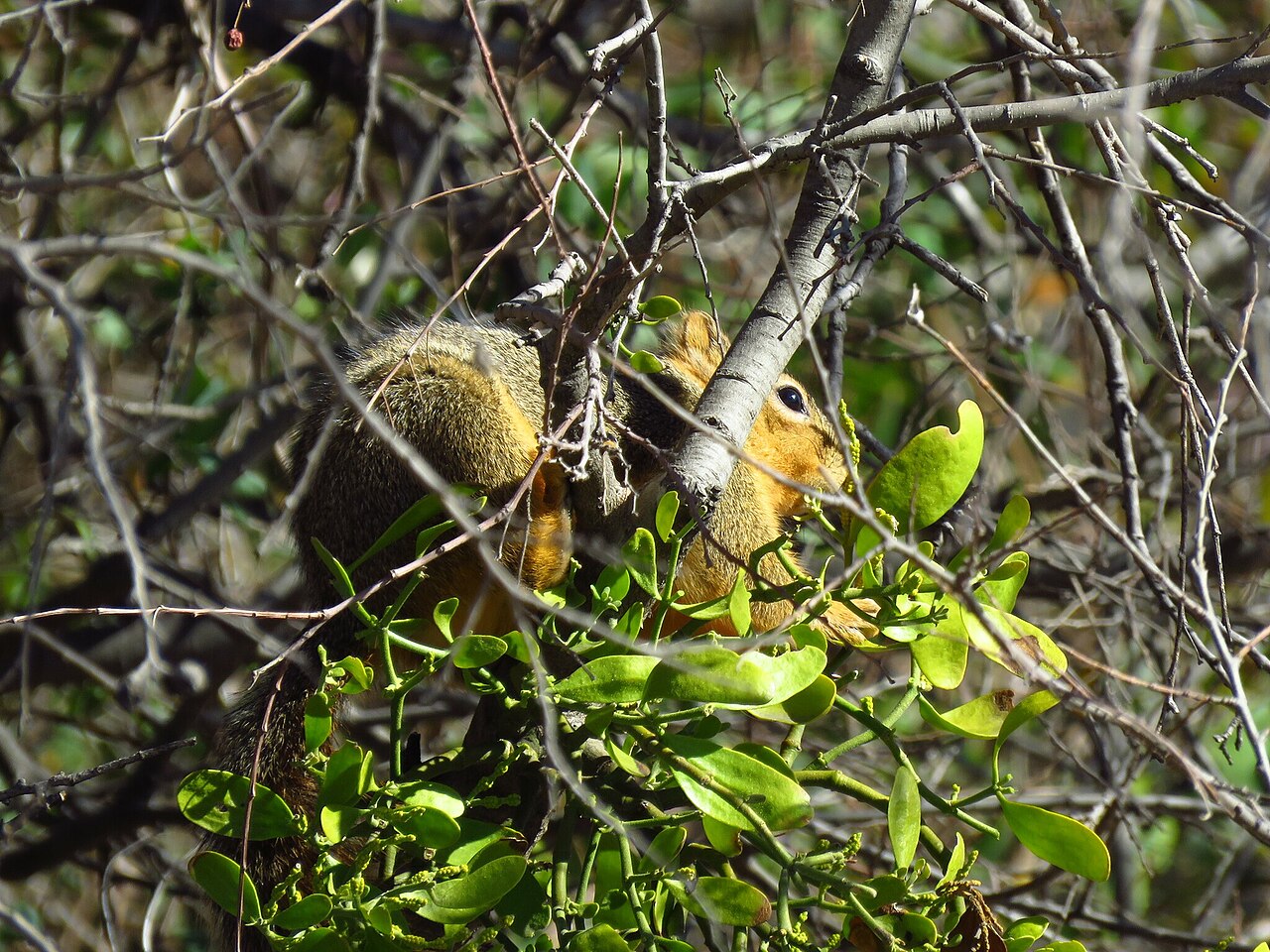
The fox squirrel (Sciurus niger) is the largest tree squirrel in North America, reaching 19 to 29 in (48 to 74 cm) and up to 2.2 lb (1 kg). Where its range overlaps the gray squirrel, the belly settles the identification: fox squirrels are rusty orange underneath, grays are white. The overall tone runs from steel gray in the Delmarva subspecies to bright cinnamon in the Midwest.
Fox squirrels prefer open woodland with scattered large trees rather than closed canopy forest, which is why they dominate oak savanna, farm windbreaks, and golf courses. They spend more time on the ground than gray squirrels and move with a slower, heavier gait.
Regional color forms confuse even experienced observers. In the Southeast, some fox squirrels have a black head with a white nose and ears, a pattern no gray squirrel ever shows.
American Red Squirrel and Douglas Squirrel
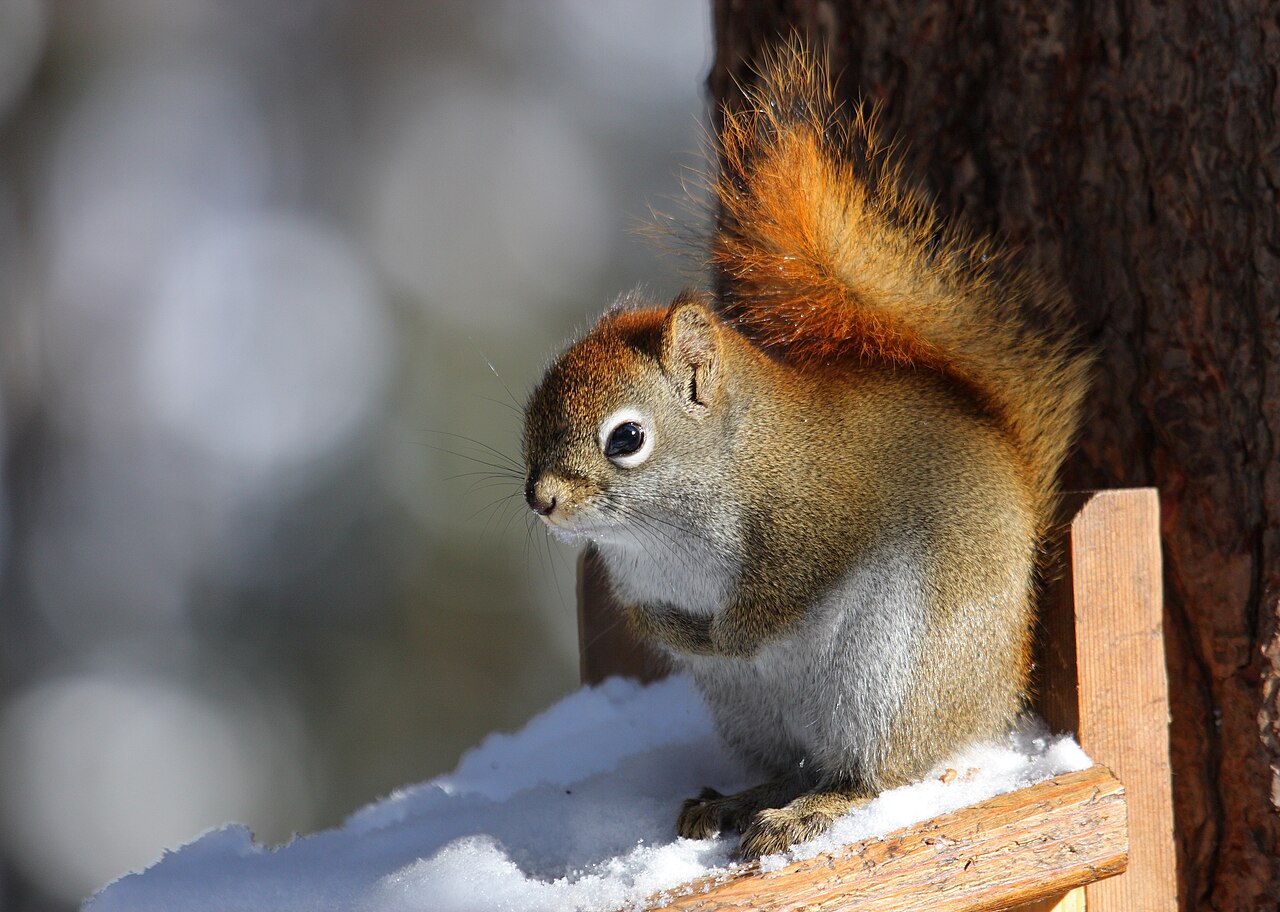
The American red squirrel (Tamiasciurus hudsonicus) is the small, furious squirrel of northern and mountain conifer forests. At 11 to 14 in (28 to 36 cm) it is roughly half the mass of a gray squirrel, with rusty upperparts, a white belly, and a conspicuous white eye ring. Its chattering alarm call carries several hundred feet and is usually the first sign it is there.
Red squirrels are larder hoarders rather than scatter hoarders. They pile cone scales into a single mound called a midden, sometimes several feet across and used by successive generations. Finding a midden means the resident is nearby and will announce you.
The Douglas squirrel (Tamiasciurus douglasii) replaces it from British Columbia to central California. It is nearly identical in size and habits but has an orange or buff belly instead of white. Range decides it: the two barely overlap.
Western Gray Squirrel and Abert’s Squirrel
The western gray squirrel (Sciurus griseus) lives in oak and pine woodland from Washington to Baja California. It is larger and a cleaner steel gray than the eastern gray, with a notably long tail and no rust tones anywhere on the body. Populations have declined in Washington and it is listed as endangered there, largely because of habitat loss and competition from introduced eastern grays.
Abert’s squirrel (Sciurus aberti), also called the tassel eared squirrel, is the most distinctive tree squirrel on the continent. Long ear tufts up to 1 in (2.5 cm) grow in through winter, and the animal depends almost entirely on ponderosa pine for food and shelter. It lives in the Southwest, and the isolated Kaibab squirrel north of the Grand Canyon is its best known population, with a black belly and an all white tail.
Flying Squirrels
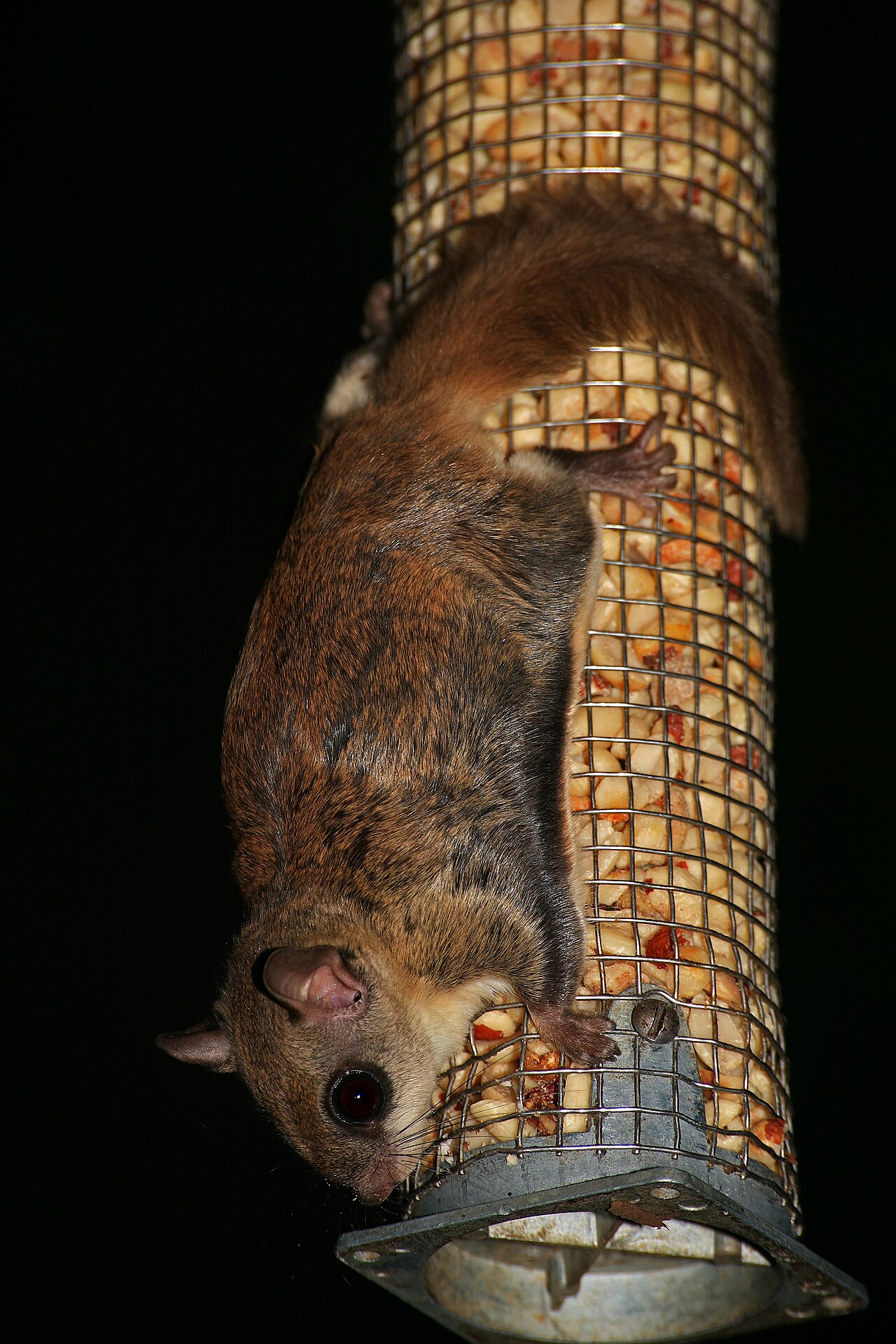
Flying squirrels do not fly, they glide, using a furred membrane that turns the body into an airfoil. The southern flying squirrel (Glaucomys volans) covers the eastern United States and the northern flying squirrel (Glaucomys sabrinus) occupies boreal and montane forest, with a third species, Humboldt’s flying squirrel, recognized on the Pacific coast in 2017.
Glides of 150 ft (46 m) have been recorded, with the flattened tail acting as a rudder and brake. Both species are strictly nocturnal, which is why they are far more abundant than people assume. A yard with mature oaks and no visible flying squirrels may still host a dozen.
They are also the most carnivorous squirrels in North America, taking insects, eggs, and nestling birds alongside nuts and fungi. Under ultraviolet light their fur fluoresces pink, a discovery made in 2019 that still has no agreed explanation.
Ground Squirrels
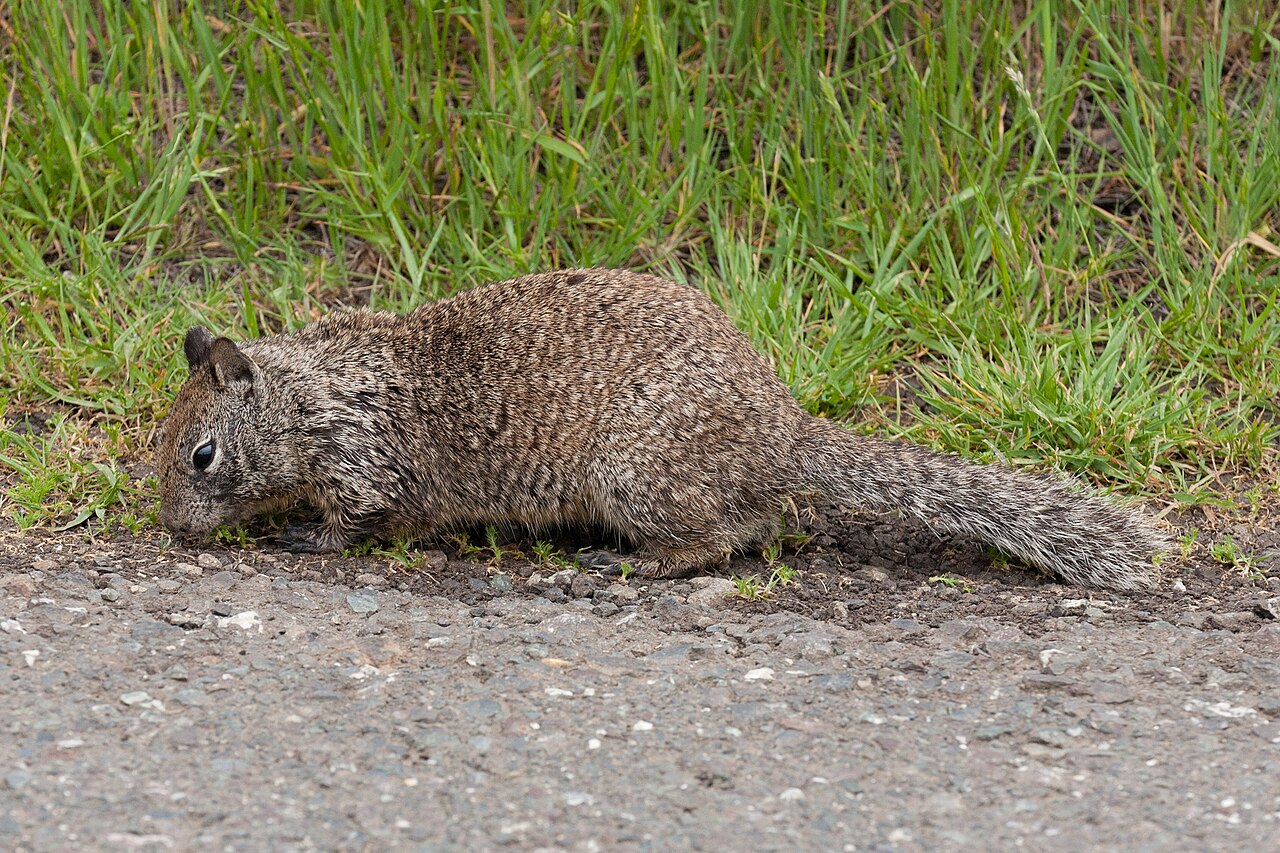
Ground squirrels are burrowing sciurids with shorter, thinner tails and eyes set high on the head for watching the sky. North America has more than 20 species. The California ground squirrel (Otospermophilus beecheyi) is the familiar one on the West Coast, mottled gray brown with a pale shoulder mantle, living in colonies along road cuts and levees.
The thirteen lined ground squirrel (Ictidomys tridecemlineatus) of the prairies wears alternating stripes and rows of pale spots, and it is a true hibernator whose body temperature drops close to freezing for months. Golden mantled ground squirrels of the Rockies are regularly mistaken for oversized chipmunks, but they lack facial stripes, which is the one mark that never fails.
Ground squirrel burrows can undermine embankments and levees, and in parts of California the species is managed as an agricultural pest. Their alarm calls are specific enough that neighboring animals react differently to an aerial predator than to a ground predator, much as birds of prey trigger a distinct response.
Chipmunks
Chipmunks are ground squirrels with facial stripes, and that single feature separates them from every other small sciurid. North America has 24 species, 23 of them western, with the eastern chipmunk (Tamias striatus) alone covering the entire East. Adults are 8 to 11 in (20 to 28 cm) and weigh 2 to 5 oz (57 to 142 g).
Expandable cheek pouches let a chipmunk carry a volume of seed close to the size of its own head, which is how a feeder empties overnight. They store food in burrow chambers rather than fattening up, then wake every few days through winter to eat, a pattern covered in more detail in our guide to whether chipmunks hibernate.
Marmots, Groundhogs, and Prairie Dogs
The largest squirrels in North America live entirely on the ground. The groundhog or woodchuck (Marmota monax) reaches 16 to 26 in (41 to 66 cm) and 13 lb (5.9 kg), and the hoary marmot of the northern Rockies is heavier still. Both are true hibernators that lose a quarter or more of their body mass over winter.
Prairie dogs (Cynomys species) are colonial marmot relatives whose towns once covered millions of acres of the Great Plains. Black tailed prairie dogs stay active all winter; white tailed and Gunnison’s prairie dogs hibernate. Their vocal system encodes information about predator type, size, and color, according to field research summarized by state wildlife agencies including the Michigan Department of Natural Resources.
What Looks Like a Squirrel but Is Not a Squirrel?
Several animals get called squirrels and are not. Tree shrews, gophers, and the pack rat all draw the label, and the closest confusion is the pocket gopher, which has external fur lined cheek pouches and tiny eyes and belongs to a different family entirely. Dormice in Europe look like miniature squirrels but are in Gliridae.
In the other direction, animals that people do not call squirrels often are ones. Prairie dogs, marmots, and chipmunks are all Sciuridae. So is the yellow bellied marmot whistling from a talus slope in Colorado.
The quick test is the tail and the teeth. A squirrel has four upper and lower incisors in a chisel arrangement, large ears set on the side of the head, and a tail at least half the length of its body. Young animals can throw off any size based guess, so check the field marks rather than the dimensions, as our guide to a baby squirrel explains.
Frequently Asked Questions
What is the most common squirrel species in the United States?
The eastern gray squirrel is the most common and widely distributed, occupying the entire eastern half of the country plus introduced populations in the West. In western states the California ground squirrel and fox squirrel are locally more abundant, but no species matches the gray squirrel nationally.
How many types of squirrels are there?
Worldwide there are roughly 280 species in the family Sciuridae, with about 60 in North America. That count includes tree squirrels, ground squirrels, flying squirrels, chipmunks, marmots, and prairie dogs, all of which are squirrels in the taxonomic sense even when common usage says otherwise.
What are other names for squirrels?
Regional names include bushytail, tree rat, limb chicken, and cat squirrel for the eastern gray. Groundhogs are also called woodchucks and whistle pigs, and ground squirrels are widely known as gophers across the Midwest even though true gophers are a separate family.
Are there rare types of squirrels?
Yes. The Delmarva fox squirrel, Mount Graham red squirrel, and northern Idaho ground squirrel are all federally protected. Black and white color morphs of common species look rare but are not separate types, just pigment variations within ordinary gray squirrel populations.
Do all squirrels hibernate?
No. Tree squirrels and flying squirrels stay active year round, relying on cached food and shared nests during cold spells. Ground squirrels, marmots, and most chipmunks enter hibernation or repeated torpor, a split explained in our article on whether squirrels hibernate.
Which squirrels are active at night?
Only flying squirrels are truly nocturnal. Tree squirrels and ground squirrels are diurnal and usually in the nest before full dark, so a squirrel sized animal moving at 11 p.m. is almost certainly a flying squirrel, as covered in our piece on whether squirrels are nocturnal.