Eastern Painted Turtle: Size, Diet, Lifespan, and Care
The eastern painted turtle (Chrysemys picta picta) is the only painted turtle subspecies whose shell scutes line up in straight rows across the back, and it is the turtle most people in the eastern United States actually see sunning on a log. Adults stay small, usually 4 to 6 inches (10 to 15 cm) long, eat almost anything that fits in the mouth, and live far longer than new keepers expect.
This subspecies ranges from southern Canada down the Atlantic seaboard to Georgia, and it shows up in farm ponds, slow rivers, roadside ditches and suburban stormwater basins. Knowing what separates it from the midland and southern forms, and from the eastern mud turtle that shares the same water, makes identification quick once you know where to look.
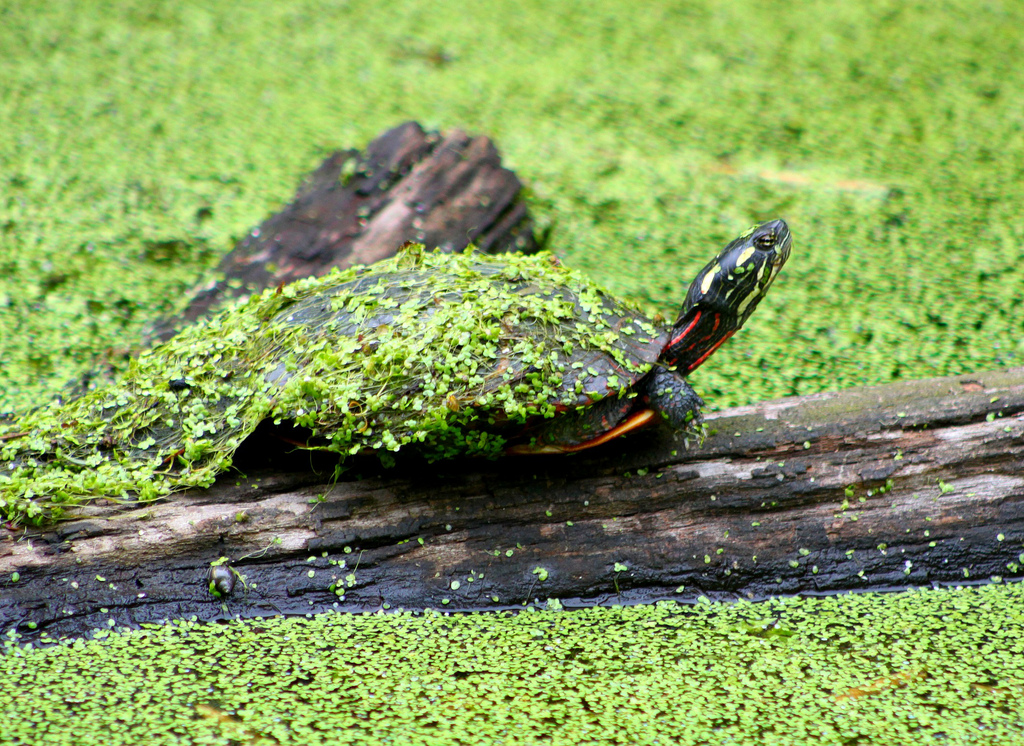
The eastern painted turtle is a small freshwater turtle with a smooth, flat, dark olive to black shell, red bars along the marginal scutes, and yellow stripes on the head and neck. Adults reach 4 to 6 inches (10 to 15 cm), live 25 to 40 years in the wild, and eat insects, snails, tadpoles, carrion and aquatic plants.
| Quick fact | Eastern painted turtle |
|---|---|
| Scientific name | Chrysemys picta picta |
| Adult shell length | 4 to 6 in (10 to 15 cm), females larger |
| Weight | 11 to 18 oz (300 to 500 g) |
| Lifespan | 25 to 40 years wild, 30 plus in captivity |
| Range | Nova Scotia to Georgia, east of the Appalachians |
| Diet | Omnivore: insects, snails, tadpoles, carrion, plants |
| Legal status | Common, but collection rules vary by state |
How to Identify an Eastern Painted Turtle
Look at the top of the shell first. On an eastern painted turtle the seams between the large central scutes line up in straight rows across the back, so the pattern reads like tidy bricks rather than staggered ones. No other painted turtle subspecies does this, and it is visible from a dock at 20 feet (6 m) with binoculars.
The carapace itself is smooth, low and oval, olive to nearly black, often with a thin yellow line running down the middle. The outer edge carries red bars or crescents that flare when the turtle is wet. The plastron, the underside, is plain yellow with no central blotch, which is the fastest way to separate an eastern from a midland painted turtle in the hand.
The head and neck are striped in yellow, and a pair of yellow spots sits just behind each eye. Males stay smaller and grow long front claws used in courtship. Females are broader and heavier, and their tails are shorter and thinner. Both sexes keep the same pattern for life, though old males darken until the stripes almost vanish.
Eastern Painted Turtle vs the Other Painted Turtle Subspecies
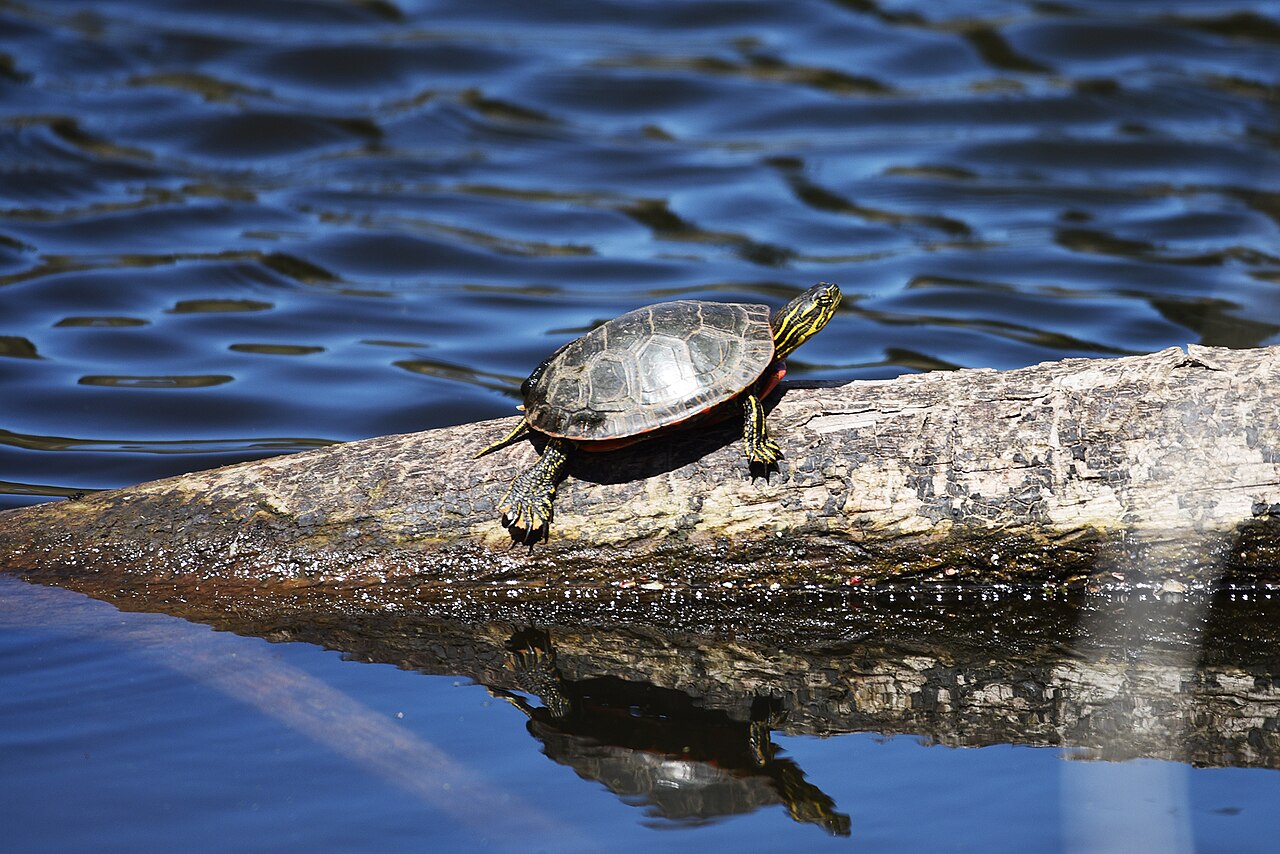
Four subspecies of painted turtle exist in North America, and they meet and interbreed where their ranges overlap. The eastern form owns the Atlantic slope, the midland form takes the Ohio Valley, the southern form follows the Mississippi, and the western form runs from the Great Lakes to the Pacific Northwest. Our overview of the painted turtle as a species covers all four in detail.
The midland painted turtle carries a dark, symmetrical shadow down the center of an otherwise yellow plastron. The southern painted turtle has a bold orange or red stripe running the length of the carapace and is the smallest of the four. The western painted turtle is the largest, up to 10 inches (25 cm), with a netted pattern of light lines on the shell and a heavily marked red plastron.
In Pennsylvania, New Jersey and southern New England you will find intergrades that show a faint plastral shadow plus aligned scutes. That is normal and does not mean you misidentified the animal. Where the subspecies meet, the field marks blur.
Where Eastern Painted Turtles Live
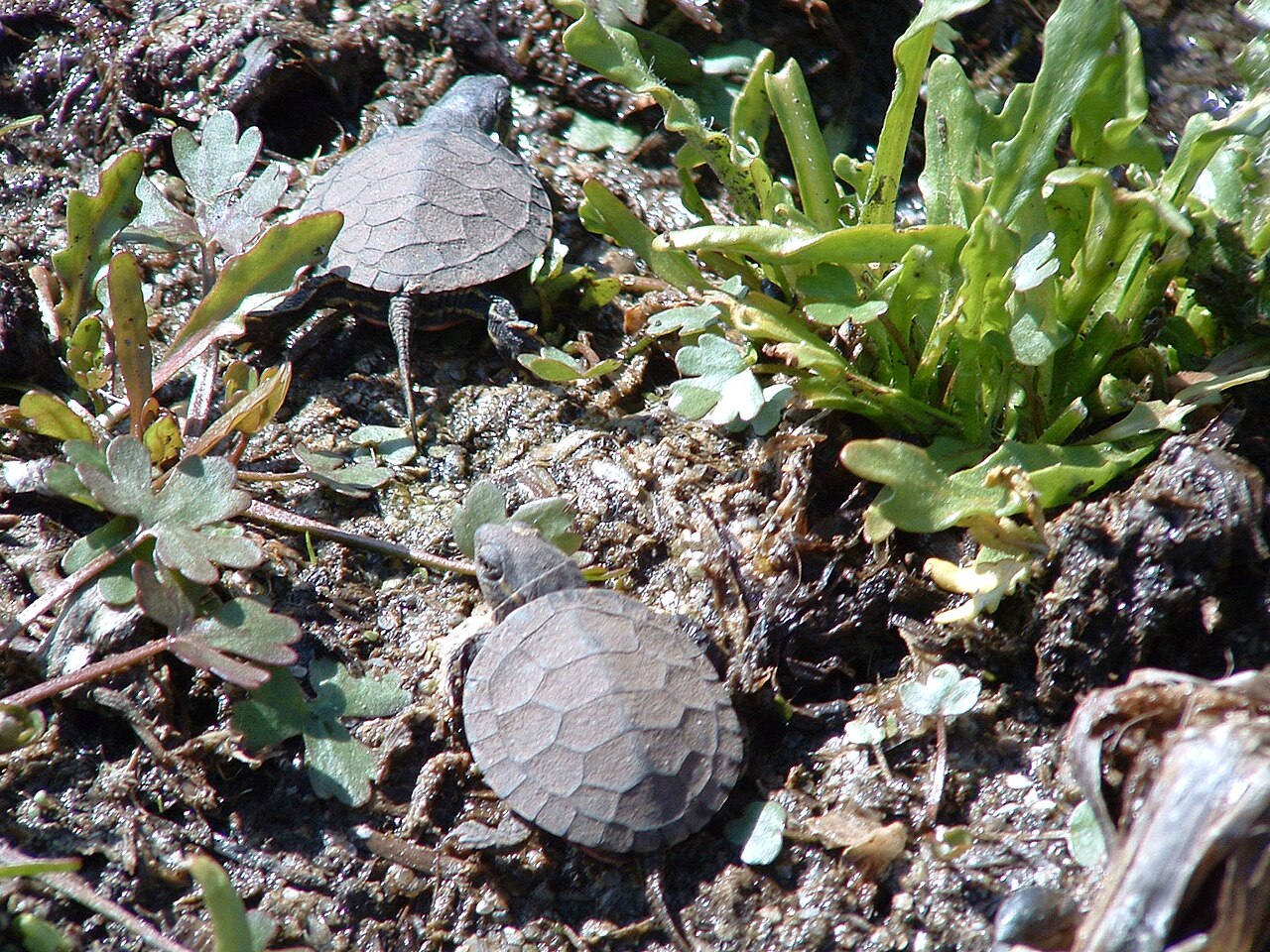
Eastern painted turtles want shallow, slow, soft-bottomed water with plenty of things to climb on. Farm ponds, oxbows, marshes, beaver impoundments, canal edges and even retention basins behind shopping centers all qualify. Depth matters less than sun: a pond with no basking log or exposed rock holds far fewer turtles than one with both.
They tolerate a surprising amount of human disturbance. Populations persist in city parks, golf course water hazards and roadside ditches as long as the water does not dry out completely and some soft soil for nesting sits within a few hundred yards. That tolerance is one reason the subspecies remains common while fussier natives decline.
Home ranges are small. A marked adult usually stays within one pond or a short stretch of stream, though females walk overland in June to nest and males occasionally move between ponds after heavy rain. Turtles found crossing roads in early summer are almost always nesting females.
What Is a Painted Turtle’s Favorite Food?
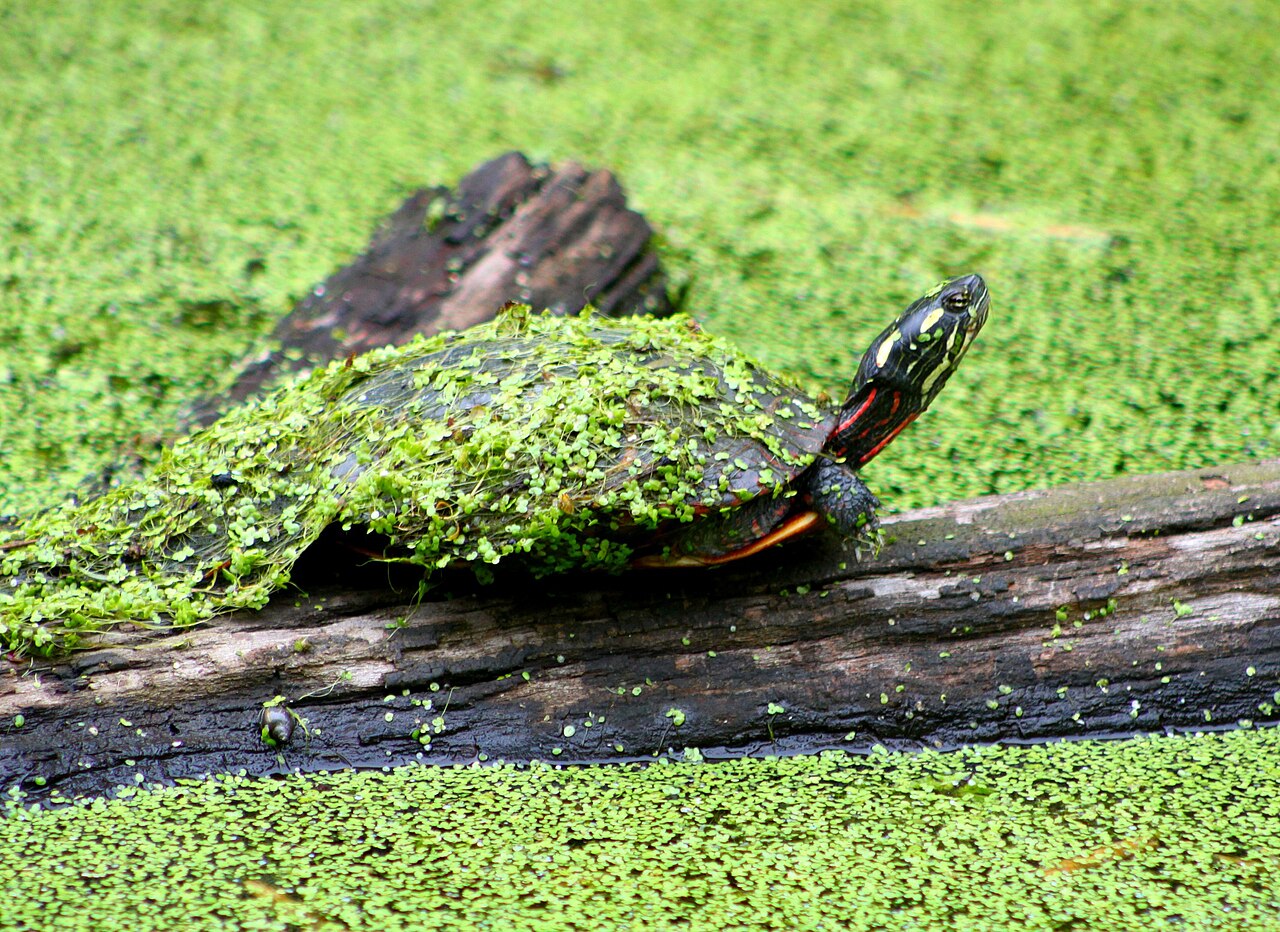
A painted turtle’s favorite food changes with age. Hatchlings and juveniles are strongly carnivorous and go after insect larvae, small snails, tadpoles, worms and anything soft and moving. Adults shift toward plants, grazing duckweed, elodea, algae and fallen seeds, but no adult turns down a dead minnow or a drowned cricket.
They feed underwater because they need water to swallow. A painted turtle will drag a bite of lettuce off the surface and back below before working on it. In ponds they act as opportunistic scavengers, cleaning up dead fish and amphibians that would otherwise foul the water.
Foraging peaks in the morning and again in late afternoon, with a long midday basking break in between. Cold water shuts feeding down entirely: below about 50 F (10 C) the digestive system slows too much to process a meal, which is why autumn turtles bask hard and eat little.
Are Eastern Painted Turtles Rare?
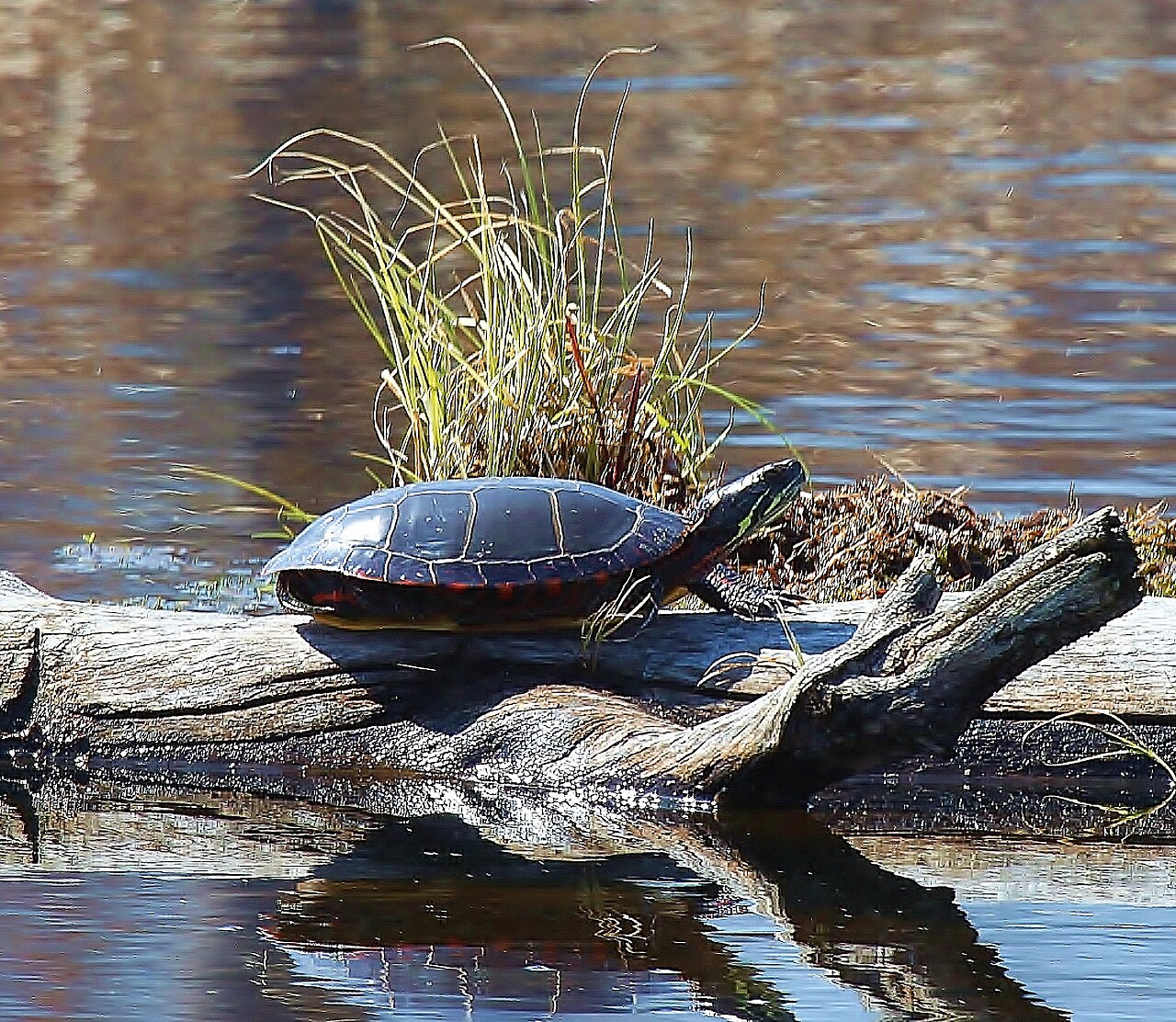
Eastern painted turtles are not rare. The painted turtle is the most widespread native turtle in North America, and the eastern subspecies is abundant across its range. The IUCN lists the species as Least Concern, and most state wildlife agencies treat it as a common, secure native.
Local declines are real, though. Road mortality kills nesting females disproportionately, and losing adult females hurts a slow-reproducing animal far more than losing eggs. Pond edges hardened with rock or bulkhead remove the soft nesting soil the population depends on, so a pond can look full of turtles for 20 years while quietly failing to recruit young.
Raccoons, skunks and foxes destroy a large share of nests, in some studies more than 80 percent in a bad year. The species copes with that because adults live for decades and females nest annually. Take away the old females and the math collapses quickly.
What Is the Lifespan of a Painted Turtle?
The lifespan of a painted turtle in the wild is usually 25 to 40 years, and documented individuals have passed 50. Captive turtles in good conditions commonly reach 30 or more, which means a hatchling bought for a child is realistically a commitment that outlasts college, several moves and possibly the marriage.
Growth is fast in the first four or five years, then nearly stops once the turtle matures. Males reach breeding age at three to five years, females at six to ten, and a large old female may be 30 years old at the same shell length she reached at 15. Counting growth rings is unreliable past the first decade.
Longevity is the reason painted turtle populations look stable even when reproduction fails. It is also the reason a released pet can persist as an unwanted genetic or disease problem in a wild pond for decades.
Basking, Brumation, and the Yearly Cycle
Basking is not optional. Painted turtles pile onto logs, rocks and muskrat lodges for several hours a day, sometimes stacked three deep, to raise body temperature, dry algae and leeches off the shell and synthesize vitamin D. Interrupt that and the shell softens and infections take hold.
From late autumn to early spring they brumate on the pond bottom, buried in mud or under submerged debris. Metabolism drops so low that they absorb the small amount of oxygen they need through the skin and the lining of the cloaca. Details of that shutdown are covered in our piece on whether turtles hibernate.
Hatchlings from a late-season nest often stay in the nest chamber all winter, tolerating body temperatures below freezing, and dig out the following spring. Few North American reptiles manage that, and it is one reason the species pushes so far north.
Can I Keep an Eastern Painted Turtle as a Pet?
You can keep an eastern painted turtle as a pet in many states, but only a captive-bred animal and only if you check your state rules first. Several states in the Northeast prohibit taking native turtles from the wild entirely, and federal law bans the sale of any turtle with a shell under 4 inches (10 cm) because of salmonella risk to children.
The setup is the real hurdle. One adult needs a minimum of 75 gallons (285 L) of water, a powerful external filter, a dry basking platform, a basking lamp holding 90 F (32 C) and a UVB tube replaced yearly. Water temperature should sit around 75 F (24 C). Painted turtles are messy eaters and heavy waste producers, so filtration and water changes drive most of the ongoing work.
Diet in captivity is a quality pellet as the base, plus leafy greens, occasional feeder insects, and calcium in the form of a cuttlebone left floating. Hatchling care differs enough that it deserves its own read on baby painted turtle care. Never release a captive turtle into a local pond.
How Much Does a Painted Turtle Typically Cost?
A painted turtle typically costs 20 to 60 USD as a captive-bred juvenile from a reputable breeder or reptile expo, with well-marked southern and western forms at the top of that range. The animal is the cheapest part of the project by a wide margin.
Expect 350 to 600 USD to set up the first enclosure: tank or stock tank, canister filter, heater, basking dock, lamp fixture, UVB bulb and a stand rated for the weight. Water weighs about 8.3 pounds per gallon (1 kg per liter), so a 75 gallon setup exceeds 700 pounds (320 kg) filled and cannot sit on ordinary furniture.
Running costs are modest but permanent: replacement UVB bulbs each year, filter media, pellets, electricity for the heater and lamp, and an exotics vet who actually sees turtles. Budget roughly 150 to 250 USD a year, plus one surprise vet visit per decade.
Are Painted Turtles Good for Your Pond?
Painted turtles are good for a backyard pond in most cases. They scavenge dead fish and insects, graze nuisance algae and soft aquatic weeds, and add movement and interest without attacking healthy adult fish. A pond with a few painted turtles usually looks cleaner along the margins than one without.
The caveats are practical. They will eat soft ornamental plants such as water lettuce and young lily shoots, they need a haul-out spot or they will crawl the liner looking for one, and they will leave the pond and walk if the water goes stagnant or the food runs out. A pond with steep concrete sides traps them and drowns them eventually.
Do not stock a pond by collecting wild turtles. Beyond the legal issue in many states, moving turtles spreads ranavirus and shell disease between watersheds. If your pond suits them, painted turtles usually arrive on their own within a couple of seasons.
What Fish Can Live With a Painted Turtle?
Fish that can live with a painted turtle are fast, cheap and small enough to escape: rosy red minnows, white cloud mountain minnows, fathead minnows, and in outdoor ponds, mosquitofish. In a large pond, adult koi and goldfish over 8 inches (20 cm) usually coexist fine because the turtle cannot catch them.
Anything slow, long-finned or bottom-hugging becomes food. Fancy goldfish, bettas, corydoras and juvenile koi all end badly. Treat any fish in an indoor turtle tank as livestock rather than pets, and never add a fish you would be upset to lose.
Bioload is the other problem. A turtle plus fish in the same tank doubles the waste in a system that is already hard to filter. If fish matter to you, keep them in a separate pond section behind a screen, the way you would separate a snapping turtle from anything you value.
Do Painted Turtles Bond With Humans?
Painted turtles do not bond with humans the way a dog or a parrot does, but they learn people fast. A captive painted turtle recognizes the person who feeds it, swims to the front glass on approach and will beg with obvious enthusiasm. That is conditioned food association, not affection, and it is still genuinely engaging to watch.
They do not enjoy handling. Being lifted triggers a stress response, and a stressed turtle scratches, empties its bladder and sometimes bites. Interaction should mean observation, target feeding and enclosure work, not cuddling. Wash hands afterward: turtles carry salmonella as normal gut flora with no sign of illness.
Wild painted turtles habituate to people in parks and will approach boats and docks expecting food. Feeding them bread or crackers does real harm, and so does picking one up to take home: several northeastern states prohibit possession of wild-caught native turtles outright. The Smithsonian’s National Zoo keeps current species profiles at nationalzoo.si.edu/animals. Let them work the pond instead.
Frequently Asked Questions
What is the friendliest turtle?
Among commonly kept species, the painted turtle and the red-eared slider are the most responsive to people, since both learn feeding routines quickly and stay active during the day. Friendly here means bold and food-motivated, not affectionate. No turtle enjoys being held, and all of them prefer observation over contact.
Do eastern painted turtles bite?
They can bite when handled, but the jaws are small and the result is a pinch that rarely breaks skin on an adult human. There is no venom and no lasting injury. Support the turtle from the sides of the shell behind the front legs, keep fingers away from the head, and most animals never attempt it.
How can I tell a male from a female painted turtle?
Males have noticeably long front claws used to stroke the female’s face during courtship, a longer and thicker tail with the vent past the shell edge, and a smaller overall size. Females are broader, heavier and have short front claws. These signs are only reliable once the turtle reaches about 4 inches (10 cm).
Can eastern painted turtles live with other turtle species?
In a large outdoor pond they mix well with other basking natives, though competition for basking space causes shoving. Indoors, mixing species is risky: sliders outcompete painted turtles for food, and musk or snapping turtles injure them. Keep one species per enclosure unless the water volume is genuinely pond-sized.
Why is my painted turtle’s shell soft or peeling?
Normal shedding sheds thin, clear scutes that lift at the edges and come off whole. Soft spots, pitting, foul smell or white patches indicate shell rot or metabolic bone disease from inadequate UVB and calcium. Check the basking temperature, replace a UVB bulb older than 12 months, and see an exotics vet if softness persists.
What do I do if my pond turtle disappears in winter?
It almost certainly brumated on the bottom under mud or leaf litter, which is normal from roughly November to March across most of the range. As long as the pond does not freeze solid to the bottom and some gas exchange continues at the surface, the turtle reappears on the first warm, sunny day of spring.