Bullfrog: Size, Identification, Calls, and Whether They Are Harmless
The bullfrog is the largest frog in North America, a heavy bodied ambush predator that reaches 6 in (15 cm) from snout to vent and 1.5 lb (0.7 kg), and that will eat anything it can fit in its mouth. The American bullfrog (Lithobates catesbeianus) is native east of the Rocky Mountains and has been introduced across the western states, Europe, Asia, and South America, where it is one of the most damaging amphibian invaders on record.
Most people meet a bullfrog by ear first. The low, two part jug o rum call carries across a pond at dusk and is often mistaken for a cow. Below are the marks that separate a bullfrog from the green frog it is most often confused with, how big they actually get, what they eat, the diseases they carry, whether they are safe around dogs and children, and why wildlife agencies in the West want them gone.
The American bullfrog is North America’s largest frog, growing to 3.5 to 6 in (9 to 15 cm) body length with legs adding another 7 to 10 in (18 to 25 cm). It is harmless to people, eats insects, fish, birds, and other frogs, calls with a deep jug o rum, and is an aggressive invasive species outside its native eastern range.
| Quick fact | American bullfrog (Lithobates catesbeianus) |
|---|---|
| Body length | 3.5 to 6 in (9 to 15 cm), rarely to 8 in (20 cm) |
| Weight | Up to 1.5 lb (0.7 kg) |
| Best field mark | No ridges down the back; skin fold curves around the eardrum |
| Call | Deep jug o rum, audible a quarter mile away |
| Tadpole stage | 1 to 3 years depending on latitude |
| Lifespan | 7 to 9 years wild, up to 16 in captivity |
| Status | Native east of the Rockies, invasive in the West and abroad |
What Is a Bullfrog?
A bullfrog is a true frog in the family Ranidae, built for sitting at a water’s edge and swallowing whatever comes close. The body is broad and muscular, the hind legs are long and heavily webbed, and the head is wide enough that the gape looks disproportionate to the rest of the animal. Adults spend their lives within a few feet of permanent water.
The species carried the scientific name Rana catesbeiana for two centuries and now sits in the genus Lithobates, so older field guides and newer ones disagree on paper while describing the same frog. Both names refer to Mark Catesby, the eighteenth century naturalist who first illustrated it. Some regional references still use the older combination.
Bullfrogs are solitary and territorial. A calling male holds a stretch of shoreline through the summer and will wrestle intruding males, sometimes for hours. That territoriality, combined with the appetite, is why a small pond rarely supports more than a handful of adults and why the loudest one tends to be the largest.
Bullfrog Identification: The Ear Test and the Back Ridges
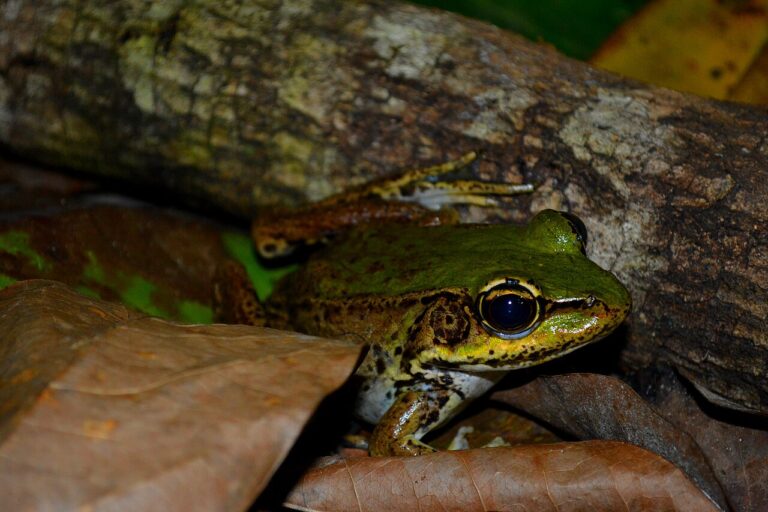
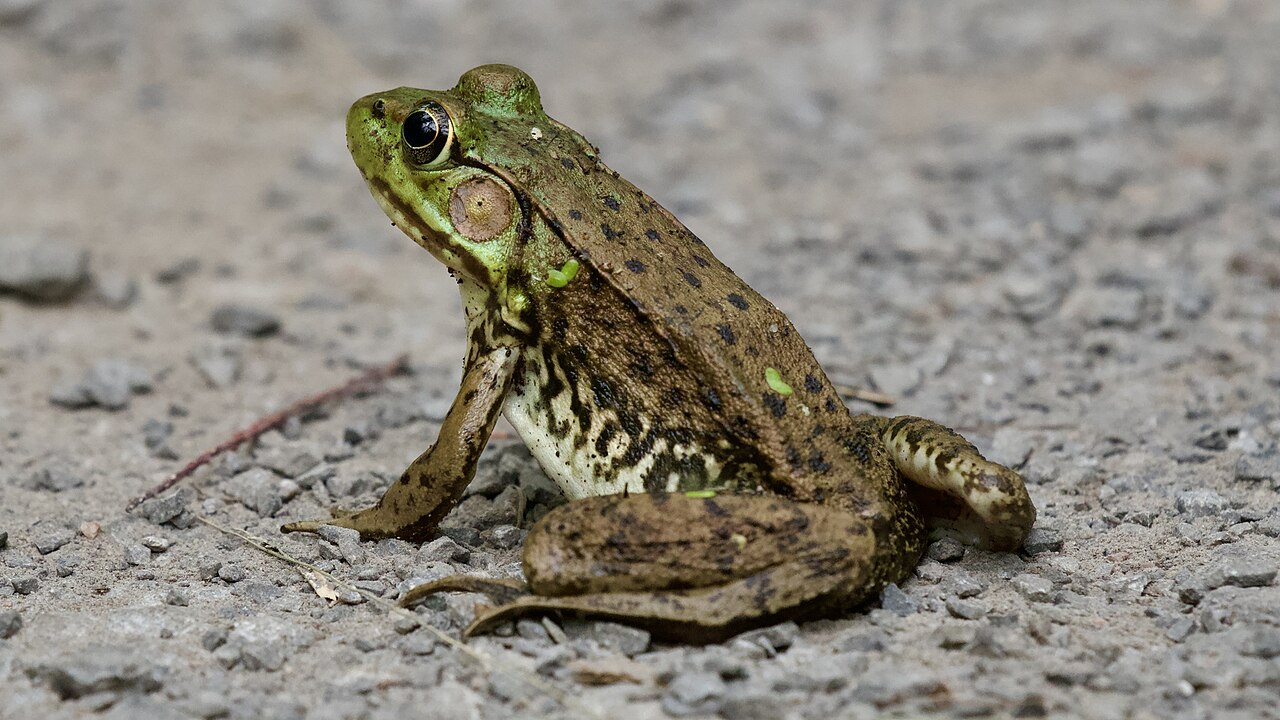
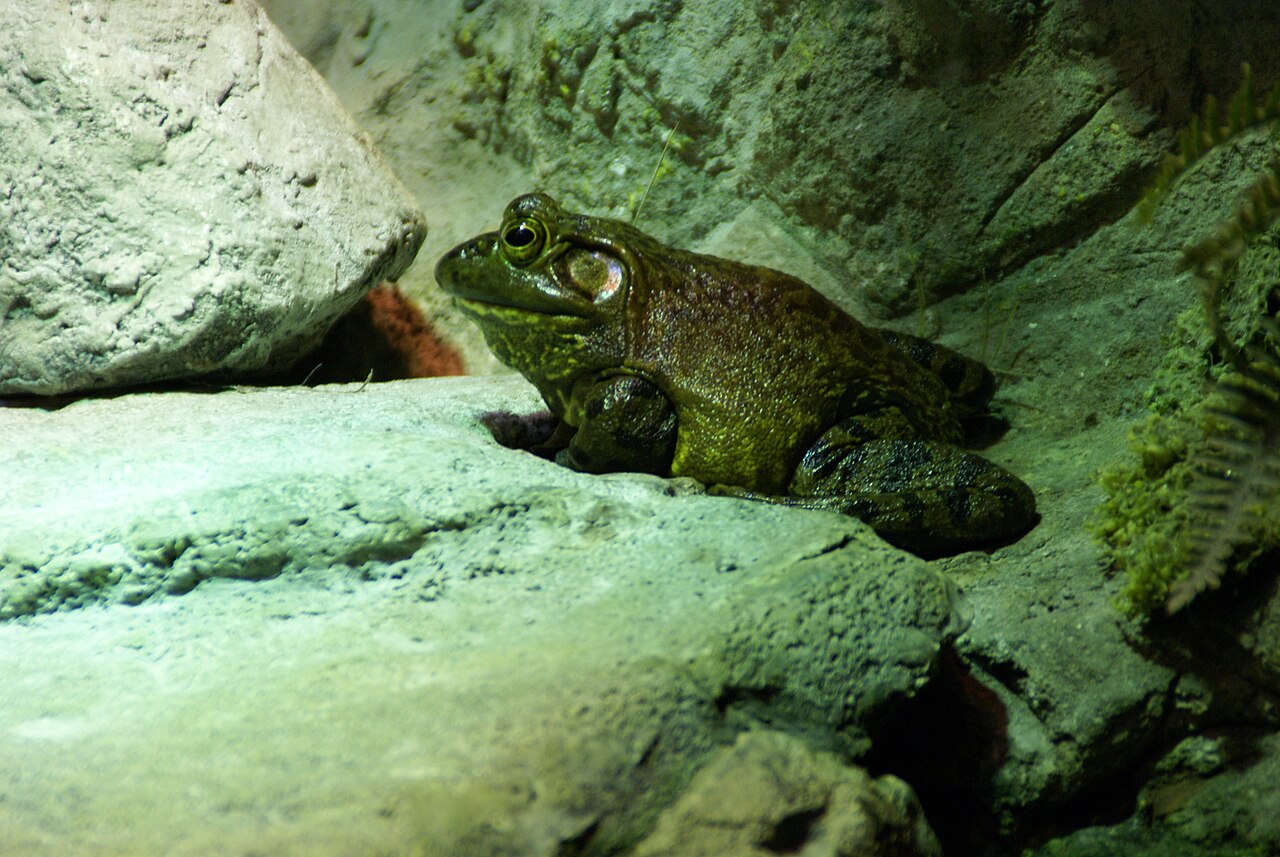
Two marks identify a bullfrog with near certainty. First, the back is smooth: there are no dorsolateral ridges, the raised lines that run from behind the eye to the hip on green frogs and leopard frogs. Instead, a single fold of skin curves from behind the eye down and around the eardrum and stops. Second, adults are simply bigger than any other frog in the region.
Color is unreliable. Bullfrogs range from olive green to brown to nearly black, often with a mottled dark pattern on the back and dark bands on the legs. The upper lip and chin may be plain cream in males or mottled in females. A bright green head over a brown body is common and is not evidence of a different species.
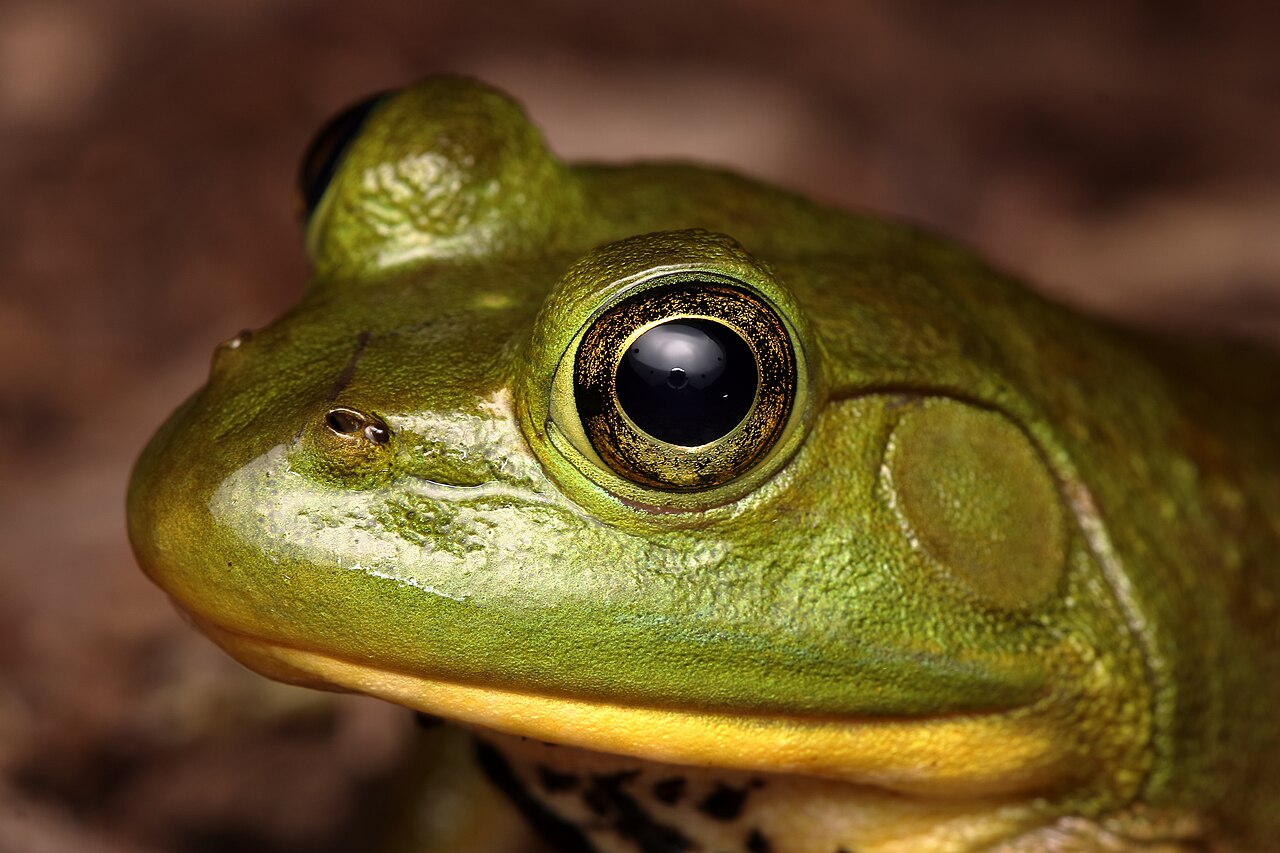
The eardrum, the flat round tympanum behind the eye, also tells you the sex. In males it is clearly larger than the eye and the throat is yellow; in females it is about the same diameter as the eye and the throat is white. That single glance works from a few feet away and needs no handling.
How Big Do Bullfrogs Get?
A typical adult measures 3.5 to 6 in (9 to 15 cm) from snout to vent, which is the measurement biologists use. Exceptional individuals reach 8 in (20 cm) and weigh 1.5 lb (0.7 kg). Stretched out with the hind legs extended, a large bullfrog covers 16 in (40 cm), which is where the photographs that look exaggerated come from.
Growth depends on food and season length. Southern bullfrogs mature in a year or two; northern ones may take three. Females run slightly larger than males at the same age, and the biggest animals in any pond are almost always old females that have escaped herons, otters, and gigging lights for years.
The tadpoles are also outsized. A full grown bullfrog tadpole reaches 4 to 6 in (10 to 15 cm) before transforming and is olive with fine black speckles and a pale belly, larger than many adult frogs of other species. Our guide to bullfrog tadpoles covers how to tell them from other large tadpoles in the same pond.
Where American Bullfrogs Live
The native range covers the eastern United States and southern Canada from Nova Scotia and the Great Lakes south to Florida, and west to the eastern edges of the Great Plains in Nebraska, Kansas, Oklahoma, and Texas. Within that area bullfrogs occupy almost any permanent water with vegetation: farm ponds, reservoirs, slow river backwaters, lakes, marshes, and drainage canals.
Introduced populations now sit in every western state, in Hawaii, and in more than a dozen countries. Most western introductions trace to failed frog leg farming ventures between 1900 and 1940, followed by deliberate stocking for hunting and accidental spread with stocked fish. California, Oregon, Washington, Arizona, and Colorado all now manage bullfrogs as an invasive species.
What made the frog so successful abroad is what makes it common at home: it tolerates warm, murky, low oxygen water, survives in reservoirs and cattle tanks that native amphibians cannot use, and breeds enormously. The California Department of Fish and Wildlife lists it among the state’s established invaders.
Bullfrog vs Green Frog and Other Lookalikes

The green frog (Lithobates clamitans) is the animal most often mistaken for a young bullfrog, and the ridge test settles it. Green frogs have two clear ridges running down the back from behind each eye; bullfrogs have none. Green frogs also top out around 4 in (10 cm) and give a single banjo like note rather than a rolling jug o rum.
Pig frogs in the Deep South look similar but have narrower, more pointed heads and fully webbed fourth toes, and they grunt rather than bellow. Leopard frogs and pickerel frogs are smaller, spotted, and unmistakably ridged. Where ranges overlap, size plus the absence of ridges resolves nearly every case.
The African bullfrog is a different animal entirely, despite the shared name. It is a squat, olive, terrestrial frog from southern Africa that buries itself for months at a time and reaches heavier weights than the American species. Our African bullfrog profile covers a frog with very different care and behavior.
The Bullfrog Call: Why It Sounds Like a Cow
The advertisement call is a low, resonant jug o rum or br wum, pitched around 200 hertz and repeated in short series. Males inflate a vocal sac under the throat and can be heard a quarter mile away across open water. The bovine quality of the sound is what gave the frog its name, and it is a common source of calls to wildlife agencies.
Males call from May through August in most of the range, peaking on warm nights above 70 F (21 C). Several other sounds accompany the main call: a sharp yelp when a frog is startled off the bank, a rapid chuckle in territorial disputes, and a loud scream when an adult is seized by a predator, which can be startling to hear at night.
Bullfrogs also call during the day in dense populations, unlike most North American frogs. Recordings and a breakdown of what each sound means are collected in our guide to bullfrog sounds, which is the fastest way to confirm an identification without seeing the animal.
What Bullfrogs Eat
Bullfrogs eat anything they can swallow. Documented stomach contents include insects, crayfish, snails, fish, other frogs including smaller bullfrogs, snakes, small turtles, mice, bats, and hatchling birds and ducklings. The frog sits still, waits for movement to pass within striking range, and lunges with the mouth and forelimbs together.
This is the behavior that makes the species a problem outside its native range. In western streams, bullfrogs eat juvenile native frogs, salamander larvae, and young western pond turtles at rates those populations did not evolve with, and the effect compounds because the bullfrogs also outcompete them for space.
Tadpoles, by contrast, are mostly algae grazers with some scavenging, which is why they survive in ponds where food for a predator would be scarce. The long tadpole stage is a strategy: a bullfrog spends one to three years growing large enough to be difficult to eat before it takes on the risks of adult life.
Are Bullfrogs Harmless to People and Pets?
Bullfrogs are harmless to people. They have no venom, no significant toxin, and no teeth capable of injury, though the upper jaw carries small vomerine teeth used to grip prey. A large adult that grabs a finger during handling can produce a surprising pinch and a scratch at worst, and the frog’s usual response to a human is a hard jump into deep water.
For dogs the risk is also low. Bullfrog skin secretions can cause drooling and occasional vomiting in a dog that mouths one, but they are nothing like the cardiac toxins of cane toads in Florida and southern Texas. A dog that has mouthed a bullfrog usually needs a mouth rinse and observation, not an emergency visit.
The real precaution is hygiene. Amphibians commonly carry Salmonella on their skin, so anyone who touches a frog, a tadpole, or the water it came from should wash with soap afterward. Children handling pond frogs should be supervised for that reason rather than from any danger posed by the animal.
What Diseases Do Bullfrogs Carry?
The disease that matters ecologically is chytridiomycosis, caused by the fungus Batrachochytrium dendrobatidis. Bullfrogs are frequently infected while showing few symptoms, which makes them efficient carriers. Moving bullfrogs or their tadpoles between water bodies, whether through the food trade, the bait trade, or a well meant relocation, is a documented route by which the fungus has reached naive amphibian populations.
Bullfrogs also carry ranaviruses, which cause mass die offs in tadpoles and other amphibians, and a long list of parasites including lung flukes, nematodes, and the trematode Ribeiroia associated with limb deformities in frogs. Most of these are amphibian problems rather than human ones.
For people, the practical concerns are Salmonella from skin contact and parasites from undercooked frog legs. Neither is a reason to avoid ponds. Wash hands after contact, cook frog legs through, and never release a captive frog or unused bait into a waterway.
Are Bullfrogs Good to Eat?
Bullfrog legs are a traditional food across the American South and the Midwest, and the meat is mild, white, and fine grained, closer to chicken thigh than to fish. Only the hind legs are usually taken. Frog gigging at night with a light and a multi pronged spear remains a regulated hunting season in many states.
Regulations vary widely and are worth checking before anyone goes out. Most states require a fishing or hunting license, set daily limits between 8 and 25 frogs, define a season that typically opens in late spring or summer, and specify legal methods. In the western states where bullfrogs are invasive, limits are often loosened or removed entirely.
Two cautions apply. Frogs from agricultural or urban water can accumulate contaminants, so the source matters, and frog legs should be cooked through to kill parasites. Commercially sold frog legs in the United States are mostly farmed imports from Asia rather than wild American bullfrogs.
What Is a Frog’s Biggest Enemy? Bullfrog Predators
Adult bullfrogs are large enough to escape most predators, but herons, egrets, bitterns, water snakes, snapping turtles, otters, raccoons, and mink all take them. Great blue herons in particular specialize on the size class that other predators cannot handle. Humans take a meaningful share as well through gigging seasons.
Tadpoles face the heavier losses. They are unpalatable to many fish, which is part of their success, but dragonfly larvae, diving beetles, giant water bugs, wading birds, and turtles all eat them. Surviving two full years as a tadpole in a permanent pond is the hardest part of a bullfrog’s life.
The bullfrog’s own appetite makes it the biggest enemy of smaller frogs nearby. Populations of green tree frogs, American green tree frogs, and other small tree frog species drop sharply in ponds with dense bullfrogs, which is the clearest sign that the pond needs a seasonal dry down rather than more stocking.
Frequently Asked Questions
What smell do frogs hate?
Vinegar, citrus oil, coffee grounds, and salt are the repellents most often recommended, and frogs do avoid all four. All four also injure permeable amphibian skin, and salt kills outright. Reducing standing water and turning off insect attracting lights moves frogs along without harming them and works far better.
Why can’t frogs drink water?
Frogs have no functional way to swallow water in quantity. They absorb it through a highly permeable patch of skin on the belly and thighs, called the drinking patch or seat patch, simply by sitting in shallow water or on damp ground. That is also why dehydration kills a frog on dry pavement so quickly.
What happens if I flush a frog down the toilet?
It dies. The frog faces chlorinated water, pressure, and a sewer system it cannot survive, and in areas with combined outflows it can also introduce disease downstream. A frog in a toilet or bathroom should be scooped with a wet container and released outside near vegetation and water.
Can you keep a bullfrog as a pet?
You can, but few people should. A bullfrog needs a 40 gallon or larger tank with deep water and a land area, eats live prey including whole fish and mice, lives up to 16 years, and cannot be handled. Local law often restricts collection, and captive frogs must never be released.
How long do bullfrog tadpoles take to turn into frogs?
One to three years, depending on latitude and water temperature. In the Gulf states transformation can finish in a single season; in the northern states and at altitude, tadpoles routinely overwinter twice. That long larval stage is why bullfrogs need permanent water and why seasonal ponds keep them out.
Are bullfrogs endangered?
No. The American bullfrog is abundant across its native range and is expanding in most places it has been introduced. Conservation concern runs the other direction: agencies in the western United States, Europe, and South America manage it as an invasive species that threatens native amphibians and reptiles.