Western Painted Turtle: 5 Marks That Separate It From the Eastern
The western painted turtle (Chrysemys picta bellii) is the largest of the four painted turtle subspecies and the easiest to name once you know where to look: turn it over. Its underside carries a dark blotch that branches out along the seams like a stain spreading through cloth, while the eastern painted turtle has a plain yellow plastron with no pattern at all.
It is also the most widespread painted turtle in North America, the one basking on logs from British Columbia to Missouri, and the only native pond turtle across much of the Pacific Northwest. Here is how to identify it, where it lives, and what the law says before you think about keeping one.
The western painted turtle is the largest painted turtle subspecies, reaching 4 to 10 in (10 to 25 cm) in shell length. Identify it by the branching dark blotch covering most of the yellow plastron and the fine red or yellow net pattern on the upper shell. It ranges from southern Canada to the central US.
| Feature | Western painted turtle |
|---|---|
| Scientific name | Chrysemys picta bellii |
| Shell length | 4 to 10 in (10 to 25 cm), females larger |
| Plastron | Large dark blotch branching along the seams |
| Carapace | Olive to black with a fine red or yellow net pattern |
| Range | British Columbia to Ontario, south to Missouri and New Mexico |
| Lifespan | 30 to 40 years in the wild, over 50 recorded |
| Diet | Omnivore: insects, snails, carrion, aquatic plants |
How to Identify a Western Painted Turtle
Five marks separate it from every other painted turtle. The plastron is the giveaway: a dark central figure that sends fingers outward along the shell seams and covers much of the yellow or orange underside. The carapace is olive to nearly black, marked with a fine light reticulation that looks like a spread net rather than solid stripes.
Size is the second clue. At up to 10 in (25 cm) this is the biggest painted turtle, and an adult female is noticeably larger than a male. The head, neck, legs and tail wear the family yellow and red striping, the upper jaw is notched, and there is no red rim on the vertebral scutes. Males have long front claws and a longer, thicker tail. For the genus as a whole, see our overview of the painted turtle.
What Are the Differences Between Western and Eastern Painted Turtles?
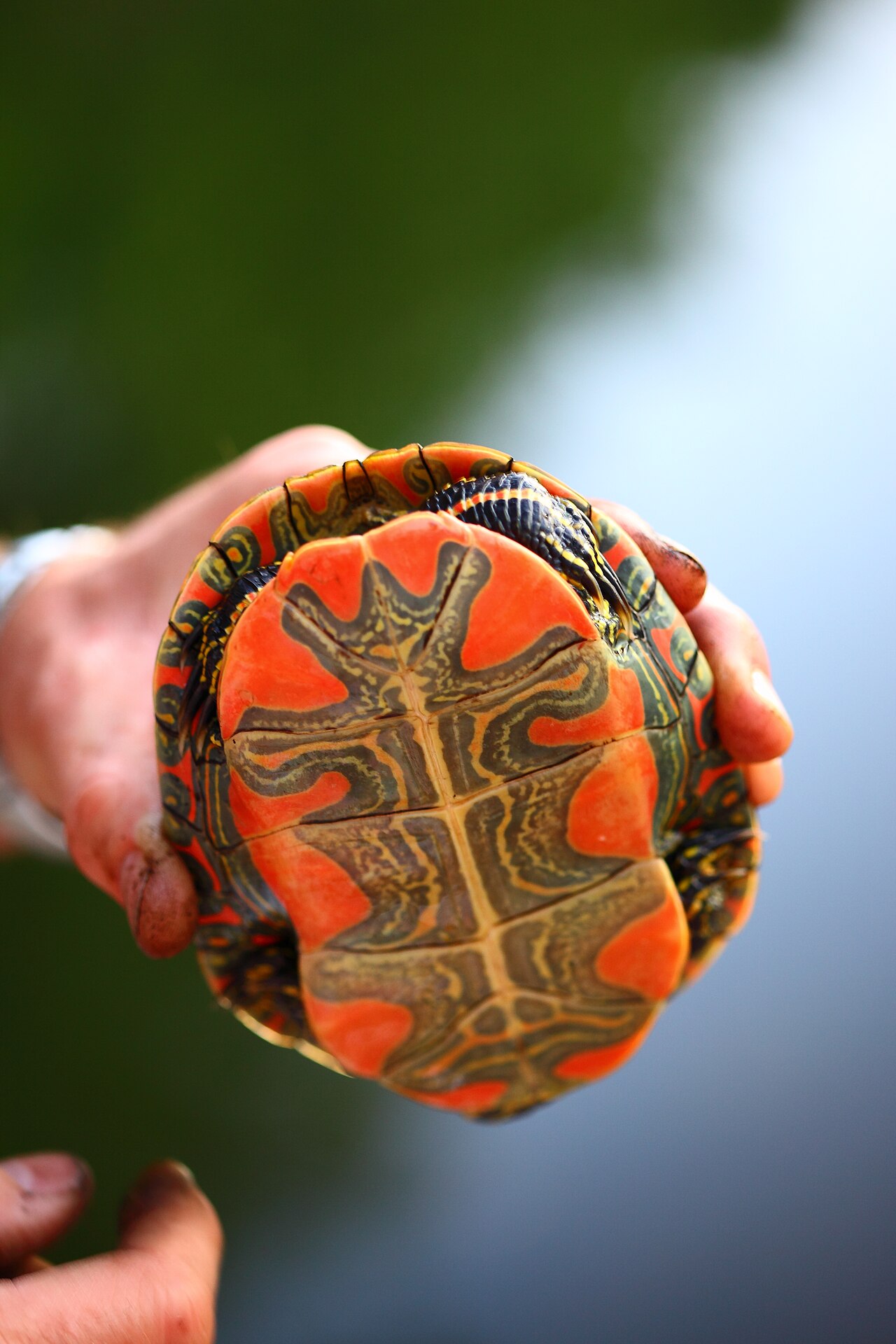
The plastron pattern is the reliable difference. The eastern painted turtle (C. p. picta) has a clean, unmarked yellow plastron; bellii has the branching dark blotch. Look at the top shell next: on the eastern subspecies the seams between the large scutes line up in straight rows across the back, which no other painted turtle does.
The other two subspecies fill in the middle of the continent. The midland painted turtle carries a smaller, symmetrical dark plastron figure with clean edges, and the southern painted turtle shows a bright red or orange stripe down the spine. Ranges overlap and hybrids occur, so in Iowa, Illinois and Missouri expect intermediate animals that will not key out cleanly.
Where Do Western Painted Turtles Live?

From southern British Columbia across the prairie provinces to western Ontario, and south through Washington, Oregon, Idaho, Montana, the Dakotas, Nebraska, Kansas and Missouri, with isolated populations in New Mexico, Arizona, Utah and Chihuahua, Mexico. That is the widest range of any painted turtle.
The habitat is shallow, soft-bottomed and slow: marshes, oxbows, farm ponds, ditches, reservoir edges and the quiet margins of rivers. What it needs is abundant aquatic vegetation, a mud bottom to burrow into, and basking logs or banks. It tolerates cold better than almost any US turtle, which is why the Pacific Northwest population survives winters that shut everything else down; the mechanics are in our piece on whether turtles hibernate.
What Western Painted Turtles Eat and Why They Bask So Much
Adults are omnivores that swing seasonally: aquatic insects, snails, crayfish, tadpoles, small fish and carrion in spring and summer, more duckweed, algae and pondweed as the year goes on. Hatchlings and juveniles are far more carnivorous, because growing shell needs protein and calcium. They feed underwater only, since the tongue cannot manipulate food in air.
Basking is not laziness, it is thermoregulation and disease control. A western painted turtle needs a surface temperature of 85 to 95 F (29 to 35 C) and ultraviolet B light to synthesize vitamin D3 and harden its shell. It will stack three deep on a favored log and sit for hours, which also dries out algae and leeches. Juvenile growth rates are the reason young ones bask most; see baby painted turtles.
Can I Keep a Western Painted Turtle as a Pet, and What Does One Cost?
Legally, often not. Painted turtles are protected from collection in much of their range, Washington and Oregon treat their native populations as a conservation concern, and several states and Canadian provinces prohibit taking them from the wild outright. A captive-bred animal from a licensed breeder runs about 30 to 100 USD, and federal FDA rules ban the sale of any turtle with a shell under 4 in (10 cm) as a pet.
Cost is the wrong number to focus on. An adult female needs a 75 to 125 gallon tank or an outdoor pond, strong filtration, a basking platform, UVB and heat lamps, and 30 to 40 years of care. Check your state wildlife agency first: the rules at the Washington Department of Fish and Wildlife are typical of the region. Longevity is the commitment most buyers underestimate, as painted turtle lifespan spells out.
What Do You Do If You Find a Painted Turtle?
Leave it where it is unless it is in immediate danger. A turtle plodding across a lawn or road in June is almost always a female looking for nesting soil, and she knows where she is going. Help across the road, nothing more.
If the shell is cracked or the animal has been hit by a car, it is worth saving: turtles survive injuries that look fatal. Put it in a ventilated box with no water and call a licensed wildlife rehabilitator or your state agency the same day. Do not try to keep an injured wild turtle, and do not release a pet turtle into a wild pond, which spreads ranavirus and shell disease into native populations. Other basking species turn up in the same ponds, including the map turtle.
Frequently Asked Questions
Do painted turtles recognize people?
They recognize patterns tied to food. A captive painted turtle learns which person appears before feeding, swims to that side of the tank, and can be conditioned to a sound or a hand signal. Field studies show individual turtles also learn specific basking sites and routes. Calling it recognition of you personally overstates a real but narrow ability.
Are painted turtles safe to touch?
Safe for you if you wash your hands, less safe for the turtle. Painted turtles carry Salmonella without showing symptoms, so soap and water afterward is not optional, especially around children under five. Handling also stresses the animal, and a frightened turtle will empty its bladder and may bite or scratch hard enough to break skin.
Can turtles get attached to humans?
Not in the way a dog or parrot bonds. Turtles lack the social wiring for attachment; what looks like affection is a learned association with food and warmth. A long-kept painted turtle may stop retreating when you approach, which is habituation rather than a relationship, and it remains a wild animal in temperament.
What makes painted turtles happy?
Water deep enough to swim in, a dry basking platform under a heat and UVB lamp, clean filtration, live plants, and cover to hide under. Varied food matters too: pellets plus insects, leafy greens and the occasional snail. A turtle that basks freely, eats readily and keeps a clean hard shell is a turtle with what it needs.
How long do western painted turtles live?
Typically 30 to 40 years in the wild, with marked individuals recorded past 50 and some estimates reaching 55. Captive animals with correct lighting and diet reach the upper end; those kept without UVB rarely pass 15 because soft shell and metabolic bone disease set in early. Females do not begin nesting until 6 to 10 years old.