Rosy Maple Moth: Identification, Range, and Why It Never Eats
The rosy maple moth (Dryocampa rubicunda) is a small pink and yellow silk moth of eastern North America, roughly the size of a quarter to a half dollar, and the adult you find on a porch screen in June has no working mouth at all. It emerged with a full fuel tank of fat built up as a caterpillar, and it will spend every hour of its short life mating and laying eggs rather than feeding.
That combination of cotton candy coloring and a life measured in days explains why the species is both common across half the country and rarely seen. It flies after midnight, it lives about a week, and it spends the rest of the year as a caterpillar chewing maple leaves or as a pupa in the soil under the tree.
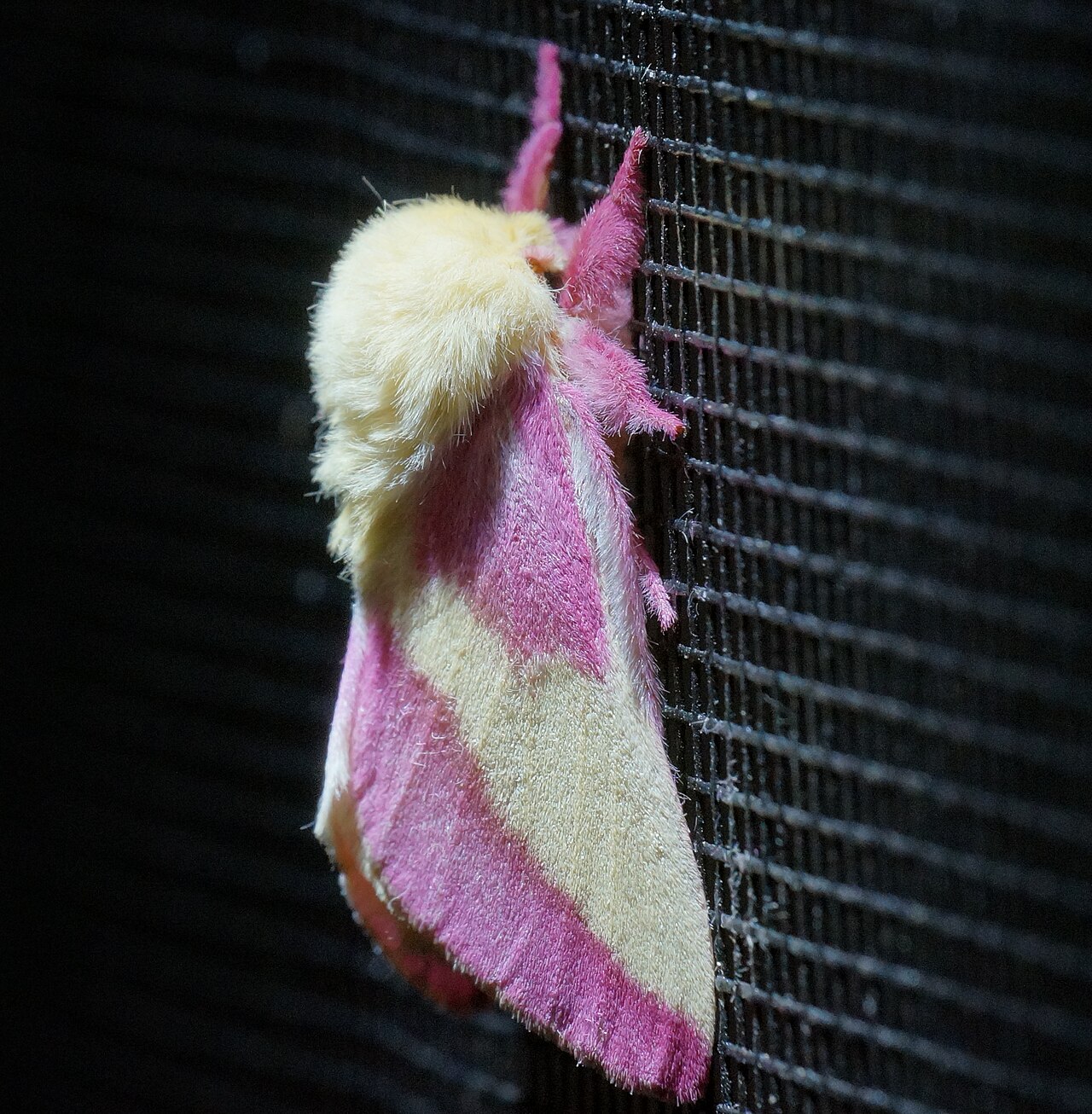
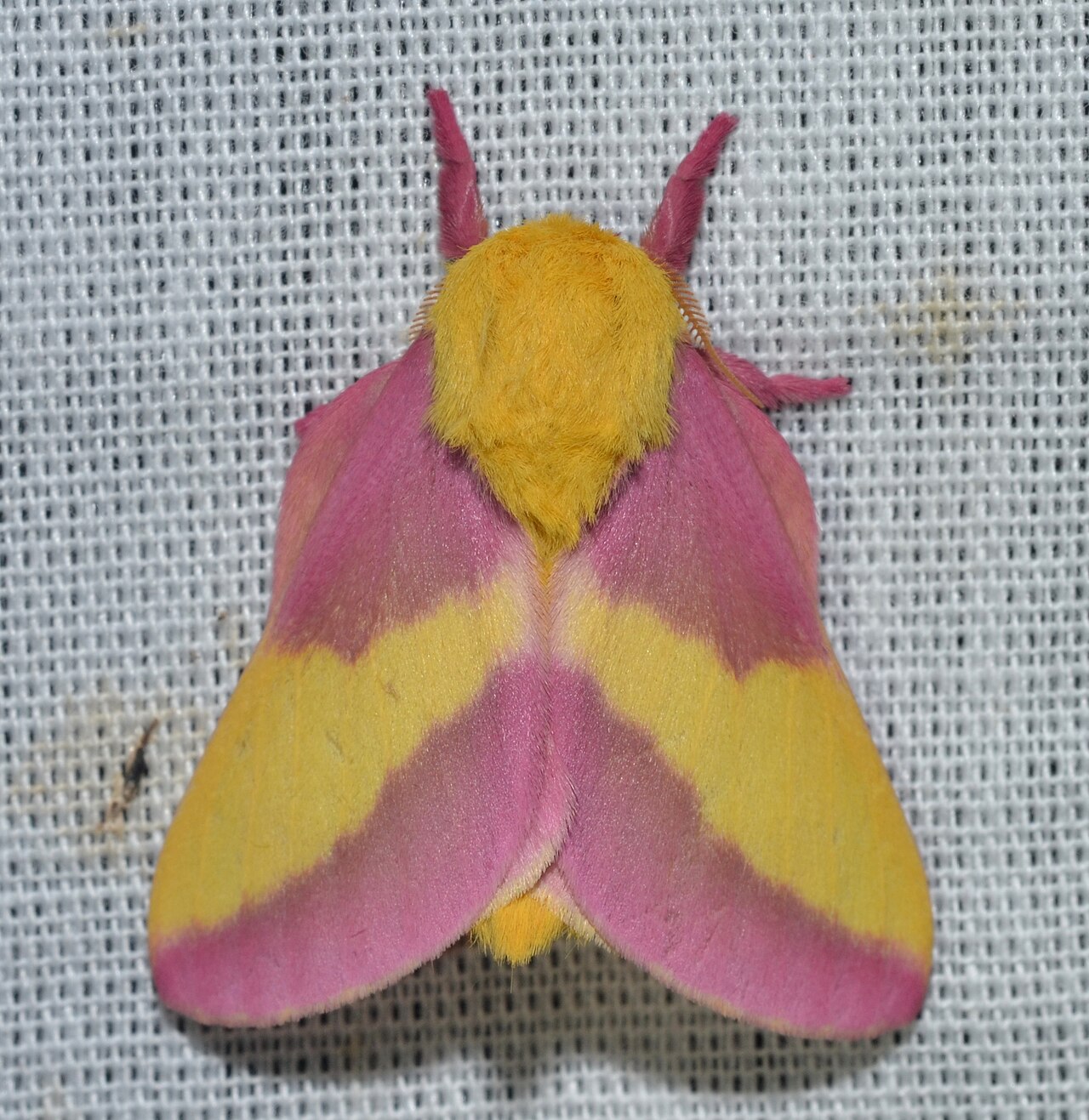
The rosy maple moth is a small silk moth, wingspan 1.25 to 2 in (32 to 50 mm), with pink wings banded in creamy yellow and a woolly yellow body. It ranges across eastern North America, is harmless to people, and the adult never eats, living only two to nine days.
| Quick fact | Detail |
|---|---|
| Scientific name | Dryocampa rubicunda |
| Family | Saturniidae, the silk moths |
| Wingspan | 1.25 to 2 in (32 to 50 mm) |
| Range | Eastern North America, Nova Scotia to Florida and west to Texas |
| Flight season | May to July in the north, April to September in the south |
| Caterpillar host plants | Red, silver, and sugar maple, sometimes oak and box elder |
| Adult lifespan | 2 to 9 days, no feeding |
How to Identify a Rosy Maple Moth
Color does most of the work. A rosy maple moth carries magenta to rose pink on the outer wing and along the leading edge, split by a broad band of creamy yellow, with a fuzzy yellow thorax and pink legs. Nothing else of that size in eastern North America wears that palette, so identification is usually settled at a glance.
Size is the second check. Wingspan runs 1.25 to 2 in (32 to 50 mm), which makes this the smallest of the North American silk moths by a wide margin: a cecropia moth spans three times as much wing. Males are slightly smaller with strongly feathered antennae used to track female pheromone, while females are broader in the abdomen with narrower antennae.
Color intensity varies by region and individual. Northern populations tend toward vivid pink, while moths from parts of the Southeast can be so pale that the pink fades to near white, a form sometimes treated separately in older literature. Worn individuals late in the flight period lose scales and look washed out regardless of origin.
Is It Rare to See a Rosy Maple Moth?
The species is not rare, but sightings are. Rosy maple moths are common and widespread wherever maples grow in the eastern half of the continent, and population surveys treat them as secure. What makes them feel rare is their schedule: adults fly in the hours after midnight, live about a week, and spend that week in the canopy rather than at eye level.
Most people meet one at a porch light, a gas station canopy, or a lit window on a warm early summer night. If you want to see one on purpose, check outdoor lights between midnight and dawn in late May through July, preferably within sight of a stand of red maples. A white sheet and a light left running will produce them reliably in good habitat.
In What States Can You Find Rosy Maple Moths?
Rosy maple moths occur in every state east of the Great Plains. The range runs from Maine and the Great Lakes south through Florida, west to eastern Texas and Oklahoma, and north again through Minnesota into Ontario, Quebec, and Nova Scotia. Records thin out on the prairie edge, where the maples they depend on give way to grassland.
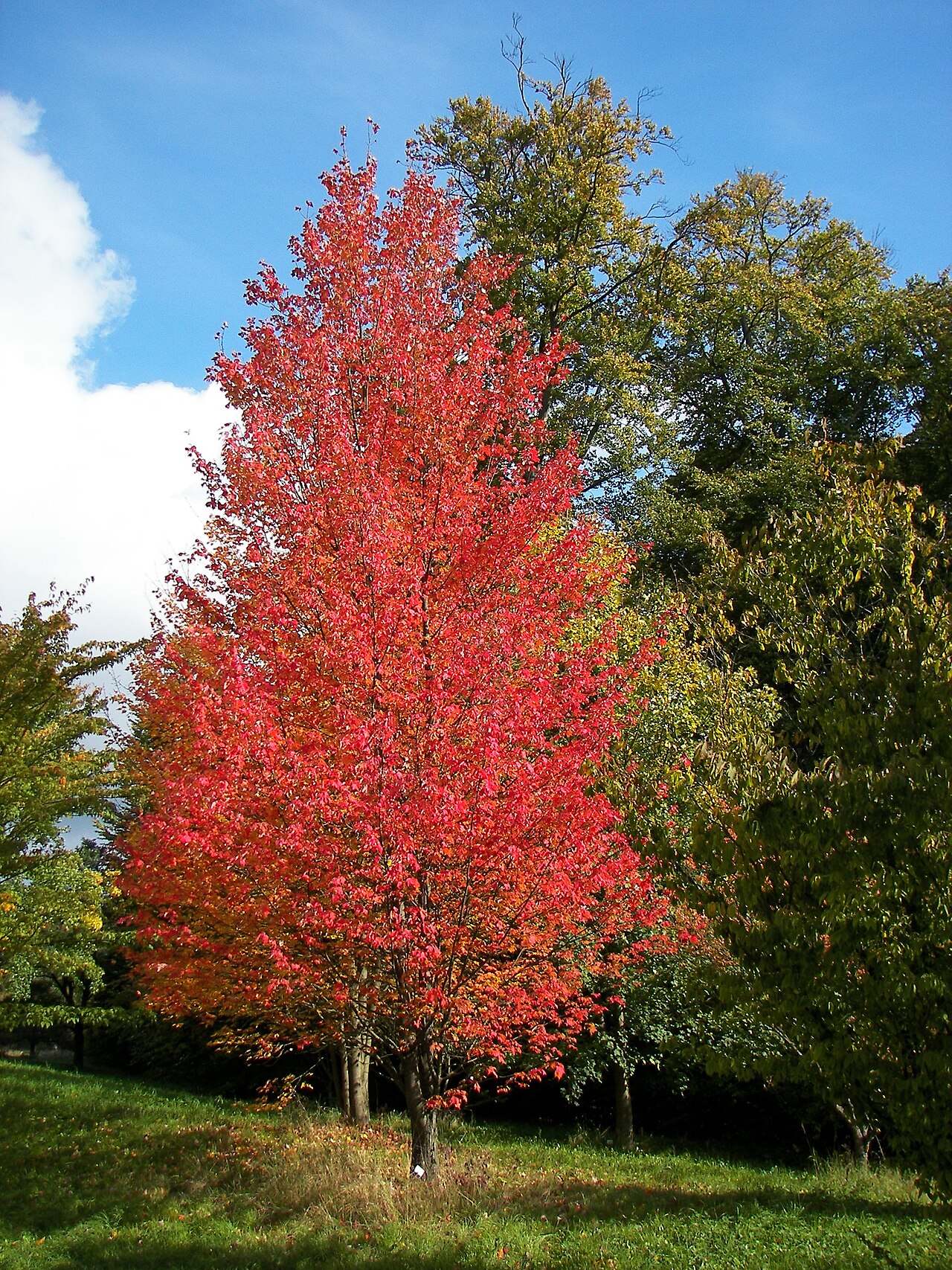
Within that range the moth follows its host trees rather than any particular habitat type. Deciduous woodland, river bottoms, suburban streets planted with silver maple, and old farm woodlots all support them. A city block with mature maples can hold a population that nobody notices for years.
Are Rosy Maple Moths Harmful?
Rosy maple moths are not harmful. The adult has no sting, no venom, and no functional mouthparts, so it cannot bite or feed on anything, including fabric or stored food. The clothes moth problem people worry about comes from entirely different, much smaller species; our guide to what moths eat separates the handful of household pests from the hundreds of harmless natives.
The caterpillar is equally safe to people. The two black horns behind its head are decoration rather than weaponry, with no spines, venom glands, or irritating hairs of the kind that make a puss caterpillar or a saddleback worth avoiding. It can be picked up bare handed.
The one real complaint is horticultural. In outbreak years green striped mapleworms can defoliate maples across a stand, which looks alarming in July. Healthy trees releaf and recover, and outbreaks collapse on their own as parasitic wasps and flies catch up with the population.
Can I Touch a Rosy Maple Moth?
You can touch a rosy maple moth safely, and the caution runs the other direction: handling is worse for the moth than for you. Moth wings are covered in loose scales that give the animal its color and help it shed a spider web or a bat’s grip, and they rub off permanently on human fingers.
If one needs moving, let it walk onto a leaf, an index card, or the back of your hand instead of pinching the wings. A moth found on a sidewalk in daylight is usually exhausted or near the end of its life; place it low in a shrub where birds are less likely to find it and where it can climb before its next flight.
Why Are Rosy Maple Moths Pink and Yellow?
The honest answer is that nobody has tested it thoroughly. The leading explanation is that the pink and yellow pattern breaks up the moth’s outline among the reddish samaras and new leaves of maples, making a resting adult read as plant material rather than as food. Bright color that works as camouflage in the right setting is common in insects.
A second idea is that the pattern advertises a bad meal. Silk moths in this group are not known to be chemically defended, though, so the warning color hypothesis has less support here than it does for a monarch. Since the adults fly at night and their main predators are bats hunting by sonar, color may simply matter less than it appears.
Rosy Maple Moth Life Cycle From Egg to Adult
A female lays 10 to 40 eggs in loose clusters on the underside of a maple leaf, usually within a night or two of emerging. The eggs hatch in about two weeks, and the young caterpillars feed side by side in a group, skeletonizing the leaf they were born on before spreading out.
Feeding takes roughly a month across five instars, after which the full grown caterpillar leaves the tree and burrows into loose soil or leaf litter. Pupation happens in a bare underground chamber with no cocoon at all, which is unusual for a silk moth: a polyphemus moth spins a dense silk case, and this relative skips it entirely.
In the north there is one generation a year, with pupae overwintering in the soil and adults emerging from May into July. The Deep South runs two or even three broods between April and September, so a Florida yard can produce fresh moths through most of the warm season.
The Rosy Maple Moth Caterpillar, or Green Striped Mapleworm
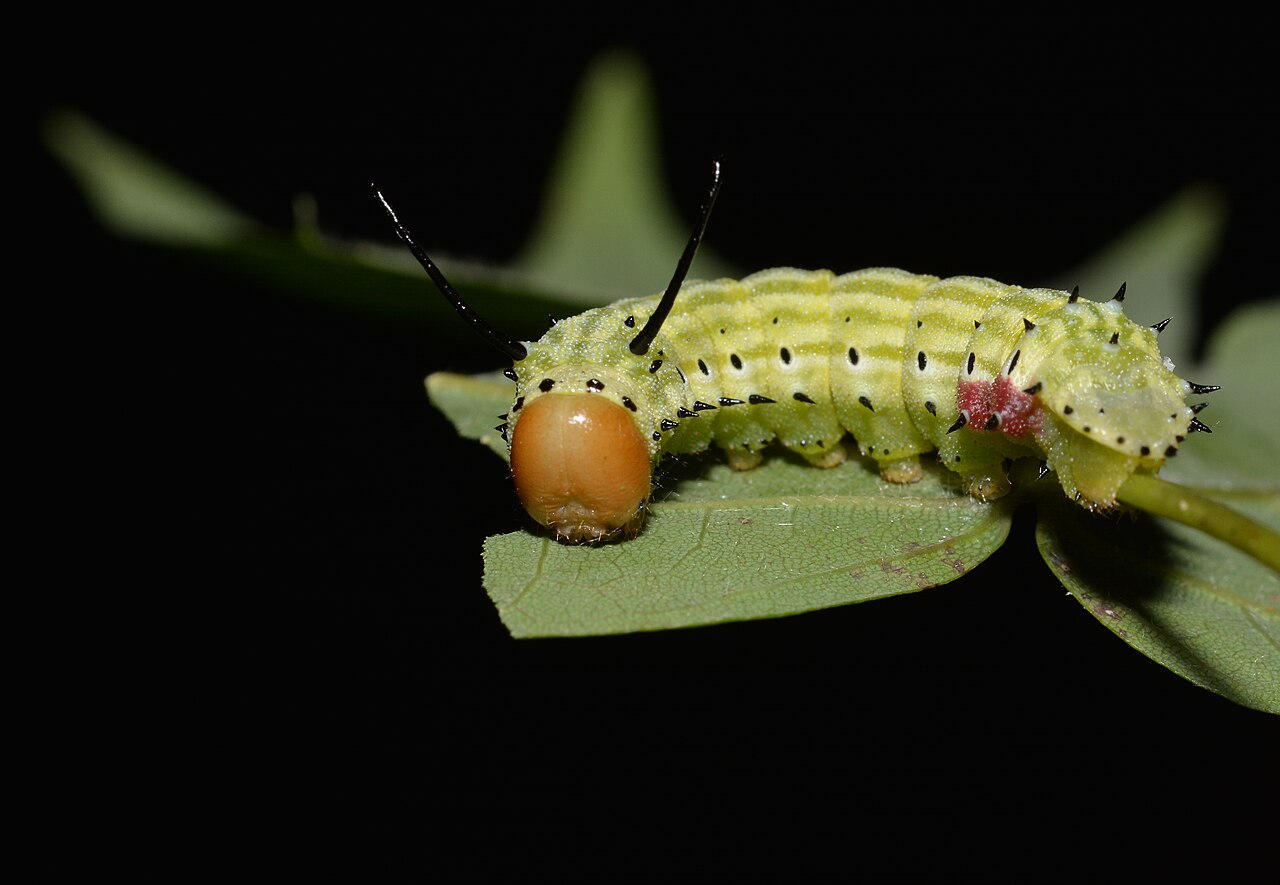
The rosy maple moth caterpillar goes by its own name, the green striped mapleworm, and looks nothing like the adult. It reaches about 2 in (5 cm), pale yellow green with narrow dark green stripes running the length of the body, a reddish or orange head, and a pair of long black horns just behind it.
Early instars are darker and stay in groups, which is when damage to a single branch is most obvious. Later instars feed alone and can turn up on any maple in the neighborhood. They are frequently mistaken for a stinging species because of the horns, but green striped mapleworms are harmless and the horns are stiff cuticle, not spines.
Look for them from midsummer into early fall, on red maple (Acer rubrum) above all, plus silver and sugar maple, box elder, and occasionally oak. Frass on a driveway under a maple is often the first sign that the tree above is full of them.
What Do Rosy Maple Moths Eat?
Adult rosy maple moths eat nothing at all. Their mouthparts are vestigial, reduced to a non functional stub with no proboscis capable of drinking nectar, a trait shared across the silk moth family that includes the luna moth and the imperial moth. The entire adult stage runs on fat stored during the caterpillar months.
All the eating happens earlier. The caterpillar is a maple specialist, and every gram of the adult moth, including the eggs a female carries, was assembled from maple leaves. That is why host trees matter so much more than flowers if you want the species around, and it is a genuine dividing line from the butterflies, as our comparison of moths and butterflies lays out.
Rosy Maple Moth Lifespan
The adult rosy maple moth lifespan is two to nine days. A moth that emerges at dusk may mate the same night, and a female typically lays most of her eggs within 48 hours before dying of simple exhaustion and dehydration. There is no feeding to extend the clock.
Measured properly, though, the animal lives most of a year. Two weeks as an egg, four to six weeks as a caterpillar, and eight or nine months as a pupa underground add up to a full annual cycle in the north. The winged stage everybody photographs is the last one percent of the life, a dispersal and breeding phase rather than a lifetime.
Can I Keep a Rosy Maple Moth as a Pet?
You cannot keep a rosy maple moth as a pet in any useful sense. An adult that cannot eat will die within a week no matter what you offer it, and a jar only shortens the time by wearing off its scales and stressing it. There is nothing to feed, tame, or maintain.
Rearing the caterpillars is a different proposition and is genuinely rewarding. Green striped mapleworms accept fresh maple leaves in a ventilated container, need a few inches of loose soil or barely damp paper for pupation, and require an unheated garage or similar cold period over winter before adults emerge. Collect only locally, never release reared insects outside the area they came from, and check your state’s rules on keeping native invertebrates first.
Frequently Asked Questions
Is it rare to see a rosy maple moth?
The moth is common across eastern North America, but sightings are uncommon because adults fly after midnight and live about a week. Your best chance is a porch light or lit window near mature maples on a warm night between late May and July, or later in the southern states.
Can I keep a rosy maple moth as a pet?
No. Adults have no working mouthparts, cannot eat, and die within two to nine days regardless of care. Raising the caterpillars on fresh maple leaves is possible and far more interesting, provided you collect locally, supply loose soil for pupation, and give the pupae a cold winter.
Are rosy maple moths harmful?
Not to people, pets, homes, or clothing. Adults cannot bite or sting and do not feed. The green striped mapleworm caterpillar occasionally defoliates maples in outbreak years, which looks dramatic but rarely kills a healthy tree, and natural predators bring the numbers back down.
Can I touch a rosy maple moth?
Yes, it is entirely safe for you. The risk is to the moth, since handling rubs off the wing scales it needs for insulation and escape. Let it climb onto a card or your open hand rather than gripping the wings, and move it into low cover if it is grounded.
In what states can you find rosy maple moths?
Every state east of the Great Plains, from Maine and Minnesota south to Florida and eastern Texas, plus southeastern Canada. The limit is the range of maples rather than climate, so records thin quickly where woodland gives way to prairie.
What is the friendliest moth?
Friendly is the wrong frame, but the rosy maple moth is among the least threatening insects you can meet: it has no mouth, no sting, no defensive chemistry, and no interest in your house. It sits still when approached, which is torpor rather than trust.
For range maps, host plant records, and state level conservation notes, the Missouri Department of Conservation maintains a solid public field guide to the species and its relatives.