Scarlet Ibis: Why It Turns Red, Where It Lives, and How Rare It Is
The scarlet ibis (Eudocimus ruber) owes its glowing red feathers to its food, not to any pigment its body produces on its own. This wading bird of northern South America and Trinidad filters carotenoids out of the crabs, shrimp and insects it probes from coastal mud, and those pigments settle into every new feather it grows. A chick hatches gray brown and takes roughly two years to reach full crimson.
Almost everything people ask about the scarlet ibis comes down to that color: how it happens, whether the bird is really a flamingo, and how hard it is to see one in the wild. The short answers are below, along with the field marks that separate this species from the white ibis it regularly interbreeds with.
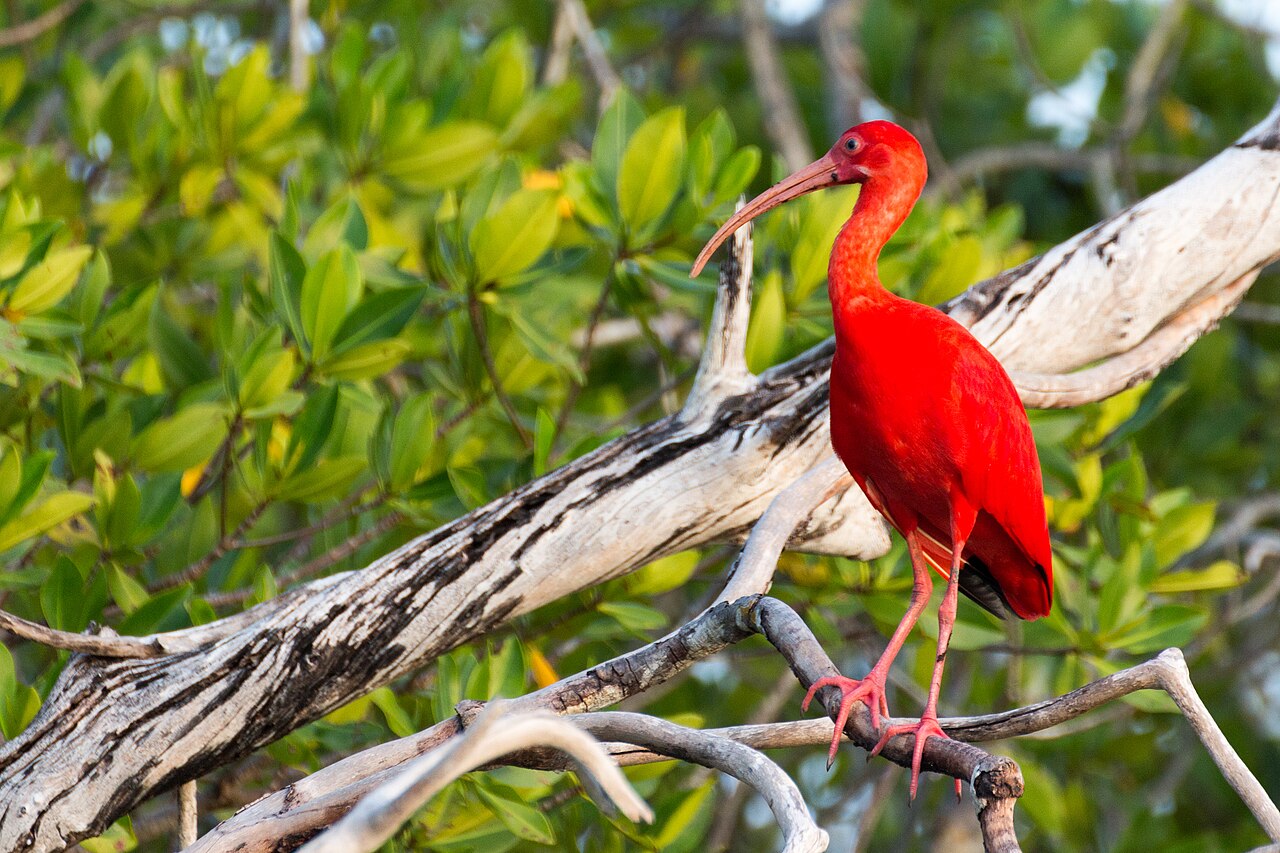
The scarlet ibis is a long legged wading bird of South America that turns bright red from carotenoid pigments in its diet of crustaceans. Adults reach 22 to 25 in (56 to 64 cm) with a curved bill and black wingtips. The species is not endangered, but it is rare in the wild outside Trinidad, Venezuela and coastal Brazil.
| Quick fact | Scarlet ibis |
|---|---|
| Scientific name | Eudocimus ruber |
| Length | 22 to 25 in (56 to 64 cm) |
| Wingspan | About 21 in (54 cm) |
| Weight | 1.2 to 1.5 lb (550 to 700 g) |
| Range | Trinidad, Venezuela, Colombia, the Guianas, northern Brazil |
| Diet | Crabs, shrimp, aquatic insects, small fish |
| IUCN status | Least Concern, population decreasing in places |
Why Do Scarlet Ibis Turn Red?
Scarlet ibis turn red because they eat red. Crabs and shrimp in mangrove mudflats are loaded with carotenoid pigments, especially canthaxanthin and astaxanthin, and the ibis stores those compounds in its growing feathers. The more crustaceans in the diet, the deeper the red.
The effect is gradual. Juveniles wear gray and brown above with a white belly, then shift through a mottled orange stage over about 24 months until the adult plumage is uniform scarlet apart from the black wingtips.
The same mechanism explains why captive birds fade. Zoos that feed a diet without supplemented carotenoids end up with pale pink birds within a molt cycle or two. It is a dietary trait, not a genetic one, which is why the color is such a reliable signal of a good feeding ground. Pigment driven color shows up across the bird world, from the yellow of a breeding goldfinch to the odd pigment failures behind an all white peacock.
Scarlet Ibis Identification: Size, Shape, and Field Marks
An adult scarlet ibis is unmistakable at close range: a vivid red bird standing 22 to 25 in (56 to 64 cm) tall on long reddish legs, with a slim decurved bill that sweeps downward in a smooth arc. The only black on the body sits at the tips of the four outermost primaries.
In flight the species holds its neck outstretched rather than folded, and flocks form loose lines or shallow V shapes low over the water. That outstretched neck separates ibis from herons and egrets instantly, even in silhouette.
The bill color shifts with age and condition, running from pinkish to almost black in breeding adults. Young birds are the ones that cause confusion, since a mottled orange juvenile looks little like the bird on the postcard. Red plumage is scarce enough in birds that the ones who have it get noticed, much like the scarlet tanager does in North American woodlots.
Is a Scarlet Ibis a Flamingo?
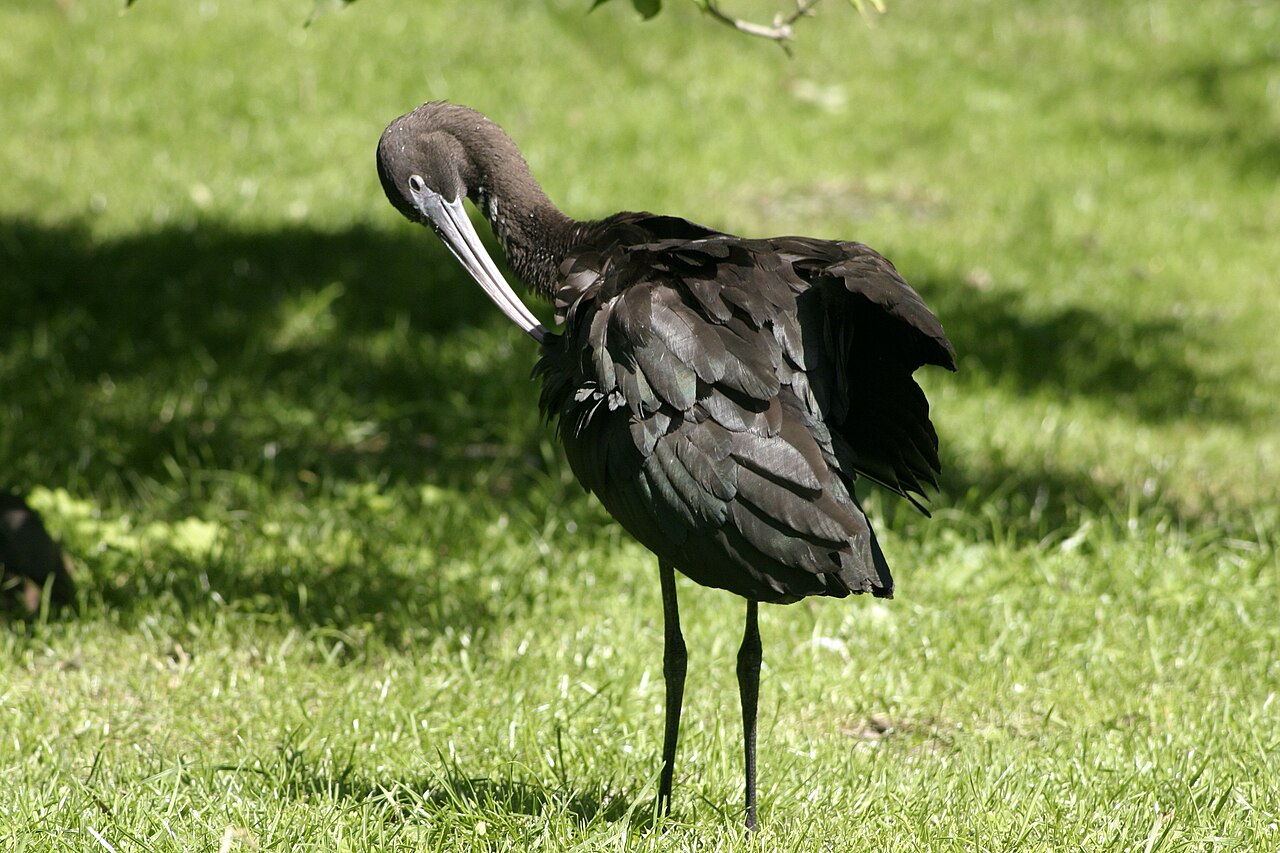
No. The scarlet ibis is not a flamingo and is not closely related to one. Ibises belong to the family Threskiornithidae, while flamingos sit in their own order, Phoenicopteriformes, whose nearest living relatives are grebes.
The confusion is understandable, because both groups are tall, pink to red, and feed in shallow salt water on carotenoid rich invertebrates. Convergent diets produce convergent colors.
The shapes settle it. A flamingo has a thick, sharply kinked bill built to filter feed upside down, an S curved neck, and legs far longer relative to the body. A scarlet ibis has a slender curved probe of a bill, a straighter neck, and it walks the mudflat jabbing for buried crabs rather than sieving the water column.
How Rare Is a Scarlet Ibis?
The species is listed as Least Concern on the IUCN Red List, with a global population estimated in the hundreds of thousands. Rare is the wrong word for the species as a whole.
Rare is the right word for the experience. Almost the entire population sits in a narrow band of coastal South America, and the reliable spectacle, tens of thousands of birds flying in to roost, happens at a handful of sites such as the Caroni Swamp in Trinidad. Tidal mudflats and mangrove coasts produce specialists like this one, the way the Galapagos shoreline produced the sea foraging marine iguana.
Local declines are real. Egg collecting, hunting and the draining of mangroves have emptied colonies in parts of Brazil and Colombia, and the bird is protected as the national bird of Trinidad and Tobago. Outside protected wetlands, a wild scarlet ibis is a genuinely uncommon sight.
What Is the Story The Scarlet Ibis About?
Most searches for this bird are actually looking for the 1960 short story by James Hurst, which is standard reading in American middle and high schools. It follows a narrator and his frail younger brother, nicknamed Doodle, in North Carolina during World War I.
A storm blown scarlet ibis lands in the family yard, far outside its range, and dies exhausted in a bleeding tree. Doodle buries it. The bird becomes the story’s central symbol of something beautiful and fragile pushed past its limits.
The biology in the story is sound in one respect: hurricanes do displace tropical waders hundreds of miles, and vagrant ibis records from the Gulf Coast exist. Birds carried far off course rarely survive long, whether it is an ibis in Carolina or a hummingbird wintering outside its normal range.
Why Don’t You See Baby Ibis?
You rarely see baby ibis because they never leave the nest tree until they can already fly. Scarlet ibis nest colonially in mangroves over water, often mixed in with egrets and herons, and the chicks stay on the platform of sticks for around three weeks.
When they do come out, they look nothing like the adults. A fledgling is gray brown with a white underside, which is exactly what a predator scanning for a bright red target does not notice.
Pairs raise three to five young per season, and both parents feed by regurgitation. The colonies themselves are hard to reach, sitting in flooded mangrove that people cannot walk into. Between the camouflage, the timing and the location, the young simply are not on display. Nest raiders such as the small falcons that hunt nestlings are one reason the colonies sit over open water.
Can an Ibis Be a Pet?
Not legally and not sensibly in the United States. The scarlet ibis is covered by CITES Appendix II and by the Migratory Bird Treaty Act, so private possession, import and sale are tightly restricted and require permits that are not issued for pets.
The practical case is worse than the legal one. These are colonial birds that need brackish water, room to fly, live invertebrate prey and company of their own kind. Kept alone in a yard, they fade to pink and do poorly.
The birds people actually see up close are in accredited zoos and aviaries, where carotenoid supplemented diets keep the color true. That is the legitimate way to get within a few feet of one.
Frequently Asked Questions
Can ibis birds fly?
Yes, and strongly. Scarlet ibis are powerful fliers that commute up to 30 mi (48 km) between feeding flats and roosting mangroves each day. They fly with the neck extended, alternating steady wingbeats with short glides, and travel in lines or loose V formations rather than as a tight flock.
Do people eat scarlet ibis?
Historically yes, and that is part of why colonies shrank. In parts of Venezuela, Brazil and Trinidad the birds and their eggs were taken for food and the feathers for decoration. Hunting is now illegal across most of the range, though poaching still happens near accessible roosting sites.
Do ibis mate for life?
Usually not. Scarlet ibis are seasonally monogamous: a pair bonds for one breeding cycle, shares nest building and chick feeding, then typically finds a new partner the following season. Some pairs do reunite, but lifelong fidelity of the kind seen in swans or albatrosses is not the rule here.
How do ibis sleep?
They sleep communally, perched in mangrove branches over water, often standing on one leg with the bill tucked into the shoulder feathers. Roosting in numbers means many eyes on the surroundings, and the water underneath stops most ground predators from reaching the branches at night.
Are scarlet ibis found in the United States?
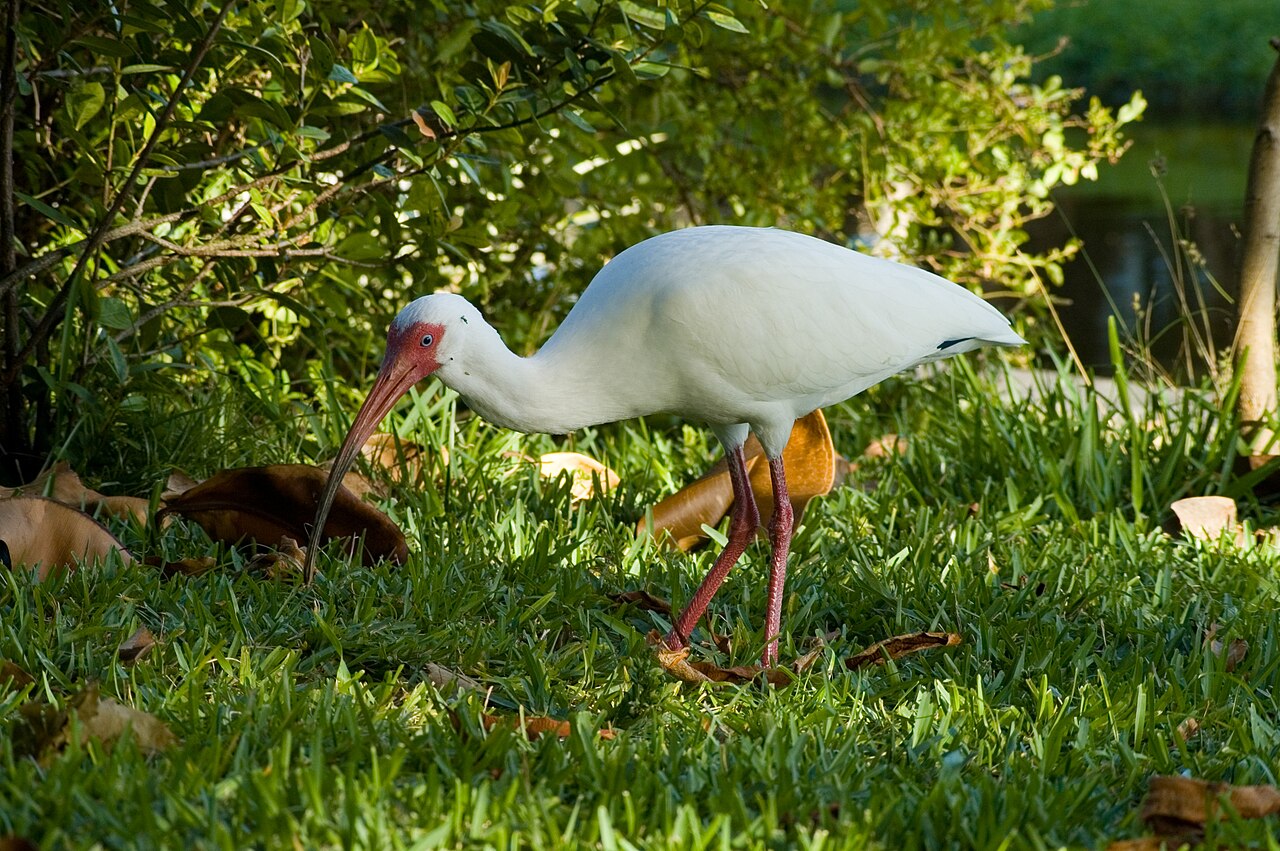
Only as escapees, storm driven vagrants or zoo birds. There is no established wild population in the United States. The native North American relative is the white ibis (Eudocimus albus), common in Florida and along the Gulf Coast, which shares the same shape and the same curved bill in white plumage.