Black Salamander: 8 US Species and How to Tell Them Apart
A black salamander found in a US yard or woodlot is almost always harmless to handle, and in most of the country it is one of about eight species that appear solid black or nearly so. None of them bite hard enough to matter, none sting, and none are venomous, though several carry skin toxins that make them a bad idea to touch and then rub your eyes.
Identifying a black salamander takes three measurements and one count: total length, whether the belly is lighter than the back, whether pale flecks or bands are present, and how many grooves run down the sides. Those four details separate the slimy salamanders from the mole salamanders from the lungless woodland species, and they work in the hand without a key. The species accounts below are ordered by how often people actually encounter them.
Black salamanders in the United States are not venomous and do not bite dangerously, but many secrete skin toxins or sticky glue-like compounds. The most commonly found all black species are the northern slimy salamander, the lead-backed phase of the red-backed salamander, the marbled salamander and the true black salamander of California. Wash your hands after any contact.
Are Black Salamanders Poisonous or Dangerous?
No salamander in the United States is venomous, meaning none can inject a toxin. Several are poisonous in the technical sense: their skin glands produce compounds that sicken a predator that bites them, and those compounds transfer to your hands.
The risk to people is low but real. Handling a salamander and then touching your eyes, mouth or an open cut can cause irritation, and amphibians routinely carry Salmonella on their skin. Children and anyone handling one in a classroom setting should wash with soap afterward, which is the same precaution that applies to turtles.
Bites are not a practical concern. Salamanders have tiny teeth meant for soft invertebrates, and most will not attempt to bite at all. The bigger danger runs the other way: dry or salted human skin damages the mucus layer a salamander breathes through, so wet your hands first or do not pick it up.
How to Identify a Black Salamander in Under a Minute

Start with size. Under 2 inches (5 cm) and worm thin points toward the slender salamanders. Between 3 and 5 inches (8 to 13 cm) covers most woodland species. Over 6 inches (15 cm) with a stocky body and a broad head means a mole salamander in the genus Ambystoma.
Then look for markings in good light. True solid black is uncommon. Most black looking salamanders carry silver or white flecks, pale bands, blue speckling or yellow spots that only show when the animal is turned toward the sun, and that pattern is usually the whole identification.
Finally count the costal grooves, the vertical creases along the flanks. Lungless salamanders in the family Plethodontidae have 13 to 19 of them and a tiny groove running from each nostril to the lip. Mole salamanders have 11 to 14 broader grooves and no nasolabial groove. That single family split removes half the candidates.
Northern Slimy Salamander (Plethodon glutinosus)
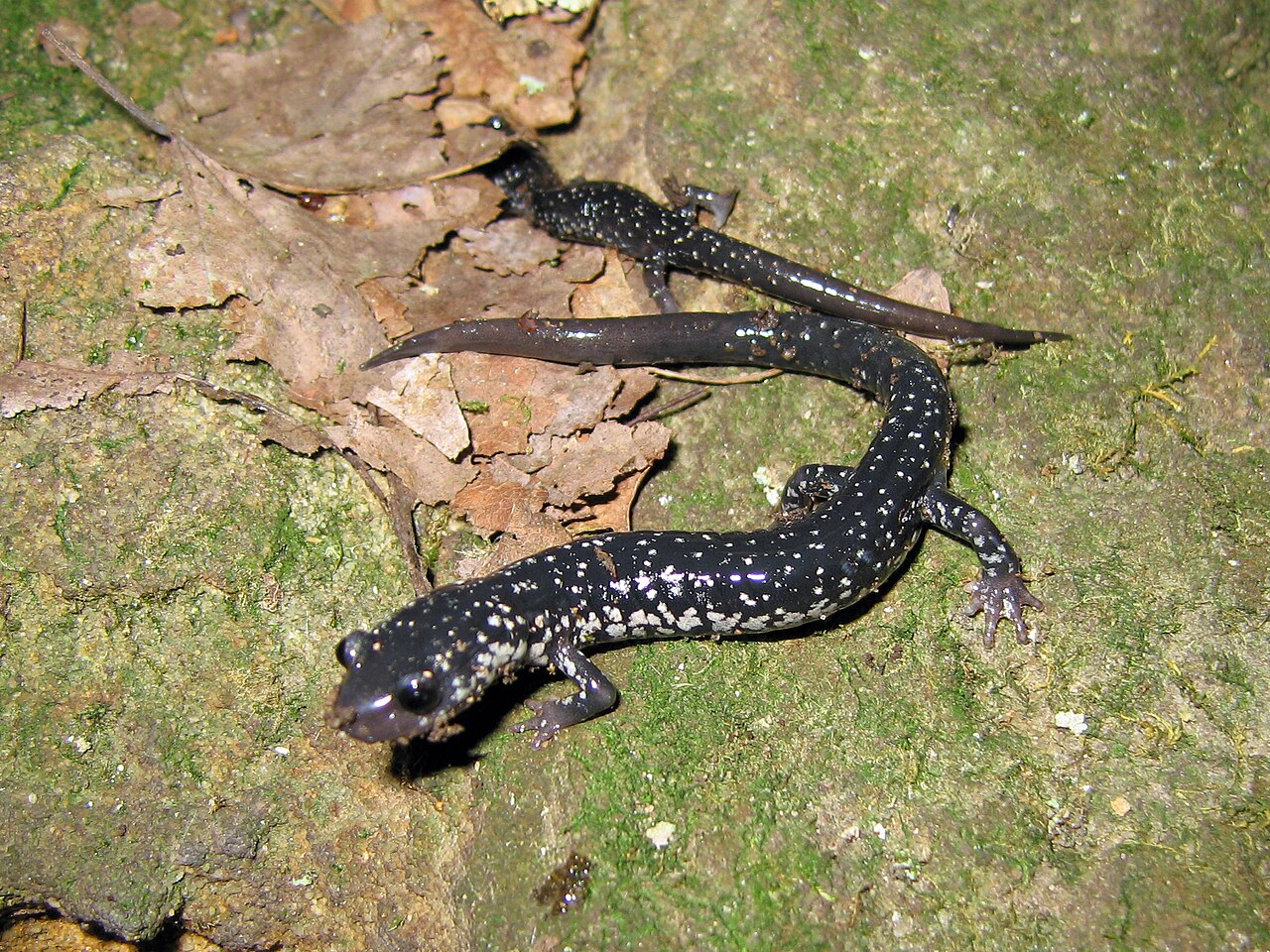
This is the species most people mean when they report a black salamander in the eastern United States. It runs 4.5 to 8 inches (11 to 20 cm), is deep black, and is scattered with bright silvery white flecks that look like someone flicked paint at it.
It ranges from New York and Connecticut south through the Appalachians to Alabama and west into Oklahoma, living in moist hardwood forest, under rocks, logs and leaf litter on wooded slopes. Unlike the mole salamanders, it never enters water to breed and lays its eggs in damp cavities instead.
Its defense gives it the name. The skin glands release a glue that is genuinely difficult to remove, sticks to hands for a day or more and resists soap. It is harmless, but it is unpleasant, and it is the reason experienced field workers photograph this species rather than hold it.
Black Salamander (Aneides flavipunctatus)
The species that officially carries the name lives only in northern California and a sliver of southern Oregon. Adults reach 3 to 5 inches (8 to 13 cm), with a flattened head, strong jaw muscles and long toes suited to climbing.
Coloration varies by population more than in most salamanders. Animals around Santa Cruz are uniformly jet black, while populations farther north carry yellow, white or pale green speckling, and juveniles often show brassy flecks that fade with age.
It is found under rocks, bark and boards in damp coastal woodland and along streambanks, usually in places that stay cool through summer. It is harmless, though it is one of the few American salamanders that will attempt a defensive nip when restrained.
Red-Backed Salamander, Lead-Backed Phase (Plethodon cinereus)
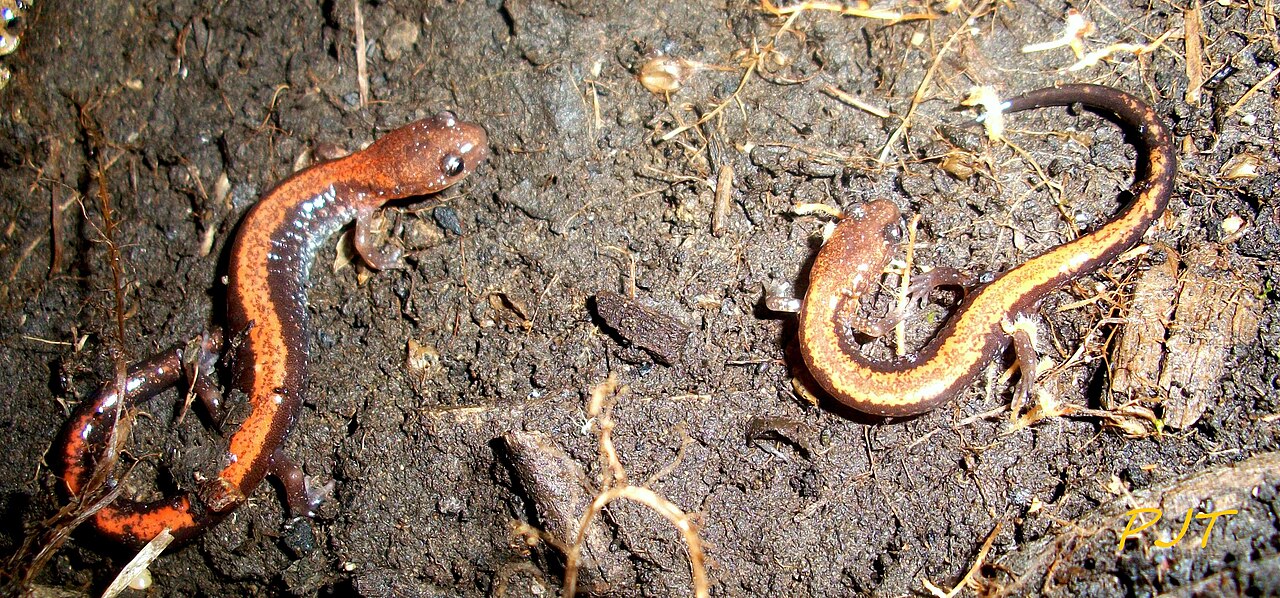
The most abundant salamander in the northeastern forest comes in two color phases, and the lead-backed phase is a uniform dark gray to near black animal with no stripe at all. In parts of its range, a third or more of the population shows this form.
Size is the quick check: 2.5 to 5 inches (6 to 13 cm), slender, with a thin tail that makes up roughly half the total length. The belly is mottled black and white, often described as salt and pepper, and that belly pattern separates it from almost everything else in the leaf litter.
It ranges from the Maritimes and Quebec through New England and the Great Lakes south to North Carolina, and it is one of the most numerous vertebrates in those forests by sheer biomass. It is entirely terrestrial, harmless, and small enough that most people who find one assume it is a juvenile of something larger.
Marbled Salamander (Ambystoma opacum)
At a glance a marbled salamander is a black animal with bright white or silver crossbands, and in low light the bands can disappear so the whole thing reads as black. Adults are stout and short, 3.5 to 5 inches (9 to 13 cm), with a chunky build typical of mole salamanders.
Males carry whiter bands and females grayer ones, which is one of the few reliable sex differences you can see in the field. The species occurs from southern New England through the Midwest to Texas and Florida, in floodplain forest and wooded sandhills.
Its breeding behavior is unusual and worth knowing, because it explains when you find them. Marbled salamanders breed on land in autumn, and the female guards her eggs in a dry depression until rain fills it, so September through November is when they move in numbers.
Spotted Salamander (Ambystoma maculatum)
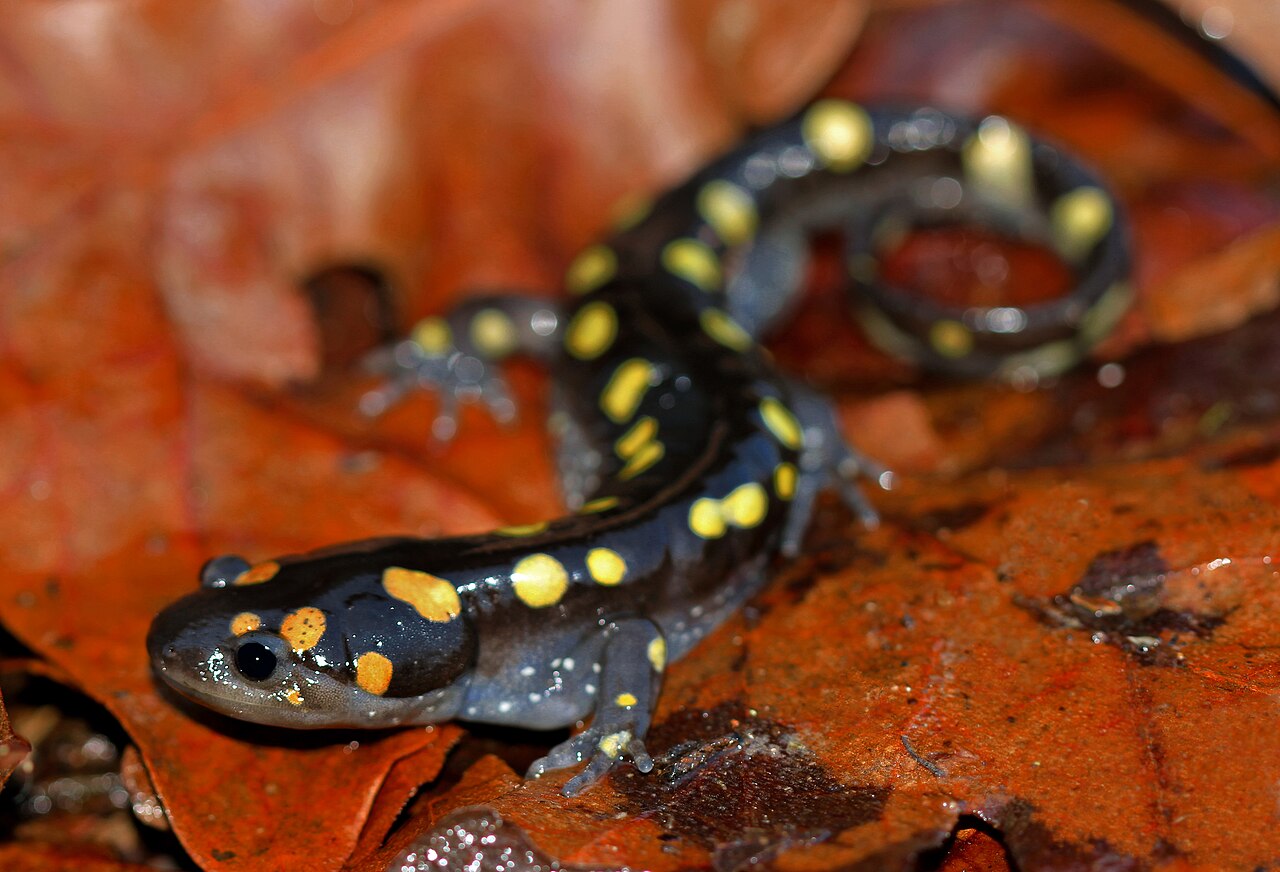
Spotted salamanders are the largest black salamander most people will see, at 6 to 9 inches (15 to 23 cm), with two rows of round yellow or orange spots running from head to tail. In a wet flashlight beam the spots are obvious, but a muddy animal can look plain black.
The body is heavy, the belly is slate gray, and the skin is smooth and glossy. They occupy deciduous forest with nearby fishless pools across most of the eastern United States and southern Canada, spending the year underground in rodent burrows.
They surface on the first warm rainy nights of late winter and early spring to breed in vernal pools, sometimes hundreds on one night. They secrete a milky toxin from glands along the back and tail, which is harmless to wash off but a strong enough deterrent that raccoons eat around them.
Jefferson Salamander (Ambystoma jeffersonianum)
Jefferson salamanders look black in dim light and dark brownish gray in good light, usually with scattered pale blue flecks concentrated on the limbs and lower sides. Adults run 4.5 to 7 inches (11 to 18 cm), with a notably long snout and long toes for the genus.
The range covers the Ohio Valley, the mid-Atlantic and parts of New England and southern Ontario, in upland hardwood forest with vernal pools. They breed earlier than nearly any other species in that forest, sometimes crossing roads over ice at the edges of a thaw.
Identification here comes with a caveat worth stating: Jefferson salamanders hybridize with blue-spotted salamanders, and the resulting all female polyploid populations are genuinely difficult to assign by appearance. If you find one in the hybrid zone of the Great Lakes region, the honest answer is often the Jefferson complex rather than a species.
Black-Bellied Slender Salamander (Batrachoseps nigriventris)
On the West Coast the small black animal in the flowerbed is usually a slender salamander. This species measures 1.5 to 2 inches (4 to 5 cm) in body length with a long tail, and the whole animal is no thicker than a pencil lead, which makes it look more like a worm than an amphibian.
It is dark brown to black with a nearly black belly, and it has four toes on each foot rather than the usual five on the hind feet. That toe count is the fastest confirmation, and it holds across the Batrachoseps genus.
It occupies coastal and inland southern California, including suburban gardens, and it is active at the surface only during the wet season. When disturbed it coils like a spring and can drop its tail, so it should be scooped rather than pinched.
Northern Dusky Salamander (Desmognathus fuscus)
Dusky salamanders are the dark, slippery animals that bolt sideways when you lift a stone in a stream. Adults are 2.5 to 5.5 inches (6 to 14 cm), variable in color from tan to nearly black, with older animals usually the darkest.
Two features identify the genus regardless of color. A pale diagonal line runs from the eye to the angle of the jaw, and the hind legs are visibly heavier than the front legs, giving the animal a hunched posture no other eastern salamander has.
They live along seeps, springs and rocky headwater streams from Maine to Georgia, rarely more than a few feet from running water. They are quick, they jump, and they are harmless, although their abundance makes them a good indicator species for stream health in monitoring programs run through the US Geological Survey.
Black Salamander Lookalikes: Telling Close Species Apart
Most misidentifications involve two or three species that overlap in range and size. The table below separates the pairs that cause the most trouble.
| Feature | Slimy salamander | Lead-backed red-backed | Marbled salamander |
|---|---|---|---|
| Adult length | 4.5 to 8 in (11 to 20 cm) | 2.5 to 5 in (6 to 13 cm) | 3.5 to 5 in (9 to 13 cm) |
| Build | Slender, long tailed | Very slender, thin tail | Stout, short tailed |
| Pattern | Silver white flecks | Plain dark gray | White or silver crossbands |
| Belly | Plain dark gray | Black and white mottling | Plain black |
| Nasolabial groove | Present | Present | Absent |
| Defense | Sticky glue secretion | Tail drop | Tail raised, milky toxin |
| Where found | Wooded slopes, logs | Leaf litter, suburbs | Floodplain forest |
Color alone fails more often than people expect, and the same holds for other black and white animals that share the habitat, from the beetles under the same logs to snakes with similar black and white patterning. Build and belly pattern are the features that hold up.
Where Black Salamanders Live and When You Will See Them
Salamanders need moisture and cover, so they concentrate in a thin layer of habitat: under logs, flat rocks, bark slabs, boards and leaf litter within reach of damp soil. Suburban yards with mulch beds and stacked wood support surprising densities, especially in the Northeast.
Timing matters more than location. Terrestrial species surface on rainy or humid nights between 50 and 68 F (10 and 20 C), and the mole salamanders concentrate their entire year of visibility into a handful of migration nights. A dry warm week drives all of them down out of reach.
Regionally, the southern Appalachians hold the greatest salamander diversity anywhere on earth, with Great Smoky Mountains National Park alone supporting around 30 species. If you are learning to tell dark species apart, that region is where the practice pays off fastest.
Finding and Handling a Black Salamander Responsibly
Lift cover objects toward you so the animal has an escape route away from your hands, and replace every rock and log in its original position. The damp seal between wood and soil takes months to reform, and a careless flip removes a shelter permanently.
Do not relocate salamanders. Many species have home ranges measured in a few square yards, populations are genetically distinct over short distances, and moving animals spreads chytrid fungus and ranavirus between sites. The same applies to taking one home: most woodland species will not feed in captivity.
Photograph instead of collecting, and record the date and the cover object. Those records are useful to state herpetological atlases, and dark salamanders are chronically under reported precisely because people assume they are all the same thing. For contrast, the striking patterns of black and yellow snakes, black and white spiders and common black and white birds make them far easier to log correctly.
Frequently Asked Questions
What is the rarest salamander?
Among US species, the Red Hills salamander of Alabama and the Texas blind salamander are two of the most restricted, each confined to a handful of sites. Globally the Chinese giant salamander is critically endangered despite its size. No common black species in North America is rare.
Are blue spotted salamanders venomous?
No. Blue-spotted salamanders are not venomous and cannot inject anything. Like most mole salamanders they produce a mild skin toxin as a defense against predators, which is harmless to people who wash their hands afterward. They do not bite in any meaningful way.
What time of day do salamanders come out?
Night, and especially the first few hours after dark on a rainy or heavily humid evening. Most species are strictly nocturnal above ground because daylight dries their skin. During the day they remain under cover objects or in burrows, which is where daytime searching finds them.
What US state has the most salamanders?
North Carolina and Tennessee lead by species count, thanks to the southern Appalachians. Great Smoky Mountains National Park alone holds roughly 30 species and is sometimes called the salamander capital of the world. By sheer numbers, red-backed salamanders in northeastern forests may outweigh all resident birds and mammals combined.
What is a salamander’s favorite food?
Small invertebrates: earthworms, springtails, mites, beetle larvae, ants, snails and spiders. Larger mole salamanders take worms and slugs readily. Aquatic larvae eat zooplankton and insect larvae, and the biggest ones will eat smaller larvae of their own species.
What smell do salamanders hate?
Salamanders avoid the chemical cues of predators, particularly snake and shrew scent, and they respond strongly to alarm substances released by injured individuals of their own species. They also avoid salt, soap residue and insecticide treated ground, which is a practical reason to keep garden chemicals away from mulch beds.