Cockroach Spiritual Meaning: Omens, Dreams and Symbolism
Seeing a cockroach is traditionally read as a sign of survival and unwelcome truth: something in your life has endured conditions it should not have, and it is now visible. Across folk traditions the cockroach stands for resilience, adaptability, hidden problems and the parts of a situation people would rather not look at.
That makes cockroach symbolism unusually double edged. The same insect that functions as a symbol of disgust in one reading is a symbol of endurance in another, and the difference usually comes down to where you saw it and what you did next. This guide separates the traditions, covers dream readings in detail, and explains what the context of a sighting is believed to change.
A cockroach symbolizes survival, adaptability and resilience, along with hidden issues coming into the open. Seeing one is commonly read as a prompt to examine something neglected rather than as a bad omen. In dream interpretation cockroaches usually point to anxiety, shame or a problem that keeps returning after you think it is handled.
What Does a Cockroach Symbolize Spiritually?
The core spiritual meaning attached to the cockroach is persistence under bad conditions. The insect is older than dinosaurs, survives on almost nothing, hides from light and reappears no matter what is thrown at it, and every symbolic reading builds from those four observable facts.
Three themes recur. The first is resilience, the capacity to keep going when circumstances are hostile. The second is adaptability, since the cockroach thrives by changing what it eats and where it lives rather than by being strong. The third, and the one people usually mean when the sighting unsettles them, is concealment: a cockroach in the open means something hidden has been forced into view.
Practitioners generally read the appearance as diagnostic rather than predictive. The insect is not understood to cause anything. It is treated as evidence that conditions somewhere, in a home, a relationship or a body, have been allowed to slide. That framing sits close to how bat symbolism is handled, where the animal signals a transition already underway.
What Is the Mythology of the Cockroach?

There is no major mythological cycle built around the cockroach, which is itself revealing. Cultures built myths around animals they admired, feared or depended on, and the cockroach was mostly beneath notice, recorded as a household nuisance from ancient Egypt onward.
What exists is scattered. An Egyptian magical text invokes a formula against the cockroach as a household pest. In parts of West Africa and the Caribbean, the cockroach appears in trickster and cautionary tales as the creature that survives by knowing when to run, including the widely repeated proverb that the cockroach is never right in the court of the chicken, a lesson about judgment delivered by an unequal party. In Chinese and Japanese folk usage the insect signals neglect and decay in a home rather than carrying a story of its own.
Modern mythology has done more with the cockroach than ancient mythology ever did. The post nuclear survivor myth, the Kafka transformation and the cockroach as metaphor for the dehumanized are twentieth century inventions, and they now drive most of what people mean when they call something symbolic about a roach.
What Is the Definition of a Cockroach?
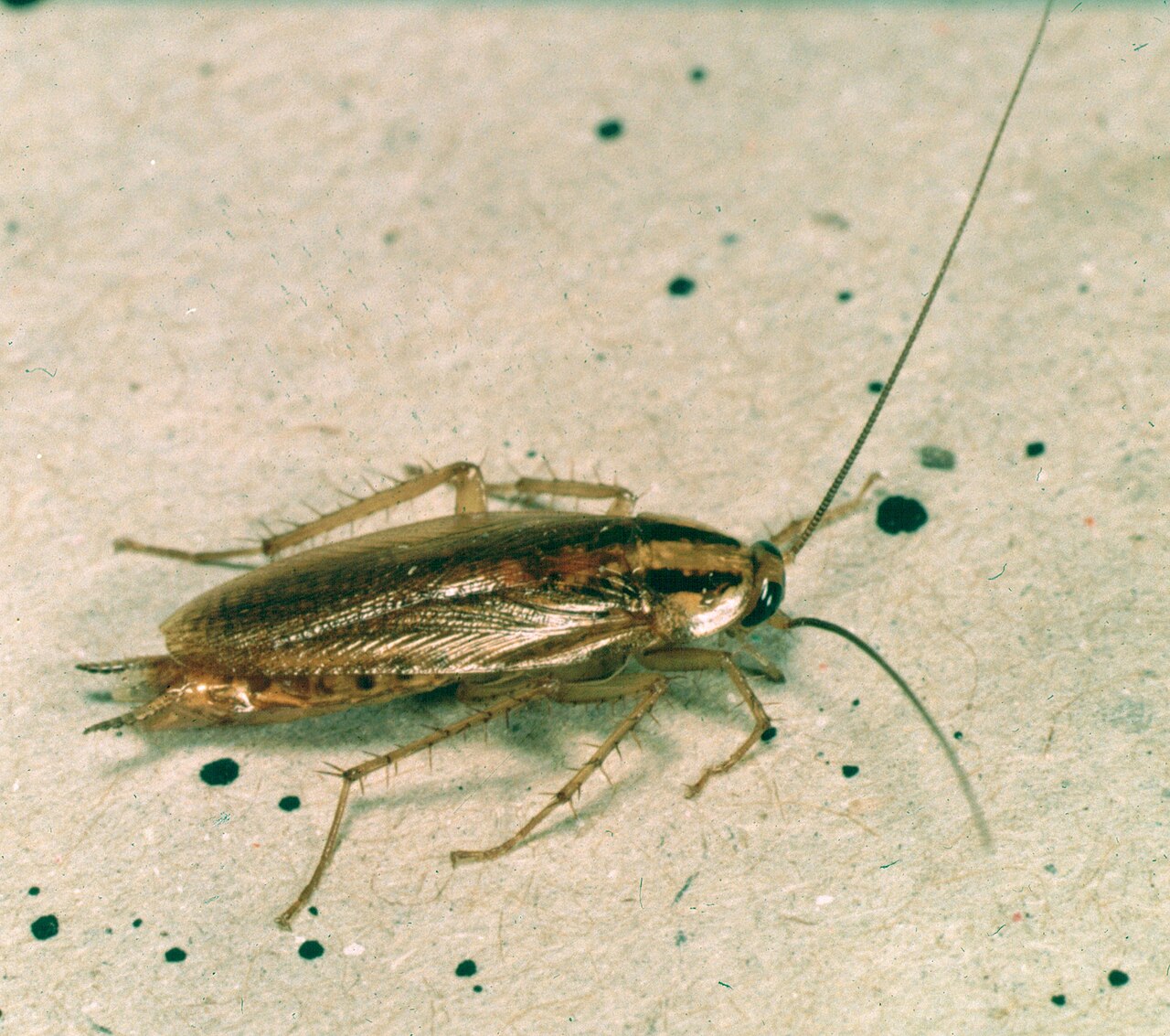
A cockroach is a flattened, fast running insect of the order Blattodea, with long thread like antennae, a shield shaped plate covering the head and a preference for warm, dark, humid spaces. Of roughly 4,600 described species, about 30 live alongside humans, and only four matter in most US homes: the German cockroach (Blattella germanica), the American cockroach (Periplaneta americana), the Oriental cockroach (Blatta orientalis) and the brown banded cockroach.
The biology matters for the symbolism. Cockroaches are detritivores that eat decaying organic matter, which is why they are tied to decay and neglect in folk reading. They are negatively phototactic, meaning they flee light, which is why they carry the sense of concealment. And some species survive a month without food, which is where the endurance imagery comes from. Documentation on US species is maintained by the University of Florida Entomology Department.
Native American and Indigenous Readings

North American indigenous traditions assign the cockroach very little symbolic weight, and specific tribal meanings offered online are generally unsupported. Native wood roaches existed in eastern forests, but the household cockroach arrived with European and African ships, so it entered the landscape far too late to be built into older story cycles.
Where insect teachings are documented in Native traditions, they tend to center on ant, butterfly, spider and cricket rather than roach. In some Mesoamerican and Caribbean folk practice the cockroach carries a sense of poverty and of houses in disrepair, but these are local beliefs recorded after contact rather than ancient cosmology. Any source presenting a unified Native American cockroach totem is filling a gap with invention.
Christian and Biblical Meaning of the Cockroach

What does God say about roaches? Nothing directly. The cockroach is not named anywhere in the Bible, though it falls under the general category of creeping things that swarm upon the earth, declared unclean in Leviticus 11. The locust gets attention, the ant gets a proverb, the roach gets silence.
Christian interpretive tradition has filled that silence in two directions. The common reading treats the cockroach as an emblem of uncleanness, sin that hides in dark corners of a life and multiplies when ignored, with the lamp and the light of scripture as the response. A minority reading inverts it, pointing out that the creature God made to survive in the lowest conditions is a testimony to endurance and to provision in scarcity.
Preaching that invokes spirit cockroaches, meaning habitual sins that scatter when examined, belongs to contemporary deliverance ministry rather than to historical doctrine. It is a sermon image, used because it is vivid, and should be weighed as that.
Celtic and European Folklore
Celtic tradition has no cockroach lore. The domestic species reached Britain and Ireland only through trade, mostly after the medieval period, and the surviving Celtic animal material concerns salmon, boar, stag, raven and crane.
Continental European folklore recorded the insect as a sign of a poorly kept house and of coming illness, which in an age before sanitation was practical observation dressed as belief. German and Russian folk usage ties the cockroach to the hearth: in some Russian households a sudden disappearance of cockroaches was taken as a warning that the house would burn or the family would suffer loss, since the insects were thought to leave before disaster. That inversion, where the pest’s absence is the omen, is one of the few genuinely distinctive pieces of cockroach folklore in Europe.
East Asian and Hindu Readings
In Chinese tradition the cockroach is read almost entirely through feng shui, where its presence indicates stagnant qi, blocked flow and accumulated clutter in a home. The remedy prescribed is cleaning and reorganization rather than ritual, which again turns the symbolism into a practical instruction.
In Japanese usage the insect carries connotations of shame about one’s living space, strong enough that an infestation is treated as a social problem rather than only a hygienic one. Hindu readings vary by region, and because many traditions emphasize ahimsa, non harm toward living creatures, some practitioners treat the appearance of a cockroach as a test of restraint, releasing it rather than killing it. Insects in these systems are generally read as reminders about one’s own conduct, much as black butterfly symbolism is read as a message about change rather than a verdict.
What Does It Mean to Dream of Cockroaches?
Dreaming of cockroaches is interpreted in most traditions as anxiety about something unresolved, contaminating or repeatedly returning. Dream analysts in the Jungian line read the insect as a shadow figure, carrying the parts of the self a person finds repellent and refuses to integrate, which is why the dream so often produces disgust rather than fear.
The details are treated as the message. Cockroaches in food point to something spoiling a source of nourishment, often a relationship or a job. Roaches emerging from walls point to a problem with structural causes rather than surface ones. Roaches crawling on the dreamer are associated with shame and with a sense of being judged, and a single large roach is usually read as one identifiable problem rather than a diffuse worry.
The biblical meaning of dreaming of killing cockroaches is generally given as decisive repentance, the deliberate removal of a sin or habit rather than a passive wish for it to go away. The counter reading, found in both religious and secular interpretation, is that killing them in a dream can indicate suppression, dealing with the visible symptom while the nest stays intact.
Where You See It Changes the Meaning
Almost every tradition reads the location as the specific part of the message. The table collects the interpretations most often cited in contemporary practice, which are traditions of belief rather than established fact.
| Situation | Common interpretation |
|---|---|
| Cockroach in the house | Neglected maintenance, in the home or in a relationship |
| In the kitchen or near food | Something is contaminating a source of support or income |
| In the bedroom | An intimate matter being avoided |
| Seen at night | Normal behavior, read as a problem working unseen |
| Flying cockroach | A problem escalating faster than expected |
| Dead cockroach | A cycle ending, or a warning that the cause remains |
| On its back, still alive | Being stuck and visibly struggling, help is needed |
| Repeated sightings | A structural issue, not an isolated event |
A cockroach in the house read as good or bad depends on the tradition. Feng shui treats it as unambiguously negative, a blockage to clear. Survival centered readings treat it as neutral information. The common ground is that no tradition recommends ignoring it, a pattern shared with blackbird symbolism and other omens of attention.
Cockroach as Spirit Animal, Totem and Omen
As a spirit animal, the cockroach is described as the teacher of surviving conditions you did not choose. People who identify with it tend to have endured instability and learned to live on little, and the reading is usually affirming rather than insulting. As a totem, a lifelong affiliation, it belongs to those who rebuild quietly after losses that would end other people.
As an omen, a single event read as a sign, the cockroach is narrower: it points to something hidden that has reached the stage where it surfaces on its own. The three terms are often used interchangeably online, but the distinction matters, because the spirit animal reading is about who you are, while the omen reading is about what is currently happening in a specific place. Endurance symbolism of this kind usually attaches to large animals such as in bear symbolism, which is why the cockroach version reads as uncomfortable.
Why Shouldn’t You Squish Cockroaches?
The practical answer comes first. Crushing a cockroach spreads bacteria from its gut and body surface onto the surface you crushed it on, releases allergenic proteins that are a documented asthma trigger in children, and can scatter an egg case that a gravid female was carrying, which contains 14 to 48 eggs depending on species. The pest control recommendation is to trap or vacuum rather than crush, and to find the harborage.
The symbolic answer runs parallel. In traditions that emphasize non harm, killing the insect is read as treating the symptom while leaving the cause, the same point the dream interpretation makes. In feng shui the instruction is to clean, not to kill, because the roach is the indicator rather than the condition.
Both answers land in the same place: the cockroach is information. Whether you read it as an omen, a shadow symbol or simply an insect, the response that actually resolves anything is to look for what it came out of. For a very different reading of an uninvited visitor, alligator symbolism covers an animal whose appearance is almost always read as a warning about boundaries.
Frequently Asked Questions
What is the biblical meaning of dreaming of killing cockroaches?
Christian dream interpreters usually read it as decisive repentance, the deliberate removal of a sin or habit rather than passive regret. A common counter reading warns that killing them in a dream can represent suppression, dealing with what is visible while the underlying source remains untouched.
Can cockroaches be monitoring spirits?
Monitoring spirits are a concept from contemporary deliverance ministry, not from scripture, and the cockroach is used there as an image for something watching from a dark corner. Within that framework the insect is symbolic rather than literal, and the prescribed response is prayer and examination rather than action against the animal.
How to know God is warning you in a dream?
Traditions that accept warning dreams usually list three markers: the dream recurs, it carries unusual clarity and emotional weight, and it points to something you already suspect while awake. Most pastors advise testing it against scripture and counsel rather than acting on a single unsettling image.
What does a dead cockroach mean spiritually?
A dead cockroach is generally read as the end of a cycle, a problem that has run its course or a habit that has finally lost its hold. The common caveat is that a dead insect indicates only that one instance is gone, so the reading often carries a prompt to check whether the cause was addressed.
Is a cockroach in the house good or bad luck?
Feng shui and most European folk traditions treat it as unlucky, a sign of stagnation and neglect. Survival centered and some African traditions treat it as neutral or even a reminder of endurance. No tradition treats the sighting as something to ignore, which is the one point they all share.
What does a flying cockroach mean spiritually?
Flight is usually read as escalation: a problem that was contained is now moving faster and reaching places it could not before. Practically, several US species including the American cockroach fly in warm weather, so a flying roach in summer often means heat and humidity rather than anything symbolic.