What Is Orange and Sounds Like a Parrot? The Answer and 7 Real Birds
What is orange and sounds like a parrot? A carrot. That is the whole joke, and if the riddle is what brought you here, the punchline works because “carrot” and “parrot” rhyme, not because any orange vegetable makes a sound. The gag has been passed around playgrounds and dad joke lists for decades, and it still trips people up because the brain hunts for a bird before it hears the rhyme.
There is a second reason people type this question, though. Sometimes an actual orange bird is screeching in the backyard, or a parrot-like squawk is coming from a tree, a wall or a neighbor’s window, and the searcher wants to know what it is. Below is the joke answer first, then the real birds that are orange, the real birds that sound like parrots, and how to tell a wild native species from an escaped pet.
The answer to the riddle “what is orange and sounds like a parrot” is a carrot, a pun on the rhyme between carrot and parrot. If you are hearing a genuine parrot-like screech from an orange bird, the likeliest candidates in the US are an escaped sun conure, an orange-winged Amazon, or a wild flock of monk parakeets.
| Candidate | Orange? | Sound | Where you hear it |
|---|---|---|---|
| Carrot (Daucus carota) | Yes | None, it is a joke | Kitchen, riddle books |
| Sun conure (Aratinga solstitialis) | Bright orange and yellow | Piercing metallic screech | Homes, escaped birds |
| Orange-winged Amazon (Amazona amazonica) | Orange wing patch | Rolling squawks, mimicry | Homes, feral south Florida |
| Monk parakeet (Myiopsitta monachus) | No, green and gray | Grating chatter, very parrot-like | Wild colonies, utility poles |
| Baltimore oriole (Icterus galbula) | Deep orange | Rich flutey whistle | Trees, wild and native |
| Northern cardinal (Cardinalis cardinalis) | Red, read as orange | Clear whistles, sharp chip | Yards across the east |
Why “A Carrot” Is the Answer to the Joke
The riddle is built on a near rhyme. Carrot and parrot differ by one consonant, so the setup promises a bird and the answer delivers a vegetable. Comedians call this a pun reveal, and it lands best on listeners who spend the setup picturing something feathered.
Versions of the joke appear in children’s joke collections, on dad joke pages and in short video clips, which is why the search results for this phrase are full of social posts rather than bird guides. No vegetable produces a call. If you want the bird half of the story, the rest of this guide covers it.
What Kind of Sound Do Parrots Make?
Parrots are built for volume. Most species communicate with loud contact calls that carry several hundred yards through forest, and in a living room that same call reads as a scream. The basic vocabulary is a contact call to locate the flock, an alarm call, soft chattering while content, and in many species learned mimicry of whatever the bird hears often.
Written out, the common sounds are a flat metallic skreee, a two part kee-ow, a rolling raak raak raak, and a low grinding beak click that means the bird is relaxed. None of it is musical in the way a thrush or an oriole is musical. That harshness is the single best clue that you are hearing a parrot and not a native songbird.
Sun Conure: The Orange Parrot With the Loudest Screech

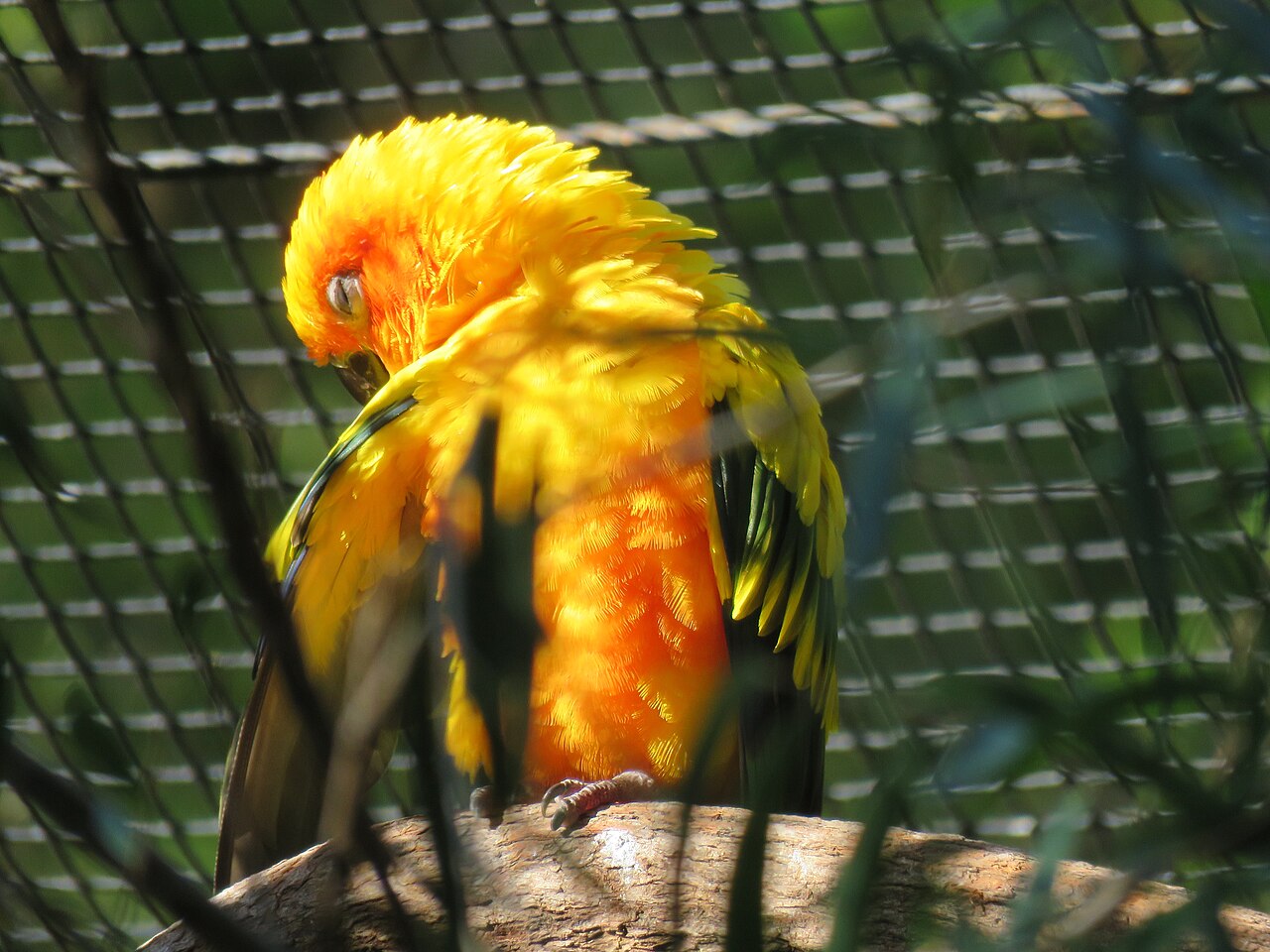
The sun conure is the bird most people picture when they imagine something orange that sounds like a parrot. Adults run about 12 in (30 cm) from head to tail tip, with a body that shades from yellow across the shoulders into deep orange on the belly and face. They are native to a small region of northeastern South America and are kept as pets across the US.
Their call is a single sharp screeeh repeated every second or two, loud enough to be uncomfortable indoors. A sun conure calling outdoors is almost always an escaped pet, and the bird will often answer a whistle and approach people, which no wild native bird does.
Do Orange-Winged Amazon Parrots Talk?

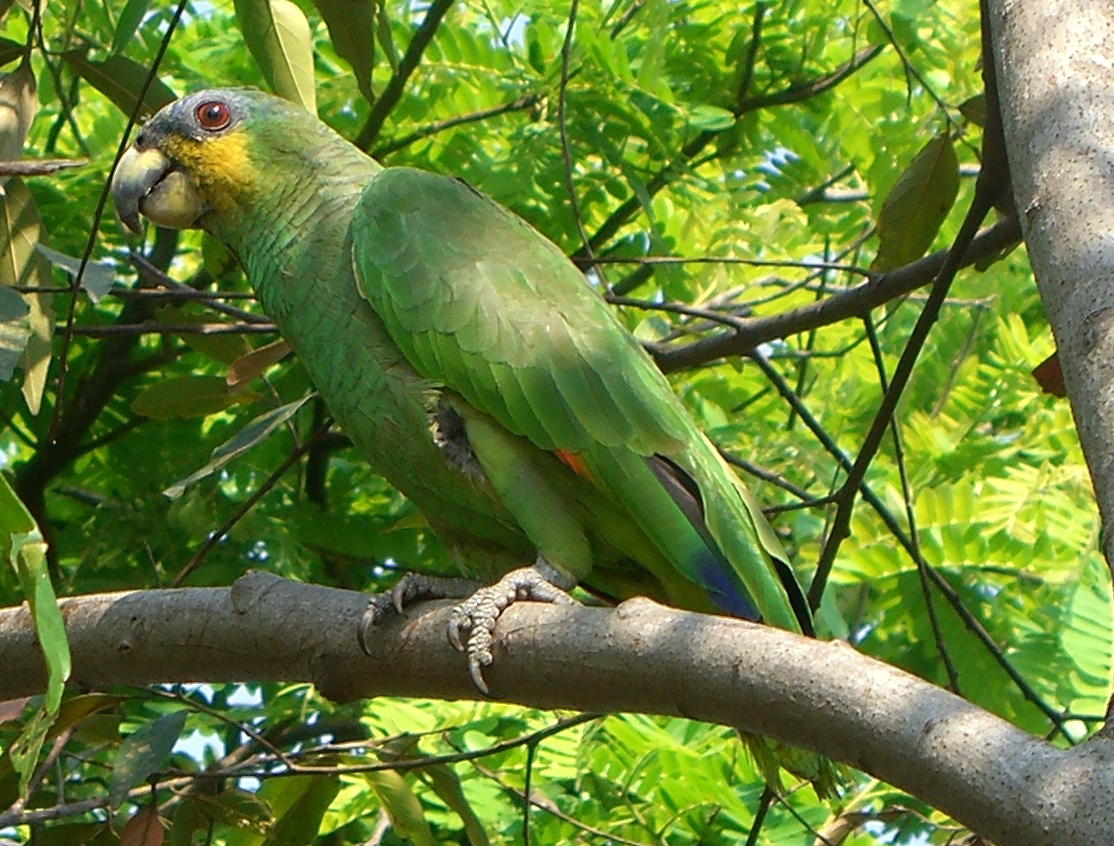
Yes. Orange-winged Amazon parrots talk, though they are considered mid range mimics compared with African grey or yellow-naped Amazon parrots. Most learn a handful of words, a laugh, a whistle or a doorbell, and they repeat them at dawn and dusk when the flock instinct peaks.
The species is mainly green with an orange patch in the wing that flashes only in flight, so a perched bird does not look orange at all. Feral flocks are established in south Florida, which means a parrot-like squawk in Miami or Fort Lauderdale can genuinely come from a wild bird rather than someone’s lost pet.
Other Orange Parrots Kept in US Homes
Several more parrots carry enough orange to fit the question. Green-cheeked conures (Pyrrhura molinae) have a rusty orange wash on the breast and are far quieter than sun conures. Lovebirds of the species Agapornis roseicollis show a peachy orange face. The orange-fronted conure, as the name says, wears the color on the forehead.
Red factor canaries and some finches look orange but chirp rather than squawk, so size and sound separate them quickly. Any orange parrot loose outdoors should be treated as a pet in trouble and reported to a local avian rescue or animal control.
Orange Wild Birds That Sound Nothing Like a Parrot
This is the mix up that sends most people searching. The orange birds in a typical American yard are songbirds, and their voices are sweet rather than harsh. A Baltimore oriole gives a clear flutey whistle from high in a shade tree. An American robin (Turdus migratorius) has an orange breast and a caroling song. A Bullock’s oriole fills the same niche in the west.
If the sound is pleasant, melodic or whistled, you are hearing a native songbird. If it is grating, repetitive and loud enough to make you flinch, you are hearing a parrot. For a native yard bird with a surprisingly large sound library, compare the range of calls a blue jay produces or the sharp metallic chip of a cardinal’s contact call.
Wild Birds in the US That Really Do Sound Like a Parrot
Monk parakeets are the main one. They are green and gray rather than orange, they build huge communal stick nests on utility poles, and their chatter is unmistakably parrot. Established colonies live in Florida, Texas, Illinois, Connecticut and New Jersey. Red-crowned parrots do the same thing in parts of Texas and southern California.
Among native species, nothing truly matches a parrot, but a few come close in harshness. The dry rattle of a belted kingfisher and the rasping scold of a gray catbird both get reported as parrot sounds. Mechanical, stuttering noises in the yard more often belong to a woodpecker; see the bird that sounds like a machine gun for that case.
Parrot Alarm Calls and Warning Sounds
An alarmed parrot is louder and faster than a calling one. The alarm is usually a burst of three to six identical screeches with almost no gap, often paired with a flattened crest, wide eyes and a sudden launch off the perch. In a flock, one bird starting the alarm sets off every other bird within earshot.
Outdoors, alarm bursts mean a hawk, a cat or a person has come too close. Indoors, the same sound answers a vacuum cleaner, a smoke alarm or a stranger in the room. Repeated evening alarm calling from a caged bird is usually a lighting or placement problem rather than a health problem.
Contact Calls, Courtship and Begging Young
Contact calling peaks at first light and again in the hour before sunset, the two windows when wild flocks regroup. A pet parrot keeps that schedule indoors, which is why the loudest minutes of the day are often 6 a.m. and 7 p.m. regardless of the household routine.
Courtship sounds are softer: muttering, bill clicking, regurgitation noises and a repeated low whistle, mostly in late winter and spring. Begging young make a thin wavering eeh eeh eeh that sounds broken and runs for minutes at a time. Nestling conures and Amazons beg through late spring and early summer.
When the Parrot Sound Comes From an Attic or Wall
A parrot-like screech from inside the structure of a house is almost never a parrot. European starlings nest in soffits and vents and produce a remarkable range of squawks, whistles and imitations from inside a wall. Young starlings begging in a vent sound close to a parrot chick.
Scratching with the noise points to a rodent or a raccoon, and night calling points to another group entirely; the sounds coming from a roof void after dark are often described in guides to bat sounds in a house or to barn owl screeches. Fix the entry point once the young have fledged, and if a bird is using a vent every season, a physical screen works better than any sound based bird deterrent.
What Bird Is Known for Being Talkative?
The African grey parrot (Psittacus erithacus) holds the reputation. Individual birds have learned vocabularies of several hundred words and use some of them in context. Budgerigars hold the recorded size record for vocabulary, and yellow-naped Amazons are prized for clarity of speech.
Outside the parrot family, the northern mockingbird and the European starling are the great mimics of North America, and a starling can reproduce a car alarm or a human whistle well enough to fool the person who owns it. The Cornell Lab’s species guide at All About Birds is the fastest way to compare a recording with a real wild bird. Owls are the other group people try to match by ear; start with birds that sound like owls if the call is hooting rather than screeching.
Frequently Asked Questions
Is orange and sounds like a parrot really just a carrot?
Yes. “What is orange and sounds like a parrot” is a rhyming riddle, and the intended answer is a carrot. There is no orange animal or object that actually produces a parrot call. The humor comes entirely from the one letter difference between the two words.
Can quaker parrots eat orange?
Yes, quaker parrots can eat orange flesh in small amounts as an occasional treat. Remove seeds and peel, serve a piece no larger than a thumbnail, and limit citrus to once or twice a week because the acidity and sugar can upset digestion and interfere with calcium uptake in heavy feeders.
How do you say “hi” in parrot language?
Parrots have no shared language, so there is no universal word for hi. The functional equivalent is a flock contact call, usually a short rising whistle. Whistle the same two note pattern every time you enter the room and most pet parrots will answer it within a few weeks.
How do I say “I love you” in bird language?
Birds signal bonding through behavior rather than phrases. Slow blinking, soft beak grinding, gentle preening of your hair and quiet muttering are all affiliative signals in parrots. Mirroring those back, by blinking slowly and speaking softly, communicates far more than repeating a human phrase.
Do parrots have high IQ?
Parrots rank with corvids and great apes on standard cognition tests. African greys have solved object permanence and simple counting tasks, and some use labels in context. Comparing species on a human IQ scale is not meaningful, but the problem solving is genuine and well documented in peer reviewed studies.
Which bird can be trained to speak like humans?
African grey parrots, Amazon parrots, budgerigars, Indian ringnecks, cockatoos and common hill mynas can all be trained to reproduce human speech. Clarity varies by individual more than by species, and consistent short daily sessions produce better results than long occasional ones.