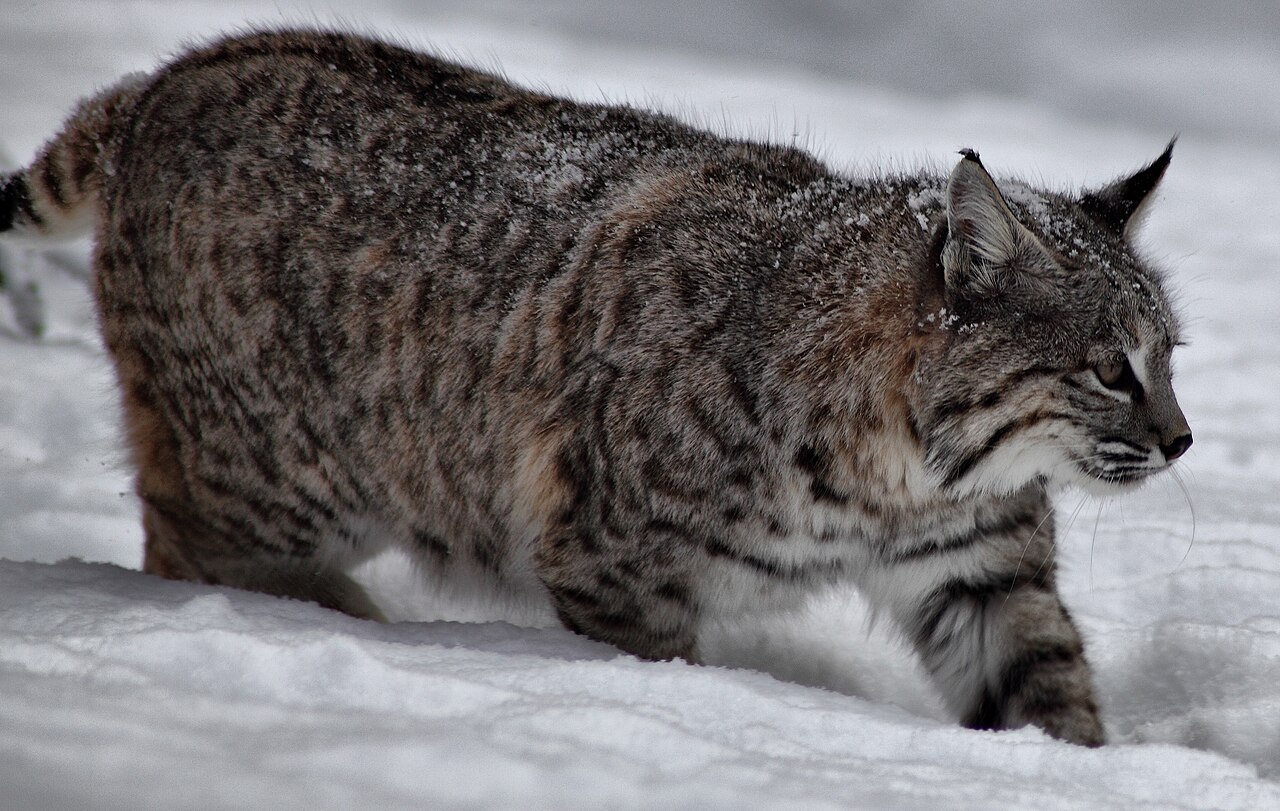
Bobcat vs Coyote Tracks in Snow: 3 Fast Ways to Tell
Bobcat and coyote tracks in snow differ in three things you can check in ten seconds: claw marks, shape, and the line of travel. A coyote leaves an oval print with two nail points and a slightly meandering trail. A bobcat leaves a round print with no nails and a trail that runs straight like a drawn line.
Both animals walk the same fields and fence rows across the United States, and both leave prints near 2 inches (5 cm) wide, so size alone never settles it. The details below are the ones that hold up in powder, crust, and wet snow.
Bobcat tracks are round, 1.75 to 2.5 inches (4.4 to 6.4 cm) wide, show four toes with no claw marks, and have three lobes on the rear edge of the heel pad. Coyote tracks are oval, 2 to 2.5 inches (5 to 6.4 cm) long, usually show two claw points, and have a two lobed pad.
Bobcat vs Coyote Tracks at a Glance
The quickest reliable sort is cat versus dog, not bobcat versus coyote. Everything that makes a track feline, retracted claws, a round outline, and an asymmetric toe arrangement, puts it with the bobcat, and everything canid puts it with the coyote.
| Feature | Bobcat | Coyote |
|---|---|---|
| Print size | 1.75 to 2.5 in (4.4 to 6.4 cm) | 2 to 2.5 in long (5 to 6.4 cm) |
| Outline | Round, as wide as long | Oval, clearly longer than wide |
| Claw marks | Absent in clean prints | Two points ahead of middle toes |
| Heel pad rear edge | Three lobes | Two lobes |
| Toe symmetry | Asymmetric, one lead toe | Near symmetric, two central toes |
| Walking stride | 9 to 13 in (23 to 33 cm) | 13 to 16 in (33 to 41 cm) |
| Trail line | Very straight, direct register | Straight when trotting, wanders when hunting |
What Do Bobcat Footprints Look Like?
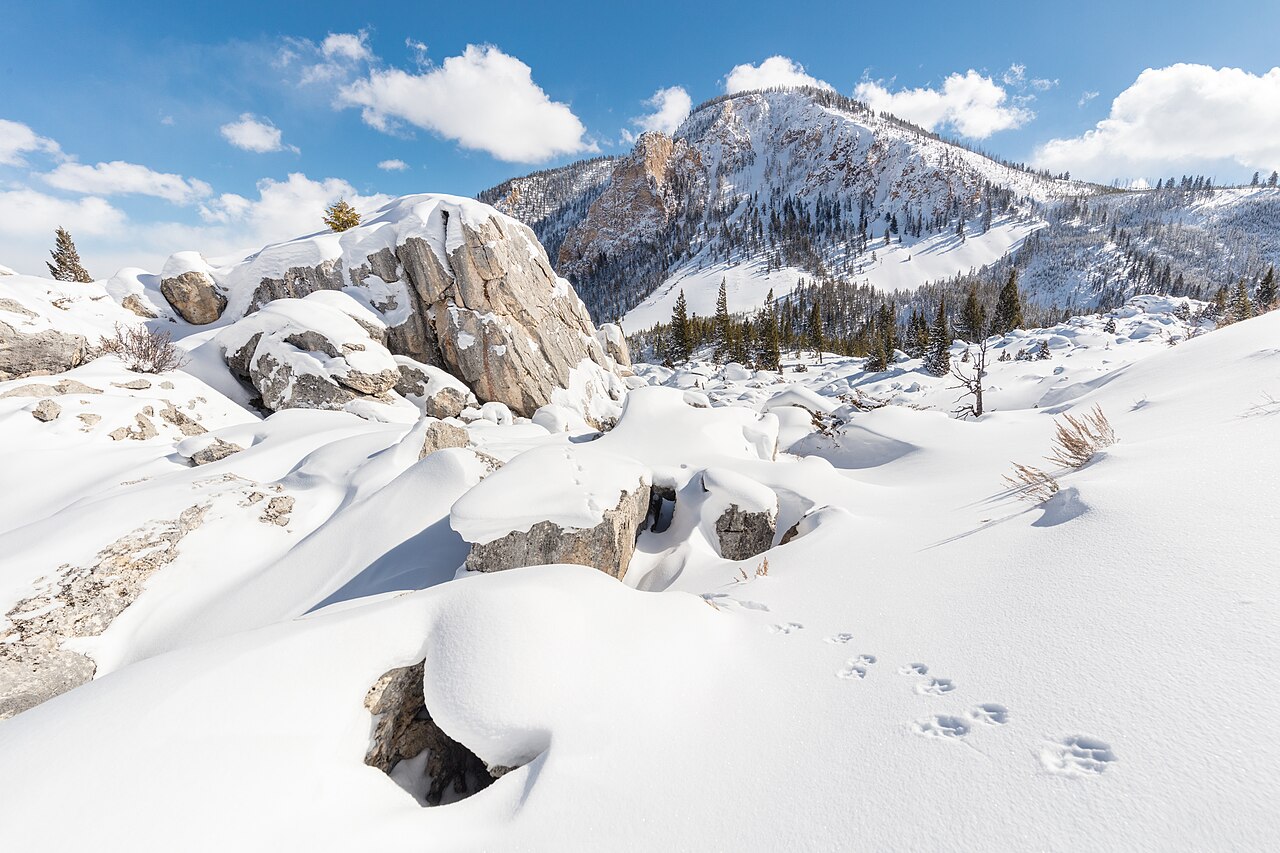
A bobcat footprint is a round print about as wide as it is long, with four toes set in an arc that leans to one side, so left and right feet are distinguishable. The front foot is slightly larger than the hind foot.
No claw marks appear in a clean print, because bobcats keep their claws sheathed while walking. The heel pad is broad with two lobes at the front and three at the back, and in firm snow that rear scalloped edge is the single most diagnostic feature.
Bobcats weigh 15 to 35 lbs (7 to 16 kg), so prints press moderately into powder. In deep snow the animal often belly drags between leaps, leaving a trough that a coyote of the same weight rarely produces. See the full bobcat track guide for mud and sand variations.
What Do Coyote Footprints Look Like?
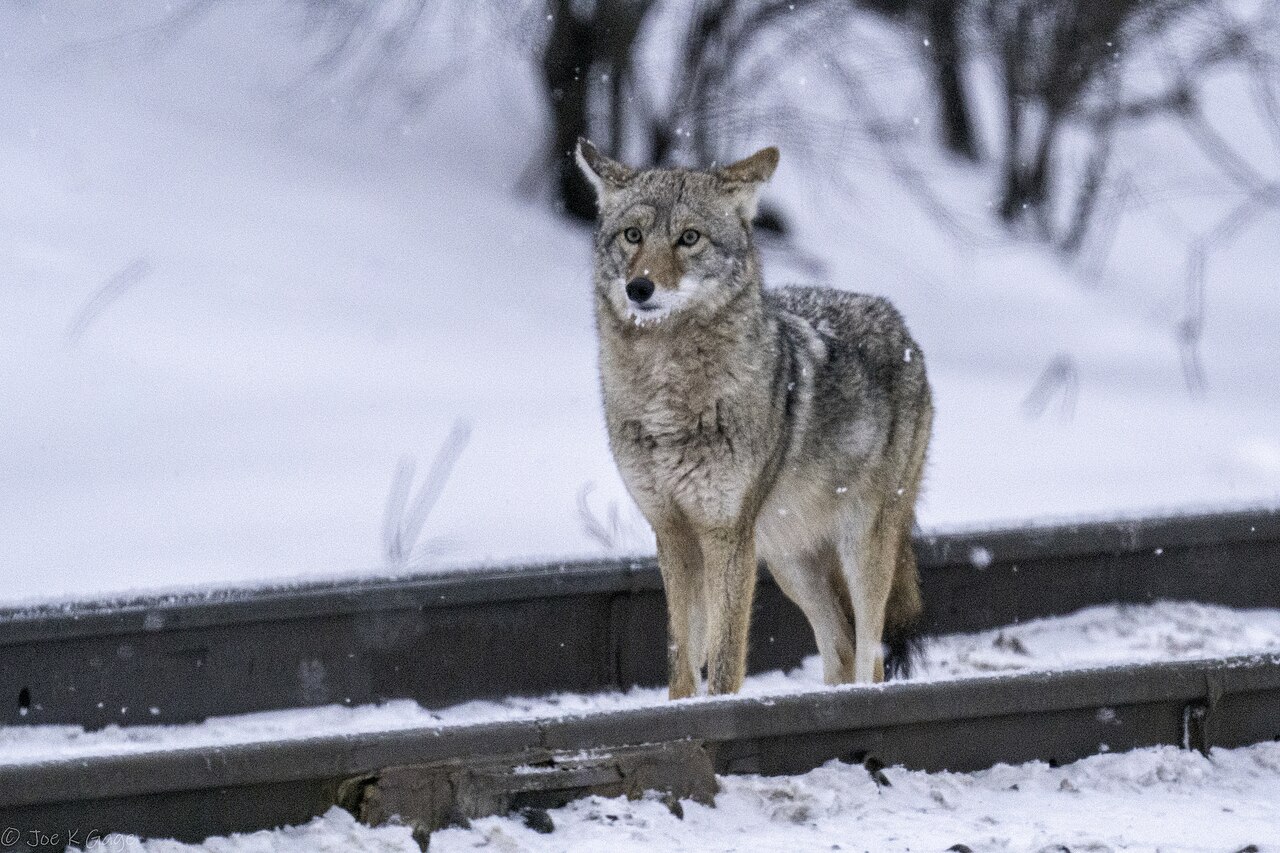
A coyote footprint is a compact oval roughly 2.5 inches (6.4 cm) long and 2 inches (5 cm) wide, with four toes pointing forward and two blunt claw points above the central pair. The hind print is smaller and narrower than the front.
The heel pad is triangular with two lobes at the rear, and the two leading toes sit close together, which gives the whole print a tight, forward driving look. Dog prints in the same snow splay wider and look relaxed by comparison.
Coyotes weigh 20 to 45 lbs (9 to 20 kg) in most of the country, heavier in the Northeast, so they sink deeper than bobcats in soft snow. More detail sits in our coyote track reference.
What Is the Difference Between Bobcat and Coyote Tracks?
In snow, the practical difference is the claw question answered by the outline. If the print is longer than wide and carries nail points, it is a coyote. If it is round and clawless with a scalloped rear pad, it is a bobcat.
When snow has filled or blurred the print, switch to stride. A bobcat steps 9 to 13 inches (23 to 33 cm) and a coyote 13 to 16 inches (33 to 41 cm), a gap large enough to measure with boots over five consecutive prints.
One warning from fresh powder: a bobcat spreading its toes can leave claw like slots where the fur parts. Trust the pad shape and the stride before a single ambiguous nail mark.
Reading the Trail Pattern in Snow, Mud and Sand
Snow is the best surface and also the most deceptive one. Both species use direct register walking, placing hind feet into front prints, so expect one neat row of prints, not two. Watch where the row goes: bobcats hold a line through cover, coyotes cut diagonally across open ground.
Mud gives the honest outline. Here the bobcat print finally shows crisp toe pads with gaps between them, while the coyote shows nail scratches and a clear pad notch. Measure in mud whenever you can; a print you measure in mud calibrates your eye for everything you see in snow.
Dry sand slumps and enlarges both prints by 15 to 20 percent, which turns a bobcat into something cougar sized if you only measure width. On sand, read the trail line and the stride instead of the print.
Common Mix-Ups: Domestic Cat, Dog and Fox
House cat prints are feline in every respect but half the size, 1 to 1.5 inches (2.5 to 3.8 cm), with strides under 9 inches (23 cm). Any clawless round print under 1.5 inches near buildings is almost certainly a house cat.
Dogs leave the most false coyote reports. Dog prints are rounder than coyote prints, with splayed toes, prominent blunt nails, and a trail that loops and backtracks. The National Park Service notes the same wandering pattern in its winter tracking guidance.
Red fox prints are smaller and furrier than coyote prints and carry a raised bar across the heel pad. That comparison is covered in our coyote versus fox track guide, and the much larger clawless prints of Canada lynx rule out both.
Frequently Asked Questions
Do coyotes stay away from bobcats?
Mostly yes. The two overlap heavily but avoid each other in time and space, with bobcats using denser cover and steeper ground. Coyotes dominate open areas and will kill bobcat kittens, so adults generally keep their distance rather than compete directly.
What is a coyote’s biggest enemy?
Humans, by a wide margin, through hunting, trapping, and vehicle collisions. Among wildlife, gray wolves are the most significant threat and suppress coyote numbers wherever packs are established. Mountain lions and bears occasionally kill coyotes at carcasses.
What smell does a coyote hate?
Coyotes avoid strong irritants such as wolf urine, ammonia, vinegar, and capsaicin based repellents, but all of them fade fast and animals habituate within days. Removing food sources and securing trash works far better than any scent deterrent.
What animal is a coyote afraid of?
Wolves first, then mountain lions, bears, and large livestock guardian dogs. A coyote also retreats from humans who act assertively, which is the basis of hazing programs that teach urban coyotes to keep their distance from yards and trails.
What do bobcat tracks look like in deep snow?
They turn into a trough. Once snow exceeds about 8 inches (20 cm), bobcats bound and drag their bellies, leaving linked leap sets with a connecting furrow. Individual prints become shapeless, so identification relies on the leap distance and the trough width.
Both species leave tracks worth following into other evidence. Prints near deer trails and bear sign place every animal in the same winter story.