Spotted Turtle: How Rare It Is and Whether You Can Keep One
The spotted turtle (Clemmys guttata) is a 4 in (10 cm) wetland turtle with bright yellow dots scattered across a black shell, and it is disappearing. The species is listed as Endangered on the IUCN Red List, protected by most states in its range, and illegal to collect from the wild across nearly all of it.
That legal status is the first thing to understand, because the second most searched question about this turtle is whether you can keep one. The answer depends entirely on where the animal came from, and the honest version of the answer disqualifies almost every turtle a casual buyer will be offered.
Spotted turtles are small semi-aquatic turtles of the eastern US, reaching 3.5 to 5 in (9 to 12 cm) and living 50 years or more. They are IUCN Endangered, state protected across most of their range, and cannot legally be taken from the wild. Only captive bred animals with documentation may be kept, at 400 to 900 USD.
| Quick Facts | Spotted Turtle |
|---|---|
| Scientific name | Clemmys guttata |
| Adult size | 3.5 to 5 in (9 to 12 cm) |
| Lifespan | 50 years, records past 100 |
| Range | Maine to north Florida, Great Lakes |
| Habitat | Bogs, fens, wet meadows, vernal pools |
| Conservation status | IUCN Endangered, CITES Appendix II |
| Captive bred price | 400 to 900 USD |
How Rare Is a Spotted Turtle?
Rare enough that most people inside its range will never see one. Populations have fallen by an estimated 50 percent or more over three generations, and the species is now classed as Endangered globally. Individual colonies are small, often fewer than 50 adults, and scattered across wetlands that no longer connect to each other.
State listings tell the same story from the ground. Illinois, Massachusetts, Maine, New Hampshire, and Vermont all give it threatened or endangered status, and it is Endangered nationally in Canada. State wildlife agencies such as New Hampshire Fish and Game publish the local rules, which differ by state and change.
The reason is not mysterious. Spotted turtles mature at 7 to 14 years, lay small clutches of 3 to 5 eggs, and depend on long adult lifespans to replace themselves. Remove a few adults from a colony, whether by collectors or road traffic, and it cannot recover on any human timescale.
How to Identify a Spotted Turtle

Look for a smooth, keelless black carapace, no more than 5 in (12 cm) long, sprinkled with round yellow spots. Hatchlings usually carry one spot per scute. Older adults may carry more than 100, and a few old individuals lose their spots entirely and appear plain black.
The spots are not pigment on top of the shell. They are translucent windows in the dark surface layer that let the yellow beneath show through, which is why they fade unevenly with wear rather than flaking off.
Check the soft parts as well. The head, neck, and legs are dark gray to black with orange or salmon patches, and the underside of the limbs is often bright orange. The plastron is yellow or orange with irregular black blotches that spread with age. Nothing else in the range matches this combination; a young eastern painted turtle has red shell margins and stripes, not dots.
Male or Female: How to Tell
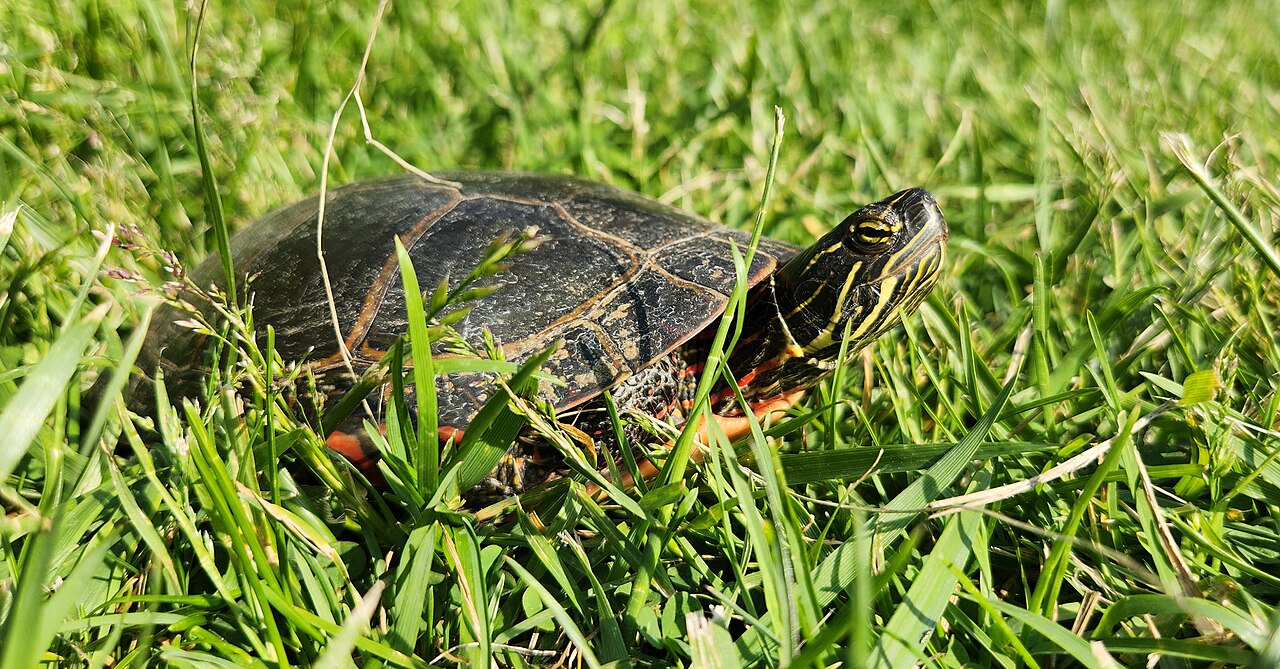
Adult males have brown eyes, a tan or dark chin, a concave plastron, and a long thick tail with the vent past the shell edge. Females have orange eyes, a yellow chin, a flat plastron, and a short slim tail. This is one of the easier North American turtles to sex once the animal is mature.
Females also grow slightly larger and taller shelled than males of the same age. Below about 3 in (8 cm) none of these traits is dependable, and hatchling sex cannot be determined at all by appearance since it is set by incubation temperature.
Where Spotted Turtles Live
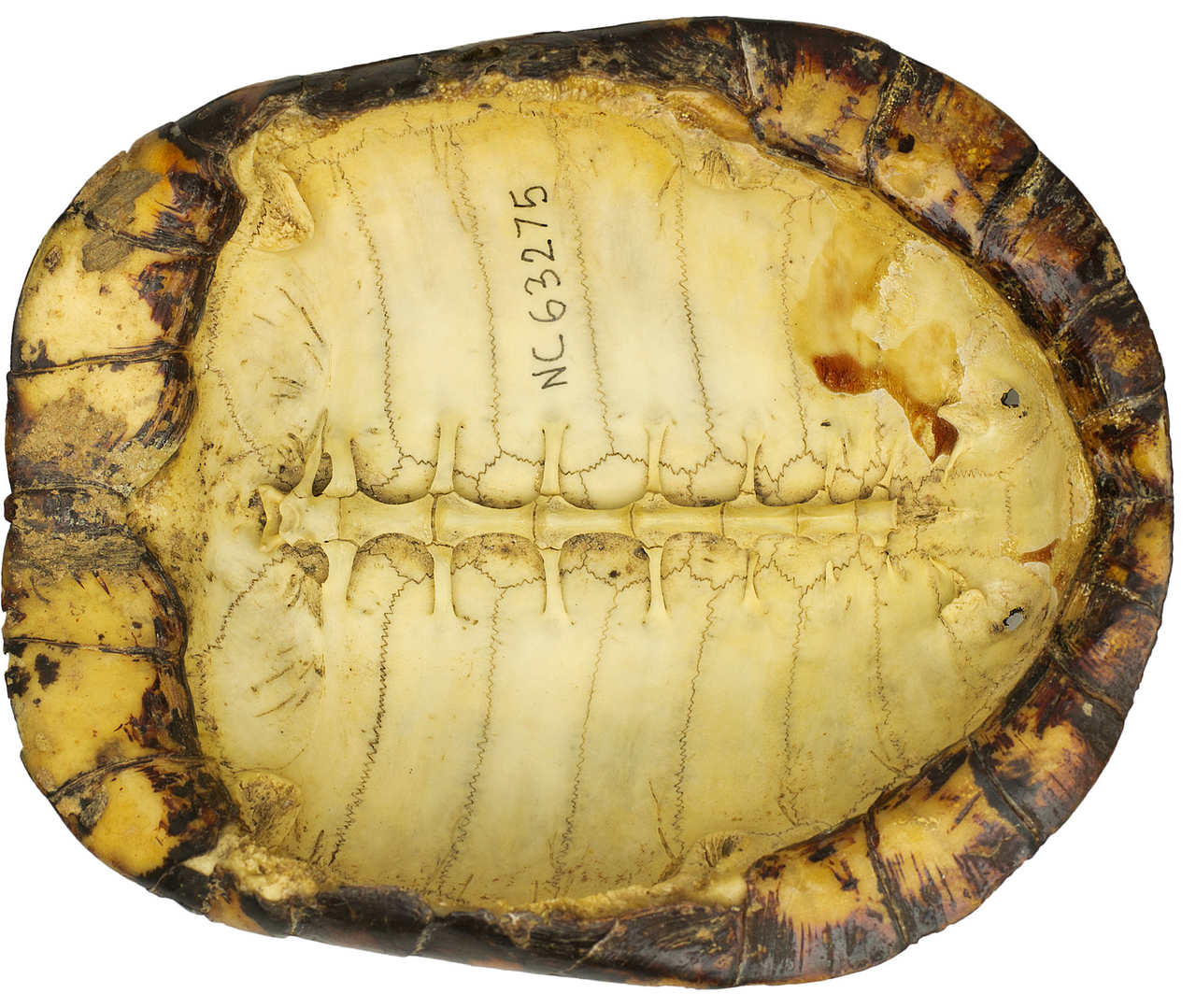
The range runs along the Atlantic coastal plain from southern Maine to northern Florida, then inland around the southern Great Lakes into Ohio, Michigan, Indiana, and Ontario. Distribution within that outline is patchy, tied to specific wetland types rather than spread evenly.
They want shallow, slow, soft bottomed water: sphagnum bogs, fens, wet meadows, marshy pond edges, vernal pools, and small woodland streams. Depth of 4 to 8 in (10 to 20 cm) with dense vegetation and a muddy bottom for burrowing is ideal.
Spotted turtles move between wetlands over land during the year, sometimes several hundred yards, and that habit is what puts them on roads. They also spend hot midsummer weeks buried in mud or leaf litter in a dormant state called aestivation, which is why a wetland can hold turtles and appear empty in August. Their needs overlap with the eastern mud turtle but they sit in colder, cleaner, more acidic water.
What Does a Spotted Turtle Eat?
Spotted turtles are omnivores that feed almost exclusively in water, because like most aquatic turtles they need water to swallow. Wild diets include aquatic insect larvae, snails, slugs, worms, crustaceans, tadpoles, small fish, carrion, algae, and soft aquatic plants.
In captivity, a quality aquatic turtle pellet forms the base, supplemented three or four times a week with earthworms, crickets, snails, blackworms, or small pieces of fish. Add a calcium source and offer leafy greens and duckweed free choice, even though many individuals ignore plant matter.
Spotted Turtle Lifespan
Spotted turtles regularly pass 30 years, commonly reach 50, and marked wild individuals have been recaptured at more than 65 years old. Claims of animals over 100 exist in the literature and are plausible given how slowly the species matures.
That longevity is the species’ whole reproductive strategy. A female may need decades of laying small clutches before enough hatchlings survive to replace her, since raccoons and skunks take the majority of nests. It also means a captive spotted turtle will likely outlive its keeper and needs a plan in writing.
What to Do if You Find a Spotted Turtle
Leave it where it is. Do not take it home, do not move it to a nicer looking pond, and do not post the location publicly. Poaching for the international pet trade is a documented driver of the decline, and a geotagged photo on social media has emptied known sites.
If the turtle is on a road, carry it across in the direction it was already heading and set it down off the shoulder. Moving it back where it came from only sends it into traffic again. Wash your hands afterwards.
Then report the sighting to your state wildlife agency or a regional herp atlas project with the date and a photo. Those records determine which wetlands get protected. A turtle already in a pet situation is a different matter: contact a turtle rescue or state agency rather than releasing it, since released captives spread disease into wild colonies.
Can You Have a Spotted Turtle as a Pet?
Only a captive bred animal with paperwork, and only where state law allows possession. Wild collection is prohibited across nearly the entire US range, the species is listed on CITES Appendix II for international trade, and several states ban possession outright regardless of origin. Check your own state before buying anything.
Legitimate captive bred spotted turtles come from a small number of long established breeders and cost 400 to 900 USD, sometimes more for adults. A cheap spotted turtle is a red flag, not a bargain, and buying one sustains the collecting that is emptying the wetlands. They make calm, alert, long lived captives for the keeper who does the legal work first.
How Big of a Tank Do Spotted Turtles Need?
A single adult needs a 40 gallon breeder tank as the floor, and a pair needs 75 gallons or more. Floor area matters more than volume for this species, so a long shallow setup beats a tall one. An outdoor pond or stock tank in a predator proof enclosure is better than any indoor tank.
Keep water 5 to 10 in (13 to 25 cm) deep with easy exits everywhere, because spotted turtles are mediocre swimmers compared with sliders or map turtles. Add a dry land section of damp moss or soil, heavy planting, submerged wood, and a basking spot at 85 to 90 F (29 to 32 C) with UVB overhead. Water sits comfortably at 70 to 75 F (21 to 24 C).
Water, Filtration, and Winter Care
Filter for double the tank volume and change 25 percent of the water weekly. Spotted turtles come from clean acidic wetlands and respond to fouled water with shell and skin infections faster than hardier species do. Tannins from oak leaves or Indian almond leaves suit them and lower the pH slightly.
Outdoor animals brumate naturally under water or mud from roughly November to March once temperatures fall below 50 F (10 C). Indoor animals can be kept active all winter at normal temperatures instead. Deliberate cooling of a captive turtle should only follow a health check, and the same rules apply to every species that hibernates in the wild.
Threats: Why the Population Keeps Falling
Wetland drainage and development remove habitat outright, and what remains is fragmented by roads and subdivisions. Because adults walk between wetlands each season, road mortality falls hardest on breeding females, the animals a population can least afford to lose.
Illegal collection for the domestic and Asian pet trade is the second major pressure, and it targets exactly those adults. Subsidized nest predators such as raccoons finish the job, taking well over half of all nests near human habitation. Habitat protection alone does not save a colony that loses two adults a year, which is why the poaching rules are enforced as strictly as they are. Land turtles face a similar pattern, as our guide to the eastern box turtle describes, and both species share the Mississippi map turtle‘s dependence on undisturbed nesting ground.
Frequently Asked Questions
Can turtles be in a full tank of water?
Not spotted turtles. They are weak swimmers from shallow wetlands and drown in deep water without easy exits. Keep the water 5 to 10 in (13 to 25 cm) deep, add plants and wood the turtle can rest against, and make sure it can reach the surface and the basking spot from every point in the tank.
Should turtles be fed every day?
Hatchlings and juveniles eat daily, adults every other day. Adult spotted turtles gain weight easily in captivity, and an overfed turtle develops a lumpy shell and fatty liver disease. Offer a portion roughly the size of the turtle’s head and remove anything uneaten within 20 minutes.
Can I put tap water in a turtle tank?
Yes, after treating it with a dechlorinator to remove chlorine and chloramine. Untreated tap water irritates eyes and skin and kills the beneficial bacteria in the filter. Match the temperature when doing water changes, since a sudden drop of several degrees stresses the turtle.
Do spotted turtles bite?
Rarely, and the bite of a 4 in (10 cm) turtle is harmless. They are among the calmer North American turtles and usually withdraw rather than snap. Like all turtles they can carry Salmonella, so wash your hands after contact and never clean the enclosure in a kitchen sink.
How much does a spotted turtle cost?
Captive bred animals run 400 to 900 USD, with proven adults higher. The price reflects slow reproduction and legal restrictions, not fashion. Anything offered well below that range is likely wild caught, which is illegal in most of the range and worth reporting rather than buying.
How many spotted turtles are left?
No reliable total exists. Assessments work from population trends rather than headcounts, and the IUCN estimate of a decline over 50 percent across three generations is what drives the Endangered listing. Individual colonies are typically under 100 adults, and many historical sites now hold none.