Badger Poop: How to Identify It and Tell It From Fox and Coyote Scat
Badger poop is a thick, tubular dropping 2 to 5 in (5 to 13 cm) long and about 0.5 to 1 in (1.3 to 2.5 cm) across, dark brown to almost black, usually packed with fur and crushed bone. The giveaway is rarely the dropping itself but where you find it, because badgers deposit much of it in shallow pits or right at a burrow entrance and often bury it.
That habit is why most people hunting for badger scat never find any, even on ground with obvious diggings. This guide covers the measurements, the contents, the latrine habit, the three animals whose scat gets confused with it most often, and the health precautions that actually apply.
Badger poop is tubular and dense, 2 to 5 in (5 to 13 cm) long and 0.5 to 1 in (1.3 to 2.5 cm) thick, dark brown to black, with visible fur and bone fragments from ground squirrels and gophers. It is often found in shallow dug pits or at burrow entrances, and American badgers frequently bury it.
| Feature | Badger scat |
|---|---|
| Length | 2 to 5 in (5 to 13 cm) |
| Diameter | 0.5 to 1 in (1.3 to 2.5 cm) |
| Shape | Thick tube, blunt or slightly tapered, sometimes segmented |
| Color | Dark brown to black fresh, gray and crumbly when old |
| Contents | Rodent fur, bone chips, insect parts, occasionally seeds |
| Where | Dug pits, burrow mouths, along field edges and fence lines |
| Accumulation | Single scats scattered, or repeated use of one shallow pit |
What Does Badger Poop Look Like?
A fresh badger dropping looks like a short, heavy sausage with a dull, slightly greasy surface. It holds its shape rather than flattening, and it breaks apart to show matted fur and splinters of bone rather than a smooth paste. Diet drives the look, and a badger that has been eating insects and earthworms produces something much softer and darker than one living on ground squirrels.
Age changes it fast. Within a few days the surface dulls and bleaches, within two weeks the whole scat is gray and crumbly, and the fur content becomes the only reliable clue left. If what you found is a tight pellet pile instead of a tube, you are looking at a herbivore, and the comparison in deer poop vs rabbit poop will sort that out quickly.
Size, Shape and Color of Badger Scat
Measure before you guess, because size does most of the work here. Badger scat runs 2 to 5 in (5 to 13 cm) long with a diameter of 0.5 to 1 in (1.3 to 2.5 cm), which puts it well above rodent droppings and below most bear scat. The thickness matters more than the length, since any tubular scat can break into shorter pieces.
Shape is a blunt tube, often slightly curved, sometimes pinched into segments but rarely drawn out into the long thin taper a fox leaves. Color is dark brown to black when fresh. European badgers on an earthworm diet leave something closer to a dark slick, which is where a lot of the photographs online come from.
What Is Inside Badger Droppings?
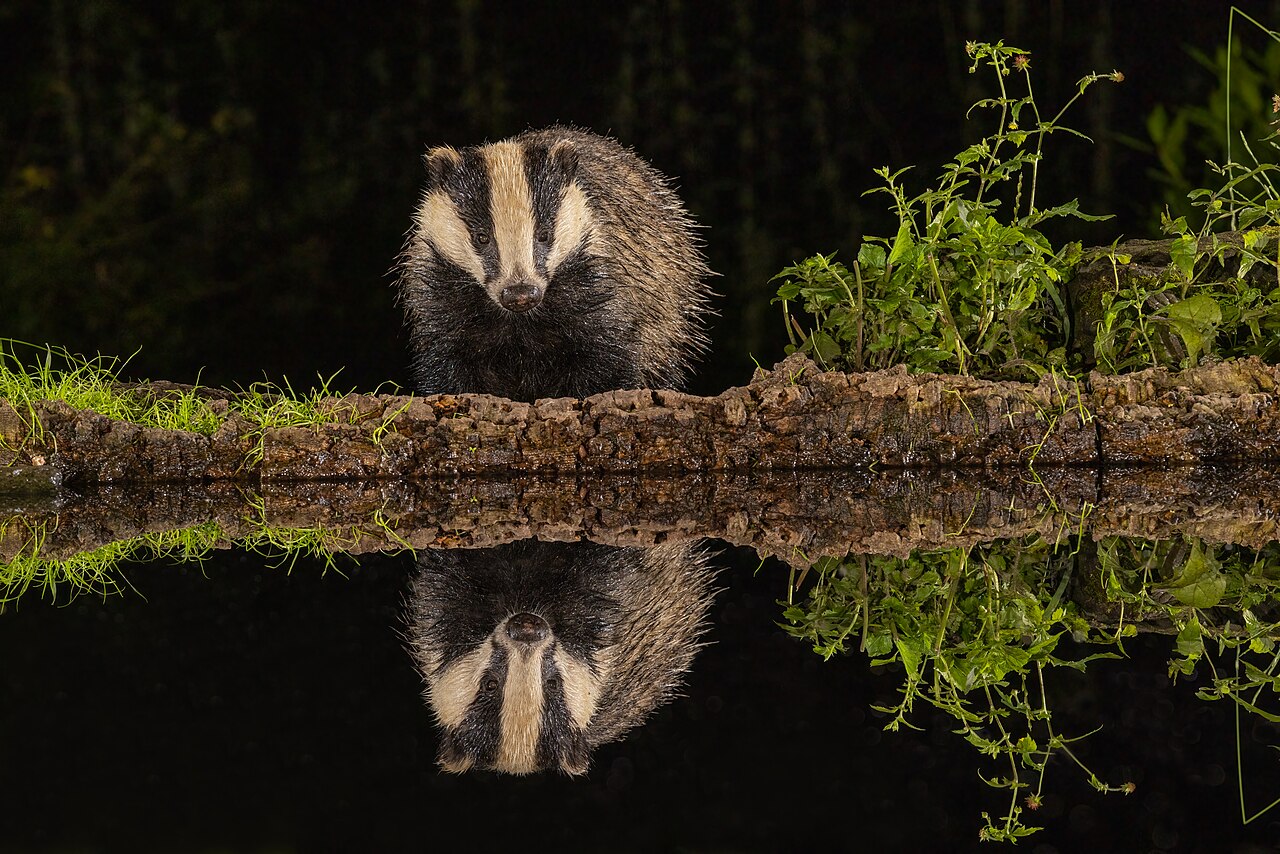
American badgers are specialist rodent hunters, so the contents are mostly ground squirrel, pocket gopher, prairie dog and mouse remains: coarse fur in mats, flattened bone chips, and the occasional tooth. Break a dry scat with a stick and the fur is unmistakable. That dense animal content is the strongest single argument for badger over most other diggers.
Mixed in you may find beetle wing cases, grasshopper parts, and in late summer some seeds or berry skins, since badgers will take what is easy. Earthworm remains dominate in European badger scat and are almost absent in American badger scat. Fur-filled scat from a much smaller animal is more likely a weasel or a rat, and rat poop vs mouse poop covers that size range.
Next question: Badger Tracks: 5 Toes and Claws Out Front, in Snow or Mud
Where to Find Badger Poop: Latrines, Dung Pits and Burrows

Badgers do not scatter droppings at random. The American badger typically digs a shallow depression a few inches across, uses it, and often scrapes soil back over the scat, which is the main reason the stuff is so hard to find on ground that clearly holds badgers. Check the loose soil fan at a burrow mouth and any small fresh scrape nearby.
European badgers go further and maintain communal latrines, clusters of shallow pits along the edges of their territory and near the sett, reused for years. Those latrines double as boundary markers. In either case, repeated use of one small spot is a badger signature, not a fox or coyote habit.
Badger Poop vs Fox Poop
Fox scat is the most common misidentification, especially in the UK where both animals share gardens. A red fox leaves a thinner tube, roughly 0.4 to 0.6 in (1 to 1.5 cm) across, usually drawn out into a long twisted point at one end, and deposited in the open on a tussock, molehill or path where it will be seen.
Badger scat is thicker, blunter, and tucked into a pit rather than displayed. Fox scat also smells sharply musky and often contains feathers and fruit stones, which badger scat rarely does. Placement is the quickest test: prominent and pointed means fox, pitted and blunt means badger.
Badger Poop vs Coyote Poop
Across most of the American badger’s range, coyote is the realistic alternative. Coyote scat overlaps badger scat in diameter at 0.75 to 1.25 in (2 to 3 cm) but is typically longer, more rope-like, and tapers to a twisted tip with fur wound visibly around it. It is left on trails, road edges and crossings as a territorial marker.
Badger scat is shorter, stubbier, and found at diggings rather than on trails. Coyote scat shifts seasonally toward fruit and grass and can look almost purple in berry season, something you will not see from a badger. For the larger end of the scale, bear poop vs deer poop shows what a genuinely big scat looks like.
Badger Poop vs Raccoon Poop
Raccoon scat is similar in diameter but breaks into shorter segments with blunt ends, and it is loaded with undigested seeds, corn kernels and berry skins rather than fur and bone. Raccoons also use latrines, which adds to the confusion, but theirs sit on raised surfaces: logs, woodpiles, decks, the base of trees and flat roofs.
Badgers cannot climb and will never leave scat on a deck rail or a log. Anything elevated is raccoon until proven otherwise. Raccoon latrines also carry a genuine roundworm risk, which is a good reason not to poke at an unidentified seed-filled scat near your house.
What Are the Signs of a Badger in the Garden?
Digging gives badgers away long before the scat does. Look for cone-shaped snuffle holes a few inches across where the animal has dug for grubs and worms, lawn turf rolled back in strips, and larger excavations at the base of banks or sheds. Fresh diggings show claw marks on the sides of the hole.
Other signs are a smooth-bottomed run under a fence or through a hedge, coarse black and white guard hairs caught on the lowest strand of wire, and a five-toed track about 2 to 3 in (5 to 7.5 cm) wide with long claw marks set well ahead of the pads. Several of those together is a badger. One snuffle hole is not.
Is Badger Poo Dangerous? Health Risks and Safe Cleanup
Treat it as you would any carnivore scat: a real but low risk that gloves and basic hygiene handle. Badgers can carry rabies, though cases are uncommon, and the relevant guidance for any mammal exposure is on the CDC’s rabies information pages. Leptospira bacteria, shed mainly in urine, are a further reason not to handle contaminated soil bare-handed.
Badgers also carry intestinal roundworms and, in parts of the UK and Ireland, Mycobacterium bovis, the bacterium behind bovine tuberculosis, which is why British guidance tells landowners not to disturb latrines near cattle. For cleanup, wear disposable gloves, dampen the scat first rather than sweeping it dry, bag it for household waste, disinfect the spot, and wash your hands and tools afterward.
American Badger vs European Badger Droppings
These are two different animals, and the photographs online mix them freely. The American badger (Taxidea taxus) ranges across the western and central United States into southern Canada, lives mostly on burrowing rodents, and leaves fur and bone-filled scat in scattered pits it often covers.
The European badger (Meles meles) is a social animal living in setts of several adults, eats earthworms as its staple, and maintains the communal boundary latrines most badger poo pictures show. If a source describes sweet-smelling, slimy, dark scat in a dug pit at a territory edge, it is describing the European species, not the one in a Nebraska pasture.
How Can I Identify Different Types of Animal Poop in My Backyard?
Work through four questions in order: diameter, shape, contents and placement. Diameter brackets the animal by body size, shape separates pellets from tubes, contents separate plant eaters from meat eaters, and placement often names the species outright, since latrine habits and marking behavior are more individual than the droppings themselves.
Then compare against the specific pairs you are likely to have. The small tubular scats on a shelf or in a drawer usually come down to squirrel poop vs rat poop, scat under a roof gap to bat poop vs mouse poop, and the tiny dark specks on a patio wall to lizard poop vs mouse poop. Photograph anything you cannot place with a coin beside it for scale.
Frequently Asked Questions
Is a badger a tough animal?
Yes, remarkably so. Badgers have loose, thick skin that is hard to grip, heavy forelimbs with long claws, and a defensive response that is to dig in and fight rather than flee. Cornered badgers have driven off much larger predators, and they are on nobody’s list of easy prey.
What eats a badger?
Adults have few predators. Coyotes, mountain lions, bears, wolves and golden eagles occasionally take badgers, mostly young or sick ones, and in Europe adult badgers are essentially predator-free. Vehicles kill far more than any wild animal does, and persecution and habitat loss outrank predation everywhere.
What food is poisonous to badgers?
Chocolate, onions, grapes, raisins, macadamia nuts and anything moldy are all risky, the same list that applies to dogs. Milk is a poor idea because adults digest lactose badly. The bigger hazard around houses is rodent bait, which badgers get through eating poisoned rodents rather than the bait itself.
Do badgers go after dogs?
Not by choice. A badger will avoid a dog if it has a route out, and problems happen when a dog corners one at a sett or burrow. The badger then defends itself hard, and serious injuries to dogs are usually the result. Keep dogs leashed around active diggings.
Who would win, a dog or a badger?
It depends entirely on the dog and the setting, and neither animal benefits from finding out. A badger defending a burrow entrance has armor, claws and position on its side, and even large dogs come away cut up. There is no wild outcome where this matchup is a fair fight worth staging.
What is the most fearless animal in the world?
The honey badger (Mellivora capensis) usually takes that title, and it is a different species from either the American or European badger despite the name. Its reputation comes from the same features: thick loose skin, strong claws and a willingness to stand its ground against animals many times its size.
Explore more: Animal Poop Identification: A Field Guide by Species