Seahorse Symbolism: Meaning, Luck, Love and Dreams
Symbolically, the seahorse stands for patience and quiet strength, the kind that holds on instead of charging ahead. Seahorse symbolism grows out of the animal itself. It is a small fish that anchors its tail to seagrass, waits for prey to drift close, and leaves the work of pregnancy to the father. Each of those habits maps to a meaning you can use in love, in dreams and in daily life.
The lined seahorse (Hippocampus erectus) lives along the US Atlantic and Gulf coasts, and the dwarf seahorse (Hippocampus zosterae) hides in Florida seagrass. Both are fish, not horses, and neither appears in the Bible or the zodiac. The meanings here come from three real sources. Those are the animal’s behavior, the hippocampi of Greek and Roman myth, and modern dream interpretation.
A seahorse spiritually stands for patience, gentle strength and loyal, protective love, drawn from a fish whose males carry the young and whose pairs in some species greet each other at dawn. Dreaming of a seahorse points to a need for calm persistence, emotional security or care for something fragile that is still growing.
What Is the Symbolic Meaning of a Seahorse?
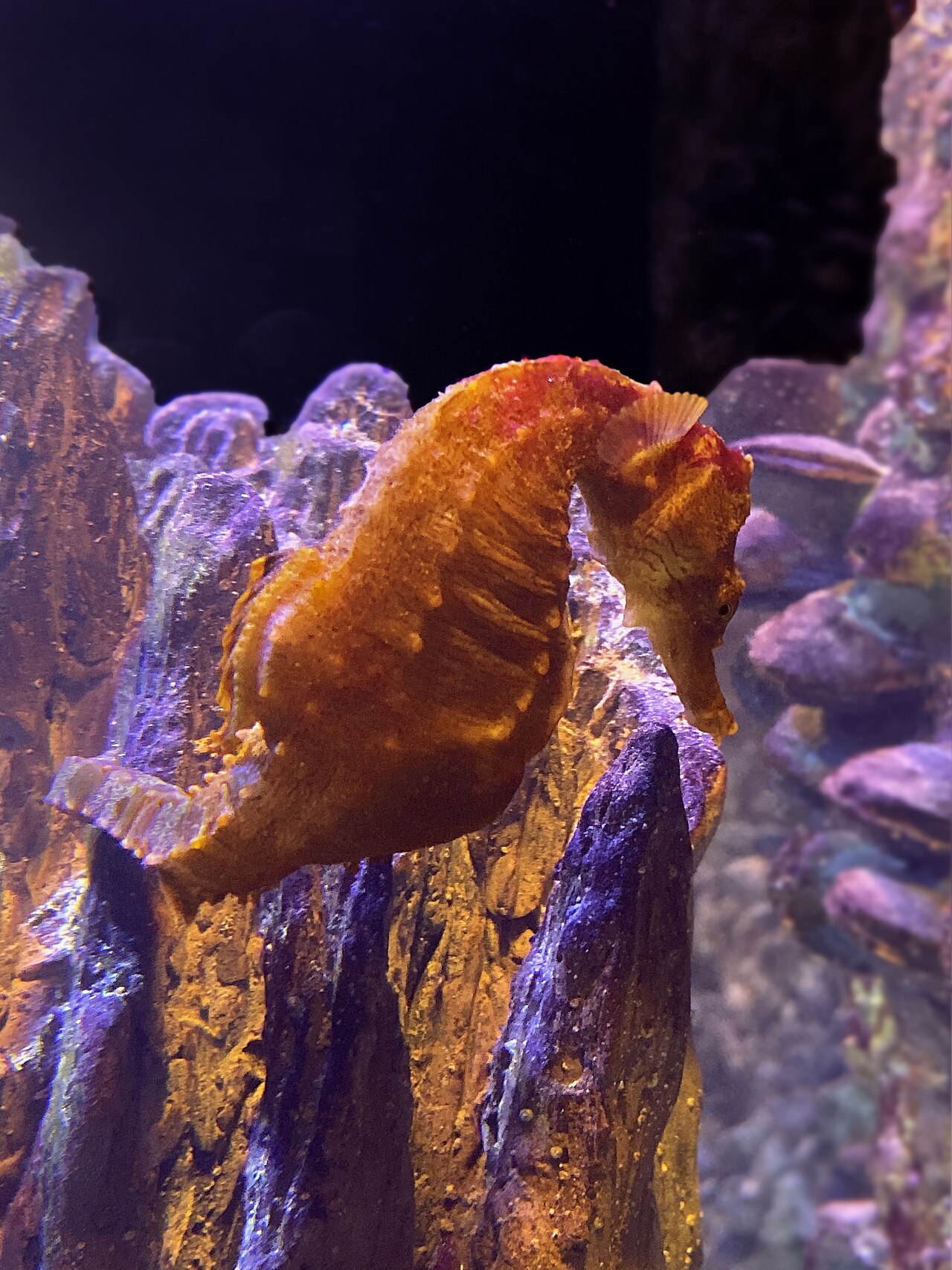
The seahorse symbolizes patience, grace, gentleness and devoted fatherhood. Each of those meanings rests on something the fish actually does. It moves slowly, holds its ground with its tail, and hands pregnancy to the male. Read the symbol through the body and the meaning stays honest.
Patience comes from the hunt. A seahorse is an ambush predator that hovers beside seagrass or coral and waits for tiny crustaceans to drift within reach of its snout. Then it strikes with a fast snap of the head and sucks the prey in. Stillness and speed belong to the same skill here, and a seahorse in your path points to waiting for the right moment instead of chasing every chance.
Grace and steadiness come from posture and grip. The seahorse swims upright, pushed by a small dorsal fin that flutters fast, and it is a weak swimmer in open water. So it curls its prehensile tail around a stem and stays put when the current pulls. That grip makes the seahorse a symbol of staying anchored to what matters while the water moves around you.
Gentleness comes from its manners. The seahorse has no venom, no sting and no bite that can hurt a person, and it never chases anything larger than a shrimp. Its courtship dance adds tenderness and ritual to the picture. Octopus symbolism shows another sea animal omen, one built on cleverness and escape rather than on holding still.
Seahorse Traits and What They Mean
Six habits of the fish carry six meanings, from tail grip to camouflage.
| Trait | What the seahorse does | Symbolic meaning |
|---|---|---|
| Tail grip | Wraps its tail around seagrass in a current | Staying grounded |
| Upright swimming | Moves slowly, driven by a fluttering dorsal fin | Grace and unhurried progress |
| Ambush hunting | Waits still, then snaps up tiny crustaceans | Patience and good timing |
| Male pregnancy | The male carries the eggs in a brood pouch | Nurturing and shared care |
| Courtship dance | Partners in some species meet, circle and change color | Devotion and daily ritual |
| Camouflage | Shifts color to match its surroundings | Adaptability and quiet protection |
Is a Seahorse Lucky?
Yes, a seahorse works as a personal lucky token, because it stands for patience, protection and steady progress, the traits that bring good things over time. Keep one as your own lucky symbol and let it remind you to stay patient while good things grow.
Seahorses in Traditional Chinese Medicine
The animal’s strongest cultural tie in Asia is commercial, not lucky. Dried seahorses are an ingredient in traditional Chinese medicine, and that demand drives the largest share of the global trade in the fish. Much of the supply comes as bycatch from shrimp trawls, so the animals die whether or not anyone wanted them. None of that trade rests on a claim of good fortune.
Should You Buy a Seahorse Charm?
Skip dried seahorse charms and amulets. Buying one feeds the trade that is shrinking wild populations. If you want a seahorse as a lucky token, choose a drawing, a carving or a photo you took on a snorkel trip. Spotting a wild one is good news in its own right, because it means the seagrass bed is healthy. The koi fish meaning and its tie to luck is the better fit when you want a fish connected to fortune.
Seahorse Spiritual Meaning and Spirit Animal
As a spirit animal, the seahorse stands for patience, protection and emotional steadiness. It is the guide for a person who gets there by persisting, not by force. The seahorse never outruns anything. It survives by holding on, blending in and choosing its moment.
The Seahorse as a Totem Animal
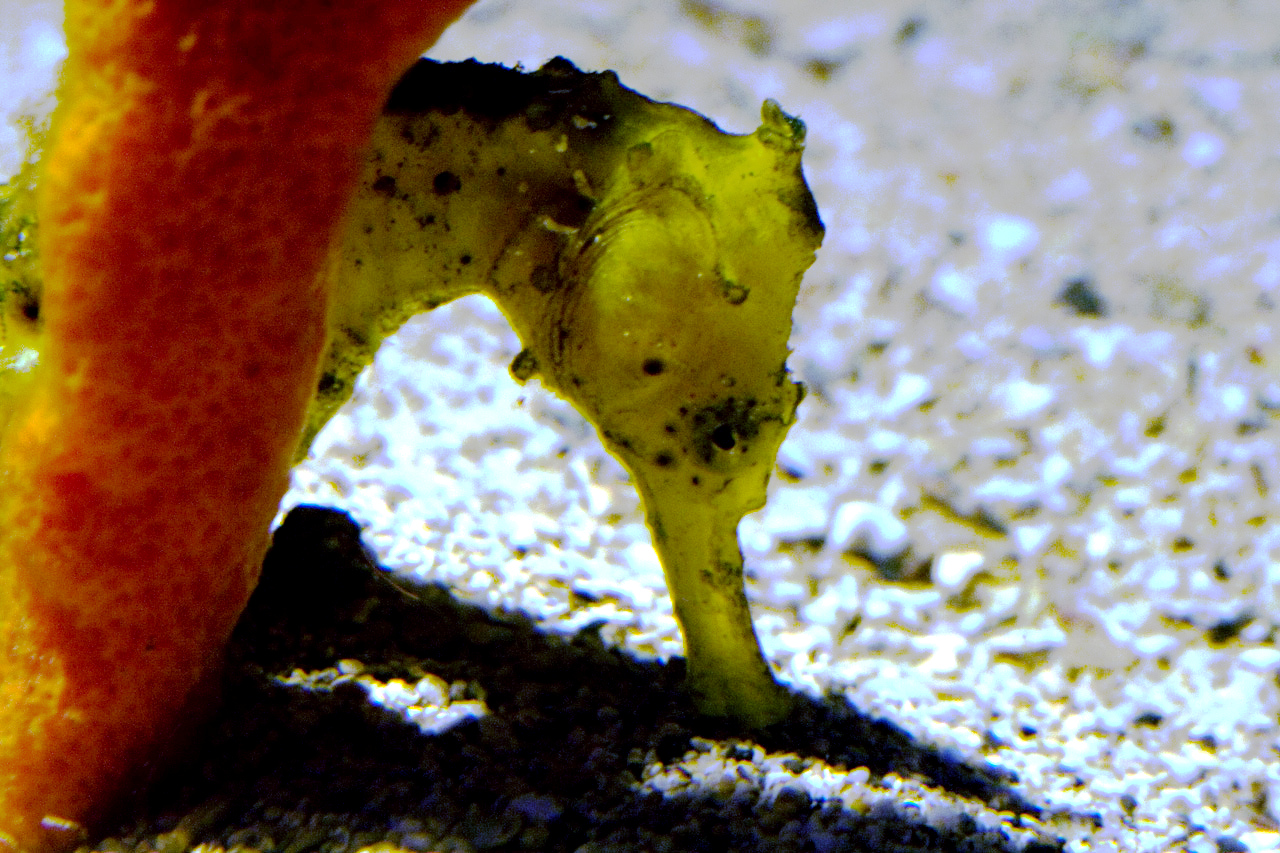
The seahorse as a totem carries four clear traits. The first is perseverance, because a slow swimmer that still crosses a reef has to keep going. The second is protection of the vulnerable, taken straight from the male’s brood pouch. The third is emotional balance, the calm of an animal that hangs upright in moving water. The fourth is flexibility, since the fish changes color to match the grass, the sponge or the coral it rests on.
You will recognize the seahorse spirit animal in people who are gentle but hard to move. They listen before they speak and wait before they decide. They protect the people they love without making noise about it. If that sounds like you, the seahorse asks you to trust your own pace and to stop measuring yourself against faster swimmers.
Seeing Seahorses Again and Again
A repeated encounter with seahorses, in art, in an aquarium or on a beach walk, points to a season of slow, steady work. Grip the thing that keeps you steady and let the current pass. Dolphin symbolism sits at the opposite end of the ocean’s temperament, fast, social and playful, with its own spirit animal reading.
Seahorse Symbolism in Love and Relationships
The seahorse stands for committed, shared love, and the reason is the male. The female deposits her eggs into a brood pouch on the male’s belly, where he fertilizes them, protects them and supplies them with oxygen until birth. Then he goes through contractions and releases fully formed young into the water. Few animals model shared parenting so literally.
Partners in several species also meet every morning. In White’s seahorse (Hippocampus whitei), a monogamous species from eastern Australia, the pair meets at dawn, brightens in color and circles with tails linked before each partner leaves to feed. Researchers who study the species tie this greeting to keeping the pair in step through the breeding season. As a love symbol, it is the small daily ritual that keeps a bond alive.
Seahorse Loyalty: Chosen, Not Automatic
Lifelong fidelity is not true for every seahorse, so do not lean on that part of the story. Some species form pairs that last a breeding season or longer. Others, such as the big-bellied seahorse (Hippocampus abdominalis), court several partners and may switch mates between breeding cycles. The accurate symbol is loyalty that is chosen and renewed, not loyalty that is automatic, and that is a stronger message for any relationship.
What the Seahorse Means for Couples, Parents and Singles
For couples, the seahorse points to dividing the heavy work fairly and showing up for each other daily. For parents, it honors the father who carries as much as the mother. For anyone single, it is a reminder that the right partner greets you every morning, not just on the good days. Jellyfish symbolism offers the contrast, a drifting animal tied to letting go instead of holding on.
Seahorse Dream Meanings
Dreaming of a seahorse points to patience, protection or a part of your life that needs gentle handling. Modern dream interpretation treats water as the world of feeling, and the seahorse is a small, careful presence inside that water. The details of the dream decide which meaning fits. Look at what the seahorse was doing and how you felt.
Common Seahorse Dream Scenarios
A seahorse swimming calmly beside you points to a period when slow progress is the right progress. Stop pushing and the result arrives. A seahorse clinging to seagrass in a strong current points to holding on through stress. It asks what you are anchored to, and whether that anchor still deserves your grip.
A pregnant male seahorse, or a cloud of tiny young, points to a new project or a responsibility you carry for someone else. A dead or stranded seahorse points to a fragile plan or relationship left without support. Treat it as a prompt to check what you have stopped tending, not as a forecast of loss. Holding a seahorse in your hand points to protecting something small and precious that depends on you.
Calm and fear in the dream change the reading more than the animal does. A peaceful seahorse dream confirms your pace. An anxious one says you feel exposed while you wait. Betta fish symbolism covers another small, striking fish that turns up in dreams with its own signs.
Seahorses in Greek and Roman Myth
The seahorse’s mythic ancestor is the hippocampus, a creature with the front half of a horse and the tail of a fish. In Greek myth, hippocampi pull the chariot of Poseidon, god of the sea, across the waves. The name joins the Greek words hippos, horse, and kampos, sea monster. The real fish took its scientific genus name, Hippocampus, from that myth.
Roman artists carried the creature into their own sea scenes, with Neptune in Poseidon’s place. Hippocampi appear in Roman floor mosaics and on carved marble sarcophagi, with Nereids, the sea nymphs, riding on their backs. In that art the hippocampus is a carrier. It moves its riders through a world humans cannot cross on their own.
The Seahorse and the Human Brain
The myth even reached anatomy. The Bolognese anatomist Julius Caesar Aranzi named a curved structure deep in the brain the hippocampus because its shape reminded him of a seahorse. That region is central to forming new memories and to finding your way through space. So one word now covers a sea god’s horse, a small fish and the part of the brain that remembers where you have been.
Biblical Meaning of a Seahorse
The Bible never mentions a seahorse. No verse in the Old or New Testament names the animal, so any biblical meaning of a seahorse is a modern reading, not scripture. Be wary of pages that quote a seahorse verse. None exists.
The closest the Bible comes is its rule on sea creatures. Leviticus 11:9 to 12 allows the Israelites to eat water animals with fins and scales and calls the rest detestable. A seahorse has fins but no scales, since its body is skin stretched over bony plates. Under that law it falls on the unclean side.
The sea itself carries weight in scripture. Psalm 107:23 to 24 describes sailors who see the works of the Lord and his wonders in the deep. Revelation 21:1 pictures a new earth where there is no more sea. A Christian reader who wants a seahorse meaning can start from Psalm 107 and see the small fish as one of those wonders of the deep.
Seahorse and the Zodiac
No zodiac sign is a seahorse. The twelve signs of Western astrology include two water creatures, Pisces the fish and Capricorn the sea goat. The Chinese zodiac includes the Horse, but not the seahorse.
In modern astrology, the seahorse pairs most naturally with Pisces, because both are water animals tied to sensitivity and intuition. That pairing is an association, not a sign. Capricorn is the other close match. Its sea goat has a fish tail, much like the hippocampus has a horse’s head on a fish’s body.
If you were born in a Year of the Horse, the seahorse makes a playful water twin for your sign, but it holds no official place in the Chinese zodiac. Treat any seahorse horoscope as a creative pairing. The animal’s real traits, patience, grip and shared care, work as a personal emblem whatever your sign.
What Is the Purpose of a Seahorse?
The purpose of a seahorse in nature is to eat small crustaceans and to feed larger animals, and both roles tie it to seagrass, mangroves and reefs. Seahorses hunt copepods, amphipods and tiny shrimp with a fast snap of the snout. They have no teeth and no true stomach, so they feed through the day to keep up. Crabs, rays and larger fish eat them in turn.
Seahorses stay in small home ranges, so they work as a signal of habitat health. When seagrass beds shrink from runoff, dredging or warming water, the seahorses go with them. The lined seahorse and the dwarf seahorse both depend on these shallow meadows in US waters. The FishBase profile of the lined seahorse lists its range from Nova Scotia south through the Gulf of Mexico. Protecting the grass protects the fish.
Threats to Wild Seahorses
Beyond habitat loss, people threaten seahorses directly. Shrimp trawls catch seahorses as bycatch, and dried seahorses supply the traditional medicine and curio trade. All seahorse species are listed in Appendix II of CITES, which means international trade needs permits showing it does not harm wild populations. The IUCN Red List rates a number of species as Vulnerable or Endangered.
The name fools people too. A seahorse is a bony fish in the family Syngnathidae, alongside pipefish and seadragons. It breathes with gills, steers with fins and keeps its upright posture with a swim bladder. It has no relation to horses at all.
Seahorse Slang and Other Meanings
Seahorse has no established slang meaning in mainstream English dictionaries. If you have heard it used as slang, treat it as local or online jargon without a fixed definition. The word has older, documented senses instead. In older English, sea horse also named the walrus, and it still names the half horse, half fish hippocampus of myth. Heraldry uses that mythic sea horse on coats of arms. In anatomy, the same Latin word names the memory center of the brain.
Frequently Asked Questions
Are seahorses fish?
Yes, seahorses are bony fish in the genus Hippocampus. They breathe through gills, swim with a small dorsal fin and control their upright posture with a swim bladder. Their closest relatives are pipefish and seadragons, and they have no connection to horses beyond the shape of the head.
Do seahorses mate for life?
No, not all of them. Some species, such as White’s seahorse, form pairs that stay together through a breeding season or longer and greet each other daily. Other species, including the big-bellied seahorse, court several partners and may switch mates between breeding cycles. Lifelong fidelity is a species trait, not a rule for every seahorse.
How many babies does a male seahorse have?
A male seahorse releases anywhere from a handful of young to more than a thousand in one birth, depending on the species. Small species such as the dwarf seahorse produce tiny broods, while larger species such as the lined seahorse release hundreds at a time. Very few of the young survive to adulthood.
Can you keep a seahorse as a pet?
Yes, but only captive-bred seahorses in a dedicated aquarium, and it is demanding. They need slow water, places to grip, live or frozen food several times a day and calm tank mates. Wild-caught seahorses suffer in home tanks and feed the trade that is shrinking wild populations.
Are seahorses endangered?
Yes, several seahorse species are rated Vulnerable or Endangered on the IUCN Red List. All species are listed in CITES Appendix II, so international trade needs permits. Bycatch from shrimp trawls, the dried seahorse trade and the loss of seagrass beds are the main threats.
What is a group of seahorses called?
A group of seahorses is called a herd, a name borrowed from the horses they resemble. Newborn seahorses are called fry, the same word used for the young of other fish. Seahorses rarely gather in large groups, and most adults spend their days close to one partner or alone.
Sources
- FishBase, Hippocampus erectus, Lined seahorse
- Animal Diversity Web, University of Michigan, Hippocampus erectus
- CITES, Appendices I, II and III