Brown Butterfly Lands on You Meaning: Signs and Luck
As a sign, a brown butterfly lands on you to say that something steady is forming in your life and that you can lean on it. The landing adds closeness. A wild insect chose to rest on you, and that turns a passing sighting into a personal moment.
The color sets the tone. Brown is the shade of soil, bark and dry leaves, so its message concerns roots and footing rather than sudden fortune.
Symbolically, a brown butterfly on your hand or shoulder stands for grounding, stability and home. It asks you to slow down, tend what you already have and trust a change that grows at its own pace. For luck, it is gentle and steady, a promise of security rather than a windfall.
What Does It Mean When a Brown Butterfly Lands on You?
A brown butterfly that lands on you means it is time to settle, stay patient and build on solid ground. The landing is the personal part. A butterfly that only flutters past is a sight. One that rests on your arm makes you hold still and pay attention, and that stillness is the lesson.
Brown carries the meaning of earth, the material that holds everything up without drawing notice. A brown butterfly on your shoulder points to stability, home and the slow work that pays off later. It favors patience over speed and roots over restlessness. If you are waiting on a decision, a job or a recovery, the visit says the ground under you is firmer than it feels.
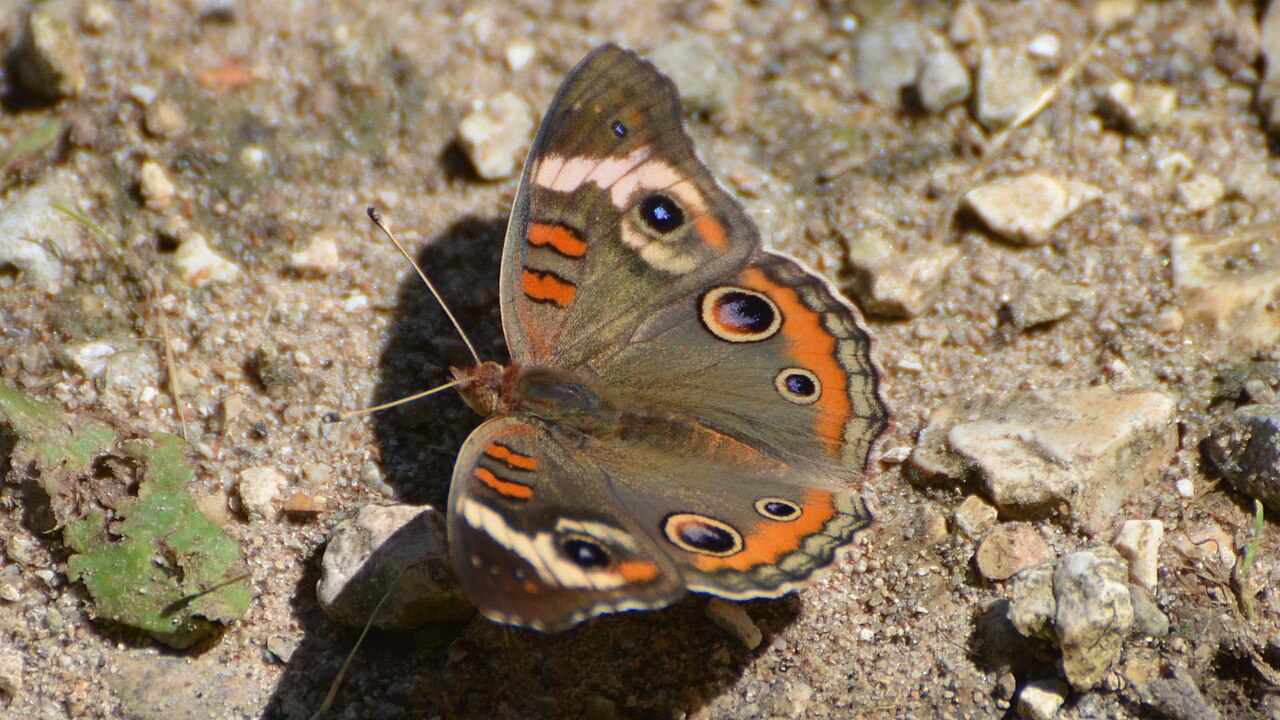
The butterfly lands on you meaning in general centers on change and trust, and brown narrows that broad message toward security. Common brown species in the US include the Common Buckeye (Junonia coenia), with its large eyespots, and the Little Wood Satyr (Megisto cymela) of shady woodland edges. Both fly low and stay close to the ground, which fits a sign about footing. Notice where the butterfly settles. One on your hand points to work you do with your hands, and one on your head points to thoughts that need calming.
Is It Good Luck When a Brown Butterfly Lands on You?
Yes, a brown butterfly landing on you counts as good luck, though of a quiet kind. Its luck is about security, such as a stable home, steady money and health that holds, rather than a sudden win. That makes brown one of the most reassuring colors to receive.
Which color butterfly is lucky depends on the kind of luck you want. Yellow points to joy and good news, orange to energy and drive, white to peace and blessings, and brown to stability. None of these colors is unlucky. The difference is the area of life the sign touches.
A butterfly that stays on you for a while strengthens the sign. Let it leave on its own. Shooing it away ends the moment early, while waiting it out keeps both you and the insect calm.
A Brown Butterfly as a Spiritual Message or Guide
A brown butterfly carries a spiritual message about staying rooted while change does its work. The message is not a warning. It is a nudge to keep faith in a slow process and to stop measuring progress by speed.
The butterfly as a soul is an old image. In ancient Greek, the word psyche meant both the soul and a butterfly or moth, a double sense recorded in the Liddell and Scott Greek lexicon. In Japanese folklore, Lafcadio Hearn wrote in Kwaidan (1904) that a butterfly can be the soul of a living or a dead person. A brown one fits the guide role well, because it looks like a messenger from the earth itself.
The seeing a brown butterfly meaning shifts the message toward direction and timing. A landing makes it close. Contact asks for a response, while a sighting asks only for attention.
Transformation and New Beginnings
A brown butterfly stands for transformation because every butterfly is the product of complete metamorphosis, from egg to caterpillar to chrysalis to winged adult. The change happens out of sight inside the chrysalis. The adult that emerges looks nothing like the caterpillar that started.
Brown gives that change a practical, everyday shape. It points to a new routine, a move, a recovery or a career step that grows from steady effort. The new beginning it promises is built, not handed over.
If a brown butterfly lands on you during a period of change, take it as a reminder that the hidden stage counts. Progress you cannot see yet is still progress.
What Brown Means Compared With Other Colors
Brown means grounding and stability, yellow means joy, white means peace, blue means calm and wishes, and black means endings and protection. Brown is the earthy member of the group, the color that keeps the brighter messages anchored.
| Color | Symbolic theme | US example species |
|---|---|---|
| Brown | Grounding, stability, home | Common Buckeye |
| Yellow | Joy, hope, good news | Eastern Tiger Swallowtail (Papilio glaucus) |
| White | Peace, purity, blessings | Cabbage White (Pieris rapae) |
| Blue | Calm, wishes, inner truth | Eastern Tailed-Blue (Cupido comyntas) |
| Black | Endings, protection, renewal | Black Swallowtail (Papilio polyxenes) |
| Orange | Energy, warmth, drive | Monarch (Danaus plexippus) |
Yellow butterfly symbolism leans bright and outward, toward cheerful news and a lighter mood, where brown leans inward toward security.
White butterfly symbolism centers on peace and spiritual presence, a softer tone than the practical brown.
Blue butterfly symbolism points to calm and wishes coming true, a lighter and more hopeful charge than brown carries.
Biblical Meaning of the Brown Butterfly
The biblical meaning of a brown butterfly comes from Christian art rather than from a verse, and there the butterfly stands for resurrection and new life. Its passage from caterpillar to tomb-like chrysalis to winged adult mirrors the Easter story.
When God sends you a butterfly, the nearest Scripture is 2 Corinthians 5:17, which calls a person in Christ “a new creature” whose old things are passed away. No verse in the King James Version gives the butterfly itself a meaning. The nearest relative the King James Version names is the moth, as in Matthew 6:19, where moth and rust corrupt treasure on earth, and the word brown appears for Jacob’s flock in Genesis 30.
Black butterfly spiritual meaning draws on the same resurrection theme from the darker side, as an ending before renewal.
Why Butterflies Really Land on You
Butterflies land on you mainly for salt and moisture. Sweat carries sodium, a nutrient male butterflies seek out, and the same urge draws them to wet mud in a habit called puddling.
Warmth plays a part too. Butterflies need warm flight muscles, so a sunny arm or a dark shirt can serve as a resting spot on a cool morning. Moths land for the same reasons, and the Library of Congress explains how to tell the two apart.
Frequently Asked Questions
What is the rarest color of a butterfly?
Butterfly colors have no fixed rarity ranking, but blue stands out because most blue butterflies make it with structure rather than pigment. Microscopic ridges on the wing scales bend light into blue, as in the Blue Morpho (Morpho menelaus). Blue pigment itself is scarce in butterfly wings.
What is the prettiest butterfly ever?
Beauty is personal, so no species holds that title, but two butterflies show why the question comes up. The Blue Morpho of Central and South America flashes metallic blue in flight. The Ulysses swallowtail (Papilio ulysses) of Australia and New Guinea carries electric blue panels edged in black.
What is the most beautiful color of butterfly?
The most beautiful butterfly color is a matter of taste, so no single color wins. Iridescent shades have a special pull because they change as the wings move. Among US species, the Red-spotted Purple (Limenitis arthemis astyanax) shows a blue-green shimmer on near-black wings.
Is a brown butterfly a moth?
No, a brown butterfly is a true butterfly, but many brown fliers are moths. Butterflies have thin antennae ending in a club, and most fold their wings upright at rest. Moths most often have feathery or tapered antennae and hold their wings flat or tent-like. Daytime flight also favors a butterfly.
Can touching a butterfly harm it?
Yes, touching a butterfly can harm it. Its wings are covered in tiny scales that rub off on fingers, and a firm grip can bend or tear the thin wing membrane. If one lands on you, let it walk and leave on its own, and never hold it by the wings.
Sources
- Library of Congress, What is the difference between a butterfly and a moth?
- Perseus Digital Library, Liddell and Scott Greek-English Lexicon, psyche
- Project Gutenberg, Kwaidan by Lafcadio Hearn
- Bible Gateway, 2 Corinthians 5:17 (KJV)
Explore more: Insect Spiritual Meanings: 15 Bugs and What They Signal