Javelina Tracks: How to Identify Them in Snow, Mud and Sand
A javelina track is a small, blunt tipped, two toed print about 1.3 in (3.3 cm) long, and the fastest way to confirm it is a clear hind print: javelinas have only three toes on the back foot, while deer and feral hogs have four. That single detail separates the collared peccary from every other hoofed animal in the Southwest, and it works in snow, mud, and firm sand alike.
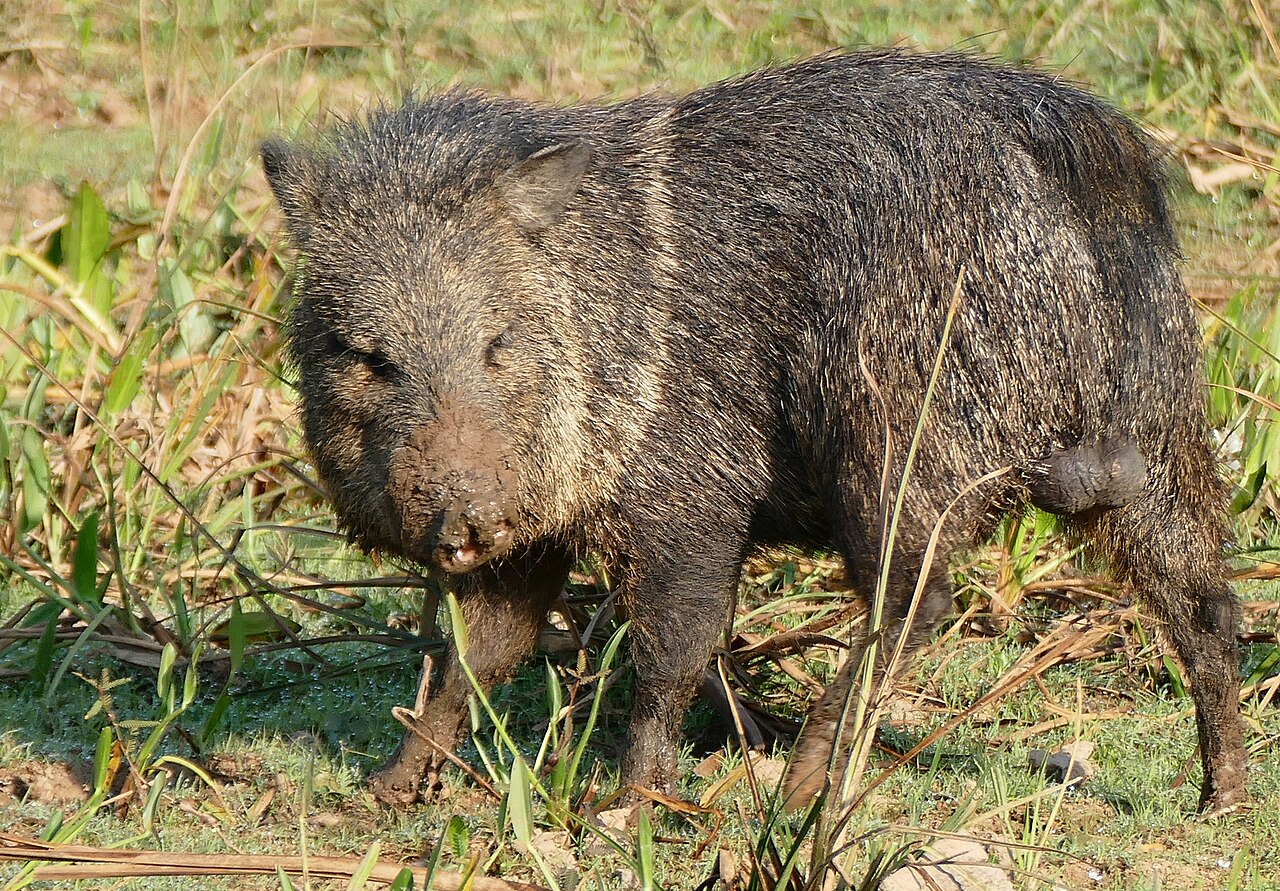
Javelinas (Dicotyles tajacu, long listed as Pecari tajacu) travel in herds of 6 to 12, so their sign rarely appears as a tidy single trail. You find a churned corridor heading toward water or a prickly pear stand. Below: measurements, substrate by substrate reading, and how to rule out the two animals this track gets confused with.
Javelina tracks are 1.1 to 1.6 in (2.8 to 4 cm) long with two blunt, rounded hooves and no splay. Front tracks are slightly larger than hind tracks. The hind foot carries three toes, the front foot four, though the small dewclaws seldom register. Walking stride is 9 to 14 in (23 to 36 cm) and tracks almost always appear in herd groups.
| Measurement | Front track | Hind track |
|---|---|---|
| Length | 1.3 to 1.6 in (3.3 to 4 cm) | 1.1 to 1.4 in (2.8 to 3.5 cm) |
| Width | 1.1 to 1.4 in (2.8 to 3.5 cm) | 1.0 to 1.2 in (2.5 to 3 cm) |
| Toes that register | 2 hooves, rarely 2 dewclaws | 2 hooves, rarely 1 dewclaw |
| Toe tip shape | Blunt and rounded | Blunt and rounded |
| Walking stride | 9 to 14 in (23 to 36 cm) | 9 to 14 in (23 to 36 cm) |
| Trail width | 4 to 6 in (10 to 15 cm) | 4 to 6 in (10 to 15 cm) |
| Usual gait | Direct register walk | Trot when alarmed |
What a javelina track looks like
The print is a compact pair of hoof marks that together form a slightly squared oval rather than a heart. Each hoof is roughly as long as it is wide, with a flat or gently rounded tip and nearly parallel inner edges. In firm ground the two halves sit tight together with a hairline gap, and the whole track fits under a US quarter.
Depth tells you about the animal. Adults weigh 35 to 60 lb (16 to 27 kg), light enough to leave almost nothing on packed desert caliche and surprisingly crisp prints in fine silt. Judge freshness against the substrate rather than a general rule: a print in dry sand degrades within hours in wind, while one in dried mud at a stock tank holds for weeks.
Front and hind feet: the three toed giveaway

A javelina’s front foot has four toes, two large central hooves carrying the weight plus two small dewclaws set high and to the rear. The hind foot has only three, because the outer dewclaw has been lost entirely in this family. That asymmetry does not exist in deer, elk, or feral hogs, all of which carry two dewclaws on every foot.
Dewclaws register only in mud deeper than about 1 in (2.5 cm), in snow, or when the animal runs. When they appear, count them: two dots behind the hooves means a front foot or a different species, one dot means a peccary hind print. Front tracks also run wider and deeper, because javelinas carry a heavy head and shoulders over short legs.
Javelina tracks in snow
Snow is uncommon in most javelina range but far from rare at elevation. Payson, Prescott, Sedona, and the Chihuahuan Desert grasslands of southern New Mexico all get several snow events a year, and javelina stay active through them. Winter is the best tracking season available here, because the animals shift to daylight activity when nights turn cold.
Fresh powder exaggerates the track by 15 to 30 percent, collapses the rim, and brings both dewclaws out as the short legs push through. Watch the gaps between prints: a javelina’s low belly leaves a continuous drag scuff in snow deeper than about 4 in (10 cm), which deer do not produce at the same depth. Compare winter prints against our guide to deer tracks.
Next question: Javelina Poop: 7 Field Marks That Identify It Fast
Javelina tracks in mud
Mud at stock tanks, spring seeps, and wash edges after monsoon rain produces the clearest javelina tracks you will find. Hoof walls, blunt tips, and dewclaws all record, and a photograph with a ruler beside it is enough for a wildlife biologist to confirm the species from the image alone.
Herd behavior shows best here. Instead of a line of prints you get a trampled fan where ten animals milled at a water edge, often with rooting marks where snouts turned the soft ground. Look along the outer edge of the disturbance for the one clean print that defines the set, and note the narrow 4 to 6 in straddle that hogs never match.
Javelina tracks in sand and dust
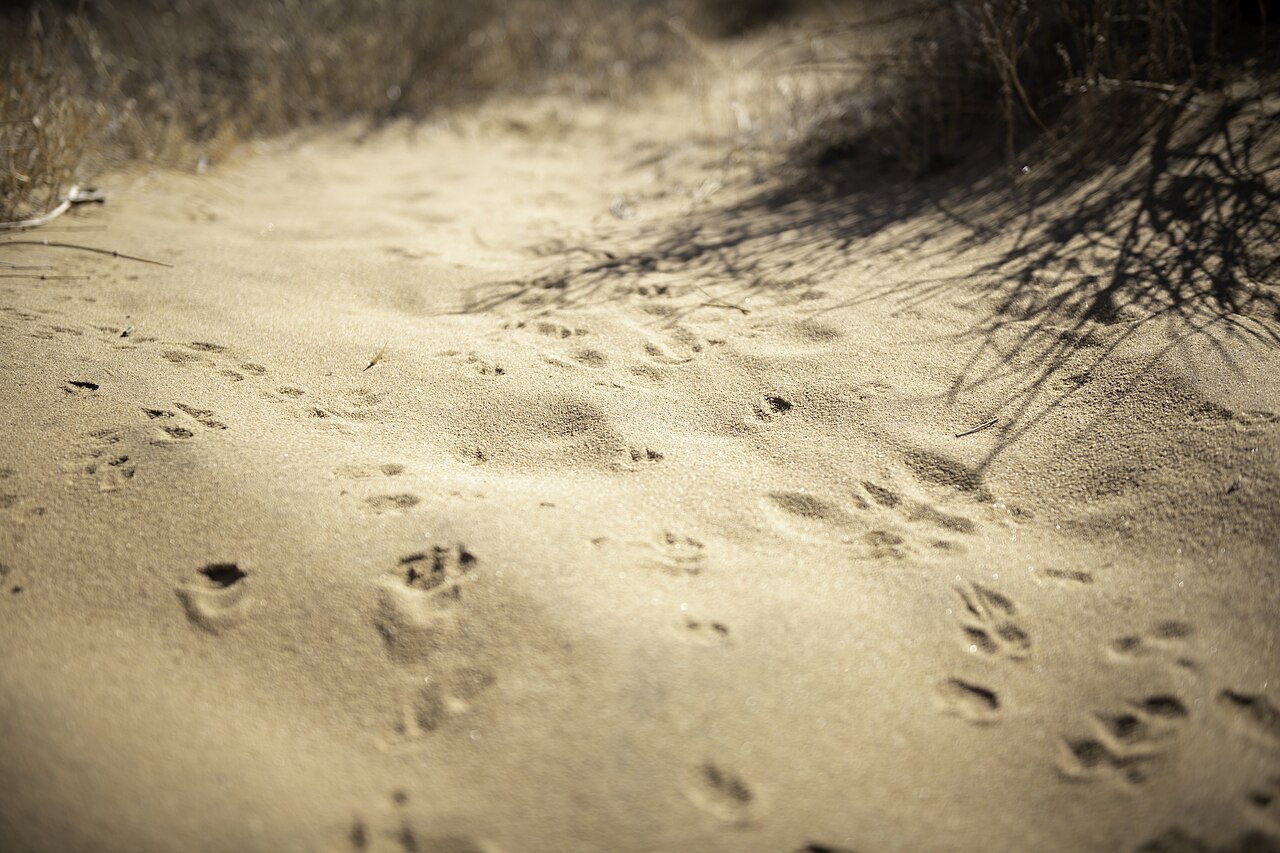
Dry sand is the most common and least informative substrate in javelina country. Loose grains collapse the hoof walls immediately, so you get two shallow dimples with no detail and no dewclaws. Do not try to identify a species from a single sand print.
Work the trail instead. Follow it until it crosses something firmer: silt in a wash bottom, a dirt road shoulder, the compacted apron around a water tank. Fifty yards of walking usually turns up one usable print. Sand still preserves pattern, so count parallel lines of travel to count animals. The same approach works for coyote tracks in identical ground.
What are the differences between javelina tracks and deer tracks?
Size is the first filter and it is decisive. A mule deer or whitetail track runs 2 to 3.5 in (5 to 9 cm) long, roughly twice the length of a javelina print. If the track is shorter than your thumb from tip to first knuckle, deer is already unlikely.
Shape is the second. Deer hooves come to distinct points and form a heart or teardrop with a narrow front, while javelina hooves end bluntly in a rounded rectangle. Deer tracks splay into a V when the animal runs or lands soft; javelina hooves barely separate at any speed. Deer also bound in spaced groups of four, where javelina walk in close herd columns. The bobcat vs coyote tracks comparison uses the same stride first method.
Javelina tracks versus feral hog tracks
Feral hogs overlap javelina range across much of Texas and are spreading west, so this is the confusion that actually costs accuracy. Hog tracks are wider than they are long, often 1.5 to 3 in (4 to 7.5 cm), with hooves that splay outward and dewclaws that print well outside the line of the main hooves in soft ground.
Javelina tracks are as long as they are wide or slightly longer, the hooves stay tight, and the dewclaws sit directly behind them. Add the three toed hind foot and it is settled. Weight helps as a secondary check, since adult feral hogs run 150 to 300 lb (68 to 136 kg) and punch far deeper. Hogs also plow continuous furrows, while javelina rooting is shallow and patchy around specific plants.
Gait, stride and reading a herd trail
The default javelina gait is a direct register walk, where each hind foot drops into the print just made by the front foot on the same side. That produces what looks like a single line of evenly spaced tracks and holds the trail width to 4 to 6 in. Stride stays between 9 and 14 in unless the animal is pressed.
Alarmed javelinas trot, lengthening the stride to 16 to 22 in (41 to 56 cm) and breaking the direct register so prints appear as offset pairs. A trail that shifts from walk to trot marks the moment the herd detected something. To count animals, find a pinch point such as a fence gap or narrow wash crossing; across open ground the prints overlap into an unreadable mass, exactly as bison tracks do on open range.
Where to find javelina tracks in Arizona and the Southwest
Range covers central and southern Arizona, southern New Mexico, and much of south and west Texas, from Sonoran Desert scrub up into oak and juniper country at 5,000 ft (1,520 m). Within that range, concentrate on water. Stock tanks, spring seeps, and cattle troughs collect tracks from every herd within a few miles.
The other reliable spots are prickly pear thickets, agave stands, dry wash bottoms used as travel corridors, and dirt road shoulders checked at sunrise. In suburban Tucson, Prescott, and Sedona, golf course edges and irrigated landscaping produce tracks nightly. Washes are worth walking slowly because they hold predator sign as well; see coyote vs fox tracks.
Other javelina sign to confirm the track
Smell is the most underrated confirmation. Javelinas carry a dorsal scent gland about 8 in (20 cm) above the tail and leave a strong, sour, musky odor on rubs, beds, and the ground where a herd has passed. Many experienced Arizona trackers smell a herd before finding a single print.
Look for rubs on rocks, fence posts, and trunks at 12 to 18 in (30 to 46 cm) above ground, often shiny with embedded coarse hair. Beds are shallow scrapes under mesquite or rock overhangs, reused for weeks. Visitor centers at National Park Service units across the Southwest publish local track guides worth picking up before a trip.
Frequently Asked Questions
What does a javelina scat look like?
Javelina scat is usually a loose, dark, segmented mass rather than firm pellets, 1 to 2 in (2.5 to 5 cm) across, often containing prickly pear fibers, seeds, and visible plant pulp. It frequently appears as a soft pile near bedding and feeding sites. Diet shifts the consistency, so after heavy cactus feeding it can be nearly formless.
Is a javelina a pig or a rat?
Neither. The javelina is a collared peccary, a member of the family Tayassuidae, which split from true pigs roughly 30 million years ago. It is not a rodent and not a feral hog. The differences are structural: a three toed hind foot, a simpler stomach, a dorsal scent gland, and straight tusks that point down rather than curling outward.
Are javelinas aggressive?
Javelinas are not aggressive by default but they are defensive and have poor eyesight, which produces most incidents. A startled herd may charge in your direction simply because it cannot see where you are. Dogs trigger genuine attacks, since javelina treat canines as predators. Give any herd 50 ft (15 m) of space and back away rather than standing still.
Where do javelinas sleep at night?
They bed in shallow scrapes under mesquite thickets, in rock overhangs, in caves, and in dense brush, usually packed close as a group for warmth. In towns they regularly bed under decks, in culverts, and in landscaped yards. The same beds get reused for weeks, which makes them a reliable place to confirm sign after finding a trail.
What time of day are javelinas active?
Activity tracks temperature. In summer javelinas are largely nocturnal and crepuscular, feeding from dusk through early morning and bedding through the heat. In winter they shift to daylight, with peak movement in mid morning and late afternoon. That winter shift is why January through March is the best window for finding and following fresh tracks.
What are javelinas scared of?
Mountain lions, coyotes, bobcats, and dogs are the threats they respond to. Loud noise, sudden movement, and sprayed water push a herd off a property reliably. Scent repellents do not work, and fencing under 3 ft (0.9 m) rarely holds them. Removing water and fallen fruit beats scaring them. See bear tracks for another large mammal visiting the same yards.