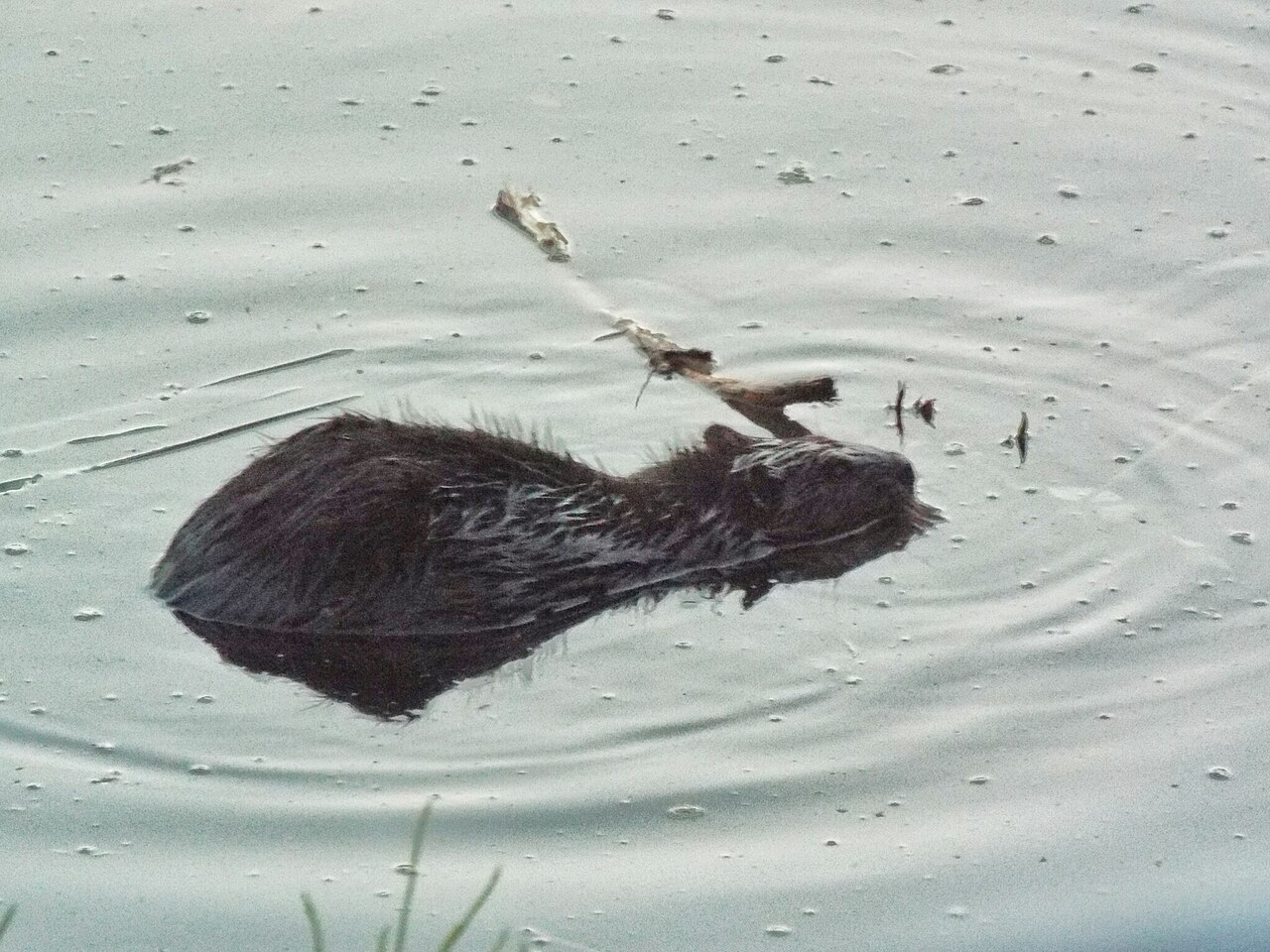
Baby Beaver
A baby beaver, called a kit, arrives far more developed than most newborn rodents, born with open eyes, a full coat of fur, and the ability to swim within hours of birth. According to the University of Maryland Extension, a typical litter of two to five kits is born in a dry chamber inside the family lodge each spring, already equipped with functioning teeth and able to start nibbling soft vegetation within about three weeks of birth.
Despite that head start, beaver kits stick close to home far longer than almost any other rodent, staying with their parents and older siblings for up to two years while they learn the complex engineering skills needed to build a lodge and dam of their own, an apprenticeship unlike anything seen in most other small mammals.
| Quick Reference | Detail |
|---|---|
| Name | Kit |
| Litter Size | 2 to 5 kits (occasionally up to 6) |
| Birth Weight | About 1 pound (9 to 21 ounces) |
| Birth Condition | Eyes open, furred, able to swim within hours |
| Weaning Age | 2 to 3 weeks |
| Leaves Family | Around 2 years old |
| Lifespan | 10 to 12 years in the wild |
What Is a Baby Beaver Called?
A baby beaver is called a kit, a term that traces back to “kitten,” which early naturalists once used loosely for the young of many small mammals before it eventually settled specifically on beavers, foxes, and a handful of other species over time. A group of kits born together is called a litter, and the extended family unit they grow up in, typically the parents plus one or two years of previous offspring, is called a colony.
Beaver colonies are unusually stable and long-lived compared to most rodent family groups, since kits don’t scatter and become independent within weeks the way mice or squirrels do. Instead, an entire multi-generational household works together, sharing lodge maintenance, food gathering, and even childcare duties across the different age groups living under one roof, a cooperative arrangement that sets beavers apart from nearly every other rodent species in North America.
How Big Is a Newborn Beaver Kit?
A newborn beaver kit weighs approximately one pound, ranging from about 9 to 21 ounces depending on litter size and individual variation, and measures roughly 12 to 15 inches long including its distinctive flat, paddle-shaped tail, a birth weight not far off that of a newborn deer fawn. Unlike most rodents, which are born blind, hairless, and utterly helpless, a beaver kit arrives already covered in soft fur with its eyes open, giving it an immediate head start most newborn mammals simply don’t get.
This advanced state at birth isn’t an accident of nature. Because beaver kits are born in a semi-aquatic environment and need to be ready to enter the water for safety within their first day of life, evolution has pushed their development timeline earlier and faster than land-dwelling rodents that don’t face the same immediate survival pressure right from the moment of birth.
Where Are Beaver Kits Born?
Kits are born inside a dry, insulated chamber at the heart of the family lodge, a carefully engineered room built above the waterline and accessible only through underwater tunnels that keep predators from reaching the nursery directly. The chamber is lined with wood shavings, grasses, and other soft plant material, refreshed regularly to keep the space clean and comfortable for the growing litter.
This dry-chamber design does double duty: it protects vulnerable newborns from both the elements and land predators, while the underwater entrances mean the whole family can come and go without ever being spotted approaching or leaving the lodge. In colder climates, the thick mud-and-stick walls of the lodge insulate so effectively that the interior rarely drops below freezing even when it’s well below zero outside, keeping the entire family, kits included, safe and reasonably warm through the harshest winter months.
What Do Baby Beavers Eat?
For their first two to three weeks, beaver kits nurse exclusively on their mother’s milk, which is notably rich in fat to fuel their rapid early growth. Uniquely among rodents, kits also receive direct food provisioning from other family members almost immediately: while the mother nurses, the father and older siblings from the previous year’s litter bring soft plant material like cambium strips, tender aquatic shoots, and young willow leaves straight to the kits inside the lodge.
This communal feeding effort is a major reason beaver kits develop so quickly compared to other rodents, since they’re getting nutritional support from multiple family members rather than relying on one parent alone. By around three weeks old, kits are eating solid vegetation directly, and they gradually transition toward the same woody, bark-heavy diet adult beavers rely on for the rest of their lives. Older kits also start experimenting with the same tree species their parents favor, gradually building a working knowledge of which bark and leaves are worth the effort to gather versus which are best left alone. This early food education, learning to distinguish preferred species like aspen, willow, and birch from less desirable trees, turns out to be just as important to a young beaver’s survival as learning to swim or build.
How Do Beaver Kits Learn to Build?
Beaver kits are born with an instinctive drive to gnaw, dam, and build, but the actual skill takes years of watching and practicing to develop properly, much like any genuinely complex trade passed down through direct observation. Young kits often ride on an adult’s back during early foraging trips, observing tree-felling, stone placement, and mud-packing technique up close before ever attempting it themselves.
Kits begin practicing almost as play, gathering small sticks and mud to construct miniature dams or lodge-like structures near the real family home, a kind of engineering apprenticeship that has no real equivalent in most other mammals. By the time a beaver reaches yearling status, it has usually graduated to genuinely helpful tasks like waterproofing the lodge roof or plugging small leaks in the dam under the supervision of its parents, gradually taking on more demanding construction jobs as its strength and confidence grow with each passing season.
Life Inside the Beaver Colony
A typical beaver colony consists of a monogamous adult pair along with the current year’s kits and the yearlings from the previous litter, creating a multi-generational household of roughly six to eight individuals working together, a far more stable family structure than the more solitary lifestyle of a young fox once it disperses. Both parents share responsibilities, with the father often focused on maintaining territory and defenses while the mother serves as the primary caregiver inside the lodge, a division of labor that shifts somewhat as kits grow older and need less constant supervision.
Older siblings, the yearlings, play an active hands-on role too, helping groom the newest kits and assisting with ongoing dam and lodge maintenance, essentially functioning as built-in babysitters and apprentice engineers at the same time. This tightly knit family structure is part of why beavers are considered one of the more socially sophisticated rodents, with strong bonds that hold the colony together for years at a stretch, reinforced daily through mutual grooming and shared responsibility for the same home.
What Threats Do Baby Beavers Face?
Even with constant family supervision, beaver kits face real danger, particularly from predators like wolves, coyotes, foxes, and eagles that target young or inexperienced animals venturing too far from the safety of the lodge, the same broad predator pressure faced by a young rabbit or raccoon caught out in the open. Environmental hazards including flooding, drought, and disease add further risk during a kit’s vulnerable first year, compounding the already steep odds facing any small, slow-moving newcomer to the pond.
Survival rates reflect these pressures: only about 50 to 75 percent of baby beavers make it through their first year, a sobering statistic driven by predation, trapping in some regions, and the general hazards of life in and around open water. Kits that do survive that critical first year have much better odds going forward, especially once they’re large and strong enough to hold their own within the colony’s shared defenses and no longer represent easy prey for most predators in the area.
When Do Baby Beavers Leave Home?
Beaver kits stay remarkably close to home compared to most rodents, remaining with their parents and siblings for about two years before finally striking out to build a lodge and family of their own. At that point, though not yet sexually mature, a young beaver has learned enough engineering and survival skill from its family to make it on its own, not unlike how a young otter eventually leaves its family group once it has mastered the basics of independent hunting.
This extended childhood is unusually long for a rodent, and it reflects just how much specialized knowledge, dam building, lodge construction, and territory management, a young beaver genuinely needs before it can survive and reproduce on its own. Once a beaver does leave, it travels in search of unclaimed water frontage, sometimes covering surprising distances, occasionally many miles overland between waterways, before settling down to build its very first lodge from scratch.
Frequently Asked Questions
What is a baby beaver called?
A baby beaver is called a kit, and a litter typically contains two to five kits born together each spring.
Can baby beavers swim right after birth?
Yes, beaver kits are capable of swimming within about 24 hours of birth, though they need practice before becoming strong, confident swimmers over longer distances.
How long do baby beavers stay with their parents?
Kits typically remain with their family colony for about two years, learning dam and lodge building skills before leaving to start their own colony.
What do baby beavers eat?
They nurse on their mother’s milk for the first two to three weeks, then transition to soft vegetation like leaves and shoots before eventually eating the same bark-heavy diet as adult beavers.
How many babies do beavers have at once?
A typical litter contains two to five kits, though litters of up to six have occasionally been recorded.
Do baby beavers have a lot of predators?
Yes, wolves, coyotes, foxes, and eagles all pose a threat to young beavers, and only about half to three-quarters of kits survive their vulnerable first year of life.
Where are beaver kits born?
Kits are born in a dry, insulated chamber inside the family lodge, built above the waterline and accessible only through underwater tunnels for protection from predators and the elements alike.