Mule Deer vs Whitetail: How to Tell Them Apart
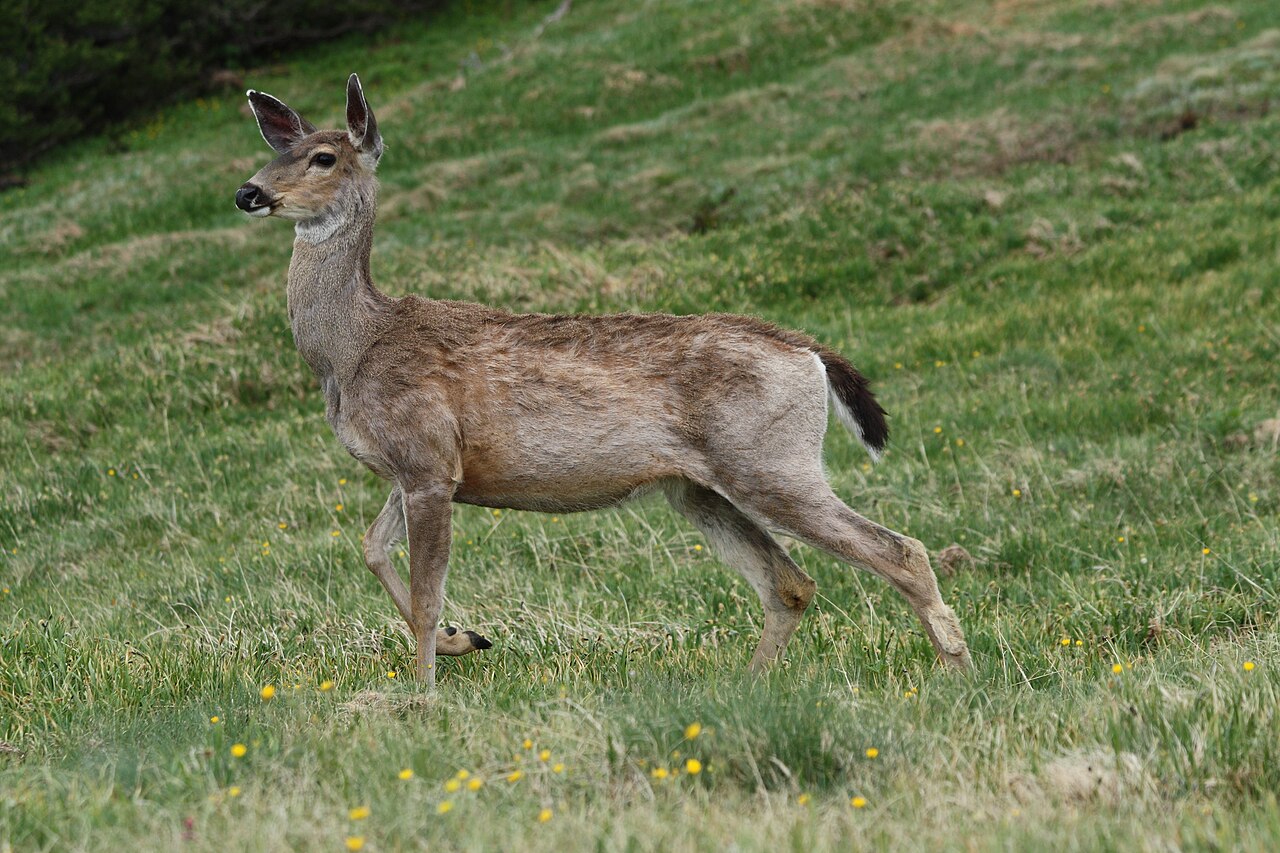
Mule deer vs whitetail comes down to four things you can check in seconds: the tail, the ears, the antlers, and the way the animal runs. A mule deer has a thin white rope of a tail tipped in black, oversized ears, and antlers that fork evenly into matched Y shapes. A whitetail has a broad tail that flashes bright white underneath when raised, proportionally smaller ears, and antlers with a single main beam that sends tines upward from one side.
The two species overlap across much of the western and central United States, so knowing the difference matters for hunters checking tag legality, for wildlife watchers logging sightings, and for anyone trying to identify what walked through the yard. The tail is the single most reliable marker, and the escape gait is the giveaway at a distance. A mule deer bounces away on all four feet at once. A whitetail runs flat out with its tail flagged straight up. Everything else below fills in the detail.
| Feature | Mule deer | Whitetail deer |
|---|---|---|
| Tail | Narrow, white, black tip, held down | Broad, brown above, white below, raised when fleeing |
| Ears | Very large, about 6 inches, mule like | Smaller, proportional to head |
| Antlers | Bifurcated, forks into even Y pairs | Single main beam with tines rising from it |
| Escape gait | Stotting, all four hooves land together | Fast smooth run, tail flagged upright |
| Adult buck weight | 150 to 300 pounds | 120 to 250 pounds, larger in the north |
| Range | West of roughly the 100th meridian | Most of North America east of the Rockies and beyond |
| Preferred habitat | Open, rugged, arid country | Forest edge, farmland, river bottoms, suburbs |
The Tail: The Fastest Way to Tell Them Apart
If you can see the back end of the animal, you have your answer. A mule deer tail is narrow and rope like, mostly white, and ends in a distinct black tip. It hangs down against a large white rump patch and stays down even when the animal is alarmed. From behind, a mule deer looks like it has a pale rear with a thin dark tipped cord hanging in the middle of it.
A whitetail tail is completely different in shape and use. It is broad, roughly the width of a hand at the base, brown on top and pure white underneath. At rest it lies flat and you see only the brown surface, which is why a relaxed whitetail can look almost tailless from a distance. When the deer is alarmed it raises that tail vertically and fans it out, showing the white underside as a bright signal. This is where the name comes from and it is the behavior every hunter recognizes.
The rump patch behind the tail differs too. Mule deer carry a large, obvious white or cream colored rump patch that is visible from a long way off and is one of the reasons they are easier to spot on open hillsides. Whitetails have a much less defined rump patch, since their white signal comes from the tail itself rather than the surrounding fur. In poor light or heavy cover, the flash of a raised white tail is often the only identification you get.
Ears, Face, and Body Proportions
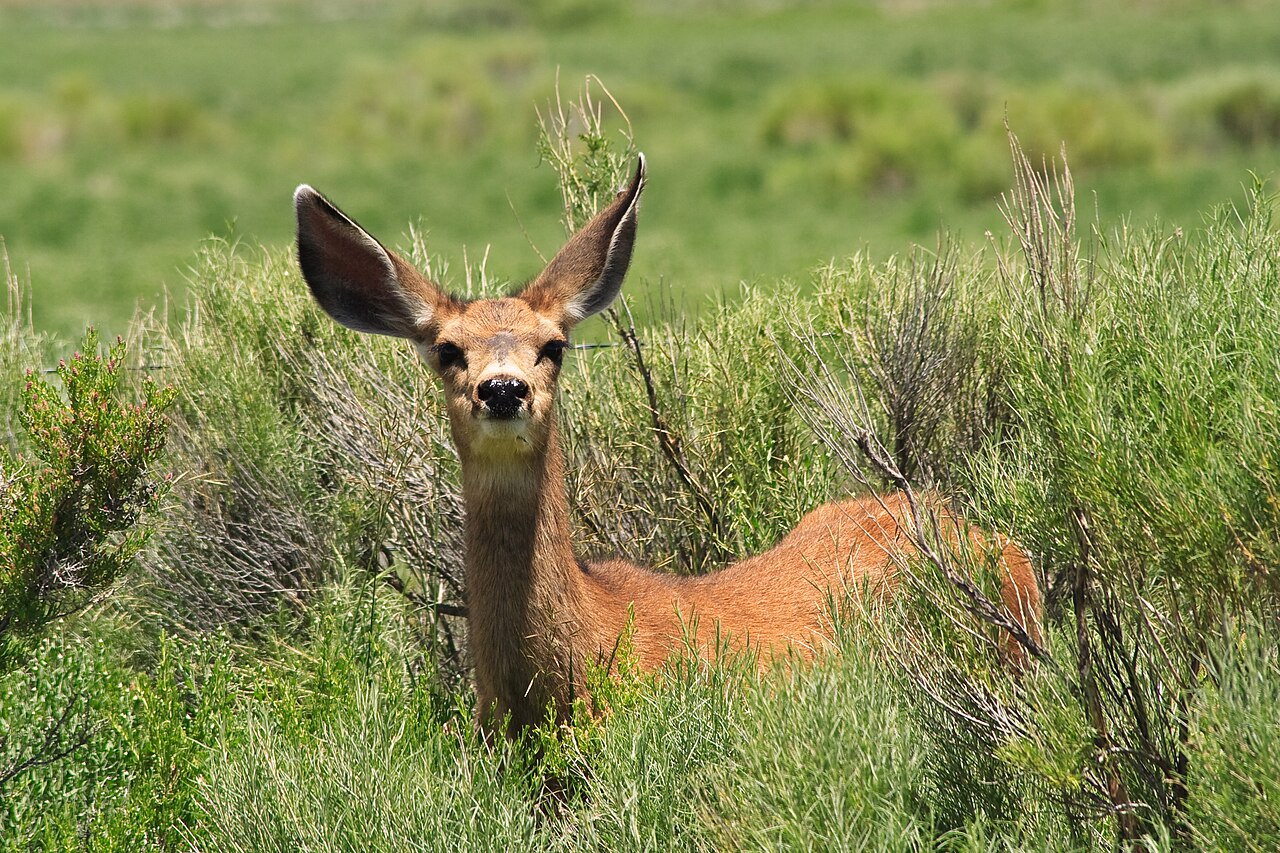
The mule deer earned its name from its ears, and once you have compared the two species directly the difference is hard to unsee. Mule deer ears run about 6 inches long and can approach a quarter of the total head length, giving the animal a distinctly top heavy look. Those ears are constantly moving independently, sweeping for sound in open terrain where a predator can approach from any direction.
Whitetail ears are noticeably smaller and sit in proportion to a narrower, more tapered head. The whitetail face is often described as more delicate, with a longer, finer muzzle and a more sloping forehead. Mule deer have a blockier head with a broader forehead and a more pronounced white face mask, especially on mature bucks, where a dark forehead patch contrasts sharply with the pale muzzle and throat.
Coat color helps as a secondary check but should never be your only marker, since both species shift dramatically between summer red and winter gray. In general, mule deer run to a grayish brown or sandy tan year round, matching the sagebrush and rock of their habitat. Whitetails tend toward a warmer reddish brown in summer that fades to a duller grayish brown in winter. A whitetail in December and a mule deer in June can look confusingly similar in color, which is exactly why the tail check comes first.
Antler Structure: Bifurcation Versus Single Beam
Antler architecture is the most reliable difference on a buck and the one that hunters and shed collectors rely on most. Mule deer antlers are bifurcated, meaning the main beam forks into two, and each of those forks typically forks again. The result is a symmetrical rack that reads as a set of matched Y shapes, which is why western hunters describe bucks as forked horn, three point, or four point counting one side only.
Whitetail antlers grow from a single main beam that sweeps forward and outward, with individual unbranched tines rising vertically off the top of that beam like tines on a fork. A typical mature whitetail carries four or five points per side arranged along one continuous beam. Eastern hunters count both sides, so the same animal a western hunter calls a four point is often called an eight point in the east, which causes endless confusion in conversation between the two regions.
Both species also carry brow tines, though whitetails carry them far more consistently. A whitetail almost always has a distinct brow tine, sometimes called an eye guard, rising near the base of the antler. Mule deer frequently have small brow tines or none at all. Antler size correlates with age and nutrition rather than species, so a young mule deer buck in poor range can carry a smaller rack than a mature whitetail on farmland.
Size and Weight: How Much Bigger Is a Mule Deer?
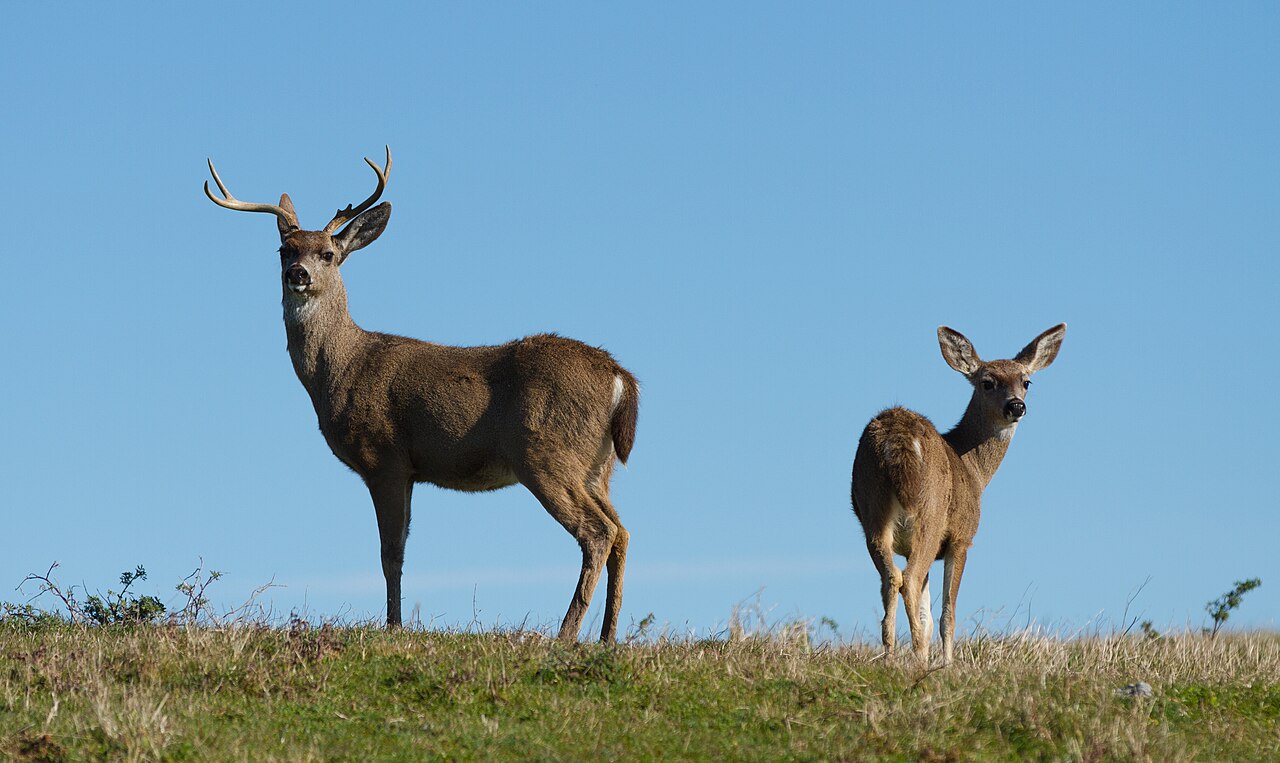
Mule deer are generally the larger animal, though the gap narrows considerably when you compare against northern whitetails. A mature mule deer buck typically weighs between 150 and 300 pounds, with exceptional animals in the northern Rockies pushing beyond that. Does run roughly 95 to 200 pounds. Shoulder height for a mature mule deer sits around 40 to 42 inches.
Whitetail size varies enormously by latitude, following the ecological pattern where body mass increases in colder climates. A Canadian or northern Minnesota whitetail buck can reach 250 pounds or more and rival a mule deer in bulk. A Florida Key deer, which is a whitetail subspecies, may weigh only 55 to 75 pounds as an adult. Coues deer, the small desert whitetail of Arizona and New Mexico, rarely exceed 100 pounds. Averaged across the continent, whitetail bucks fall in the 120 to 250 pound range.
Body shape offers a clue where weight does not. Mule deer are built stockier with a deeper chest, a more muscular neck, and thicker legs relative to body length, all suited to climbing broken terrain. Whitetails have a more streamlined, athletic build with longer legs relative to body depth, matched to running fast through cover rather than climbing. Watching a fawn grow shows the difference emerging early, as our guide to baby deer describes.
Range and Where the Two Species Overlap
Mule deer occupy western North America, from the Yukon and British Columbia south through the Rockies and Great Basin into northern Mexico, roughly west of the 100th meridian. They favor open, rugged, arid country: sagebrush flats, pinyon juniper woodland, foothill chaparral, aspen stands, and high alpine basins in summer. Many populations migrate seasonally between high summer range and low winter range, sometimes covering more than 100 miles in a single move.
Whitetails have the broader distribution by a wide margin, occupying nearly all of the United States east of the Rockies, southern Canada, and large parts of Central and South America. They are also expanding westward, moving up river corridors and into agricultural valleys that were historically mule deer country. Whitetails thrive on edge habitat, which means farmland borders, regrowing clearcuts, river bottoms, and suburban greenbelts all support them well.
The overlap zone runs through the Great Plains states, eastern Montana, Wyoming, Colorado, and into the Southwest, and it is exactly where identification matters most because tag regulations frequently differ by species. In much of that zone the two sort themselves by terrain: whitetails hold the brushy creek bottoms and river breaks, mule deer occupy the open ridges and higher ground above. Where whitetails have expanded, mule deer numbers have often declined, and wildlife agencies including state fish and wildlife departments track that shift closely.
Movement: Stotting Versus Flagging
The escape gait separates the two species at distances where you cannot make out a tail or an antler. A startled mule deer performs a bounding gait called stotting or pronking, in which all four hooves leave the ground and land together, propelling the animal in a series of stiff legged bounces. A stotting mule deer can clear 8 feet or more per bound and change direction almost instantly, which is a genuine advantage in boulder fields and steep broken slopes where a flat sprint would be dangerous.
Stotting also functions as communication. The high bouncing gait keeps the animal’s head up and eyes on the threat, and biologists have argued it signals fitness to a predator, effectively telling a coyote that this particular deer is not worth chasing. It is inefficient over long distances but extremely effective over short bursts in rough country.
Whitetails do not stot. A fleeing whitetail runs in a fast, low, smooth gallop, reaching around 30 miles per hour and covering ground in long leaps that can span 25 feet. The raised white tail flagging above the back serves as a follow me signal to other deer and possibly as a distraction to a pursuing predator. In dense timber a whitetail typically breaks away in a curving line rather than a straight sprint, using cover to break the line of sight. Predators such as coyotes and wolves shape both of these escape strategies, and understanding how foxes and coyotes hunt smaller prey helps put deer antipredator behavior in context.
Behavior, Diet, and the Rut
Both species are crepuscular browsers, most active in the hours around dawn and dusk, and both eat a mix of woody browse, forbs, grasses, and mast. Mule deer lean more heavily on browse: sagebrush, bitterbrush, mountain mahogany, and serviceberry make up much of the diet in winter, when they may lose 20 percent or more of their body weight surviving on low quality forage. Whitetails exploit richer feed, including agricultural crops, acorns, soybeans, and garden plants, which is a large part of why they thrive near people.
Temperament differs in ways that show up on the ground. Mule deer, adapted to open country where they can see a threat coming, often stop and look back after a short flight, which is famously the moment that ends badly for them. Whitetails are far more likely to vanish into cover without a second look. Whitetails are also more tolerant of human presence and more likely to establish home ranges in suburbs, while mule deer generally require larger, less developed landscapes.
Rut timing overlaps but is not identical. Whitetail rut peaks in most of the United States between early and late November, driven by photoperiod, with a secondary peak in December for does that did not conceive. Mule deer rut runs slightly later in many areas, generally peaking from mid November into early December, and mule deer bucks tend to tend a group of does rather than pursue individuals the way whitetails do. Both species leave similar sign, and telling deer droppings apart from other wildlife scat is a useful field skill regardless of which species you are tracking.
Do Mule Deer and Whitetails Interbreed?
Yes, mule deer and whitetails can hybridize, and confirmed hybrids have been documented in overlap zones across the western states. Both belong to the genus Odocoileus, mule deer as Odocoileus hemionus and whitetail as Odocoileus virginianus, which makes them close enough genetically to produce offspring. Genetic studies in states including Texas, Montana, and Alberta have found hybrids present in wild populations, though almost always at low frequencies of a few percent or less.
Hybrids are not the common occurrence that hunting camp stories suggest. Courtship behavior differs enough between the species to act as a strong barrier, since whitetail bucks chase does while mule deer bucks tend them, and a mismatch in approach usually ends the encounter. Most confirmed hybrids result from whitetail bucks breeding mule deer does rather than the reverse. Hybrid fawns also show poor survival, partly because they inherit a confused escape response that is neither a proper stot nor a proper run, which leaves them vulnerable to predators.
Identifying a hybrid in the field is difficult and often impossible with confidence. Suspected hybrids typically show intermediate features: a tail that is broader than a mule deer tail but darker than a whitetail tail, ears of middling size, and antlers that fork inconsistently. Metatarsal gland length is one of the more useful checks, running about 5 inches on mule deer, roughly 1 inch on whitetails, and something in between on hybrids. If you believe you have taken or photographed a hybrid, your state wildlife agency is the right place to report it, since these records feed directly into range overlap research. Wildlife identification puzzles like this are common, and even young animals such as baby coyotes are routinely misidentified for similar reasons.
Related reading: Deer Lifespan.
Related reading: Types of Deer.
Frequently Asked Questions
What is the easiest way to tell a mule deer from a whitetail?
Look at the tail. A mule deer has a narrow white tail with a black tip that hangs down against a large white rump patch. A whitetail has a broad tail that is brown on top and raises to flash bright white underneath when the animal is alarmed.
Are mule deer bigger than whitetail deer?
Usually yes. Mature mule deer bucks average 150 to 300 pounds while whitetail bucks average 120 to 250 pounds. Northern whitetails can match or exceed mule deer in weight, and southern subspecies such as Coues deer and Key deer are much smaller.
How can you tell mule deer and whitetail antlers apart?
Mule deer antlers are bifurcated, forking into matched Y shapes so that each tine branches off another branch. Whitetail antlers have a single curving main beam with individual unbranched tines rising vertically from it, plus a distinct brow tine near the base.
Do mule deer and whitetails live in the same places?
They overlap across the Great Plains, the Rocky Mountain states, and the Southwest. Within that zone they usually separate by terrain, with whitetails holding brushy creek bottoms and river breaks while mule deer use open ridges and higher elevations.
Why do mule deer bounce when they run?
That gait is called stotting, and all four hooves leave and hit the ground together. It allows rapid direction changes over boulders and steep broken ground, keeps the head up so the animal can watch the threat, and may signal fitness to a predator that a chase would be wasted effort.
Can mule deer and whitetail deer breed together?
Yes, hybrids occur in overlap zones but remain rare, usually only a few percent of local populations. Differing courtship behavior acts as a barrier, and hybrid fawns show poor survival because their escape response is neither a clean stot nor a proper run.
Which deer is more common in North America?
Whitetails by a very large margin. They occupy nearly all of the United States east of the Rockies plus southern Canada, Mexico, and much of Central and South America, and they continue to expand westward into historically mule deer country along river corridors and farmland.