Hawk Moth: Identification, Hornworms, and Behavior
A hawk moth is a large, thick-bodied moth in the family Sphingidae, recognized by its narrow pointed forewings, torpedo-shaped body, and powerful hovering flight. There are roughly 1,450 species worldwide and about 125 in North America, and most people meet them in one of two ways: as an adult moth hovering at flowers in the half light of evening, or as a fat green hornworm chewing through a tomato plant. The same insect is also called a sphinx moth, and both names describe the same family.
Hawk moths are among the strongest fliers in the insect world. They can hover in place, feed without landing, and cover long distances in a single night. That flight style is why so many people report seeing a tiny hummingbird at dusk and then realize the visitor has antennae.
Every summer, gardeners report a baby hummingbird at their flowers. The visitor is nearly always a hawk moth, usually a hummingbird clearwing or a white-lined sphinx. The confusion is understandable, because both hover, both feed from tubular flowers, and both are gone in seconds. The differences are reliable once you know where to look.
A hummingbird has a beak, feathers, and legs tucked out of sight. A hawk moth has antennae, scales, and six visible legs that often dangle below the body while it feeds. The moth also unrolls a long flexible tongue rather than probing with a rigid bill, and you can sometimes see that tongue curl back under the head between flowers. Size helps too, since even the largest North American hawk moth is smaller than a ruby-throated hummingbird.
Sound gives it away in quiet conditions. A hummingbird produces a distinct high hum from its wings, while a hawk moth is much quieter, closer to a soft blur. The day-flying members of the family are the ones most often mistaken for birds, and they are covered in detail in our guide to the hummingbird moth, which is itself a hawk moth in the genus Hemaris.
Hornworms: The Caterpillars That Become Hawk Moths
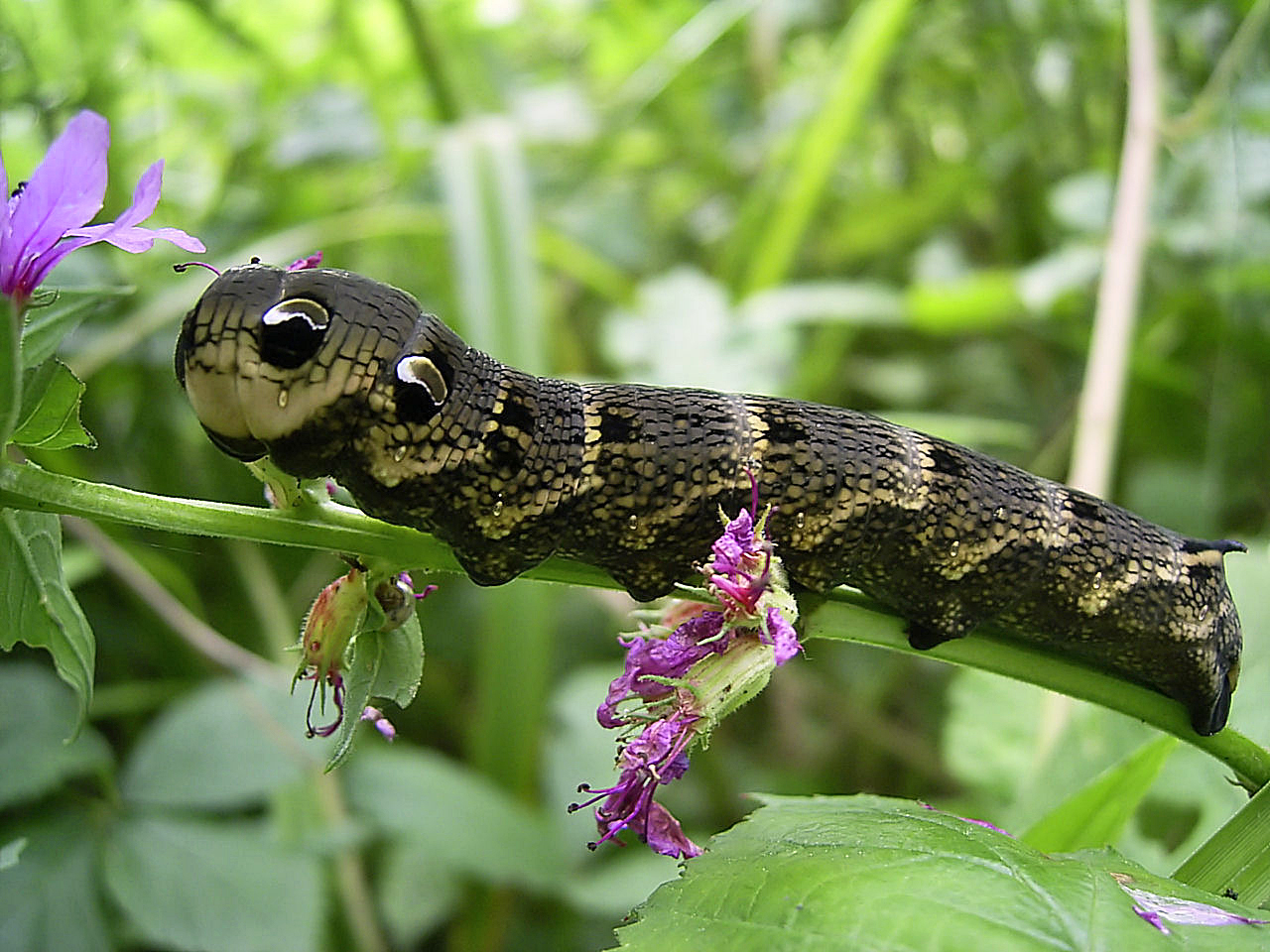
Hawk moth caterpillars are called hornworms because nearly all of them carry a curved spine, or horn, on the eighth abdominal segment. The horn is soft, harmless, and purely decorative from a defense standpoint. It cannot sting, inject anything, or break skin, despite its dramatic look.
The two hornworms most gardeners meet are the tomato hornworm and the tobacco hornworm, and they are different species with different adult moths. The tomato hornworm becomes the five-spotted hawk moth and wears eight white V-shaped marks along its sides with a dark blue-black horn. The tobacco hornworm becomes the Carolina sphinx and wears seven diagonal white stripes with a red horn. Both feed on tomato, pepper, eggplant, and potato foliage, and both can strip a plant fast because a full-grown larva reaches about 4 inches.
Other hornworms never come near a vegetable bed. Some feed on grape and Virginia creeper, others on willow, ash, or evening primrose, and the caterpillars can be green, brown, pink, or nearly black. Many mimic snakes when disturbed, tucking the head under and inflating the front segments so that false eyespots appear. It is one of the better bluffs in the insect world, and it works on birds. If you enjoy caterpillar identification, our field guide to the monarch caterpillar covers a very different defensive strategy built on toxins rather than mimicry.
Common Hawk Moth Species in North America
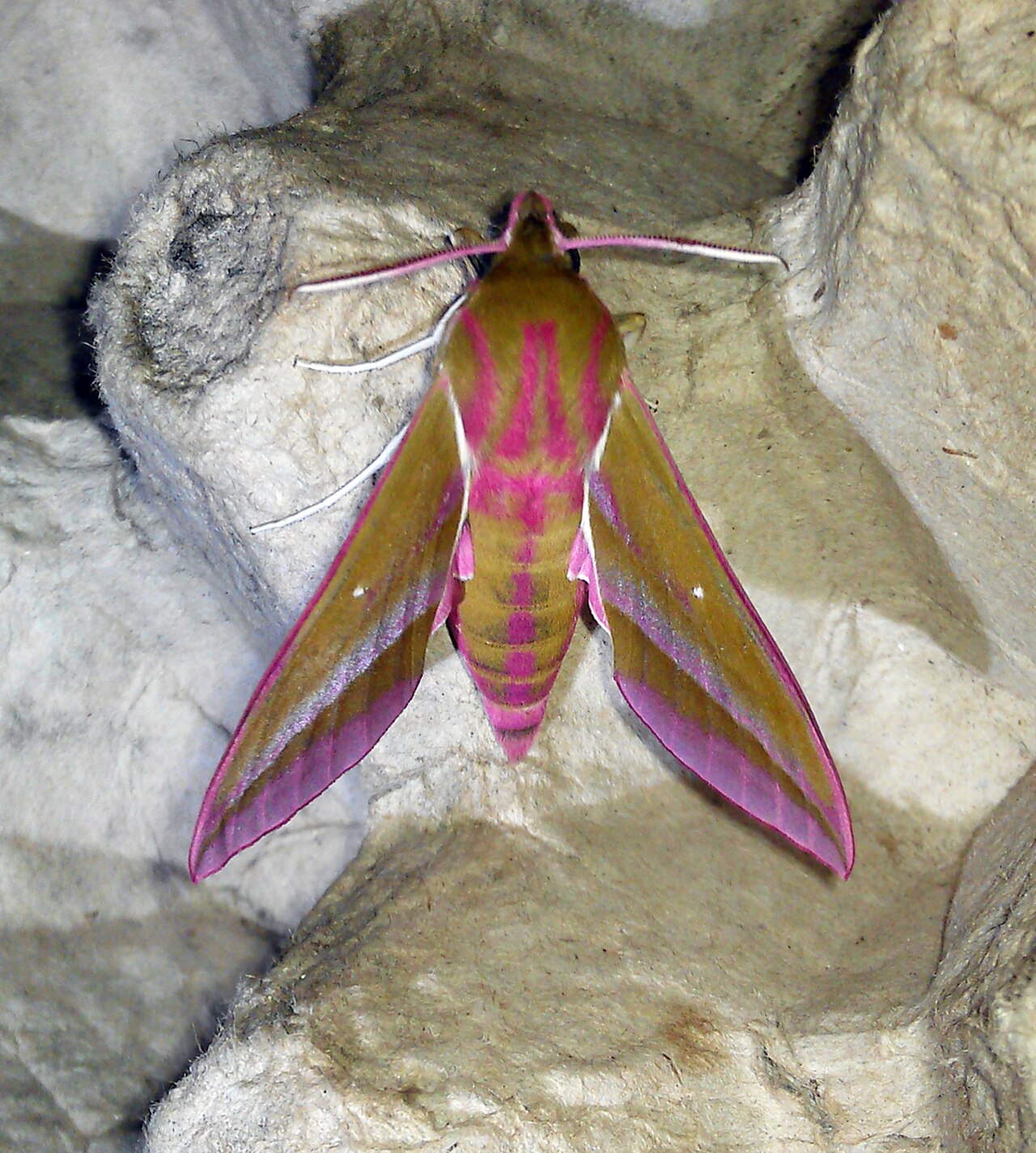
The white-lined sphinx is the species most people encounter. It is common across the continent, flies at dusk and sometimes in daylight, and shows a broad tan stripe running diagonally across each forewing with pink bands on the hindwings. In good years it appears in enormous numbers in the Southwest, and drivers report clouds of them around desert wildflowers after summer rain.
The Carolina sphinx and five-spotted hawk moth are the two large gray species behind garden hornworms. Both have rows of yellow-orange spots along the abdomen, five pairs on one and six on the other, and both hold a wingspan close to 5 inches. The Pandora sphinx is an olive and pink species tied to grape and Virginia creeper, and the waved sphinx is a common gray woodland species that comes readily to lights.
In the day-flying group, the hummingbird clearwing and snowberry clearwing both lose most of their wing scales on the first flight, leaving clear panels bordered in reddish brown. They visit bee balm, phlox, and butterfly bush in full sun and are the species behind most hummingbird moth reports. Together these few species account for the large majority of hawk moth sightings in yards and gardens.
The Death’s-Head Hawk Moth and Other Famous Species
No hawk moth has more cultural baggage than the death’s-head, a large species named for the skull-like pattern on its thorax. Three species carry the marking, all in the genus Acherontia, and they live in Europe, Africa, and Asia rather than North America. The moth appears in folklore, on album covers, and most famously on a film poster, which is why it is often the first hawk moth people can name.
The biology is stranger than the mythology. Death’s-head hawk moths raid honey bee colonies for stored honey, and they get away with it partly through chemical camouflage that keeps the workers from treating them as intruders. They also squeak. When handled or alarmed, the moth forces air through its short proboscis to produce an audible chirp, a rare trick among moths.
Another famous member of the family belongs to a nineteenth century prediction. After examining a Madagascan orchid with a nectar tube nearly a foot deep, Charles Darwin argued that a moth with a matching tongue had to exist. Decades later the hawk moth Xanthopan morganii was confirmed doing exactly that job. The Smithsonian’s National Museum of Natural History treats it as a textbook case of coevolution between a plant and its pollinator.
The Hawk Moth Life Cycle
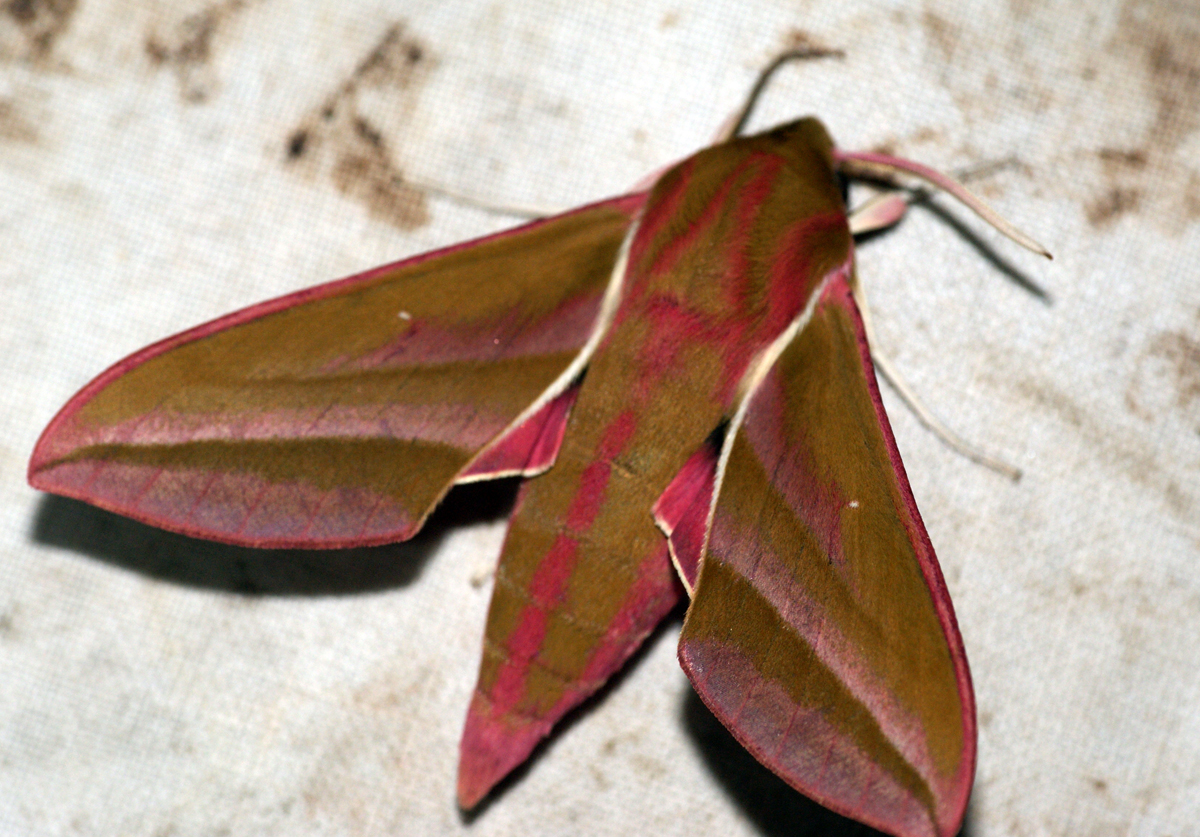
Females lay small, round, pale green eggs singly on the underside of host plant leaves, often scattering them across several plants rather than clustering them. Eggs hatch in roughly 3 to 8 days depending on temperature. The newly emerged caterpillar is tiny and pale, with a horn that looks absurdly long for its body.
Larvae typically pass through five instars over about three to four weeks, molting between each stage and growing dramatically at the end. A full-grown hornworm stops feeding, changes color slightly, and wanders off the plant to find soft soil. Most sphingids do not spin a cocoon at all. Instead they burrow several inches down and form a smooth brown pupa in an earthen chamber, which is why gardeners turning soil in autumn sometimes uncover what looks like a polished brown jug with a handle. That handle is the case holding the developing tongue.
Timing depends on latitude and species. Northern populations usually produce one generation per year and overwinter as pupae underground, emerging in late spring. Southern populations often fit in two or three generations, with adults on the wing from spring through early autumn. Adults that feed on nectar generally live 10 to 30 days, long enough to mate, disperse, and lay several hundred eggs.
Hawk Moths as Pollinators
Hawk moths are among the most important night pollinators in temperate and tropical systems. Their long proboscis reaches nectar that bees and butterflies cannot, which means an entire guild of flowers has evolved specifically around them. These blooms tend to be pale or white, strongly scented after dark, tubular, and open in the evening.
Because the moths hover rather than land, they carry pollen on the face, tongue, and forelegs and move it between plants that may be far apart. Research from university extension entomology programs consistently ranks sphingids as long-distance pollen carriers, more effective than many bees at connecting isolated plant populations. Evening primrose, moonflower, four o’clocks, jimsonweed, nicotiana, and many cactus flowers all depend heavily on this service.
The relationship runs in both directions. A moth that pollinates a plant may also be laying eggs on it, so the same species can be a partner and a herbivore at once. Manduca moths pollinate datura while their caterpillars eat it, which is one of the most studied examples of that balance anywhere in insect ecology.
Are Hawk Moths Dangerous?
No. Adult hawk moths have no sting, no venom, and no biting mouthparts capable of breaking skin. The proboscis is a drinking straw built for nectar, not a weapon, and a moth resting on your hand can do nothing more alarming than grip with its feet. There is no species in the family that poses a medical risk to people or pets.
The caterpillars are equally harmless to handle. The horn is flexible and blunt, and hornworms have no urticating hairs of the kind found on some other caterpillars. They may thrash, regurgitate a green fluid, or make a faint clicking noise when grabbed, all of which are bluffs. Anyone worried about caterpillars that genuinely do cause skin reactions should compare with our guide to the fuzzy caterpillar species that carry irritating hairs.
The real conflict is agricultural. Hornworms can defoliate tomato and tobacco plants quickly, and a few large larvae can strip several branches overnight. Handpicking works well on a home scale. If you find a hornworm covered in small white rice-like capsules, leave it alone, because those are the cocoons of a parasitoid wasp that will kill that caterpillar and produce more wasps to control the next generation.
How to Attract Hawk Moths to Your Yard
Plant for the night shift. Evening primrose, moonflower, four o’clocks, nicotiana, phlox, and native honeysuckle all open or release scent after sunset and offer the deep tubes hawk moths prefer. Group plantings in a sunny, sheltered spot rather than scattering single plants, because the moths locate flowers largely by scent plumes.
Tolerate the caterpillars. No hornworms means no adults, so leaving a few sacrificial host plants at the edge of a garden pays off. Grape, Virginia creeper, willow, and evening primrose all host species that will not touch your vegetables. Skipping broad-spectrum insecticides matters more than any planting choice, since a single application removes the entire local generation.
Finally, manage your lighting. Many hawk moths come to lights, and a single porch bulb left on all night can pull them away from flowers and leave them exhausted by morning. Warm-toned bulbs, motion sensors, and downward-facing fixtures reduce that pull. If you want to watch them, a headlamp with a red filter over a patch of evening primrose is far more productive than a bright porch light, and it works well alongside the seasonal appearances of larger species such as the giant moths that share the same nights.
Frequently Asked Questions
Are hawk moths and sphinx moths the same thing?
Yes. Hawk moth and sphinx moth are two common names for the same family, Sphingidae. Some sources also use hornworm moth, which refers to the same insects through the caterpillar stage. The names are regional habits rather than different groups, so a white-lined sphinx and a white-lined hawk moth are one species.
Do hawk moths bite or sting?
No. Adults feed only on nectar through a soft coiled tongue and have no sting or biting jaws. The caterpillars cannot sting either, and the horn on the rear is flexible and harmless. Handling one carries no medical risk, though it is best to move caterpillars with a leaf to avoid damaging them.
What do hawk moth caterpillars turn into?
Each hornworm becomes a specific hawk moth. Tomato hornworms become five-spotted hawk moths and tobacco hornworms become Carolina sphinx moths. If you rear one, keep it supplied with the same host plant you found it on and give it several inches of loose soil or damp coconut fiber for pupation, since most species burrow rather than spinning a cocoon.
How long do hawk moths live?
Adults that feed on nectar generally live 10 to 30 days. The full life cycle takes far longer, since the pupal stage can last a few weeks in summer or the entire winter in northern populations. Species with non-feeding adults live only a few days once they emerge.
Is a hummingbird moth a hawk moth?
Yes. Hummingbird moths in the genus Hemaris are members of the hawk moth family that fly during the day and lose most of their wing scales, leaving clear panels. They are the most common source of hummingbird sightings that turn out to be insects, especially around bee balm and phlox in midsummer.
What flowers attract hawk moths?
Pale, tubular, night-scented flowers work best. Evening primrose, moonflower, nicotiana, four o’clocks, phlox, and native honeysuckle are all reliable. Day-flying species add bee balm, butterfly bush, and milkweed to that list. Planting in clumps and avoiding insecticides matters more than the exact species mix.
Should I kill tomato hornworms?
That depends on how many you have. A few can be moved to a sacrificial plant rather than destroyed, since they become important night pollinators. Handpicking is enough for most home gardens. Always leave hornworms carrying small white capsules on their backs, because those are parasitoid wasp cocoons doing free pest control for you.